DevSecOps Services Outsourcing from Argentina
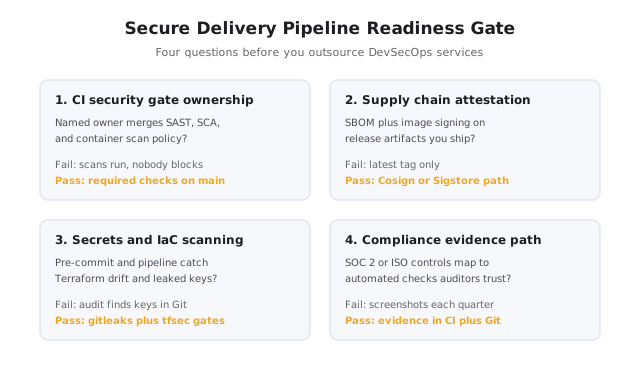
What: Production DevSecOps services wire security into delivery: merge-blocking CI gates, SBOM exports on release artifacts, signed container images verified at deploy time, secrets and Terraform scanning in the same pull request path as application tests, and SOC 2 change evidence your auditors can follow. Who: CISOs, VP Engineering, platform directors, and compliance leads at B2B SaaS, health data, and fintech companies where GitHub or GitLab pipelines ship daily but findings still live in spreadsheets nobody merges. Problem: Releases bypass scans, base images drift, signing keys have no custodian, and diligence asks for proof of secure change management you cannot produce in one sprint. Why nearshore: Pipeline security needs same-day pairing when a gate blocks production, a cosign key rotates, or a customer security review lands mid-quarter. How to evaluate us: Ask whether a vendor can pass the Secure Delivery Pipeline Readiness Gate in the hero diagram: CI gate ownership, supply chain attestation, secrets and IaC scanning, and a compliance evidence path.
We outsource discovery through handoff: pipeline baselines, policy-as-code gates, dependency and container scanning, image signing and verification, infrastructure policy checks, microservice boundary reviews, and evidence packs aligned with the OWASP Top Ten, the SLSA specification, and GitHub code security documentation. Runtime telemetry and SLO work belong under observability engineering services; golden paths and developer portals under platform engineering; LLM-specific guardrails under AI code security. Need one senior engineer embedded in your squad? See hire DevOps engineers for staff augmentation.
Siblings Software is a software outsourcing company headquartered in Cordoba, Argentina, with daily overlap on US Eastern time. We have shipped outsourced engineering since 2014 across B2B SaaS, regulated health, and fintech platforms. Browse the full catalog on our all services directory or compare our nearshore development model if procurement is weighing regions. Service decomposition and API hardening pair naturally with microservices development when blast radius is the concern.
What the Service Covers
DevSecOps services outsourcing is the cross-functional work of making secure delivery repeatable without turning every release into a security review meeting. A typical program: baseline pipelines and artifact flows, run the Secure Delivery Pipeline Readiness Gate, define severity thresholds and exception owners, enforce scans and policy checks in CI, generate SBOMs and signed images on promoted builds, wire Terraform and Kubernetes checks into the same merge queue as application code, and hand off evidence templates compliance can reuse each quarter.
That is different from DevOps engineering, which optimizes deploy frequency and reliability rather than attestation and audit trails. It is also different from observability engineering services, which optimizes detection in production rather than prevention in pull requests. DevSecOps work optimizes for merge-blocking clarity, supply chain provenance, and evidence that survives customer questionnaires. We pair with platform engineering when golden paths must embed secure defaults, with QA automation services when security checks belong beside functional suites, and with AI code security when copilots introduce new secret-leak patterns.
Quality gates follow what audit and customer security teams expect: no promotion of unsigned images to production, documented break-glass for critical hotfixes, and tabletop exercises on key compromise before SOC 2 fieldwork. Teams often combine DevSecOps with project-based outsourcing for a first hardening wave, then an dedicated development team retainer for ongoing gate maintenance.
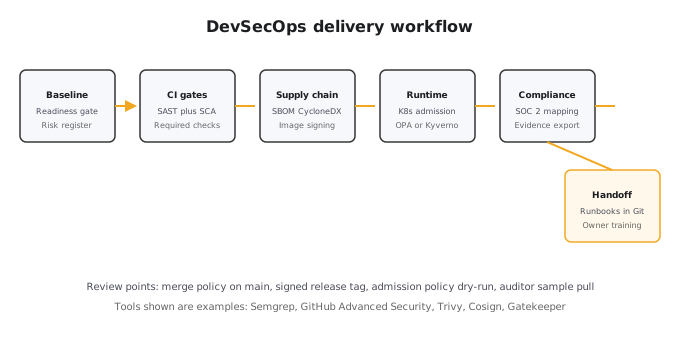
Most production DevSecOps programs treat signed artifacts and merge-blocking gates as non-negotiable: security should not discover critical findings only after a tag reaches production.
Who It Is For
Platform and security leaders where software ships through CI/CD daily, findings exist in dashboards nobody merges, and enterprise customers ask for SBOMs plus change evidence you cannot assemble in a week. If nobody can name who approves a pipeline exception within one business day, you are the audience.
B2B health and regulated data
API platforms under HIPAA or SOC 2 where customers expect signed artifacts, access logs, and change tickets tied to every production deploy.
Fintech and payments
Separate production and audit pipelines need consistent gates, secret scanning, and evidence packs that satisfy internal control reviews.
Multi-repo product engineering
Dozens of services on GitHub Actions or GitLab CI where each team invented a different scan configuration and security cannot see aggregate risk.
Kubernetes and container estates
Clusters pulling unsigned images, mutable tags in production, and Helm charts nobody scans before promotion.
Teams facing customer security reviews
Enterprise procurement sends SIG or CAIQ questionnaires while your pipeline still allows skip-scan deploys on hotfix branches.
Organizations after a failed tooling rollout
A SAST license went enterprise-wide but merge rates did not change. You need delivery that wires gates, not another shelf dashboard.
Typical Project Scenarios
Six situations we see on discovery calls. Each maps to a bounded DevSecOps wave we can scope in the first week after the Secure Delivery Pipeline Readiness Gate.
Establish CI gates after rapid microservice growth
Engineering added repositories faster than security could standardize workflows. We define severity thresholds, enforce scans in required checks, and backfill SBOM generation on the top ten deploy paths before the next customer audit.
Sign container images and verify at deploy
Production still trusts mutable tags. We implement cosign or equivalent signing, store public keys in your KMS, and wire verification into GitOps or DevOps engineering deploy pipelines with rollback notes.
Scan Terraform and Kubernetes before merge
Infrastructure drift creates findings application scans never see. We add Checkov, tfsec, or Conftest policies aligned to your landing zone, merged through the same review path platform already uses.
Wire secret scanning to engineers who can rotate
Alerts land in a shared mailbox. We connect GitHub Advanced Security or GitLab secret detection to Slack routing, name custodians, and rehearse revocation within one business day.
Build SOC 2 change evidence from pipelines
Auditors want proof that production changes map to approved pull requests. We export check summaries, link tickets, and package sample releases aligned to CC8-style controls.
Harden APIs without pausing feature work
Customer contracts add mTLS and scope reviews mid-roadmap. We coordinate boundary tests with microservices development and QA automation services so gates augment rather than replace delivery.
How Delivery Works
Six phases, usually eight to fourteen weeks for a first secure delivery program with enforced gates, signed release artifacts, IaC policy checks, compliance evidence samples, and paired handoff documentation. Tabletop exercises on signing key compromise are non-negotiable when customers ask for supply chain attestations.
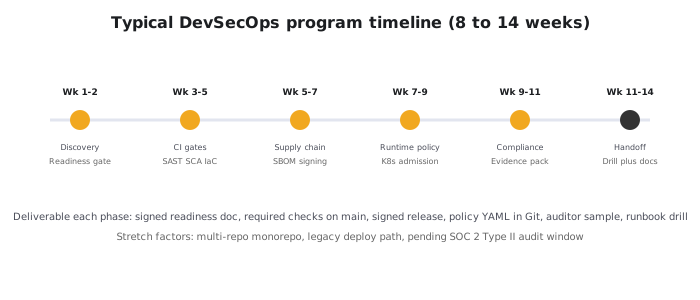
Discovery inventories repositories, pipelines, and artifact registries, runs the Secure Delivery Pipeline Readiness Gate from the hero diagram, and documents gate owners, signing custodians, and evidence gaps. If any gate answer is undefined, we capture owners before changing production workflows.
Gate design delivers severity matrices, required checks per branch, exception workflows security signs, and policy-as-code bundles your platform team merges like application code.
Supply chain wave implements SBOM generation on promoted builds, image signing, provenance metadata aligned with SLSA targets, and verification hooks in deploy pipelines validated in staging before production promotion rules change.
IaC and secrets adds Terraform, Helm, and Kubernetes scans, secret detection on push, and rotation runbooks wired to the same on-call paths as production incidents.
Evidence and reporting configures export jobs, sample SOC 2 folders, and customer questionnaire templates reconciled to actual pipeline outputs. Security and compliance sign off on samples before external audits.
Handoff includes runbooks for onboarding a new service, rotating keys, and regenerating attestations. Paired weeks let your team merge changes under our review before we step down to advisory hours or transition to project-based outsourcing for wave two.
Team Composition
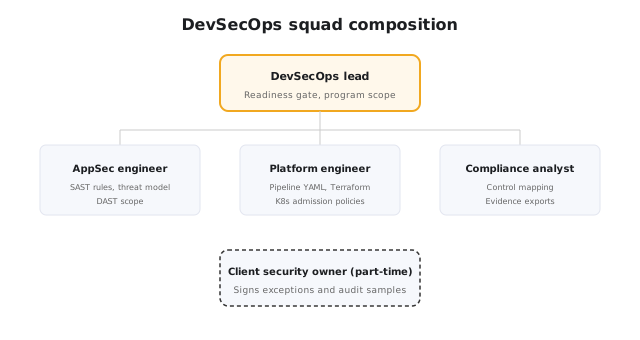
A four- to five-person squad is the usual shape for a first DevSecOps program. The DevSecOps lead who owns the readiness gate, customer evidence narratives, and exception policy and the platform engineer who merges workflow and signing changes are the two roles vendors cut to win on price. Those are also the roles that determine whether auditors trust the next release sample.
Typical roster: DevSecOps lead, application security engineer for threat modeling and gate tuning, platform engineer for pipelines and IaC, part-time compliance or GRC owner from your side who signs evidence templates, and optional QA liaison when security checks integrate with functional automation. For ongoing gate maintenance after wave one, the same squad can run as an dedicated development team on a monthly retainer. For a single senior engineer inside your org, staff augmentation is the better fit.
Project, dedicated team, or staff augmentation depending on how much of the secure delivery roadmap you want us to own.
Pricing and Engagement Models
Project-based
Fixed scope for a bounded secure delivery program: readiness gate, CI gate rollout, supply chain signing, IaC and secret scanning, evidence samples, and handoff documentation. Typical duration eight to fourteen weeks. Published bands run USD 30,000 to USD 115,000 after discovery, depending on repository count, multi-cloud scope, and audit reporting depth.
Dedicated team
Ongoing squad owning gate tuning, signing key lifecycle, SBOM storage hygiene, and quarterly evidence refresh. USD 20,000 to USD 55,000 per month for four to six people depending on seniority mix and pipeline surface area.
Staff augmentation
Embed one or two senior DevOps engineers with security depth when you already own the program and need hands on workflow YAML, policy bundles, or cosign modules. USD 7,500 to USD 12,500 per month per senior engineer on published brackets.
Compared With In-House Hiring, Freelancers, and Large Consultancies
Outsource when
- You need merge-blocking gates, signed artifacts, and audit evidence in one or two quarters, not after a six-month search for a rare AppSec plus platform hybrid.
- Security owns dashboards but engineering never merges findings.
- Leadership wants a third party to document the Secure Delivery Pipeline Readiness Gate before customer diligence on your SDLC.
- Enterprise questionnaires arrive every quarter because nobody owns an evidence regeneration playbook.
Keep it in-house when
- You already run weekly secure delivery reviews, gate bypass rates near zero, and only need a short spike on one repository.
- Software is internal-only with no customer audit pressure and no plan to sell into regulated industries next year.
- A vendor delivers PDF reports your engineers are not allowed to merge into pipelines.
Freelancers can tune one pipeline quickly but rarely stay for signing key custody or SOC 2 sample packs at board level. Nearshore delivery from Cordoba gives you senior AppSec and platform profiles at a lower total cost than hiring the same mix in major US metros, with overlap security and engineering can use. Browse case studies for examples of how we work with product teams.
Illustrative Scenario: Northline Health API
Composite illustrative scenario only. Not a published client case study. No performance metrics are claimed.
The situation
Northline Health API is a fictional B2B health data platform connecting payers to provider systems. GitHub Actions deploys forty microservices daily while security still runs quarterly manual reviews. Container images pull from a shared registry without verification, Terraform plans skip policy checks on hotfix branches, and SOC 2 auditors asked for change evidence the team cannot export from CI.
Leadership approved a DevSecOps program before renewing two enterprise contracts. They need the Secure Delivery Pipeline Readiness Gate passed, required checks on main and release branches, cosign verification in Kubernetes, and sample evidence folders mapped to change-management controls before the next customer security summit.
What we would deliver
A twelve-week nearshore project with a five-person squad from Cordoba: DevSecOps lead, application security engineer, platform engineer, part-time GRC analyst for evidence mapping, and a security owner from the client side. Daily overlap with the US Eastern platform lead during gate rollouts and signing key ceremonies.
- Secure Delivery Pipeline Readiness Gate documenting CI gate owners, supply chain attestation gaps, secrets and IaC scan coverage, and the compliance evidence path signed by security and platform.
- Reusable workflow modules with merge-blocking SAST, dependency, and secret scans on protected branches.
- SBOM generation on release tags and cosign-signed images verified in Argo CD, coordinated with DevOps engineering promotion rules.
- Terraform and Helm policy packs with exception workflows security approves in writing.
- SOC 2 sample change packets linking pull requests, checks, and tickets for three production releases.
In a scenario like this, the win is predictable secure delivery: engineers merge fixes like product work, customers receive attestations with releases, and leadership enters diligence with evidence already in the repository.
Risks and Mitigation
Gates block every release until noise overwhelms bypass culture. Teams disable checks after false positives spike. Mitigation: tune severities on historical findings, staged enforcement, and exception owners security signs.
Signing keys become a single-person dependency. Mitigation: dual custodians, documented ceremonies, and quarterly rotation drills in staging.
SBOM storage fills with unreadable JSON nobody consumes. Mitigation: attach SBOMs to release objects customers already download and automate retention aligned to contract language.
IaC scans fight platform templates. Mitigation: policy packs owned by platform, exceptions time-boxed, and findings routed like application defects.
Evidence packs rot when pipelines change. Mitigation: regenerate samples each quarter and tie updates to the same change tickets as workflow edits.
Microservice boundaries hide auth gaps. Mitigation: pair service reviews with microservices development and threat modeling workshops before new public APIs launch.
Questions buyers ask before the first discovery call
Frequently Asked Questions
Staff augmentation embeds one or two security-minded engineers inside your team on your backlog. Outsourced DevSecOps services deliver a governed program: pipeline security gates with named owners, supply chain attestation for images and dependencies, secrets and IaC scanning merged as engineering work, and compliance evidence packs auditors can trace. You still own repositories, cloud accounts, and IP. Choose staff augmentation when you already run secure delivery rituals and need extra hands. Choose this page when releases ship without consistent gates, SBOM exports are missing, and nobody can produce SOC 2 change evidence within one sprint.
We work across GitHub Actions, GitLab CI, Azure DevOps, Jenkins, and Argo CD style GitOps flows on AWS, Azure, and Google Cloud. Common tooling includes SAST and dependency scanners your team already licenses, OPA or Conftest for policy gates, cosign or Notary for image signing, Syft or CycloneDX for SBOM generation, and secret scanners wired to the same pull request path as unit tests. We align controls with OWASP Top Ten categories, SLSA build levels your risk team targets, and GitHub code security documentation when that is your source of truth. We do not mandate a single vendor on day one if security already paid for a stack.
Discovery documents the Secure Delivery Pipeline Readiness Gate: CI gate ownership, supply chain attestation, secrets and IaC scanning, and a compliance evidence path. Delivery includes merge-blocking checks for critical findings, SBOM generation on release artifacts, signed container images with verification in deploy pipelines, Terraform and Kubernetes policy scans through the same review path as application code, and evidence folders mapped to SOC 2 change-management controls. Runbooks name who approves exceptions and how to regenerate attestations after a key rotation.
Eight to fourteen weeks is typical for a first program: two weeks on baseline and readiness gate, four to eight weeks on gate rollout, supply chain signing, and IaC policy enforcement, two to four weeks on evidence packaging, tabletop exercises, and paired handoff. Timelines stretch when pipelines are fragmented per team, signing keys lack custodians, or compliance wants evidence for legacy services nobody owns.
Project-based DevSecOps programs typically land between USD 30,000 and USD 115,000 depending on repository count, multi-cloud scope, container surface area, and audit reporting depth. Dedicated DevSecOps squads run USD 20,000 to USD 55,000 per month for ongoing gate tuning, supply chain maintenance, and evidence refresh. Senior staff augmentation for DevOps engineers with security depth ranges from USD 7,500 to USD 12,500 per month per engineer on published brackets via hire DevOps engineers. We confirm pricing after discovery once readiness gate answers are documented.
You do. Workflow definitions, policy bundles, signing configs, SBOM storage, and audit evidence templates ship under your IP in your repositories and cloud org. We document how to onboard a new service, rotate signing keys, and regenerate SOC 2 change packets without paging us. Ongoing runtime monitoring stays a separate engagement through observability engineering services if you want SRE-style coverage after handoff.
Yes. Delivery teams are based in Cordoba, Argentina, with daily overlap on US Eastern business hours. DevSecOps work needs same-day iteration with platform and security leads when a gate blocks a release, a signing key expires, or auditors request evidence before a customer diligence window.
Related Services