DevOps engineers who own your pipelines—not a slide deck about Kubernetes
· Typical time to first production change: 12–15 business days
If you are comparing hire DevOps engineers options, you probably need three things on one page: what will actually change in your pipelines and clusters, what it costs per month in plain numbers, and how you avoid the contractor who disappears the week before a compliance audit. This page answers those directly. We staff DevOps and SRE work from Argentina with full-time engineers who overlap US Eastern business hours.
DevOps in 2026 is not a single job description. Teams run Kubernetes on EKS or GKE, keep Terraform modules honest across environments, adopt CNCF tooling where it earns its keep, and still measure delivery with DORA metrics instead of slide-deck maturity models. We match that reality instead of sending a generic “cloud engineer” profile. For breadth across roles, see multi-stack staff augmentation; for timezone context, read nearshore developer hiring; when ceremonies need reinforcement, explore embedded agile coaches.
When IDP, developer portal, or golden path work is the bottleneck rather than pipeline breadth, see platform engineer staff augmentation. When cluster ownership is the bottleneck rather than CI/CD breadth, see Kubernetes developer staff augmentation. When the bottleneck is module libraries, remote state, and landing zone design rather than pipelines alone, see Terraform engineer staff augmentation. When cloud spend outpaces tagging and rightsizing discipline, see FinOps engineer staff augmentation. When models need registry promotion and serving SLOs, see MLOps engineer staff augmentation. If you need full delivery ownership rather than individuals embedded in your rituals, compare DevOps engineering outsourcing, platform engineering, or AI-powered DevOps from the same leadership team.
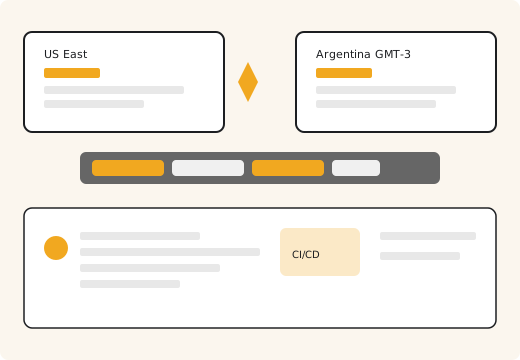
Most clients get 3-4 hours of direct overlap with US Eastern time for pipeline review, deploy pairing, and incident sync.
Prefer numbers before a call? Jump to monthly pricing bands for embedded seniors, pairs, and small pods.
Who hires DevOps engineers through us
Four buyer shapes cover most discovery calls; your situation may combine two.
Platform leads with a broken hiring funnel
Healthy internal culture, open reqs for six months, and releases still gated on one senior who is also on call. Staff aug is the bridge while you close an in-house hire—or it becomes the steady state when recruiting cost is not where you want margin to go.
CTOs inheriting fragile delivery plumbing
Post-acquisition or post-departure, you need a calm audit: which pipelines are load-bearing, where Terraform state is scary, which alerts page people for noise. The goal is a written map before anyone suggests a rip-and-replace.
Product teams shipping faster than infra can absorb
Microservices multiplied; observability did not. You need someone who can harden GitHub Actions or GitLab CI, tighten deployment windows, and teach developers what “done” means for infra changes—not block every feature behind a ticket queue.
Regulated environments that cannot pause releases
SOC 2, HIPAA, or financial audit windows approaching. You need evidence: change logs, secrets hygiene, backup restores tested—not a consultant deck. We embed engineers who have shipped under those constraints before.
None of the above? Say so on the call. We turn down engagements when the fit is wrong, which keeps our bench credible.
What an embedded DevOps engineer does week to week
Concrete work streams, not a reprint of the DevOps outsourcing homepage.
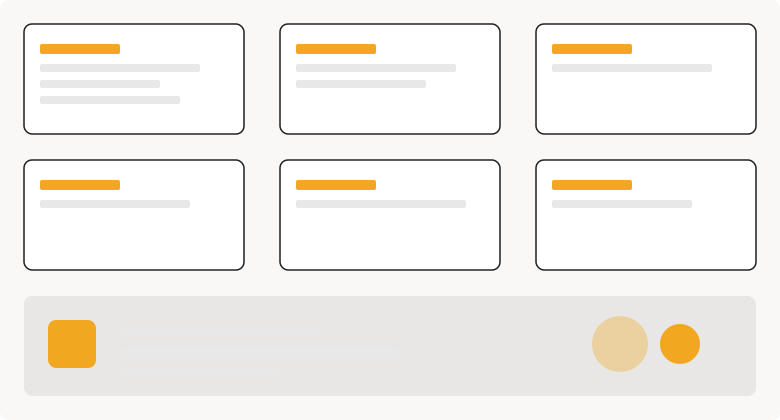
“Senior DevOps engineer” is overloaded. In a typical month with us, an embedded engineer might harden a deployment workflow, refactor a Terraform module so staging stops drifting, add tracing to a service that lacked it, pair on a Sev-2, and document the rollback path that used to live in one person’s head. The diagram below is a schematic of those parallel tracks; your mix depends on backlog and risk.
CI/CD that developers trust
GitHub Actions, GitLab CI, CircleCI, or Jenkins—pipelines with clear ownership, artifact promotion, and deployment gates that fail for real defects. We align with the Google SRE idea that toil should shrink over time, not become permanent heroics.
Terraform and cloud operations
Module boundaries, remote state discipline, environment promotion, and cost guardrails on AWS, GCP, or Azure. We treat plans and applies as code review events, not Friday-afternoon surprises.
Kubernetes day-two operations
Rollouts, HPA/VPA tuning, ingress and cert management, pod security standards, and cluster upgrades staged without betting the weekend. We follow upstream docs, not folklore.
Observability and on-call hygiene
OpenTelemetry, Prometheus, Grafana, Datadog, or New Relic—dashboards tied to SLOs, alert routes that respect sleep, and post-incident notes that actually change the system.
Production Readiness Gate (how we match SRE, platform, or DevOps generalist)
A lightweight decision model buyers can reuse even if they never hire us.
Most mismatches on DevOps engagements come from hiring the wrong shape of senior: a brilliant SRE who will not touch Terraform, or a “DevOps” generalist who has never owned an on-call rotation. Before we shortlist, we score three signals with your platform lead on a thirty-minute call.
- Signal A — deploy frequency risk. If releases are rare, manual, or feared, we overweight candidates who have led pipeline redesigns and can show before/after lead time without hiding behind “process.”
- Signal B — observability gap. If incidents start as “something feels slow” instead of a trace or SLO burn, we prioritize engineers who have rolled out metrics, logs, and traces under real spend constraints—not only installed a demo stack.
- Signal C — IaC drift. If staging diverges from production or state files are scary to touch, we bias toward Terraform operators who module-ize carefully; if the pain is mostly runtime orchestration, we bias toward Kubernetes operators who understand day-two ops.
Across dozens of platform-shaped staff aug engagements for teams in the US, Canada, and the UK, shortlists that used those three signals had the lowest swap rate. That is not a guarantee for your team; it is how we reduce guesswork before anyone signs a statement of work.
Engagement models and monthly ranges
Published bands beat “contact us for a quote” when you are budgeting a quarter.
We publish ranges because hidden pricing wastes cycles. The point inside the band moves with seniority, how much stakeholder-facing English you need, and rare depth such as multi-cluster Kubernetes upgrades or regulated audit support.

Embedded senior
One senior in your ceremonies, change reviews, and on-call rotation where appropriate. Strong when your culture is healthy and you need throughput without re-teaching fundamentals.
Monthly: USD 7,500–11,500. Minimum: three months.
Senior + mid pair
The senior sets guardrails and incident patterns; the mid-level absorbs tickets once context lands, usually by week four. Common when you want sustained pipeline work more than a single niche.
Monthly: USD 14,000–22,000. Minimum: three months.
Small pod (three to four engineers)
Covers vacations internally and can split between CI/CD hardening and a parallel observability or security track under your lead. If you want a vendor-owned roadmap instead, dedicated team outsourcing is usually the better commercial shape.
Monthly: USD 22,000–40,000. Minimum: four months.
Figures include recruiting, benefits, laptops, and employer costs. Cloud, observability SaaS, and security tools stay on your accounts.
How hiring a DevOps engineer through us works
Short, inspectable steps that end with you meeting the person who will commit.
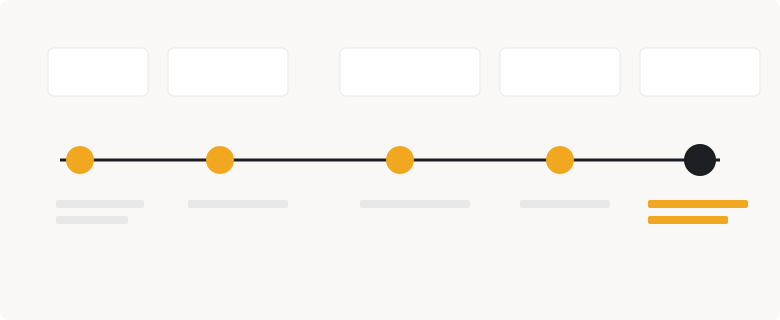
- Discovery (day 1). Stack, on-call topology, risk areas, hard nos on tooling, budget envelope. We say no on the call when we are the wrong partner.
- Shortlist (by day 5). Two or three profiles from our bench plus, when needed, engineers we have tracked for years who are finishing notice elsewhere. You receive repos, incident write-ups where available, and a written answer to a scoped reliability question.
- Live exercise (days 5–8). Ninety minutes with your platform lead on a sanitised slice of work: flaky workflow, Terraform drift, or rollout failure. No trivia wall.
- Paperwork (days 8–10). Master services agreement, monthly statement of work, fourteen-day swap clause in plain language.
- First production change (days 12–15). Onboarding pairs on a small, reversible change so you see integration speed, not slide decks.
DevOps with us versus freelancer, in-house, or large offshore bench
Each option wins sometimes; pretending otherwise wastes your time.
Freelance marketplaces
Win on narrow spikes under ~80 hours. Lose on continuity, state-file discipline, and on-call runbooks when the incentive is ticket throughput.
In-house hiring in the US or UK
Wins on five-year ownership. Loses on funnel length and regret cost when the hire misses at month six while incidents continue.
Large offshore agencies
Win when you need ten mid-level operators with a PM layer. Lose when the engineer in the interview is not the engineer in your Terraform repo, or when Kubernetes day-two depth is change-order territory.
Where we sit
Small senior bench, GMT-3, full overlap with US Eastern hours, fifteen-day notice after the minimum, and the person you interview is the person who commits. That is the trade we optimize for.
Composite scenarios (anonymised, rounded numbers)
Shapes we have shipped multiple times; details blended to protect clients.
EKS upgrade with zero “big bang” weekend
US fintech on Kubernetes 1.27, terrified of ingress regressions. Embedded senior staged node groups, rehearsed rollbacks, and moved production across three maintenance windows. Deploy frequency recovered; Sev-1 infra pages dropped from three per quarter to zero over two quarters in the composite retelling.
Terraform drift audit before SOC 2
UK SaaS with hand-edited staging. Six-week engagement: module boundaries, enforced plans in CI, secrets moved out of env files, evidence packet for auditors. Change failure rate improved without freezing the product roadmap.
Mini case study
Secure collaboration platform: deploy time down 58%, audit findings closed
One senior, five months, anonymised metrics from a real engagement pattern.
Context. Encrypted collaboration product (same shape as our HighSide case study), GitHub Actions plus Terraform on AWS, Kubernetes for core services, eight internal engineers. Releases took most of a day; security reviewers flagged manual promotion steps and weak traceability from commit to cluster.
What we did. Weeks one and two were instrumentation and pipeline mapping: artifact signing, environment promotion gates, and pairing on the smallest reversible changes. We modularised Terraform, moved secrets to a managed store, and tightened rollout health checks. Three focused PRs across weeks four to eight, each with rollback notes aimed at regression classes auditors actually ask about.
Outcome. Median deploy time fell 58% from the week-one baseline; change failure rate dropped from roughly one in five releases to one in twelve; two moderate audit findings closed with evidence the client could reuse. The internal team kept shipping product work in parallel.
Caveat. Weeks one and two looked “slow” if you measure hero commits only. That trade is explicit: we optimize for compounding reliability, not dashboard theater.
At a glance
Stack: GitHub Actions, Terraform, EKS, Datadog
Deploy time: −58%
First prod change: 13 days
Risks of external DevOps staff—and how we mitigate them
Honest controls beat “risk-free” slogans.
Interview star, week-three stall
Mitigation: exercise on real infra, fourteen-day swap window, explicit day-fourteen check-in with your lead.
Shadow contractor behavior
Mitigation: refuse “side lane” engagements; our engineer joins your change reviews both directions, not only outbound PRs.
Knowledge leaves with the engagement
Mitigation: ADRs for non-obvious calls, runbooks for pipelines we touch, handover notes at month three even if you extend.
Vanity platform work instead of metrics
Mitigation: monthly scorecard on three to five numbers your leadership tracks—deploy frequency, change failure rate, MTTR, infra cost per customer.
Why Siblings for DevOps staff augmentation
Small bench, direct access, no parallel sales organization inventing capacity.
30+
Engineers in-house
Córdoba-based team; fintech, health, collaboration, logistics clients
Dozens
Platform-shaped placements
CI/CD, Terraform, Kubernetes, observability, regulated releases
GMT-3
Argentina overlap
Same-day with US East; workable with most US zones
We are deliberately not a fifty-person recruiting shop. Founders still review new DevOps engagements, and engineers talk to clients without a telephone game of account managers. That is why the process above stays short.
Reviewed by Javier Uanini, Founder & CEO, Siblings Software — technical discovery on DevOps engagements, pricing bands, and fit decisions.
Frequently Asked Questions
Senior and mid-senior DevOps and SRE engineers employed full-time by Siblings and embedded in your team. They join your stand-ups, open pull requests in your infrastructure repositories, pair on incidents in your paging rotation, and work in your Slack or Teams. We cover recruiting, payroll, hardware, benefits, and Argentine employer obligations. You keep architecture direction, change management, and intellectual property. Typical scope spans CI/CD hardening, Terraform and Kubernetes operations, observability rollouts, secrets management, release engineering, and incident response runbooks.
A single senior DevOps engineer is usually USD 7,500 to 11,500 per month all-in. A senior plus mid pair lands around USD 14,000 to 22,000 per month. A three-to-four person pod with shared platform context is typically USD 22,000 to 40,000 per month. Figures assume a full-time month, include recruiting and local taxes, and exclude your own cloud, observability SaaS, and paid security tooling so you keep billing and data custody.
Most engagements reach a first production-safe change in roughly 12 to 15 business days: discovery on day one, a two-or-three-person shortlist by day five, a ninety-minute live exercise on real pipeline or Terraform code before day eight, paperwork by day ten, then onboarding with your platform lead. If you already interviewed a candidate we employ under an employer-of-record path, we can compress the middle steps toward seven to nine days.
We end on a live exercise drawn from production-shaped problems: a flaky GitHub Actions workflow, a Terraform plan that drifts only in staging, or a Kubernetes rollout that fails health checks for a subtle readiness probe reason. We publish a short written answer to a scoped reliability question before the call so you see reasoning, not buzzwords. In the last eighteen months we replaced two placements, both inside a fourteen-day free-swap window.
Freelancers fit narrow scopes under roughly eighty hours. For ongoing platform work they optimize for utilization, which often starves pipeline hygiene, state-file discipline, and on-call runbooks. Our engineers are full-time employees in one time zone with a fifteen-day notice period after the minimum term, a fourteen-day swap window, and an explicit expectation to do unglamorous maintenance alongside roadmap work.
We replace the engineer at no placement fee during the first fourteen days and cover reasonable handover overlap. After that, either side may exit with fifteen days notice. We track fit with a simple day-fourteen question to your platform lead so quiet failure modes do not drift for a quarter.
We place all three shapes, but we refuse mismatches: an SRE who will not touch Terraform, or a "DevOps" generalist who has never been on call. If your brief is SLO design, error budgets, and on-call sustainability rather than pipeline ownership, see our SRE engineer staff augmentation page. If you need paved roads and developer portals, compare our platform engineering outsourcing lane. If you want ML in pipelines and intelligent alerting, see AI-powered DevOps. If you need full delivery ownership rather than individuals embedded in your rituals, compare our DevOps engineering outsourcing and dedicated platform team offerings.
Our standards for DevOps work
What we hold ourselves to once embedded.
- Pipelines fail for the right reasons. Fast feedback on real defects; flaky tests and permissive gates are treated as production risk.
- Terraform and Helm changes are reviewable. Plans posted, blast radius stated, rollback path named before apply.
- Observability is operable. Dashboards and alerts someone on call can act on—SLOs tied to user pain, not vanity graphs.
- Secrets never live in chat. Vault, cloud secret managers, or sealed patterns; rotation owners documented.
- On-call humane. Runbooks, escalation paths, and error budgets that respect sleep.
- Written artifacts. ADRs, pipeline READMEs, incident notes that survive turnover.
Contact Siblings Software Argentina
Describe your stack, on-call rotation, and risk areas. We reply within one business day—or tell you we are not the right partner.