Case study · Real estate · In delivery
Argentine rental-management app (client name withheld)
Building an Owner-First Rental Management App in 12 Weeks
An Argentine real estate company wanted its own product for property owners: an app to manage properties, tenants, guarantors and leases, update rent from official indices, collect payments and send receipts, without asking tenants to download anything. The company had approved screen designs and a budget, but no engineering team.
Siblings Software is building the full product under a fixed-scope, 12-week contract: iOS and Android apps, a versioned API, an admin panel and the integrations Argentine landlords actually need. This case study covers what shipped in the first weeks and how we deliver it. We will update it at launch.
At a glance
| Client | Argentine real estate company (name withheld) |
| Product | Rental-management app for property owners, iOS, Android and web admin |
| Engagement | Fixed-scope full product, 12-week contract |
| Timeline | Started October 2026, launch planned for early 2027 |
| Stack | Expo and React Native, Next.js 16 on Vercel, PostgreSQL on Neon, Prisma 7, OpenAPI |
| Integrations | Mercado Pago, BCRA debtor registry, official ICL and CPI indices, SendGrid, WhatsApp, in-app purchases |
| Status | In delivery: core owner flows working, first iOS preview build out |
- Delivery partner: Siblings Software
- Related services: MVP development, Mobile app development, React Native development
- More examples: all case studies
The Challenge
Argentine landlords juggle spreadsheets, bank transfers and WhatsApp to manage rentals. Rent is updated periodically from official indices such as the ICL and CPI, which is easy to get wrong by hand. Checking whether a prospective tenant has debts in the central bank's registry is a separate manual step. And chasing payments and issuing receipts takes hours every month.
The product had to be owner-first: owners get the app, while tenants receive notices by email and WhatsApp and pay through a link, with no account to create. It also had to be a real business from day one, with monthly and annual subscriptions sold through the app stores.
What Siblings Is Building
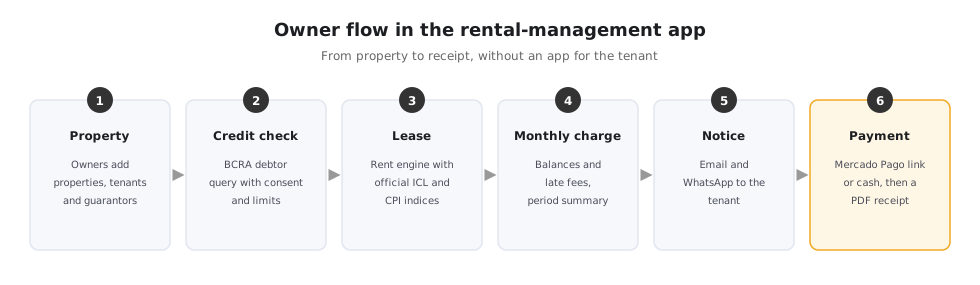
The scope covers properties, tenants and guarantors; leases with a rent-amount engine driven by official ICL and CPI data; a free public calculator for those indices; a BCRA debtor query with the person's consent and usage limits; monthly charges, balances and late fees; Mercado Pago payment links with verified collections, plus cash recording; notices by email and WhatsApp; PDF receipts with corrections and annulments; subscriptions through in-app purchases; and an admin panel for the client's team.
Later in the plan, AI will draft lease contract sections from the owner's data, with each section validated against a schema, personal data filled in on the server after generation rather than sent to the model, and a monthly usage budget.
What Shipped in the First Weeks
Within the first three weeks the team delivered the domain model and owner sessions, the property and people APIs, scheduled jobs that ingest official ICL and CPI data, the lease and rent-amount engine, the BCRA debtor query, period summaries with balances and late fees, Mercado Pago links with verified collections, email and WhatsApp notices, public legal and support pages, and an app-version gate. By early November, PDF receipts, corrections and annulments were working, and the first iOS preview build was out for review.
Each piece reached both the API and the mobile app, and each was demonstrated against a scripted demo before moving on.
How We Deliver It
The API is a set of versioned Next.js route handlers on Vercel's São Paulo region, with PostgreSQL on Neon in the same region to keep latency low for Argentine users. An OpenAPI contract generates the mobile app's client, and CI blocks any breaking change to that contract, so the app and the API cannot drift apart.
Every pull request runs lint, type checks, unit and integration tests with coverage, the OpenAPI breaking-change gate, Playwright end-to-end tests, a dependency audit, a licence policy and a gitleaks secret scan; Dependabot and SonarQube Cloud watch the rest. On mobile, Maestro flows exercise the main journeys on a simulator, including one that checks an owner can never see another owner's data. The work is split into 36 small, independently deliverable plans, executed by one senior engineer working with AI coding agents under written repository rules, with every change reviewed before it merges. See MVP development for how we scope projects like this one.
Status and What Comes Next
The project is in delivery. The next milestones are subscriptions through in-app purchases, the admin panel, AI-assisted contract drafting, a load test and a security and privacy review before launch. App store organization accounts are the main external dependency, because the stores can take weeks to approve them, so we started those procedures on day one.
We will update this page with launch results once the client approves.
Frequently Asked Questions
Yes. The same building blocks apply to property management, rentals and real estate services in Argentina and the rest of Latin America: owner and tenant records, index-based rent updates, payment links, notices and receipts. A fixed-scope build usually starts with a 3 to 5 day discovery.
Owners connect their own Mercado Pago account through OAuth, the app creates payment links for each charge, and collections are verified before they are marked as paid. Cash payments can be recorded too, so every payment ends in the same receipt flow.
No. Tenants receive notices by email and WhatsApp and pay through a link. Only owners use the app, which keeps adoption simple.
The build is a 12-week fixed-scope contract. App store and payment-provider review times sit outside those 12 weeks, which is why we start store account procedures on the first day.
AI is planned for drafting lease contract sections. Each section is validated against a schema, personal data is inserted on the server after generation instead of being sent to the model, and usage is capped by a monthly budget.
Have a product idea for property owners or another market?
We build mobile and web products with payments and local integrations in fixed-scope sprints. See MVP development and mobile app development, or tell us about your idea below.