Software outsourcing company: pick the engagement model that fits your roadmap
Technical review: Juan Pablo Licera, CTO, Siblings Software (LinkedIn).
Siblings Software is a software outsourcing company headquartered in Córdoba, Argentina. Since 2014 we have run programs across three engagement shapes: project-based outsourcing, dedicated development teams, and staff augmentation. The most useful thing this hub can do is help you pick which one fits before the first sales call.
Engineers sit in client time zones. You interview every developer, join every standup you want to, and own the code in your repositories from the first commit. Stack-specific detail lives on child pages such as web development, app development, AI development, AI testing, and the all-services index. For a two-minute orientation on models and stacks, browse the software outsourcing video library. For end-to-end delivery with written estimates, see software development outsourcing.
What a software outsourcing company delivers here
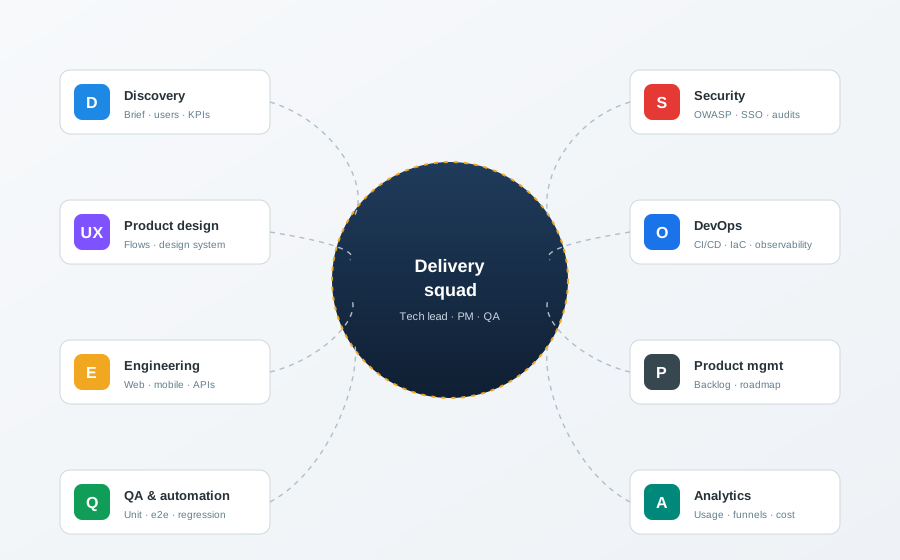
Outsourcing is not a ticket queue and not a body shop. At Siblings Software it means a team of engineers (tech lead, two to ten developers, QA automation, sometimes a designer or DevOps specialist) working on your roadmap, in your tooling, on your schedule. We handle recruiting, retention, payroll, and replacement. You set priorities and run rituals; we run the people side.
This hub covers the engagement-shape decision. It is distinct from our nearshore software development page (geography and overlap economics) and from software development outsourcing (managed delivery with milestone estimates). If you already know you only need one or two senior seats inside your ceremonies, start on hire software developers instead.
What we take ownership of
- Recruiting, vetting, and bench backup for every seat
- Delivery lead or squad composition when you lack an internal tech lead
- Sprint cadence, demos, and written scope on project-based work
- Replacement within two weeks when a seat is not the right fit
What stays yours
- Product priorities, roadmap, and architecture decisions you want to keep
- Repositories, cloud accounts, and CI/CD pipelines
- All intellectual property from day one
- Direct access to engineers in Slack, Teams, or your chat of choice
Who hires a software outsourcing company
About 40% of the book is venture-backed startups; the rest is mid-market and enterprise. Across 250+ engagements since 2014, four buyer shapes account for almost everything we see from Argentina teams serving US and European clients.
Funded founders racing an investor calendar
Seed or Series A is closed; investors have a milestone in their head; the founding team does not include enough engineers and US recruiting cycles do not fit. Three to five engineers in two weeks instead of three months, usually a small dedicated development team.
Mid-market product orgs hitting a hiring ceiling
The roadmap has more in it than the team can ship. Hiring senior US engineers takes 60 to 90 days per seat at high fully loaded cost. Outsourcing adds capacity in weeks and scales back when the crunch passes without approving five new headcount lines this quarter.
Enterprises modernising a legacy stack
The monolith still pays the bills, every feature takes twice as long, and the people who understand the legacy do not want another year inside it. An outsourced team owns the modernisation track while senior staff stays on the revenue roadmap.
Engineering leaders who need specific seats
Two senior React Native engineers for six months. A Rust specialist for a performance-critical module. A DevOps lead to harden CI/CD before SOC 2. Classic staff augmentation: plug a known gap, not commission a whole pod.
Three engagement models, one honest conversation
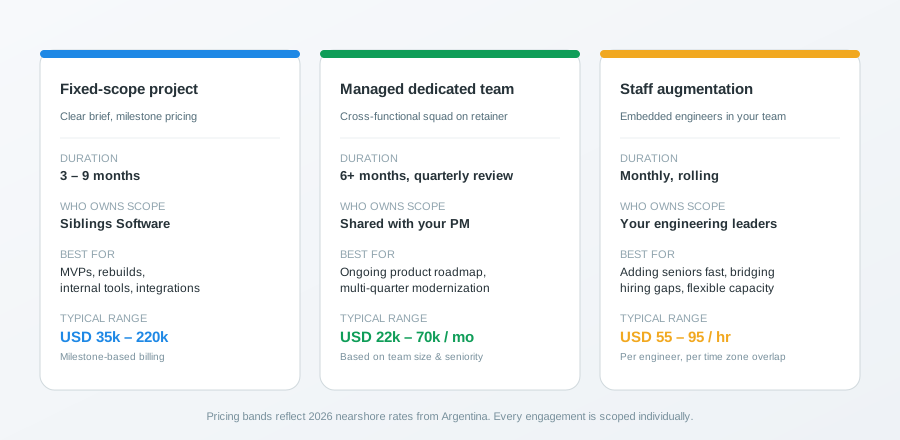
Every engagement starts with a 30-minute call that ends in a recommendation. Sometimes that recommendation is to hire two senior engineers in your home market and call us when the roadmap doubles. The three models below cover the rest. Typical nearshore bands from Córdoba in 2026: USD 25k to 180k fixed-scope, USD 22k to 70k per month dedicated squads, USD 55 to 95 per hour or USD 6,500 to 12,500 per month per engineer in staff augmentation.
Project-based outsourcing
Fixed scope, agreed timeline, defined deliverables. We own architecture, build, QA, and deployment; you review progress in biweekly demos. Fits MVPs, redesigns, integrations, standalone tools.
Choose this when: scope is clear and you want a predictable handoff date.
Dedicated development teams
Your team, our recruiting and operational layer. A cross-functional pod on your roadmap for as long as you need them. You set priorities and run rituals; we run the people side. Most long-term Siblings relationships live here.
Choose this when: the roadmap is open-ended and needs cross-functional capacity.
Staff augmentation
Individual engineers embedded in your existing team. They join your standups, code reviews, and on-call rotation; we handle payroll, benefits, equipment, and replacement.
Choose this when: the gap is a known seat, not a missing program.
Every seat carries a 2-week satisfaction guarantee and 30-day scale-down notice. No multi-year minimums. For same-time-zone specifics, see nearshore software development.
Programs we have actually shipped
Three engagements mapped onto the three models. Numbers below are the ones our clients let us publish; everything is verifiable on the linked case-study page or in the case studies hub.
Dedicated team · product build
Bari: B2B wholesale platform
A 6-person dedicated team (.NET Core API, React frontend, GraphQL) shipped a wholesale-ordering portal end-to-end for an Argentinian B2B distributor.
- 12 distributors and 230 retailers live
- 80 K wholesales processed
- 2,400 M AR$ processed
- Released in 6 months
Project & small team · smart cities
BinSensors: smart-cities IoT
A 3-person team built the REST API backend and Azure cloud-native services behind a waste-collection platform routing municipal trucks against real-time fill-level data.
- 50 K fuel gallons saved last year
- 25 K driving hours saved
- Multi-municipality Azure deployment
Staff augmentation · platform
NetApp: platform engineering
Eight senior Go developers augmenting NetApp’s platform-engineering org: REST and gRPC services, workers, and the observability layer behind hybrid data-infra SLOs.
- 8 senior Go engineers placed
- REST + gRPC service surface ownership
- Long-running enterprise engagement
What we build — the short tour
Six service families cover ~90% of engagements. Each link opens the dedicated page with stack-specific decision frames, team shapes, and case studies.
For narrower stacks — Python, Go, Rust, .NET, Rails, React, Next.js, TypeScript, Swift, Kotlin, Flutter — see the all-services index.
Frequently Asked Questions
We start every conversation with a 30-minute call to understand scope, timeline, internal team strength, and budget shape. Project-based outsourcing fits when scope is clear and the budget is fixed. A dedicated development team fits when the roadmap is open-ended. Staff augmentation fits when your team is the right shape and you are short two or three seats. We will tell you which one to pick, even when it means a smaller contract for us.
All intellectual property belongs to the client from day one. Every team member signs an NDA before they get access to your repos. We work in client-owned GitHub or GitLab on client infrastructure; code never leaves your perimeter unless you approve it. Standard MSA includes US-counsel-reviewed IP-assignment clauses; we will sign yours if it is closer to your paperwork.
Yes. We shortlist 2 to 3 candidates per role; you run the final technical and culture interview. If someone is not the right fit in the first two weeks we replace them within a week at no extra cost. That is the 2-week satisfaction guarantee on every seat.
Engineers work in your time zone: full overlap with US Eastern and 4 to 6 hours with US Pacific. Standups, demos, and retros happen on your calendar; Slack or Teams stays the system of record. For same-time-zone detail, see our nearshore software development page.
Add a seat with 2 to 3 weeks notice; scale down with 30-day notice. The existing MSA covers team-shape changes through a short addendum. Common moves: adding a DevOps seat after sprint two, swapping a backend developer for a data engineer mid-roadmap, halving the team after launch when the product enters maintenance.
All three. About 40% of clients are venture-backed startups; the rest is mid-market and enterprise. Series A founders usually start with a small dedicated team; enterprise platform groups usually start with staff augmentation. The case studies hub spans all three sizes.
Every engagement assumes you may take the program in-house eventually. ADRs, runbooks, and diagrams live in your repos throughout, not in a parallel vendor wiki. The last sprint is a documented handoff: knowledge-transfer sessions, a final architecture overview, and a written list of follow-ups.
Start a conversation
Tell us what you are building and we will tell you honestly whether outsourcing is the right move.