Hire DevSecOps Engineers for Staff Augmentation
· Typical time to first merge-blocking security gate: 12 to 15 business days
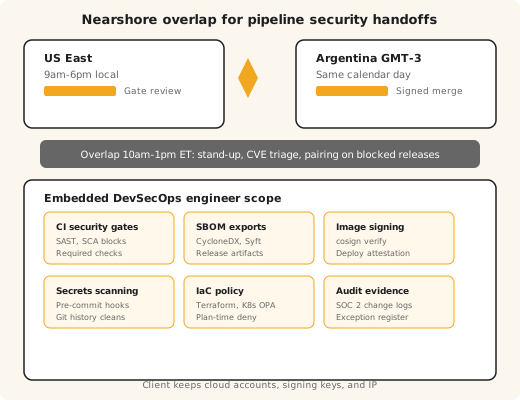
Hire DevSecOps engineers through Siblings Software when you need senior pipeline security talent embedded in your platform team without running a six-month search for scarce AppSec plus CI/CD hybrids. We help CISOs, VP Engineering, platform directors, and compliance leads add DevSecOps capacity from Córdoba, Argentina, with four to eight hours of overlap with US Eastern business hours. Screening focuses on live exercises on merge-blocking gates, SBOM and signing paths, and whether you need gate tuning, supply chain attestation, or SOC 2 evidence in pull requests.
This page explains what embedded DevSecOps engineers do week to week, how we vet candidates, engagement models and monthly bands, timelines to onboarding, comparison with freelancers and in-house hiring, risks we contract around, and when DevSecOps services fits better than individual seats. This lane is not hire DevOps engineers for general CI/CD throughput, not hire SRE engineers for on-call reliability alone, and not hire platform engineers for golden paths only. For the parent service, see staff augmentation. For breadth across stacks, see multi-stack staff augmentation; for timezone context, read nearshore developer hiring. For full delivery ownership, compare DevOps engineering, observability engineering services, or AI code security from the same leadership team.
Prefer numbers before a call? Jump to monthly pricing bands for embedded seniors, pairs, and small pods.
When companies hire DevSecOps engineers through us
Four situations cover most discovery calls; yours may combine two.
Platform teams with scans that never block merges
GitHub Advanced Security or Snyk reports pile up while main still merges on green unit tests only. Staff aug adds engineers who live in workflow YAML and policy bundles while you close a full-time hire, or becomes steady state when AppSec plus platform hybrids are scarce locally.
Teams inheriting unsigned container promotion
Production trusts mutable tags, cosign keys have no custodian, and hotfix branches bypass required checks. You need a calm audit and gate fixes without pausing the roadmap.
Compliance asking for SOC 2 change evidence in CI
Auditors want traceability from commit to signed artifact without a quarterly screenshot scramble. Embedded engineers pair with your leads to wire evidence folders aligned with the OWASP Top Ten and SLSA without freezing product velocity.
SaaS teams facing customer security questionnaires
Enterprise prospects send SIG questionnaires while your pipeline still allows skip-scan deploys. Engineers embed to add merge-blocking gates, SBOM exports, and sample evidence packs auditors can trace.
None of the above? Say so on the call. We turn down engagements when the fit is wrong, which keeps our bench credible.
What DevSecOps engineers do in real client teams
Day-to-day work on CI gates, supply chain attestation, and evidence packs, not a generic security checklist page.
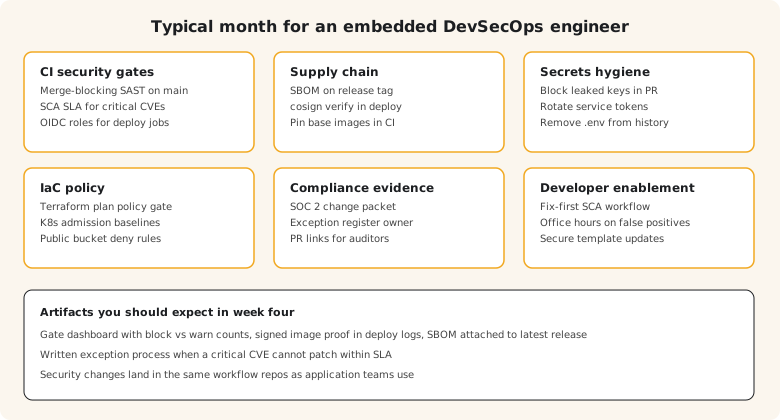
Senior DevSecOps engineer is an overloaded title. In a typical month, an embedded engineer might turn a warning-only SCA step into a merge blocker on main, attach CycloneDX SBOMs to release tags, verify cosign signatures in deploy pipelines, add Checkov gates beside Terraform plans, refresh a SOC 2 evidence folder after a control change, and document who approves gate exceptions. The diagram below is a schematic of those parallel tracks; your mix depends on audit pressure, repository count, and how mature your Secure Delivery Pipeline Readiness Gate answers are today.
CI security gates and policy
SAST, SCA, and container scan severity thresholds with named owners, required checks on main and release branches, and exception workflows your security team can audit. We align with the OWASP Top Ten and your existing GitHub or GitLab workflows rather than parallel spreadsheets.
Supply chain attestation
SBOM generation on promoted builds, image signing with cosign or Sigstore, verification in deploy pipelines, and attestations mapped to the SLSA specification. For vendor-owned programs see DevSecOps services.
Secrets and IaC scanning
Gitleaks or equivalent on pull requests, Terraform and Kubernetes policy checks in the same merge queue as application code, and routing alerts to engineers who can rotate credentials within one business day.
Compliance evidence and enablement
Evidence folders mapped to SOC 2 change-management controls, sample PR check exports, and brown-bag sessions so product teams understand why a gate blocked their merge. Runtime detection work belongs under observability engineering services; copilot secret patterns under AI code security.
How Siblings vets DevSecOps engineers
Resume screens miss the failures that show up in week three of an audit window. We end on live pair work.
Before anyone joins your stand-up, we run a written scoping answer on a small CI gate design question, then a ninety-minute live session on production-shaped pipeline code: a workflow that reports critical CVEs but never fails, unsigned images promoted through GitOps, or Terraform policy checks skipped on release branches. We check communication in English or Spanish, how they explain tradeoffs to a platform lead, and whether they reach for gate evidence before recommending another dashboard. Red flags we screen out: candidates who treat security as a ticket queue outside engineering, who cannot read your workflow YAML, or who need a greenfield demo to show value in week one. Roughly one in five bench profiles reaches a client shortlist.
External reference: we align engineering practice with the OWASP Top Ten, the SLSA specification, and GitHub code security documentation, not audit-only slide decks.
The Secure Delivery Pipeline Readiness Gate (four signals)
A lightweight decision model buyers can reuse even if they never hire us.
Before we shortlist, we walk through four signals with your platform or security lead on a thirty-minute call. The same gate appears on our DevSecOps services page because buyers confuse staff aug and vendor-owned programs when gate ownership is unclear.
- 1. CI security gate ownership. Is there a named owner who merges SAST, SCA, and container scan policy and enforces required checks on main? If scans run but nobody blocks, you may need a program via DevSecOps services, not only another engineer through staff aug.
- 2. Supply chain attestation. Do release artifacts ship with SBOM exports and image signing verified at deploy time? If production trusts latest tag only, we sequence cosign or Sigstore paths before widening scan coverage.
- 3. Secrets and IaC scanning. Do pre-commit and pipeline checks catch leaked keys and Terraform drift before merge? If audits still find secrets in Git history, we prioritize gitleaks and tfsec gates before cosmetic dashboard work.
- 4. Compliance evidence path. Can SOC 2 or ISO controls map to automated checks auditors trust? If evidence is quarterly screenshots, we wire folders in CI and Git before the next customer diligence cycle.
Those four signals reduce guesswork before anyone signs a statement of work. Your platform lead validates the shape on the discovery call; we match the bench to that profile rather than sending a generic DevOps resume with security buzzwords.
Engagement models and monthly ranges
Published bands beat “contact us for a quote” when you are budgeting a quarter.
We publish ranges because hidden pricing wastes cycles. The point inside the band moves with seniority, how much stakeholder-facing English you need, and rare depth such as service mesh depth, regulated environments, or multi-cluster operations.
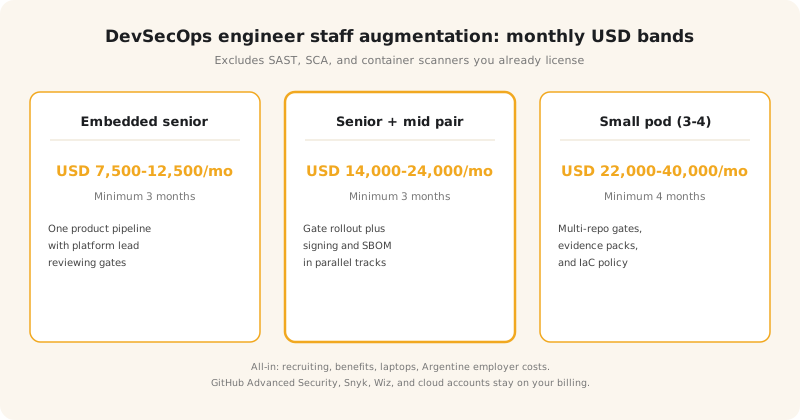
Embedded senior
One senior in your ceremonies and code review rotation. Strong when your engineering culture is healthy and you need additional throughput without re-teaching basics.
Monthly: USD 7,500 to 12,500. Minimum: three months.
Senior + mid pair
The senior sets quality and architecture guardrails; the mid-level absorbs tickets quickly once context lands, usually by week four. Common when you want sustained velocity more than a single niche specialist.
Monthly: USD 14,000 to 24,000. Minimum: three months.
Small pod (three to four engineers)
Covers vacations internally and can split between CI gate rollout and a parallel signing or evidence track under your platform lead. If you want a vendor-owned program instead, DevSecOps services is usually the better commercial shape.
Monthly: USD 22,000 to 40,000. Minimum: four months.
Figures include recruiting, benefits, laptops, and Argentine employer costs. Infra, security SaaS, and signing KMS stay on your accounts.
How hiring a DevSecOps engineer through us works
Short, inspectable steps that end with you meeting the person who will commit.
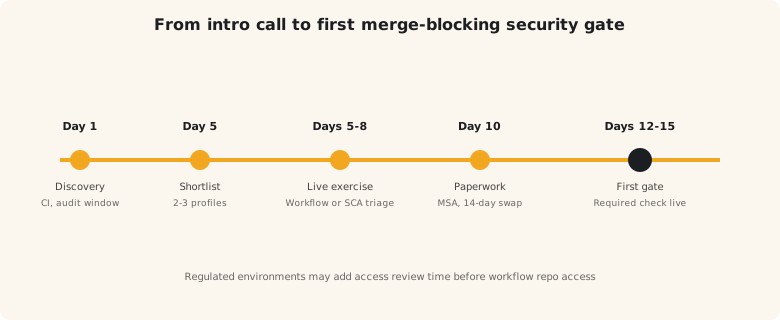
- Discovery (day 1). Stack, team topology, risk areas, hard nos on tooling, budget envelope. We say no on the call when we are the wrong partner.
- Shortlist (by day 5). Two or three profiles from our bench plus, when needed, engineers we have tracked for years who are finishing notice elsewhere. You receive repos, workflow examples where available, and a written answer to a scoped CI gate design question.
- Live pair (days 5 to 8). Ninety minutes with your platform lead on a sanitised slice of work: flaky scan step, bypassed required check, or cosign verification gap.
- Paperwork (days 8 to 10). Master services agreement, monthly statement of work, fourteen-day swap clause in plain language.
- First merge-blocking gate (days 12 to 15). Onboarding pairs on a small production-safe gate change so you see integration speed, not slide decks.
DevSecOps engineers with us versus freelancer, in-house, or large offshore bench
Each option wins sometimes; pretending otherwise wastes your time.
Freelance marketplaces
Win on narrow spikes under ~80 hours. Lose on continuity, gem audits, and queue hygiene when the incentive is ticket throughput.
In-house hiring in the US or UK
Wins on five-year ownership. Loses on funnel length and regret cost when the hire misses at month six while incidents continue.
Large offshore agencies
Win when you truly need ten mid-level ticket takers with a PM layer. Lose when the engineer in the interview is not the engineer in your workflow repos, or when supply chain attestation is treated as change-order territory.
Where we sit
Small senior bench, GMT-3, full overlap with US Eastern hours, fifteen-day notice after the minimum, and the person you interview is the person who commits. That is the trade we optimize for.
Illustrative scenarios (anonymised composites)
Shapes we have shipped multiple times; details blended to protect clients. Not named case studies with verified metrics.
CI gates after microservice sprawl
US B2B SaaS with twenty microservice repos and inconsistent scan configs. Embedded senior plus mid pair, required checks on main, SBOM on top deploy paths, exception owners named. Product kept shipping features while security risk moved in controlled slices.
Signed images before enterprise renewal
UK fintech with mutable tags in production and two enterprise renewals pending. Six-week engagement: cosign verification in GitOps, evidence sample mapped to change-management controls, gitleaks on all active repos. Sales got questionnaire answers without a platform rewrite.
Example engagement
Illustrative composite: SOC 2 pipeline evidence hardening
Anonymised composite scenario. Not a named case study with verified metrics.
Context. A US B2B SaaS team passed unit tests in CI but merged critical container CVEs because scans were advisory only. Customer security reviews landed the same quarter.
What we did. Embedded senior plus mid DevSecOps engineers enforced merge-blocking SCA on main, attached SBOMs to release tags, and packaged sample evidence folders compliance could trace.
Outcome. No fabricated percentage claims here. The team gained named gate owners and a written runbook for exception approval. For published delivery work under ISO 27001 constraints, see the ISO 27001 compliance SaaS case study.
At a glance
Model: DevSecOps staff augmentation
Scale: senior plus mid pair
Focus: CI gates, SBOM, signing
Risks of embedding DevSecOps engineers and how we reduce them
Honest controls beat “risk-free” slogans.
Interview star, week-three stall
Mitigation: pair on real pipeline code, fourteen-day swap window, explicit day-fourteen check-in with your lead.
Shadow contractor behavior
Mitigation: refuse “side lane” engagements; our engineer joins your reviews both directions, not only outbound PRs.
Knowledge leaves with the engagement
Mitigation: ADRs for non-obvious calls, runbooks for jobs we touch, handover notes at month three even if you extend.
Vanity refactors instead of metrics
Mitigation: monthly scorecard on three to five numbers your leadership actually tracks: blocked critical findings, unsigned deploy attempts, mean time to rotate leaked secrets, evidence pack freshness.
Why Siblings for DevSecOps staff augmentation
Small bench, direct access, no parallel sales organization inventing capacity.
30+
Engineers in-house
Córdoba-based team; fintech, health, retail, logistics clients
Dozens
DevSecOps staff aug placements
CI gates, SBOM, signing, and compliance evidence
GMT-3
Argentina overlap
Same-day with US East; workable with most US zones
We are deliberately not a fifty-person recruiting shop. Founders still review new DevSecOps engagements, and engineers talk to clients without a telephone game of account managers. That is why the process above stays short.
Reviewed by Javier Uanini, Founder & CEO, Siblings Software. Technical discovery on DevSecOps staff augmentation engagements, pricing bands, and fit decisions.
Frequently Asked Questions
Senior DevSecOps engineers employed full-time by Siblings and embedded in your team. They join your stand-ups, open pull requests in your pipeline repositories, tune merge-blocking CI gates, export SBOMs, and work in your Slack or Teams. We cover recruiting, payroll, hardware, benefits, and Argentine employer obligations. You keep security policy, key custody, and intellectual property. Typical scope spans SAST and SCA gates, container scans, secrets and IaC policy, compliance evidence, and developer security enablement.
A single senior DevSecOps engineer is usually USD 7,500 to 12,500 per month all-in. A senior plus mid pair lands around USD 14,000 to 24,000 per month. A three-to-four person pod with shared pipeline context is typically USD 22,000 to 40,000 per month. Figures assume a full-time month, include recruiting and local taxes, and exclude cloud accounts, security SaaS, and signing infrastructure so you keep billing and data custody.
Most engagements ship a first merge-blocking gate in roughly 12 to 15 business days: discovery on day one, a two-or-three-person shortlist by day five, a ninety-minute live exercise on pipeline or supply chain code before day eight, paperwork by day ten, then onboarding with your platform or security lead. Regulated environments can take longer when access reviews are required.
The last gate is a live session on production-shaped pipeline work: scans that warn but never block, unsigned images reaching production, or Terraform policy checks skipped on hotfix branches. We watch for gate discipline, honest pushback when another dashboard is the wrong fix, and scars from real audit cycles. Roughly one in five bench profiles reaches a client shortlist. If the match is wrong in the first fourteen days, we replace the engineer at no placement fee with overlap for handover.
A solo senior fits one repo family, named gate owners, and a lead who reviews every policy change. A pod wins when CI gate rollout, signing hardening, and evidence refresh for SOC 2 run in parallel. For vendor-owned programs compare DevSecOps services.
DevSecOps engineer staff augmentation embeds pipeline security engineers in your rituals. Hire DevOps engineers covers broader CI/CD and cluster operations. DevSecOps services delivers a governed program when gate ownership is still undefined. We say no on the discovery call when another lane is the better fit.
We replace the engineer at no placement fee during the first fourteen days and cover reasonable handover overlap. After that, either side may exit with fifteen days notice. We track fit with a simple day-fourteen question to your tech lead so quiet failure modes do not drift for a quarter.
Our standards for DevSecOps work
What we hold ourselves to once embedded.
- Gates before exceptions. Merge-blocking policy before ad-hoc waivers on production paths.
- Artifacts you can attest. SBOMs, signatures, and promotion logs documented for auditors.
- Findings you can route. Scan output lands where engineers rotate secrets, not a shared mailbox.
- Gates with owners. Severities, exception approvers, and break-glass paths assigned, not implied.
- Policies versioned. Workflow and policy bundle changes tagged in release notes with evidence linked.
- Written artifacts. Runbooks for key rotation, gate exception logs in PR templates, rollback notes for signing changes.
Contact Siblings Software Argentina
Describe the services, team topology, and risk areas. We reply within one business day, or tell you we are not the right partner.