Microservices Development Services Outsourcing from Argentina
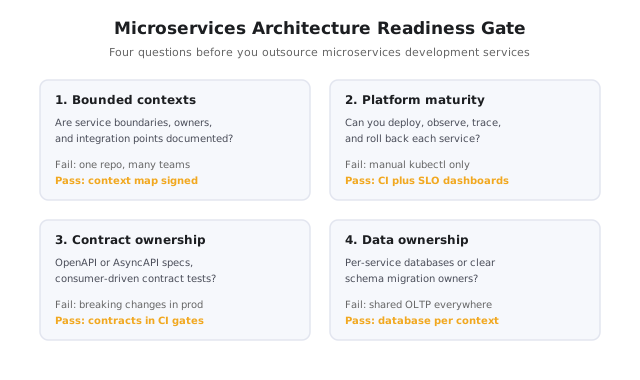
What: Production microservices development services design bounded contexts, ship independently deployable services on Kubernetes, wire event-driven integration with contract tests, and leave runbooks your platform team can operate. Who: VP Engineering, platform leads, and architects at B2B SaaS, marketplaces, and fintech teams that outgrew a modular monolith or need a greenfield service mesh without hiring six specialists in one quarter. Problem: Releases queue behind one deployable, cross-team schema changes break production, and a slide-deck microservices roadmap never survives the first on-call weekend. Why nearshore: Service extraction needs same-day pairing when a Kafka consumer lag alert fires, a Pact contract fails in CI, or a Helm rollback must happen before US business hours end. How to evaluate us: Ask whether a vendor can pass the Microservices Architecture Readiness Gate in the hero diagram: signed bounded contexts, platform maturity, contract ownership, and per-service data ownership.
We outsource discovery through production hardening: context mapping, OpenAPI and AsyncAPI contracts, Java, Go, or .NET services, Kafka or cloud-native messaging, idempotent consumers, distributed tracing, and CI gates aligned with Microsoft Azure microservices guidance, AWS microservices practices, and the microservices.io pattern catalog. Legacy monolith extraction belongs under application modernization services; this page covers net-new service platforms and scale-out architectures. Need one senior backend engineer embedded in your squad? See hire back-end developers for staff augmentation.
Siblings Software is a software outsourcing company headquartered in Cordoba, Argentina, with daily overlap on US Eastern time. We have shipped outsourced engineering since 2014 across B2B SaaS, fintech, and enterprise platforms. Browse the full catalog on our all services directory or compare our nearshore development model if procurement is weighing regions. Hosting moves stay under cloud migration services; golden paths and developer portals under platform engineering; pipelines and on-call under DevOps engineering.
What the Service Covers
Microservices development services outsourcing is the engineering work of replacing monolithic release trains with extractable services, stable APIs, and strangler routing without losing billing integrity or audit trails. A typical pattern: map bounded contexts and data coupling, define API contracts and ownership, build anti-corruption layers at the monolith edge, extract one capability behind feature flags, route production traffic slice by slice, automate regression on invoice, payment, or ledger flows, and hand off runbooks your team uses for the next slice.
That is different from cloud migration services, which optimize workload inventory, landing zones, and cutover runbooks when hosting changes. It is also different from a greenfield rewrite that hides progress behind a parallel codebase nobody trusts. Microservices work optimizes for safe decomposition, observable routing, and test coverage on paths that earn revenue. We pair with back-end development when extracted services need new persistence layers, and with API development when external partners need stable HTTP contracts before internal modules move.
Quality gates follow patterns your security team expects: authenticated service-to-service calls, schema migration reviews per bounded context, and contract tests before strangler routes flip in production. Teams often combine microservices with QA automation services so Playwright or API suites block promotions when dual-write drift exceeds thresholds. When the monolith still runs on aging VMs, we coordinate hosting moves through cloud migration while keeping the strangler schedule as the source of truth for product-facing milestones.
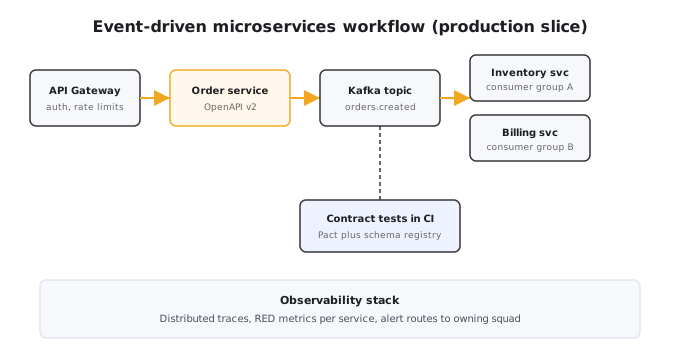
Most production microservices programs treat signed production ownership and documented strangler routing as non-negotiable: every slice records who approves rollback before traffic moves off the monolith path.
Who It Is For
Product and platform teams where the monolith still ships revenue but every release feels risky, shared databases block parallel teams, and leadership refuses another big-bang rewrite. If nobody can draw bounded contexts on a whiteboard and name who owns production on-call for a new API, you are the audience.
B2B billing and ERP adjacency
Invoicing, subscription, and ledger modules buried in .NET or Java monoliths need API extraction without breaking month-end close or partner integrations.
Fintech and regulated finance
Payment capture and reconciliation services need auditable API boundaries, schema ownership per context, and regression suites before strangler routes touch production money paths.
Platform and architecture leads
Teams tasked with monolith decomposition need a nearshore squad that delivers OpenAPI specs, routing config, and CI templates your internal developers extend, not slideware.
API-first product initiatives
Mobile apps and partner portals need public APIs while the monolith still powers admin workflows. Strangler routing lets both coexist during a multi-quarter roadmap.
Legacy .NET and Java estates
Framework upgrades stall because business logic, UI, and reporting share one deployable. Incremental extraction targets modules with clear data boundaries first.
Teams after a failed rewrite
Parallel rewrite repos fell behind feature parity. Strangler microservices returns visible production progress every sprint while the monolith keeps earning revenue.
Typical Project Scenarios
Six situations we see on discovery calls. Each maps to a bounded microservices slice we can scope in the first week after the Microservices Architecture Readiness Gate.
Extract customer billing APIs from a .NET monolith
B2B SaaS keeps invoice generation, tax rules, and PDF rendering inside one IIS deployable. We define billing bounded context, publish REST APIs, route partner traffic through an API gateway, and leave internal admin on the monolith until parity tests pass.
Strangle Java Spring modules behind feature flags
Order capture and fulfillment share tables and nightly batch jobs. We introduce anti-corruption layers, dual-write with monitoring, and strangler routes that shift read traffic before write cutover.
Replace tightly coupled reporting with read APIs
Operational dashboards query production OLTP and destabilize releases. We build read-optimized services, migrate dashboard queries slice by slice, and document schema ownership per context.
Modernize authentication without stopping feature work
Session logic is embedded in every controller. We extract an identity service, integrate OIDC, and route login flows through strangler rules while product teams keep shipping on the monolith branch.
Coordinate code microservices with cloud hosting moves
Leadership wants AWS or Azure for cost and compliance while engineering needs cleaner service boundaries. We sequence strangler milestones with cloud migration services so cutover windows align with API stability, not arbitrary infra dates.
Stand up regression gates before partner API launches
External APIs cannot fail silently when monolith and microservice both write invoices. We implement contract tests, synthetic monitoring, and QA automation that blocks route promotion when drift appears.
How Delivery Works
Six phases, usually twelve to twenty weeks for a first production slice with one extracted capability, strangler routing in production, API contracts, regression suites on critical flows, and paired handoff documentation. Routing rehearsals with documented rollback triggers are non-negotiable when money paths split across monolith and new services.
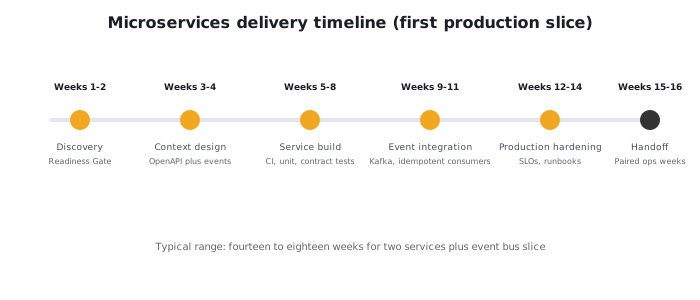
Discovery maps bounded contexts, runs the Microservices Architecture Readiness Gate from the hero diagram, and documents data coupling, strangler routing constraints, and production ownership. If any gate answer is undefined, we capture it before writing API contracts.
Domain and API design delivers context maps, OpenAPI specs, versioning rules, and anti-corruption layer boundaries. Architecture and security reviews start in week one when external partners consume APIs.
Pilot extraction implements one service or module behind feature flags, with contract tests and dual-write or read-replica strategies validated in staging before production routing.
Strangler routing configures gateway or proxy rules, observability dashboards, and rollback playbooks. Platform engineering reviews auth, rate limits, and logging before each traffic shift.
Production slice promotes routing for a bounded capability with synthetic checks and on-call runbooks signed by your engineering owner. Product and finance stakeholders review billing or ledger samples before full traffic.
Handoff includes runbooks for the next extraction, schema migration ownership, and CI templates. Paired weeks let your team ship under our review before we step down to advisory hours or transition to project-based outsourcing for slice two.
Team Composition
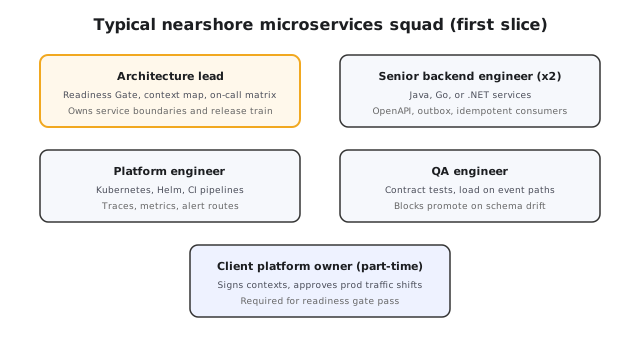
A four- to five-person squad is the usual shape for a first microservices slice. The microservices lead who owns the readiness gate, strangler schedule, and production ownership sign-off and the senior full-stack engineer who owns service extraction and .NET or Java refactors are the two roles vendors cut to win on price. Those are also the roles that determine whether rollback works when dual-write drift appears during a release train.
Typical roster: microservices lead, senior full-stack engineer, API specialist during contract-heavy weeks, QA engineer for regression and contract test suites, and a part-time product or platform owner from your side who signs bounded contexts. For ongoing slice delivery after wave one, the same squad can run as an dedicated development team on a monthly retainer. For a single senior engineer inside your org, staff augmentation is the better fit.
Project, dedicated team, or staff augmentation depending on how much of the microservices roadmap you want us to own.
Pricing and Engagement Models
Project-based
Fixed scope for a bounded first slice: readiness gate, two production services, event bus integration, contract tests in CI, Kubernetes deployment, observability dashboards, and handoff documentation. Typical duration fourteen to eighteen weeks. Published bands run USD 55,000 to USD 320,000 after discovery, depending on service count, event topology, and compliance scope.
Dedicated team
Ongoing squad owning service delivery, event schema changes, contract test maintenance, and microservices incident response. USD 24,000 to USD 68,000 per month for four to six people depending on seniority mix and service surface area.
Staff augmentation
Embed one or two senior backend engineers when you already own architecture and need hands on service code, Kafka consumers, or Helm charts. USD 6,000 to USD 11,500 per month per senior engineer on published brackets.
Compared With In-House Hiring, Freelancers, and Large Consultancies
Outsource when
- You need a production strangler slice and public APIs in one or two quarters, not after a six-month hiring cycle for scarce microservices architects.
- Your product team knows the domain but not strangler routing, dual-write patterns, or OpenAPI governance at scale.
- Engineering leadership wants a third party to document the Microservices Architecture Readiness Gate before SOC 2 or enterprise diligence on monolith risk.
- You tried a rewrite that stalled and need incremental extraction with visible production milestones every sprint.
Keep it in-house when
- You already run a mature platform team with established domain-driven design practice and only need a short spike on one API.
- Your entire estate is three stateless services with no shared database coupling.
- A vendor framework forces a big-bang microservices cutover you cannot roll back.
Freelancers can spike one service quickly but rarely stay for production routing ownership or regression gates when finance paths split across codebases. Nearshore delivery from Cordoba gives you senior microservices profiles at a lower total cost than hiring the same mix in major US metros, with overlap your product team can use. Browse case studies for examples of how we work with product teams.
Illustrative Scenario: Clearwater Commerce
Composite illustrative scenario only. Not a published client case study. No performance metrics are claimed.
The situation
Clearwater Commerce is a fictional B2B marketplace connecting industrial suppliers with regional buyers. Order capture, inventory reservations, and seller payouts still run in one Java Spring modular monolith on Kubernetes, but every release requires a full regression suite and on-call engineers cannot tell which team owns a failed checkout step. Traffic grew enough that the catalog search tier needs independent scaling while payouts must stay on stricter change control.
Leadership approved a microservices slice for orders and inventory first, with Kafka topics for order.created and inventory.reserved events, contract tests for three downstream consumers, and database-per-service boundaries for those two contexts. They need a nearshore squad that passes the readiness gate before any topic ACLs touch production.
What we would deliver
A sixteen-week nearshore project with a five-person squad from Cordoba: architecture lead, two senior backend engineers, platform engineer, QA engineer, and part-time platform owner from the client side. Daily overlap with the US Eastern platform lead during contract test failures and consumer lag rehearsals.
- Microservices Architecture Readiness Gate documenting order versus inventory contexts, platform maturity on the shared EKS cluster, Pact contract ownership, and per-service database boundaries signed by engineering and operations.
- Order and inventory services with OpenAPI v1, outbox publishers, idempotent Kafka consumers, and Helm charts with staged rollout and rollback notes.
- Contract tests and schema registry rules wired into CI so a breaking event field blocks promotion.
- RED metrics dashboards and trace sampling coordinated with DevOps engineering alert routes.
- Handoff runbooks for a third service (payouts) and optional coordination with application modernization services if remaining monolith modules need strangler extraction later.
In a scenario like this, the win is predictable scale-out: hot paths deploy independently, events stay versioned, and leadership sees production progress without pretending the entire monolith disappeared overnight.
Risks and Mitigation
Hidden data coupling blocks extraction. A reporting query or batch job locks tables the new service needs. Mitigation: data coupling map in discovery, read-path analysis, and pilot extraction that fails fast in staging when coupling is unresolved.
Dual-write drift corrupts invoices or ledger entries. Monolith and service disagree on totals. Mitigation: reconciliation jobs, alerting on drift thresholds, and finance sign-off on sample periods before full routing.
Strangler routing misconfigures auth or rate limits. Partner traffic hits the wrong backend. Mitigation: gateway review checklist, synthetic monitors per route, and rollback playbooks rehearsed before production flips.
API contracts churn and break integrators. Field renames ship without versioning. Mitigation: OpenAPI as source of truth, contract tests in CI, and deprecation policy agreed with partner-facing product owners.
Team confusion on production ownership. On-call pages the wrong squad when the new service fails. Mitigation: ownership matrix signed at the readiness gate, runbooks linked from the service repo, and paired weeks before we step down.
Microservices stalls when infra and code timelines fight. Mitigation: explicit sequencing with platform engineering and cloud migration when hosting moves, with strangler milestones as the product schedule anchor.
Questions buyers ask before the first discovery call
Frequently Asked Questions
Choose microservices when independent deployment, separate on-call ownership, and event-driven integration solve a measurable bottleneck: release trains blocked by one database, teams stepping on each other's schema migrations, or scaling one hot service requires over-provisioning the entire monolith. Stay on a modular monolith when the engineering org is under roughly ten product engineers, platform maturity is still manual deploys without traces, or bounded contexts are not signed yet. Outsourced microservices development services start with the Microservices Architecture Readiness Gate so you do not pay operational tax for services nobody can deploy safely.
We build services in Java Spring Boot, Go, or .NET on Kubernetes with Helm or Kustomize, expose HTTP with OpenAPI, and integrate asynchronously with Kafka, Amazon SQS, or Azure Service Bus depending on your estate. We use outbox patterns, idempotent consumers, saga orchestration only where compensation logic is explicit, and consumer-driven contract tests (Pact or schema registry checks) in CI. We align reference architecture with Microsoft Azure microservices guidance, AWS microservices practices, and the microservices.io pattern catalog. API gateways, service mesh, and observability stacks match what your platform team already operates.
Discovery produces a context map, AsyncAPI or event catalog entries, and database-per-service boundaries or explicit schema owners when brownfield data must be shared temporarily. Contract tests block promotion when a producer breaks a consumer. Event schemas version through a registry or documented compatibility rules. Production ownership is signed before traffic shifts: which squad merges migrations, who approves topic ACL changes, and who pages when consumer lag crosses SLO thresholds.
A first production slice with two services, event bus integration, contract tests in CI, Kubernetes deployment, observability dashboards, and paired handoff weeks typically ships in fourteen to eighteen weeks. That includes the readiness gate, staging load on event paths, and on-call runbooks. Timelines stretch when platform maturity gaps require a parallel platform engineering sprint, compliance reviews delay external topics, or bounded contexts remain disputed across product teams.
Project-based programs for a bounded first slice typically land between USD 55,000 and USD 320,000 depending on service count, event topology complexity, compliance scope, and observability requirements. Dedicated microservices squads run USD 24,000 to USD 68,000 per month for ongoing service delivery and incident response. Senior staff augmentation for backend engineers ranges from USD 6,000 to USD 11,500 per month per engineer on published brackets via hire back-end developers. We confirm pricing after discovery once readiness gate answers are documented.
You do. Service repositories, Helm charts, OpenAPI and AsyncAPI specs, Kafka topic definitions, CI pipelines, contract tests, and runbooks ship under your IP. We document how to add the next service, rehearse rollback, and extend events without paging us. Ongoing platform operations are separate engagements through DevOps engineering or platform engineering if you want managed ops after handoff.
Yes. Delivery teams are based in Cordoba, Argentina, with daily overlap on US Eastern business hours. Microservices work needs same-day iteration with platform leads when contract tests fail, consumer lag spikes before a release, or a Helm rollback must be rehearsed with your on-call engineer.
Related Services