Rust Development Outsourcing Company in Argentina
We are a Rust software outsourcing company in Córdoba, Argentina. Engineering leaders hire us to ship memory-safe APIs, embedded firmware, FFI migrations, and blockchain infrastructure without staffing a full-time Rust bench. We also staff dedicated Rust squads and single engineers through staff augmentation.
On this page you can compare when Rust is worth the learning curve, how we vet Rust candidates, what changes pricing, and which risks show up in real migrations. For engagement models, timelines, and our overview video, see the Rust outsourcing buyer guide. Payment and fintech delivery context is documented in our SUR Technology Holdings case study, where low-level performance and compliance both mattered.
Rust Development Services
We build systems that are fast by default and safe by design.
Our growing team of Rust specialists in Argentina covers every layer of the stack, from bare-metal embedded to cloud infrastructure. Whether you need a brand-new system or want to migrate legacy C/C++ code to Rust, our engineers bring deep expertise in Rust's ownership model, async runtime, and ecosystem. We've worked with clients across fintech, IoT, and logistics, industries where a single memory bug can mean real financial or operational damage.
Systems & Embedded
Rust Development
High-performance firmware, IoT runtimes, and safety-critical embedded systems, all without a garbage collector. We've built sensor data processors for agricultural IoT deployments across the Argentine Pampas region.
Back-End & API
Rust Development
Blazing-fast REST and gRPC APIs with frameworks like Actix Web, Axum, and Rocket, handling hundreds of thousands of requests per second with predictable latency.
Cloud & WebAssembly
Rust Development
Cloud-native CLIs, serverless functions, and WebAssembly modules that run at near-native speed in browsers or edge nodes. Ideal for compute-heavy front-end tasks and plugin systems.
Hire Rust Development Teams And Rust Developers
Matched with your industry, technology and company culture.
Staff
Augmentation
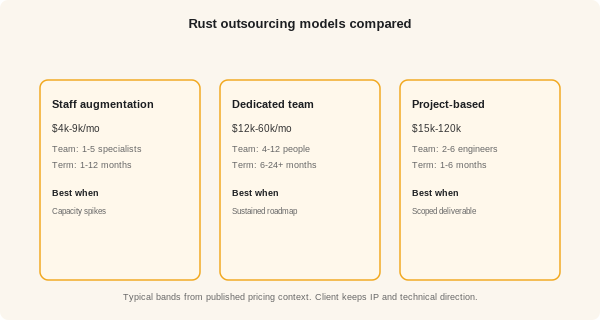
Embed one or more Rust engineers directly into your existing team. They join your standups, follow your workflows, and contribute from day one, all from Argentina's timezone-friendly location.
Dedicated
Teams
Get a fully self-contained Rust squad, developers, a tech lead, and QA, focused exclusively on your project with no context-switching.
Project-Based
Outsourcing
Hand us a defined scope and timeline. We plan, execute, and deliver the Rust project end-to-end while keeping you in the loop at every sprint.
Do you want to outsource Rust development?
Senior Rust developers are among the hardest roles to fill, the Rust community is growing fast, but demand still outstrips supply. Outsourcing to Argentina gives you instant access to vetted talent at competitive rates, without months of recruiting.
Custom Rust Software Development
Rust has earned the title of "most admired programming language" for eight consecutive years in the Stack Overflow Developer Survey, and for good reason. Its compiler catches bugs that would become production incidents in other languages, while its zero-cost abstractions mean you never pay a runtime penalty for safety. Our engineers in Cordoba use Rust's ecosystem of mature frameworks and libraries to deliver production-ready code on aggressive timelines, pairing deep systems knowledge with the agile mindset Argentina's tech culture is known for.
Actix Web & Axum
High-throughput HTTP frameworks rank at the top of public Rust benchmarks. We use them for APIs, real-time services, and microservice gateways when latency SLOs leave little headroom for GC pauses.
Tokio & Async Rust
The de-facto async runtime powering Discord, Cloudflare, and AWS. We design concurrent systems that saturate modern hardware without data races, critical for the real-time financial systems we build for Latin American clients.
WebAssembly (Wasm)
Compile Rust to Wasm for near-native browser performance. Perfect for compute-heavy front-end tasks, edge functions, and plugin systems where JavaScript alone hits its limits.
If you need to outsource your Rust project, we can help you.
Memory safety without sacrificing performance.
Why choose us?
We build Rust systems that are fast, reliable, and maintainable.
Zero-Compromise Performance
Rust's zero-cost abstractions deliver throughput on par with C and C++. We've built APIs that handle 300K+ requests per second on modest hardware, without a garbage collector in sight. That kind of raw efficiency matters when you're processing real-time financial data or sensor streams.
Guaranteed Memory Safety
The borrow checker eliminates use-after-free, buffer overflows, and data races at compile time. That means fewer CVEs, lower maintenance costs, and systems you can trust in production. For our fintech clients in Argentina and abroad, this isn't a nice-to-have, it's a compliance requirement.
Fearless Concurrency
Rust's type system prevents data races before your code ever runs. We design async architectures that fully utilize multi-core hardware while remaining safe and predictable under heavy load, something we've proven in production for high-volume payment platforms.
EXAMPLE ENGAGEMENT
Incremental C++ to Rust migration on an IoT data plane

A logistics buyer had a field-device pipeline in C++ that crashed under bursty sensor traffic. They did not want a big-bang rewrite: firmware teams still shipped C++ weekly, and production could not pause for a greenfield rewrite.
We paired one Rust engineer with their embedded lead for three months. Sprint one mapped unsafe boundaries and built a thin FFI crate around the existing ingest path. Sprint two moved matching and normalization into Rust while C++ kept radio drivers. Sprint three added property tests around the FFI surface and documented the unsafe contract for their internal auditors.
The buyer measured success in operational terms: fewer field reboots, clearer crash artifacts in logs, and a written plan for the next modules to move. We do not publish client names for this pattern; for a named fintech reference with payment-scale constraints, see SUR Technology Holdings.
How we vet Rust engineers before they join your repo
Generic portfolio reviews miss ownership, unsafe, and async failure modes.
Rust interviews that only ask syntax trivia do not predict production fit. Our bar combines live exercises and repo artifacts your team can replay later:
Ownership drill
Fix a compile-error chain involving lifetimes across iterators and error types, with explanation of each borrow decision. We look for idiomatic Result flow, not clever macros.
Unsafe and FFI review
Review a small unsafe block with a written safety invariant. Candidates must state what breaks if the invariant is violated and how they would test it. This matters for C/C++ migrations and embedded shims.
Async production trace
Walk through a Tokio service with timeouts, backpressure, and structured logging. We expect explicit discussion of task cancellation and poisoned locks, not only happy-path benchmarks.
Vetting notes and exercise artifacts travel with the engineer into your onboarding doc, so your staff engineers see why we backed the hire.
What drives Rust outsourcing cost
Rust sits in a thin talent market, so price follows scope and risk more than logo count. These are the levers we quote against after a discovery call:
- Seniority and domain: embedded/no_std profiles cost more than CRUD APIs; blockchain validator work adds audit and adversarial-input review.
- Migration depth: greenfield Actix/Axum services differ from FFI-heavy strangler paths that keep C++ online for quarters.
- Engagement shape: staff augmentation tracks individual seniority; dedicated squads include a tech lead and QA; fixed-scope projects bundle discovery and hardening.
- Compliance load: audit trails, PCI-adjacent logging, or regulated export controls add review gates and documentation time.
For nearshore overlap and model comparison with video walkthrough, use the nearshore development hub alongside our Rust buyer guide.
Rust outsourcing risks buyers should plan for
Rust removes whole classes of bugs, but outsourcing still fails when expectations and toolchain reality are misaligned. We surface these early in discovery:
- Compile-time tax on CI: full workspace builds can stretch pipelines. We budget caching, test splitting, and Cargo workspace layout up front.
- Wrong language choice: not every service needs Rust. We will say when Go or Kotlin covers the latency target with a simpler hire market.
- Unsafe creep: FFI and embedded work needs written invariants. We pair unsafe changes with tests and code review rules, not heroics.
- Crate supply chain: we prefer maintained crates with clear MSRV and audit dependency updates as part of delivery, especially for long-running services.
Our Standards
Safe and fast are not mutually exclusive.
There's a long-standing myth in systems programming that safety requires sacrificing performance. Rust disproves this every day. We write idiomatic Rust, leveraging ownership, lifetimes, and the trait system, to produce binaries that are as fast as hand-tuned C while being provably free of entire bug categories.
Major tech companies have validated this at scale. Microsoft rewrote parts of the Windows kernel in Rust. Google reduced Android memory vulnerabilities significantly. AWS built its Firecracker microVM (powering Lambda and Fargate) entirely in Rust. The Rust programming language isn't experimental anymore, it's production-grade infrastructure. The Rust Foundation now counts members like Huawei, Toyota, and Samsung, signaling broad industrial commitment.
Rust pairs exceptionally well with back-end development where latency and reliability matter most. Our engineers use Tokio, Actix, and cloud-native patterns to build APIs and data platforms that scale with your business without trading correctness for speed. For projects that also need a blockchain layer, Rust is the dominant language in ecosystems like Solana, Polkadot, and NEAR Protocol.
We stay connected to the broader Rust ecosystem through resources like This Week in Rust and the official Rust blog, tracking every edition release and RFC that could improve our clients' systems.
Rust Development Outsourcing from Argentina
Why outsource Rust development to Argentina?
Benefits of Rust Development Outsourcing
Access scarce talent, ship faster, and lower long-term costs.
Hiring in-house Rust developers is expensive and slow, senior Rust engineers are among the highest-paid in the industry, and the talent pool is a fraction of what you'd find for Java or Python. Outsourcing to Argentina solves both problems at once:
Cost Efficiency
Skip the overhead of recruiting, relocation, and benefits. Our Argentina-based engineers deliver senior Rust talent at a fraction of US salary costs while maintaining overlapping working hours with New York, Chicago, and the entire Eastern seaboard.
Deep Expertise
Our Rust engineers have shipped production systems, async services, FFI integrations, embedded firmware. You get specialists who understand ownership, lifetimes, and unsafe boundaries, not developers who read the Rust book last month.
Risk Mitigation
Rust's compiler prevents entire bug categories before deployment. Combine that with our QA processes and you get systems that rarely break, reducing maintenance costs long after delivery.
Faster Time-to-Market
Our teams are already up to speed on Rust tooling, CI/CD for Rust projects, and cargo workspace best practices. No ramp-up time, we start delivering value in the first sprint.
Scalability
Need to scale from one Rust developer to five mid-project? Outsourcing gives you the flexibility to ramp up or down based on project phases without long-term commitments.
Timezone Alignment
Argentina sits in UTC-3, overlapping with US Eastern time for a full workday. That means real-time code reviews, pair programming sessions, and sprint ceremonies, no waiting overnight for answers.
Nearshore And Offshore Rust Outsourcing
Nearshore Rust Outsourcing from Argentina
We offer nearshore Rust software development services for companies in the United States and Canada.
With our engineering talent based in Cordoba and Buenos Aires, we deliver Rust expertise in your time zone. That means real-time code reviews, pair programming sessions, and sprint ceremonies without the friction of large time differences. For teams adopting Rust for the first time, having a nearshore partner who can walk you through ownership patterns over a shared screen is invaluable.
Argentina has become one of the top nearshore destinations in Latin America for a reason: a strong university system producing skilled engineers, widespread English proficiency, and a cultural affinity with North American work styles that makes collaboration feel natural from day one.
Offshore Rust Outsourcing
We also offer offshore Rust software development services for companies in Europe and the UK.
For European clients, we adapt schedules to maximize the four-to-six-hour overlap window. Our asynchronous workflows, detailed PR descriptions, Loom walkthroughs, and thorough documentation, ensure that progress never stalls while one time zone is offline.
Turn your idea into a production-grade Rust system.
Rust sits at a unique intersection: the raw performance of C and C++ combined with the safety guarantees of higher-level languages. That combination makes it the right choice for a growing list of domains, from financial trading engines that need sub-microsecond latency to blockchain nodes that must handle adversarial inputs safely, to AI inference engines where every millisecond of latency impacts throughput.
Our engineers stay close to the Rust ecosystem. We track every edition release, follow the latest RFCs, and keep up with the evolving back-end and systems tooling landscape. When you work with us, you're getting a team from Argentina that doesn't just write Rust, they understand the tradeoffs of every crate they pull in.
Why Rust?

Rust is a systems programming language that guarantees memory safety, thread safety, and freedom from undefined behavior, all at compile time, with no runtime overhead. Created by Mozilla and now governed by an independent foundation, Rust has gone from a niche experiment to a cornerstone of modern infrastructure. Major platforms like the Linux kernel, Android, and Windows now include Rust code, and Argentina's tech sector is increasingly adopting it for fintech, IoT, and cloud-native projects where reliability is non-negotiable.
Rust Features
Rust offers a unique set of properties that no other mainstream language matches simultaneously.
Memory Safety Without GC
Rust's ownership system and borrow checker eliminate use-after-free, null pointer dereferences, and buffer overflows at compile time, without needing a garbage collector or manual memory management.
C/C++-Level Performance
Zero-cost abstractions mean Rust compiles to highly optimized native code. In benchmarks, Rust matches or exceeds C++ throughput while using significantly less memory than garbage-collected alternatives.
Fearless Concurrency
The type system prevents data races at compile time. Combined with Tokio's async runtime, Rust lets you write massively concurrent systems with confidence that race conditions won't appear in production.
In addition, Rust has a mature package manager (Cargo), excellent cross-compilation support, and one of the most helpful and active developer communities in the industry. It targets every platform from bare-metal microcontrollers to web applications via WebAssembly.
Your technology partner for performance-critical systems, from Argentina.
Industries
We serve multiple industries, globally.
Our goal is to help businesses harness the power of Rust to build systems that are simultaneously blazing fast, secure, and maintainable. From our base in Argentina, we've delivered Rust solutions for clients across these verticals:
Financial Services & Fintech
Payment engines, trading systems, and reconciliation platforms where microsecond latency and zero downtime are table stakes. Argentina's booming fintech ecosystem is a natural fit for Rust.
IoT & Embedded Systems
Sensor data processors, fleet trackers, and agricultural monitoring platforms. We've built embedded Rust for IoT deployments across Argentina and Latin America.
Cloud Infrastructure
CLIs, orchestration tools, and serverless runtimes. Rust's small binary size and fast cold starts make it ideal for edge computing and container-native workloads.
Blockchain & Web3
Smart contracts, validator nodes, and DeFi protocols. Rust dominates blockchain ecosystems like Solana, Polkadot, and NEAR, and we have experience across all three.
Automotive & Aerospace
Safety-critical control systems and telemetry processors where undefined behavior isn't just a bug, it's a hazard.
Healthcare & Biotech
High-throughput data pipelines for genomics, medical device firmware, and HIPAA-compliant API layers where memory safety is a regulatory concern.
Choose us as your
Rust Development Company
in Argentina
Argentina Rust Development Company
We're an Argentina-based Rust development company focused on delivering high-performance, memory-safe software solutions to clients around the world. From payment platforms processing millions of daily transactions to high-throughput APIs that need sub-millisecond response times, Rust is our weapon of choice when safety and speed are both non-negotiable.
Our engineering team is based in Cordoba, Argentina, one of the country's largest tech hubs with a strong university pipeline and a growing community of systems programmers. This gives us the depth to staff projects of any size and the timezone coverage to collaborate same-dayly with North American, European, and Latin American clients.
For US nearshore delivery patterns and ceremony overlap, see nearshore software development.
Our Clients
Organizations around the world are building software with Siblings Software Argentina
Frequently Asked Questions
Outsourcing fits when you need senior Rust skills for a bounded migration or product slice, not a multi-year internal Rust academy. If your roadmap includes FFI work, embedded modules, or a performance-critical API with a six-to-twelve month horizon, a nearshore Rust squad from Argentina can start while you keep permanent hiring focused on core product engineers.
Staff augmentation engineers join your standups, PR rules, and on-call rotation like internal hires. Dedicated squads bring a tech lead and QA but still use your backlog and release train. We document toolchain choices (edition, MSRV, clippy denies) in week one so reviews do not fight your existing CI.
Bring a map of unsafe boundaries, build reproducibility notes, and which modules must stay in legacy code for the next two quarters. We need test hooks or golden traces at the FFI edge, plus a rollback story if a Rust module misbehaves in production. Without those, migrations stall on fear, not compiler errors.
Most staff augmentation starts land a vetted engineer in one to three weeks after scope alignment. Dedicated squads need one to two weeks longer when we add QA and a tech lead. Expect the first sprint to focus on toolchain, workspace layout, and review norms before feature throughput ramps.
Staff augmentation bills individual seniority and utilization. Dedicated teams bundle leadership, QA, and delivery management with a monthly squad rate. FFI-heavy or embedded scopes add review time and tend to price closer to dedicated delivery even when you only wanted one senior seat.
Choose Rust when memory safety guarantees, predictable latency without GC pauses, or FFI into C/C++ dominate the architecture. Go stays the better default for straightforward microservices with a large hiring pool. We will recommend Go when it meets your SLO with less operational risk.
Córdoba is UTC-3 year-round, which gives roughly four to eight hours of overlap with US Eastern and Central business hours depending on your ceremony schedule. That supports live pairing on hard lifetime bugs and same-day PR review without overnight lag.