AI Customer Support Automation Outsourcing from Argentina
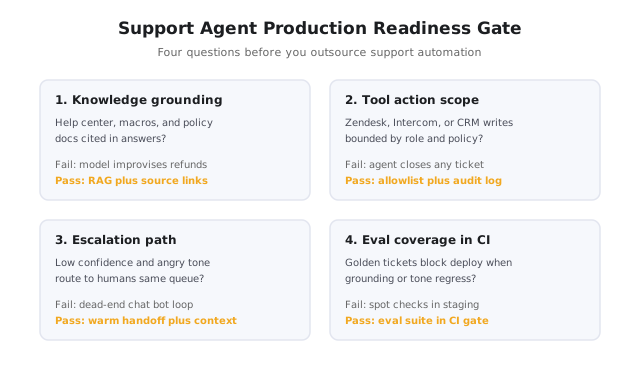
What: Production AI customer support automation wires helpdesk agents into Zendesk or Intercom: grounded answers from your knowledge base, bounded tool actions on tickets, eval gates in CI before every prompt change, and warm handoff when confidence or tone fails. Who: VP CX, support operations directors, and platform leads at B2B SaaS and subscription businesses where ticket volume outgrows macros but leadership will not ship another chatbot without citations. Problem: Copilots hallucinate refund policy, bots loop without escalation, and nobody owns golden-ticket regressions before Friday deploys. Why nearshore: Support automation needs same-day pairing when shadow mode surfaces a bad answer or a webhook breaks during peak volume. How to evaluate us: Ask whether a vendor can pass the Support Agent Production Readiness Gate in the hero diagram: knowledge grounding, tool action scope, escalation path, and eval coverage in CI.
We are distinct from AI voice agent development (telephony and speech UX), AI agents development (open-ended tool picking), AI workflow automation (multi-system back-office flows), and RAG development (retrieval infrastructure without helpdesk cutover).
We outsource discovery through handoff: helpdesk baselines, indexed macros and help articles, agent reply and tone guardrails, Zendesk and Intercom tool wiring, human queue routing, eval suites merged in CI, and runbooks aligned with the OWASP Top 10 for LLM Applications, the Zendesk API client reference, and Intercom Node client patterns. Knowledge indexing depth belongs with RAG development; eval harness design with LLM evaluation engineering; production traces with AI agent observability development. Need one senior engineer embedded in your squad? See hire AI automation developers for staff augmentation.
Siblings Software is a software outsourcing company headquartered in Cordoba, Argentina, with daily overlap on US Eastern time. We have shipped outsourced engineering since 2014 across B2B SaaS, logistics, and subscription platforms. Browse the full catalog on our all services directory or compare our nearshore development model if procurement is weighing regions.
Quick answer
How is AI customer support automation different from a general AI agent or voice bot?
Support automation targets helpdesk queues with grounded answers and bounded tools, not open-ended copilots or phone bots. This page is for Zendesk and Intercom teams that need citations, eval gates in CI, and human handoff before auto-send expands.
What the Service Covers
AI customer support automation outsourcing is the cross-functional work of making helpdesk agents safe to run in production without freezing your CX team every sprint. A typical program: baseline Zendesk or Intercom flows and ticket taxonomy, run the Support Agent Production Readiness Gate, index macros and help articles with citation checks, scope tool actions by role, wire human escalation with full thread context, merge golden-ticket evals in CI, and hand off shadow-mode runbooks operations can own.
That is different from AI agents development, which optimizes autonomous tool selection rather than ticket SLAs and refund policy. It is different from AI workflow automation, which moves documents across ERP systems rather than answering customers in the helpdesk. Support automation optimizes grounded replies, bounded writes, and escalation clarity. We pair with RAG development when retrieval quality is the bottleneck, with LLM evaluation engineering when eval design needs a dedicated wave, and with AI code security when copilots touch agent repos.
Quality gates follow what CX and trust teams expect: no auto-close on billing disputes, documented break-glass when the model vendor changes, and rehearsal of escalation paths before peak season. Teams often combine this service with project-based outsourcing for a first agent lane, then an dedicated development team retainer for KB refresh and eval tuning.
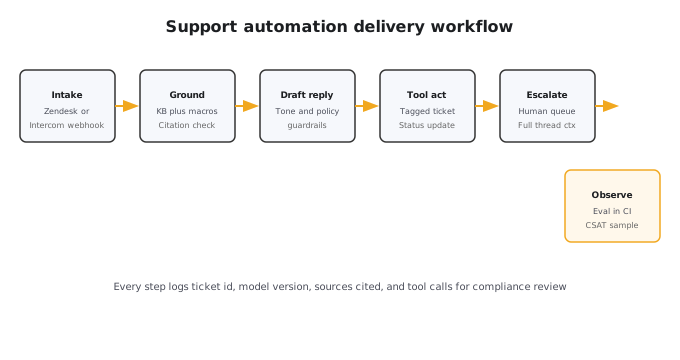
Most production support agents treat citations and escalation as non-negotiable: CX should not discover a bad refund answer only after a customer tweets about it.
Recent proof
Two recent engagements where delivery rigor on this page shows up in production engineering.
ISO 27001 compliance SaaS · Europe
Hardened for production on AWS
Moved a European ISO 27001 compliance SaaS to AWS Fargate with Cognito MFA, forced row-level security and gated deploys. Trivy blocks any release with a fixable critical vulnerability.
Rental-management app · Argentina
Owner-first rental app in 12 weeks
Every pull request runs lint, type checks, tests with coverage, an OpenAPI breaking-change gate, Playwright, a dependency audit, a licence policy and a gitleaks scan, with Dependabot and SonarQube Cloud on top.
Who It Is For
CX and platform leaders where ticket volume grows faster than hiring, macros contradict each other, and leadership wants AI assist without losing control of refunds and account changes. If nobody can name who approves a new auto-reply category within one business day, you are the audience.
B2B SaaS with high ticket volume
Subscription products where tier changes, billing disputes, and onboarding questions repeat daily and macros no longer match the product.
Marketplaces and logistics
Order status, refund, and carrier delay tickets need grounded answers without agents improvising policy on live shipments.
Multi-brand help centers
Several product lines share Zendesk but each brand has different refund rules and nobody unified retrieval before adding AI.
Teams after a failed chatbot pilot
A vendor demo looked fine in staging but production had no citations, no escalation, and angry CSAT comments within a week.
Teams scaling support without proportional hiring
Leadership approved AI assist for tier-one tickets but legal has not signed language on refunds and account deletion.
Organizations with messy knowledge bases
Notion, Confluence, and in-app help disagree. You need indexing and governance before the agent speaks to customers.
Typical Project Scenarios
Six situations we see on discovery calls. Each maps to a bounded support automation wave we can scope in the first week after the Support Agent Production Readiness Gate.
Automate tier-one billing and plan questions
Macros exist but agents still copy-paste. We index plan docs, wire citations in replies, and scope Zendesk tags so only verified answers auto-send on tier-one lanes.
Add warm handoff without losing context
Bots dump customers into a blank queue. We pass full thread summaries, sentiment flags, and attempted tool actions when confidence drops below your threshold.
Scope Intercom or Zendesk writes safely
Agents over-tag or close tickets. We implement allowlisted actions with OAuth apps, audit logs, and pairing with your QA automation services for golden tickets.
Refresh retrieval after every macro change
Editors change help articles without reindexing. We wire webhooks to embedding refresh and block prompt promotion when evals fail on updated policy language.
Run shadow mode before public auto-send
CX wants proof before Friday traffic. We draft replies beside human agents, measure citation accuracy, and promote only lanes that pass eval thresholds.
Unify multi-language support lanes
English and Spanish macros diverge. We align retrieval per locale, separate eval suites, and keep escalation rules consistent across brands.
How Delivery Works
Six phases, usually six to ten weeks for a first support automation program with grounded replies, scoped tool actions, eval gates in CI, shadow mode, and paired handoff documentation. Rehearsals on refund-language regressions are non-negotiable before auto-send goes live.
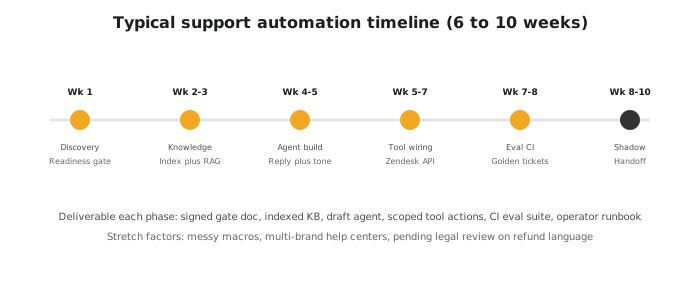
Discovery inventories helpdesk flows, macros, and escalation paths, runs the Support Agent Production Readiness Gate from the hero diagram, and documents KB owners, tool allowlists, and eval gaps. If any gate answer is undefined, we capture owners before changing customer-facing replies.
Knowledge wave delivers indexed articles and macros, citation formatting, embedding refresh hooks, and retrieval evals your CX team signs before auto-send expands.
Agent wave implements reply templates, tone guardrails, confidence scoring, and shadow drafts validated with CX leads before any customer-facing auto-send rule changes.
Tool wiring adds Zendesk or Intercom OAuth apps, allowlisted ticket actions, webhook reliability, and rollback runbooks wired to the same on-call paths as payment incidents.
Eval CI configures golden-ticket suites, merge-blocking thresholds, and regression reports reconciled to actual ticket categories. CX and platform sign off on samples before peak traffic.
Handoff includes runbooks for adding a ticket category, refreshing embeddings, and reverting prompts. Paired weeks let your team merge changes under our review before we step down to advisory hours or transition to project-based outsourcing for wave two.
Team Composition
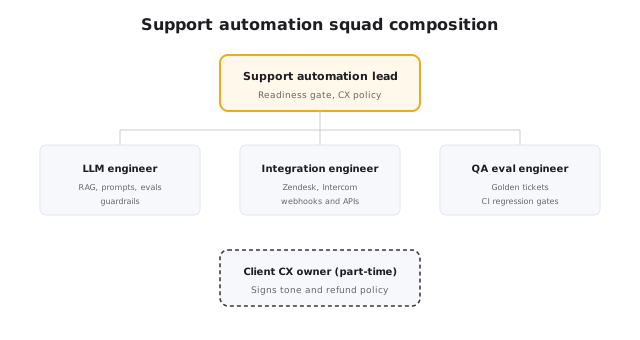
A four- to five-person squad is the usual shape for a first support automation program. The support automation lead who owns the readiness gate, CX policy narratives, and escalation rules and the LLM engineer who owns retrieval and evals are the two roles vendors cut to win on price. Those are also the roles that determine whether customers trust the next auto-reply lane.
Typical roster: support automation lead, LLM engineer for RAG and prompts, integration engineer for Zendesk and Intercom APIs, QA eval engineer for golden tickets in CI, and part-time CX owner from your side who signs tone and refund language. For ongoing KB refresh after wave one, the same squad can run as an dedicated development team on a monthly retainer. For a single senior engineer inside your org, hire AI automation developers is the better fit.
Project, dedicated squad, or staff augmentation depending on how much of the support automation roadmap you want us to own.
Pricing and Engagement Models
Project-based
Fixed scope for a bounded support automation program: readiness gate, KB indexing, agent and tool wiring, eval CI, shadow mode, and handoff documentation. Typical duration six to ten weeks. Published bands run USD 28,000 to USD 95,000 after discovery, depending on brand count, languages, and integration depth.
Dedicated team
Ongoing squad owning prompt tuning, KB refresh, eval maintenance, and new ticket lanes. USD 18,000 to USD 48,000 per month for four to six people depending on seniority mix and helpdesk surface area.
Staff augmentation
Embed one or two senior AI automation engineers when you already own the program and need hands on prompts, eval suites, or Zendesk apps. USD 7,500 to USD 11,000 per month per senior engineer on published brackets via hire AI automation developers.
Compared With In-House Hiring, Freelancers, and Large Consultancies
Outsource when
- You need grounded tier-one automation, eval gates, and helpdesk cutover in one or two quarters, not after a six-month search for a rare CX plus LLM hybrid.
- CX owns macros but engineering never ships citations or escalation rules.
- Leadership wants a third party to document the Support Agent Production Readiness Gate before peak season or a trust-and-safety review.
- Ticket volume spikes every quarter because nobody owns a prompt rollback playbook.
Keep it in-house when
- You already run weekly CX quality reviews, citation spot-checks, and only need a short spike on one ticket lane.
- Support is internal-only with no customer-facing chat and no plan to add AI assist next year.
- A vendor delivers slide decks your agents are not allowed to merge into Zendesk workflows.
Freelancers can draft one prompt quickly but rarely stay for eval CI or escalation runbooks at board level. Nearshore delivery from Cordoba gives you senior LLM and helpdesk integration profiles at a lower total cost than hiring the same mix in major US metros, with overlap CX and platform can use. Browse case studies for examples of how we work with product teams.
Illustrative Scenario: Harborlane Subscription Support
Composite illustrative scenario only. Not a published client case study. No performance metrics are claimed.
The situation
Harborlane Subscription Support is a fictional B2B SaaS billing and onboarding desk. Zendesk receives hundreds of tier-one tickets daily about plan changes, failed payments, and trial extensions while macros contradict the public help center. A chatbot pilot auto-sent refund language legal never approved, and CSAT comments spiked on weekends when no human reviewed drafts.
Leadership approved a support automation program before holiday peak season. They need the Support Agent Production Readiness Gate passed, indexed KB with citations, allowlisted Zendesk actions, golden-ticket evals in CI, and warm handoff rules before any auto-send lane goes live.
What we would deliver
An eight-week nearshore project with a five-person squad from Cordoba: support automation lead, LLM engineer, helpdesk integration engineer, QA eval engineer, and a CX owner from the client side. Daily overlap with the US Eastern support operations lead during shadow mode and tool wiring.
- Support Agent Production Readiness Gate documenting knowledge grounding, tool action scope, escalation paths, and eval coverage in CI signed by CX and platform.
- Indexed help center and macros with citation checks and embedding refresh on article publish.
- Zendesk OAuth app with allowlisted tags and status updates, coordinated with your existing helpdesk change window.
- Golden-ticket eval suite merged as a CI gate before prompt or retrieval changes promote.
- Shadow-mode runbook and warm handoff templates for billing disputes and account deletion requests.
In a scenario like this, the win is predictable customer answers: agents escalate with context, citations match policy, and leadership enters peak season with rollback steps already in Git.
Risks and Mitigation
Auto-send expands before citations are trustworthy. Teams enable every lane after a good demo week. Mitigation: shadow mode per category, eval thresholds CX signs, and staged promotion by ticket type.
Tool actions become a single-person dependency. Mitigation: dual approvers for new allowlist entries, documented OAuth scopes, and quarterly access reviews.
KB indexes rot when macros change. Mitigation: webhook-driven reindex, eval block on stale embeddings, and owners named per article family.
Retrieval fights outdated macros. Mitigation: retrieval packs owned by CX, exceptions time-boxed, and findings routed like content defects.
Eval suites rot when product changes. Mitigation: regenerate golden tickets each quarter and tie updates to the same change tickets as macro edits.
Refund language hides policy gaps. Mitigation: pair macro reviews with legal and CX workshops before new auto-send categories launch.
Questions buyers ask before the first discovery call
Frequently Asked Questions
Support automation targets helpdesk queues with grounded answers, bounded tool actions on Zendesk or Intercom, and warm handoff to humans when confidence drops. A general AI agent optimizes for open-ended tool selection across many domains. Voice bots add telephony latency and speech UX. This page fits when ticket volume is high, macros are stale, and leadership wants eval gates before every prompt change. Compare AI agents development for copilots, ai-voice-agent-development for phone, and ai-workflow-automation for multi-system back-office flows without a chat surface.
We wire agents to Zendesk via the REST API and webhooks, Intercom through the intercom-node client patterns, Freshdesk, Salesforce Service Cloud, and custom ticket stores. We prefer OAuth apps with scoped permissions over shared admin passwords. If your knowledge lives only in Notion or Confluence, we index it into a retrieval layer before the agent answers customers.
Discovery documents the Support Agent Production Readiness Gate: knowledge grounding, tool action scope, escalation path, and eval coverage in CI. Delivery includes indexed help center and macro sources with citation checks, allowlisted ticket actions, human queue routing with full thread context, golden-ticket evals merged as CI gates, and runbooks for shadow mode and rollback aligned with OWASP LLM Top 10 risk categories.
Six to ten weeks is typical: one week on discovery and the readiness gate, two weeks on knowledge indexing and RAG, two to three weeks on reply quality and tool wiring, one to two weeks on eval CI, and one to two weeks on shadow mode with paired handoff. Timelines stretch when macros contradict each other, legal has not signed refund language, or sandbox Zendesk data is empty.
Project-based support automation programs typically land between USD 28,000 and USD 95,000 depending on brand count, language mix, integration depth, and eval rigor. Dedicated squads run USD 18,000 to USD 48,000 per month for ongoing prompt tuning, KB refresh, and eval maintenance. Senior staff augmentation for AI automation engineers ranges from USD 7,500 to USD 11,000 per month on published brackets via hire AI automation developers. We confirm pricing after discovery once readiness gate answers are documented.
You do. Agent definitions, retrieval indexes, prompt versions, eval suites, Zendesk or Intercom app configs, and escalation rules ship under your IP in your repositories and helpdesk org. We document how to add a macro category, refresh embeddings, and roll back a bad prompt without paging us. Runtime agent telemetry stays a separate engagement through ai-agent-observability-development if you want production tracing after launch.
Yes. Delivery teams are based in Cordoba, Argentina, with daily overlap on US Eastern business hours. Support automation needs same-day iteration with CX and platform leads when shadow mode surfaces a bad refund answer or a webhook breaks during peak ticket volume.
Related Services