AI Voice Agent Development Company in Argentina
We are an AI voice agent software development company based in Argentina. We design, build and deploy production-grade conversational voice agents that handle real phone calls, understand natural speech, reason about caller intent and take action across your business systems, all in real time and with sub-second response latency.
The economics have shifted dramatically. Google released Gemini 3.1 Flash TTS in April 2026 with unprecedented voice quality and control. Combined with Whisper-class speech-to-text that now runs at pennies per minute and LLMs that can reason through complex conversations, the cost of handling a phone call with AI has dropped to under $0.15 per minute. Compare that to $6-$12 per call for a human agent. Companies are not replacing their call centers out of curiosity; they are doing it because the math is impossible to ignore, and because the quality of AI voice interactions has crossed the threshold where callers genuinely cannot tell the difference. Our team builds these systems from scratch, custom-fit to your call flows, your backend systems and the specific way your customers actually talk.
AI Voice Agent Development Services
From prototype to production: voice agents that handle thousands of calls daily.
Most companies that explore voice AI start with a chatbot and bolt on a voice layer. That approach fails. Voice conversations are fundamentally different from text: they are real-time, they demand emotional intelligence, they break when there is a half-second too much silence, and callers abandon the moment something feels off. Building a voice agent that people actually want to talk to requires deep expertise in speech processing, conversational design, LLM orchestration and telephony infrastructure. We have built this expertise across dozens of deployments for insurance companies, healthcare providers, logistics operators and SaaS platforms across Latin America and the US. Here is what we build.
Inbound Voice
Agents
These handle your incoming calls end to end. A customer calls about an insurance claim, a delivery status, a billing question or an appointment reschedule, and the voice agent resolves it without ever transferring to a human. We build agents that connect to your CRM, ERP, calendar and ticketing systems through MCP servers and function calling so the agent does not just answer questions but actually takes action: updates records, sends confirmations, schedules callbacks.
Outbound Voice
Campaigns
Outbound calling at scale without hiring a room full of agents. We build systems that make hundreds or thousands of calls per day for appointment reminders, payment collection, lead qualification, survey collection and re-engagement campaigns. The agent adapts its tone and approach based on the conversation, handles objections naturally and logs structured outcomes back to your CRM. Not a robocall; a real conversation at machine scale.
Custom Voice
and Persona Design
Your voice agent should sound like your brand, not like a generic text-to-speech robot. We design custom voice personas using neural TTS engines like ElevenLabs, Google Gemini TTS and Play.ht, fine-tuned with your brand guidelines, preferred vocabulary and emotional tone. For multilingual deployments, we build agents that switch between Spanish and English mid-conversation without losing context or sounding unnatural.
How We Build AI Voice Agents
A layered architecture designed for sub-second latency and reliable call handling.
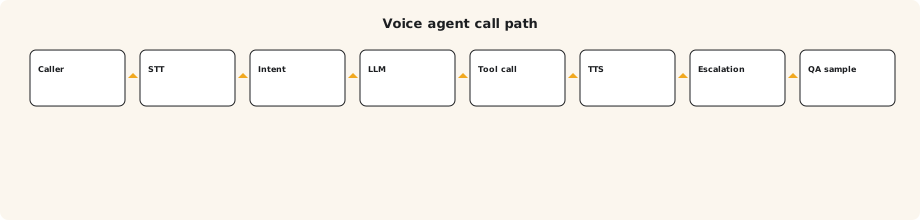
Every production voice agent we build follows a three-layer architecture: speech-to-text, LLM reasoning with tool execution, and text-to-speech. That sounds simple on paper. In practice, making these layers work together in real time at under 800 milliseconds total latency while maintaining conversation coherence is where most implementations fail.
The speech-to-text layer runs on Whisper-based models or Deepgram for real-time transcription. We optimize for streaming mode so the LLM starts processing before the caller finishes speaking, shaving 200-300 milliseconds off response time. The LLM layer handles intent classification, context management, decision-making and tool calls. We use function calling to connect the agent to your backend systems: pulling up a customer record from Salesforce, checking appointment availability in your calendar API, creating a ticket in Zendesk or processing a payment. The text-to-speech layer converts the LLM response into natural-sounding speech using neural voice engines.
What makes our approach different from off-the-shelf platforms is the conversation design layer we build on top. We model your actual call flows, train the system on your real call transcripts (when available), implement fallback strategies for edge cases and build intelligent handoff logic that transfers to human agents seamlessly when the AI reaches its limits. We also build monitoring dashboards that track call outcomes, latency metrics, customer satisfaction scores and escalation patterns so you can continuously optimize.
Ready to automate your phone operations with AI?
We also offer general AI development, AI agents development, MCP development and Python development services.
Step-by-Step: How We Build Your Voice Agent
There is a common misconception that building a voice agent is like building a chatbot with audio. It is not. Voice has unique constraints, timing matters enormously, and a missed edge case does not just produce a wrong text response but results in an awkward silence that makes your caller hang up. Here is how we approach it.
1. Call Flow Discovery (Week 1-2)
We start by listening. Literally. We review your existing call recordings (or sit in on live calls) to understand the real patterns: what callers actually say, how they phrase things, which edge cases trip up your current team, where calls go off-script. We map every call type to a decision tree with branching logic, identify which calls are automatable (usually 60-80%), and flag which require human handoff. This is the phase that separates a voice agent that works from one that frustrates callers.
2. Architecture and Integration Design (Week 2-3)
We design the technical architecture: which STT engine fits your latency requirements (Deepgram for speed, Whisper for accuracy), which LLM balances reasoning quality with cost (GPT-4o for complex flows, Claude for nuanced conversations, Gemini Flash for high-volume simple calls), which TTS engine matches your brand voice, and how the agent connects to your backend. Telephony integration is planned here too: Twilio for most cases, Vonage for specific regulatory needs, or direct SIP for enterprise PBX systems.
3. Prototype and Iteration (Week 3-6)
We build a working prototype handling one or two call types and test it internally first, then with a small group of real callers. This phase is intentionally iterative. Voice agents expose problems that text bots never encounter: pronunciation issues with domain-specific terms, timing awkwardness when the agent processes a tool call, callers who talk over the agent, background noise that degrades transcription accuracy. Each issue gets a specific fix, and we test again.
4. Production Deployment and Monitoring (Week 6-10)
Deployment is gradual. We start by routing 10-20% of calls to the AI agent while human agents handle the rest, compare outcomes (resolution rate, customer satisfaction, handle time) and expand coverage as confidence grows. We build real-time monitoring dashboards tracking latency per call segment, transcription accuracy, LLM response quality, tool execution success rates and customer satisfaction. Post-launch, we optimize continuously based on real call data, not assumptions.
Your customers are calling. The question is who answers.
Pricing and Engagement Models
We offer three engagement models depending on your stage and budget. Every project starts with a paid discovery phase because we have learned that skipping discovery is the single most expensive mistake in voice agent development.
Discovery Sprint
$5,000 - $8,000
2-3 weeks
Call flow analysis, architecture recommendation, prototype of one call type, cost projection and implementation roadmap. This is the phase where you find out whether voice AI makes financial sense for your specific call volume and complexity before committing to a full build.
Full Build
$25,000 - $80,000
6-16 weeks
End-to-end voice agent development: call flow design, STT/LLM/TTS pipeline, backend integrations, custom voice persona, telephony setup, testing, gradual deployment and monitoring dashboards. The range depends on how many call types you need automated, how many backend systems need integration and whether you need multilingual support.
Dedicated Team
From $12,000/mo
Ongoing
A dedicated team of 2-4 engineers focused on continuous voice agent optimization, new call flow development and maintenance. This model makes sense for companies running voice agents at scale (10,000+ calls/month) where continuous improvement directly impacts the bottom line. Learn more about our dedicated team model.
Ongoing Infrastructure Costs
Beyond development, your voice agent has per-call infrastructure costs. Here is what to expect based on current 2026 pricing:
Speech-to-Text
$0.01-$0.04
per minute
LLM Inference
$0.02-$0.06
per minute
Text-to-Speech
$0.02-$0.05
per minute
Telephony
$0.01-$0.02
per minute
Total per-minute cost for a production voice agent: $0.06-$0.17 per minute. For a 3-minute average call, that is $0.18-$0.51 per call versus $6-$12 for a human agent. The ROI calculation usually pays for the entire development cost within 3-6 months for companies handling 2,000+ calls per month.
AI Voice Agents vs. Alternatives: An Honest Comparison
Not every company needs a custom AI voice agent. Here is when each option makes sense, and when it does not.
Traditional IVR
Pros: Cheap, proven, simple to maintain.
Cons: Callers hate them. Menu trees force rigid paths. No natural language. High abandonment rates.
Best for: Very simple routing ("press 1 for sales, 2 for support") where cost is the only factor.
Off-the-Shelf Platforms
Pros: Fast setup, no-code interfaces, pre-built integrations.
Cons: Limited customization. Vendor lock-in. Per-minute pricing that gets expensive at scale. Generic voices.
Best for: Companies handling under 1,000 calls/month with standard call flows.
Human Call Center
Pros: Handles anything. Empathy and judgment. No technical risk.
Cons: $6-$12 per call. Training overhead. Turnover. Not 24/7 without night shifts. Inconsistent quality.
Best for: Complex, high-stakes conversations where empathy matters more than efficiency.
Custom AI Voice Agent
Pros: Natural conversations. $0.18-$0.51 per call. 24/7. Scales instantly. Full control.
Cons: Higher upfront investment. Requires tuning. Not suited for very complex emotional scenarios.
Best for: Companies handling 2,000+ calls/month with repeatable call types.
The decision usually comes down to call volume and complexity. If you handle fewer than 500 calls a month with simple routing needs, an IVR or off-the-shelf platform is probably sufficient. If you handle 2,000+ calls with moderate complexity (insurance claims, appointment booking, order management), a custom voice agent typically pays for itself within one to two quarters. For highly complex or emotional calls (crisis lines, high-value negotiations), human agents remain the right choice, though AI can still handle the initial intake and triage.
Voice AI Technology Stack
We are not married to any single vendor. We pick the best tool for each layer based on your specific requirements: latency tolerance, accuracy needs, language support, cost sensitivity and regulatory constraints.
Speech-to-Text
Deepgram (fastest, streaming), OpenAI Whisper (most accurate), Google Cloud STT, AssemblyAI. Selected based on language requirements, latency budget and cost.
LLM Reasoning
GPT-4o, Claude, Gemini 3.1 Flash, Llama for on-premise. Function calling for backend actions. Prompt engineering optimized per call flow to minimize latency and token usage.
Text-to-Speech
ElevenLabs (highest quality), Google Gemini 3.1 TTS (multilingual, controllable), Play.ht, Cartesia. Custom voice cloning available for brand consistency.
Telephony
Twilio Voice, Vonage, VAPI, Bland AI. SIP trunk integration for enterprise PBX. WebRTC for browser-based voice. We handle number provisioning, call routing and failover.
Integrations
MCP servers, Salesforce, HubSpot, Zendesk, Calendly, Stripe, custom APIs. The agent does not just talk; it acts on your systems. We build secure, auditable integration layers.
An AI voice agent that handled 3,000 insurance calls per month in Cordoba, Argentina.
Case Study: AI Voice Agent for an Insurance Company in Cordoba
One of the most technically demanding voice agent projects we have delivered involved an insurance company headquartered in Cordoba, Argentina, serving over 80,000 policyholders across five provinces. The company's call center was drowning: 12 agents handling 4,200 inbound calls per month, mostly about claims status, policy renewals, coverage inquiries and appointment scheduling for damage assessments. Average handle time was 3.2 minutes, and the center operated Monday through Friday from 8am to 6pm, which meant callers on evenings and weekends hit voicemail and often never called back.
The pain was both financial and operational. At $8.40 per call (loaded cost including salary, benefits, training and infrastructure for an Argentine call center), the monthly phone operation cost $35,280. Agent turnover was 40% annually because the work is repetitive and stressful. Training a new agent took three weeks, and quality varied wildly depending on who picked up the phone. The company had tried a basic IVR, but callers abandoned at 38% because the menu tree could not handle the variety of questions policyholders asked. "I had a fender bender on Route 9 yesterday and I want to know if my policy covers the tow truck" does not map neatly to "press 3 for claims."
When the company approached us, they had a clear goal: automate at least 50% of inbound calls without degrading customer satisfaction. They had evaluated two off-the-shelf voice agent platforms but both had the same limitation. They could handle English reasonably well but their Spanish support was mediocre, especially for Argentine Spanish with its distinctive intonation, voseo ("vos" instead of "tu") and regional vocabulary. Insurance terminology in Argentine Spanish is specific: "siniestro" (claim event), "tercero" (third party), "franquicia" (deductible), "perito" (assessor). Generic Spanish language models routinely misunderstood these terms.
Over ten weeks, a four-person team from our Cordoba office built and deployed a bilingual AI voice agent. The system handles five primary call flows: claims intake (new claim filing with structured data collection), claims status inquiries, policy coverage questions, appointment scheduling for damage assessment and policy renewal reminders.
The architecture uses Deepgram for streaming speech-to-text (chosen for its Argentine Spanish accuracy after benchmarking four providers with 200 real call recordings), Claude as the reasoning LLM (selected for its ability to handle nuanced insurance conversations without hallucinating policy details), and ElevenLabs for text-to-speech with a custom voice trained on 45 minutes of recordings from the company's best agent, a woman named Laura whose calm, professional tone was consistently rated highest in customer surveys.
The critical technical challenge was integrating the voice agent with the company's legacy insurance management system, a 15-year-old .NET application with a SOAP API. We built a middleware layer using MCP servers that translates the LLM's function calls into SOAP requests, handling policy lookups, claims creation, appointment scheduling and status updates. The agent does not just read data back to callers; it actually creates claims, schedules assessor visits and sends confirmation SMS messages, all within the call.
We deployed gradually: 15% of calls in week one, 40% by week three, 73% by month two. The remaining 27% of calls are transferred to human agents, either because the caller explicitly requests it, the conversation involves a disputed claim requiring empathy and negotiation, or the agent's confidence score drops below threshold. The handoff is seamless: the human agent receives a full transcript and context summary before picking up.
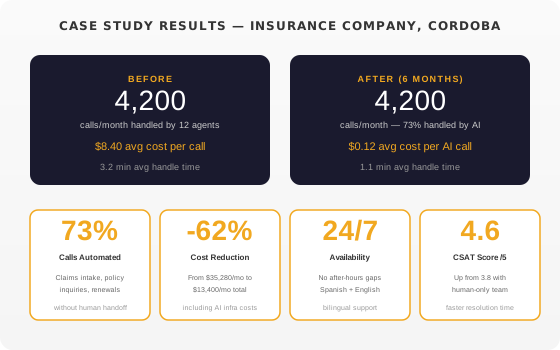
Results after 6 months in production:
73%
of inbound calls handled end-to-end by the AI agent without human intervention, exceeding the original 50% target
-62%
reduction in total phone operation cost, from $35,280/month to $13,400/month including AI infrastructure, telephony and the reduced human team
24/7
availability with no staffing gaps, which captured 680 calls per month that previously went to voicemail during evenings and weekends
4.6/5
customer satisfaction score, up from 3.8 with the human-only team, driven by faster resolution times and zero hold time
The human team went from 12 agents to 5, focused exclusively on complex claims that require empathy and judgment. Nobody was laid off; 4 agents moved to a new quality assurance role reviewing AI call transcripts and improving the system, and 3 transferred to other departments during natural attrition. The company has since expanded the voice agent to outbound renewal reminder calls, which recover an estimated $18,000/month in policies that would have lapsed. Want to see what a voice agent can do for your call operations? Let's talk.
Risks of AI Voice Agents and How We Mitigate Them
We would rather be upfront about the risks than have you discover them in production. Here are the real challenges and our specific approach to each one.
Hallucination in High-Stakes Conversations
An LLM that invents a policy detail or quotes a wrong price on a phone call creates real liability. We mitigate this with constrained generation: the agent can only state facts retrieved from your backend systems, never from its training data. For regulated industries we implement a "cite-or-decline" pattern where the agent either provides verified information with a source reference or says "let me transfer you to a specialist who can confirm that."
Caller Frustration with AI
Some callers want a human, period. We always provide an immediate escape hatch: saying "agent" or "representative" at any point triggers an instant transfer. We also monitor sentiment in real time. If the LLM detects rising frustration (repeated questions, raised voice indicators in the audio, explicit negative language), it proactively offers a human handoff rather than pushing through a conversation that is going badly.
Latency Spikes That Kill Conversations
A 2-second pause in a phone call feels like an eternity. We architect for latency from day one: streaming STT so processing starts before the caller finishes, LLM response streaming so TTS starts before the full response is generated, and filler phrases ("Let me check that for you") when a tool call takes longer than 1.5 seconds. We also run latency monitoring with automatic alerts when p95 response time exceeds thresholds.
Regulatory and Compliance Concerns
Voice recordings are sensitive data. We implement call recording disclosure at the start of every call (legally required in most jurisdictions), encrypt all recordings at rest and in transit, provide configurable retention policies and ensure PII redaction in transcripts stored for training. For healthcare and financial services, we design systems that meet HIPAA, PCI-DSS and local Argentine data protection requirements (Ley 25.326).
Why Argentina for AI Voice Agent Development?
Argentina: A Natural Fit for Voice AI Development
Voice agents are uniquely sensitive to language and accent. An agent that sounds wrong, even subtly, destroys caller trust immediately. This is where Argentina has an advantage that most nearshore destinations do not: native bilingual talent. Argentine engineers and linguists speak both Spanish and English at professional level, and they understand the nuances of both languages' speech patterns, intonation and cultural expectations in phone conversations.
For companies serving Spanish-speaking markets across the Americas, Argentina offers a particularly clean accent that is widely understood across Latin America while being distinctive enough to feel authentic. For bilingual deployments (English and Spanish on the same system), having engineers who natively understand both languages means fewer misunderstandings in conversation design, more natural fallback handling when a caller switches languages mid-sentence, and better quality assurance because the team can evaluate both languages without translation artifacts.
Beyond language, Argentina has a mature tech ecosystem with over 150,000 IT professionals, 320+ AI startups concentrated in Buenos Aires' AI District, and universities like UBA, ITBA and UNC producing 5,000+ computer science graduates annually. The country works in the same time zone as the US East Coast (GMT-3) and costs 40-60% less than equivalent US engineering talent. For more about our Argentine operations, visit our Argentina page.
Stop paying $8 per call for work AI can do at $0.15.
Real-World Use Cases for AI Voice Agents
Where Voice Automation Delivers Immediate ROI
Not every phone interaction should be automated. The sweet spot for AI voice agents is high-volume, repeatable call types where the conversation follows recognizable patterns but still requires natural language understanding. Here are the use cases we see delivering the fastest payback.
Appointment Scheduling
Medical clinics, dental offices, salons, repair services. The agent checks real-time availability, books the appointment, sends a confirmation SMS and calls back with reminders. Handles rescheduling and cancellations without human involvement. This is the single highest-ROI use case we see, with 85-90% automation rates.
Insurance Claims Intake
Collecting structured claim information over the phone: incident date, location, description, policy number, contact details. The agent validates each data point, asks clarifying questions when something is ambiguous and creates the claim in your system before the call ends. Cuts intake time from 8-12 minutes to 3-4 minutes.
Order Status and Logistics
E-commerce and delivery companies handling thousands of "where is my package?" calls daily. The agent pulls real-time tracking data, communicates estimated delivery windows and handles exception cases (delayed, returned, missing items) with appropriate next steps and escalation when needed.
Lead Qualification
Outbound agents that call inbound leads within minutes of form submission, qualify them with 3-5 questions, score them and route hot leads to your sales team with full context. Response time drops from hours to minutes, which alone typically doubles conversion rates from web form to qualified meeting.
Payment and Collections
Outbound reminder calls for overdue payments that handle the full conversation: verification, balance inquiry, payment processing over the phone (PCI-compliant) and payment plan negotiation within defined parameters. Much more effective than emails and far cheaper than human collectors.
Healthcare Patient Intake
Pre-appointment calls that collect patient history, current symptoms, medication lists and insurance information before the visit. Reduces administrative burden on clinical staff, shortens in-office wait times and captures data in structured format that feeds directly into the EHR system.
For a deeper look at AI agent capabilities beyond voice, explore our AI agents development and AI e-commerce development services. For information on voice agent developer platforms, see the Twilio Voice documentation and Deepgram's speech platform.
What Clients Usually Get Wrong About Voice Agents
Common misconceptions that lead to failed voice AI projects.
"We just need to plug in an LLM and it will handle calls"
This is the most expensive misconception. A raw LLM connected to a phone line will produce a terrible caller experience: long pauses, inconsistent tone, no ability to do anything useful beyond chat. The LLM is 20% of a production voice agent. The other 80% is conversation design, latency optimization, telephony integration, tool execution, error handling, monitoring and continuous improvement. Companies that skip this work spend twice fixing it later.
"We should automate everything from day one"
The opposite is true. Start with one or two call types that represent the highest volume and lowest complexity. Prove the ROI, build confidence internally and expand. Companies that try to automate 20 call flows simultaneously end up with a system that handles none of them well. Gradual deployment with real performance data beats ambitious launches every time.
"Voice quality does not matter that much"
It matters enormously. The voice is the first thing a caller judges, and they judge it in under two seconds. A robotic, flat or overly cheerful synthetic voice triggers immediate distrust. We invest heavily in voice persona design: selecting the right TTS engine, fine-tuning prosody, testing with real users and iterating until the voice feels right. This is not vanity; it directly impacts call completion rates and customer satisfaction scores.
"We can evaluate voice agents with text-based testing"
No, you cannot. A voice agent that passes every text-based test can still fail catastrophically on real calls because of background noise, accented speech, interruptions, mumbling, long pauses and all the messy reality of phone conversations. We test with real voice calls from the start, including deliberately difficult scenarios: noisy environments, strong accents, callers who interrupt and callers who go off-topic.
Choose us as your
AI Voice Agent Development Company
in Argentina
Frequently Asked Questions
An AI voice agent is a conversational system powered by large language models that understands natural speech, reasons about caller intent and responds in a human-like voice in real time. Unlike traditional IVR systems that force callers through rigid menu trees with keypad inputs, AI voice agents handle open-ended conversations, ask clarifying questions, access backend systems to retrieve or update information and complete tasks like booking appointments or processing claims autonomously. The response latency for modern voice agents is 400-800 milliseconds, making conversations feel natural rather than robotic.
A production-ready AI voice agent typically costs between $25,000 and $80,000 to develop depending on complexity. A basic inbound agent handling one or two call types with a single language takes 6-8 weeks and costs around $25,000-$35,000. A more complex system with multiple call flows, CRM and calendar integration, bilingual support and custom voice takes 10-16 weeks and ranges from $45,000-$80,000. Ongoing infrastructure costs run approximately $0.08-$0.15 per call-minute for STT, LLM inference and TTS combined, compared to $6-$12 per call for human agents.
Argentina offers a unique combination of advantages for voice AI development. The country has over 150,000 IT professionals with strong NLP and speech processing expertise, native Spanish speakers with high English proficiency critical for bilingual voice agents, time zone alignment with the US East Coast at GMT-3, and rates 40-60% lower than equivalent US talent. Buenos Aires' AI District has over 320 active AI startups and Argentine engineers have production experience with voice technologies used in Latin America's largest call center operations.
For well-defined call types like appointment scheduling, order status inquiries, policy questions and basic troubleshooting, production AI voice agents typically handle 60-80% of calls without any human intervention. The key factor is call complexity and variability. Highly structured interactions like appointment booking can reach 90% automation, while complex scenarios requiring empathy or nuanced judgment like complaint resolution may only automate 30-40%. A well-designed system always includes graceful handoff to human agents for calls it cannot resolve.
Related Services