Hire AI Automation Developers for Staff Augmentation
· Typical time to first production workflow: 12 to 15 business days
If you are comparing hire AI automation developers options, you probably need three things on one page: what will actually change in your business workflows, what it costs per month in plain numbers, and how you avoid the contractor who wires a demo flow that breaks the first time a PDF arrives with a missing field. This page answers those directly. We staff workflow and LLM integration engineers from Argentina with full-time people who overlap US Eastern business hours and work inside your n8n, Make, or Zapier workspaces plus your repos where custom code is required, not a parallel shadow environment.
This lane is not hire AI developers for ML models and training pipelines, not hire agentic coding developers for IDE and repository orchestration, and not AI agents development outsourcing for customer-facing autonomous agents. If you need a vendor-owned squad to design and ship the first production workflow end-to-end, see AI workflow automation outsourcing. We focus on operational automation: document intake, CRM and ERP connectors, LLM steps inside approved flows, human-in-the-loop review, and monitoring that operations teams can trust. For broader bench depth see software developer staff augmentation; for timezone context read nearshore developer hiring; for the parent practice see staff augmentation.
When evaluating vendors, ask for a live exercise on your workflow shape, published monthly bands, and a clear answer on when a small pod beats one senior. If you need full delivery ownership rather than individuals embedded in your rituals, compare nearshore development outsourcing or specialized lanes such as RAG development from the same leadership team.
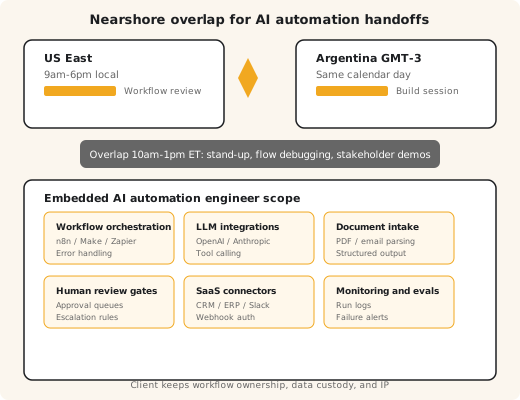
Most clients get 3-4 hours of direct overlap with US Eastern time for stand-ups, workflow reviews, and production cutovers.
Prefer numbers before a call? Jump to monthly pricing bands for embedded seniors, pairs, and small pods.
What AI automation developers do in client teams
Business workflow automation, not a reprint of the ML or agentic coding homepage.
"AI automation engineer" is overloaded. In a typical month with us, an embedded engineer might migrate a brittle Zapier chain to n8n, add an LLM extraction step with schema validation and human review, wire a Salesforce or HubSpot connector that handles duplicate records, build alerting when workflow runs fail silently, and document the approval path finance asked about. The diagram below is a schematic of those parallel tracks; your mix depends on stack maturity, document volume, and how much custom code your ops team already owns.
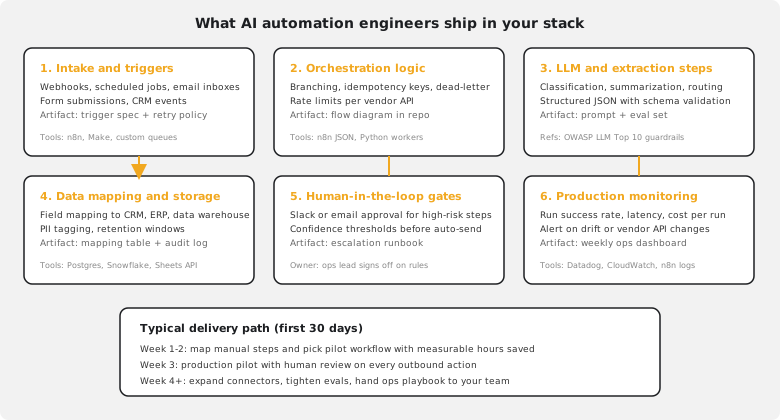
Workflow platforms plus custom code
n8n, Make, Zapier, or a hybrid where Node.js or Python fills gaps the platform cannot. We follow platform docs and version pinned nodes, not copy-paste templates that break on the next API change. Deliverables include exportable workflow definitions, environment variables documented, and rollback notes your ops lead can audit.
LLM steps inside operational flows
Structured extraction, classification, and summarization with output schemas, retry logic, and cost caps. We design prompts and guardrails aligned with the OWASP LLM Top 10, not open-ended chat endpoints in production pipelines.
Document intake and CRM or ERP connectors
Invoices, contracts, and intake forms routed through OCR or native parsers, validated fields pushed to Salesforce, HubSpot, NetSuite, or custom APIs. Idempotency keys, duplicate detection, and dead-letter queues so a bad row does not poison the whole sync.
Human-in-the-loop and monitoring
Review queues for low-confidence extractions, Slack or email alerts on failed runs, dashboards for throughput and error rates, and runbooks for the three failure modes that actually happen in production. We align with NIST AI Risk Management Framework ideas where governance teams ask for traceability.
Tools we meet most often: n8n self-hosted or cloud, Make and Zapier for lighter chains, OpenAI or Anthropic APIs with structured outputs, webhooks into existing services, and your incident channel. For security review of generated code in adjacent repos, see AI code security; for retrieval-heavy product features rather than ops automation, see RAG development.
When companies hire AI automation developers through us
Four buyer shapes cover most discovery calls; your situation may combine two.
Ops leads drowning in manual handoffs
Spreadsheets, email threads, and five Zapier zaps nobody owns. Staff aug is the bridge to documented workflows with monitoring, not another demo that works until volume doubles.
CTOs inheriting brittle automations from consultants
Flows that fail on edge-case payloads, LLM steps with no schema validation, no written rollback path. The goal is a calm audit: what is load-bearing, what breaks duplicate detection, which connectors lack error handling before anyone suggests a greenfield rebuild.
Revenue teams waiting on document processing
Quotes, POs, and contracts stuck in inboxes while CRM records lag. You need someone who can wire intake, extraction, human review, and sync without blocking the sales cycle on a six-month platform project.
Regulated environments with automation evidence gaps
SOC 2, HIPAA, or financial audit windows approaching. You need change logs from approval to production run, PII handling documented, and tested failure paths, not a diagram of "AI maturity." We embed engineers who have shipped under those constraints on workflow platforms plus custom code.
None of the above? Say so on the call. We turn down engagements when the fit is wrong, which keeps our bench credible.
Workflow Automation Readiness Gate
A lightweight vetting framework buyers can reuse even if they never hire us.
Most mismatches on AI automation engagements come from hiring a strong full-stack developer who has only clicked through Zapier templates, or a "prompt engineer" who has never owned a failed production sync at month-end close. Before we shortlist, we score three signals with your operations lead on a thirty-minute call.
- Signal A: platform and integration debt. If workflows span three tools with no central monitoring or duplicate handling, we overweight candidates who have migrated chains between n8n, Make, or Zapier and can show idempotent CRM writes, not slide-deck roadmaps.
- Signal B: LLM step fragility. If extractions fail on real documents or costs spike without caps, we prioritize engineers who enforce JSON schemas, human review thresholds, and retry policies drawn from production logs, not demo prompts.
- Signal C: governance and PII boundary. If auditors ask where customer data touches LLM APIs, we bias toward builders who document data flows, redact where required, and can explain tradeoffs to compliance teams without blocking every iteration.
Across dozens of workflow-shaped staff aug engagements for teams in the US, Canada, and the UK, shortlists that used those three signals had the lowest swap rate. That is not a guarantee for your team; it is how we reduce guesswork before anyone signs a statement of work.
Engagement models and monthly USD bands
Published bands beat "contact us for a quote" when you are budgeting a quarter.
We publish ranges because hidden pricing wastes cycles. The point inside the band moves with seniority, how much stakeholder-facing English you need, and rare depth such as multi-system ERP connectors, regulated audit support, or high-volume document pipelines.
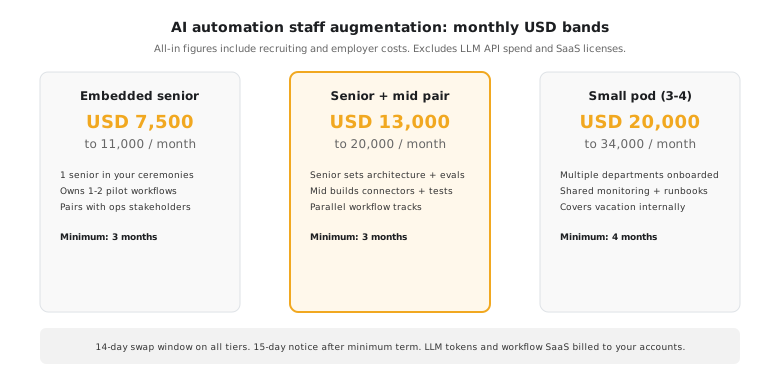
Embedded senior
One senior in your ceremonies, workflow reviews, and on-call rotation where appropriate. Strong when your culture is healthy, you have one primary automation platform, and you need throughput without re-teaching fundamentals.
Monthly: USD 7,500 to 11,000. Minimum: three months.
Senior + mid pair
The senior sets workflow and LLM guardrails; the mid-level absorbs connector tickets and monitoring setup once context lands, usually by week four. Common when you want sustained automation hygiene more than a single niche.
Monthly: USD 13,000 to 20,000. Minimum: three months.
Small pod (three to four engineers)
Covers vacations internally and can split between a platform migration track and parallel document intake or CRM connector work under your lead. If you want a vendor-owned roadmap instead, dedicated nearshore delivery is usually the better commercial shape.
Monthly: USD 20,000 to 34,000. Minimum: four months.
Figures include recruiting, benefits, laptops, and employer costs. LLM API spend and workflow SaaS licenses stay on your accounts. All tiers include a fourteen-day swap window and fifteen-day notice after the minimum term.
Hiring process timeline
Short, inspectable steps that end with you meeting the person who will commit to your workflow repos.
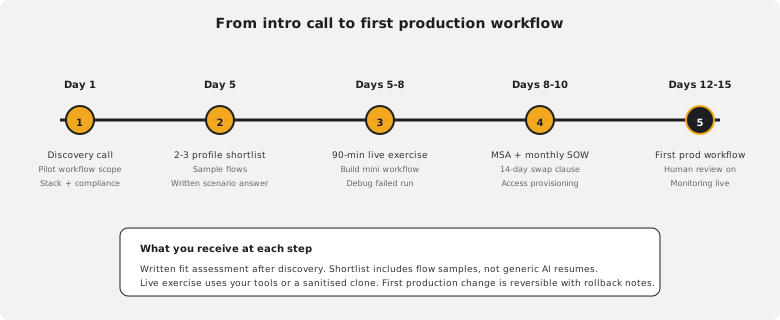
- Discovery (day 1). Current tools, document volume, CRM or ERP targets, LLM usage, approval topology, budget envelope. We say no on the call when we are the wrong partner or your need maps to ML or customer-facing agents instead.
- Shortlist (by day 5). Two or three profiles from our bench plus, when needed, engineers we have tracked for years who are finishing notice elsewhere. You receive workflow samples, incident write-ups where available, and a written answer to a scoped automation design question.
- Live exercise (days 5 to 8). Ninety minutes with your operations lead on a sanitised slice of work: broken webhook chain, LLM extraction that misses required fields, or CRM sync that loops on duplicates. No trivia wall.
- Paperwork (days 8 to 10). Master services agreement, monthly statement of work, fourteen-day swap clause in plain language.
- First production workflow (days 12 to 15). Onboarding pairs on a small, reversible flow so you see integration speed, not slide decks.
AI automation staff aug versus freelancer, in-house, or agency bench
Each option wins sometimes; pretending otherwise wastes your time.
Freelance marketplaces
Win on narrow spikes under roughly eighty hours: one Zapier fix, one n8n node. Lose on continuity, error monitoring, and runbooks when the incentive is ticket throughput across unrelated clients.
In-house hiring in the US or UK
Wins on five-year ownership of your automation standards. Loses on funnel length and regret cost when the hire misses at month six while a quarter-end intake deadline does not move.
Large offshore agencies
Win when you need ten mid-level builders with a PM layer. Lose when the engineer in the interview is not the engineer in your n8n workspace, or when LLM guardrails become change-order territory.
Where we sit
Small senior bench, GMT-3, full overlap with US Eastern hours, fifteen-day notice after the minimum, and the person you interview is the person who commits. That is the trade we optimize for.
Composite scenarios (anonymised, rounded numbers)
Shapes we have shipped multiple times; details blended to protect clients.
Invoice intake without a big-bang ERP project
US services company processing hundreds of PDF invoices monthly through email. Embedded senior moved intake to n8n with LLM field extraction, human review for low-confidence rows, and NetSuite sync with duplicate keys. Manual entry hours dropped sharply over two quarters in the composite retelling; failed sync alerts went from silent to paged within week three.
CRM hygiene before a sales ops audit
UK B2B SaaS with hand-wired Zapier zaps and stale HubSpot records. Six-week engagement: consolidated flows, schema-validated LLM enrichment with approval queues, monitoring dashboard, evidence packet for auditors. Sales ops recovered lead routing without freezing the product roadmap.
Mini case study
Operations platform: document processing time down 48%, audit findings closed
One senior, five months, anonymised metrics from a real engagement pattern.
Context. B2B operations team (same shape as engagements in our case studies portfolio), n8n for workflows, Salesforce for CRM, twelve internal staff touching intake manually. Contract and PO processing took most of a business day per batch; compliance reviewers flagged missing traceability from email attachment to CRM record.
What we did. Weeks one and two were workflow mapping and failure inventory: which zaps silently dropped rows, where LLM steps lacked schemas, which connectors needed idempotency. We migrated critical paths to versioned n8n flows, added human review for extractions below confidence thresholds, and wired alerting to the existing Slack channel. Three focused releases across weeks four to eight, each with rollback notes aimed at regression classes auditors actually ask about.
Outcome. Median document processing time fell 48% from the week-one baseline; failed syncs dropped from roughly one in six batches to one in fourteen; two moderate audit findings closed with evidence the client could reuse. The internal team kept shipping product work in parallel.
Caveat. Weeks one and two looked slow if you measure hero commits only. That trade is explicit: we optimize for compounding workflow reliability, not dashboard theater.
At a glance
Stack: n8n, Salesforce, OpenAI structured outputs, Slack alerts
Processing time: -48%
First prod flow: 14 days
Risks of external AI automation staff and how we mitigate them
Honest controls beat risk-free slogans.
Interview star, week-three stall on production flows
Mitigation: live exercise on real workflow code, fourteen-day swap window, explicit day-fourteen check-in with your operations lead.
Shadow automations outside change control
Mitigation: our engineer joins your approval flow both directions; we refuse engagements where production workflows bypass your documented review path.
Knowledge leaves with the engagement
Mitigation: runbooks for flows we touch, exported workflow definitions, handover notes at month three even if you extend.
Vanity LLM demos instead of throughput metrics
Mitigation: monthly scorecard on three to five numbers your leadership tracks: successful runs per day, mean time to recover failed syncs, review queue depth, LLM cost per document, duplicate rate in CRM writes.
Why Siblings for AI automation staff augmentation
Small bench, direct access, no parallel sales organization inventing capacity.
30+
Engineers in-house
Cordoba-based team; fintech, health, collaboration, logistics clients
Dozens
Workflow-shaped placements
n8n, Make, Zapier, LLM steps, CRM connectors, document intake
GMT-3
Argentina overlap
Same-day with US East; workable with most US zones
We are deliberately not a fifty-person recruiting shop. Founders still review new AI automation engagements, and engineers talk to clients without a telephone game of account managers. That is why the process above stays short.
Reviewed by Javier Uanini, Founder & CEO, Siblings Software: technical discovery on AI automation engagements, pricing bands, and fit decisions.
Frequently Asked Questions
Senior workflow and LLM integration engineers employed full-time by Siblings and embedded in your operations or platform team. They join your stand-ups, build and maintain automations in your n8n, Make, or Zapier workspaces plus custom code where needed, wire LLM steps into existing business flows, and work in your Slack or Teams. We cover recruiting, payroll, hardware, benefits, and Argentine employer obligations. You keep process ownership, approval rules, and intellectual property. Typical scope spans document intake pipelines, CRM and ERP connectors, human-in-the-loop review queues, error monitoring, and runbooks for failed workflow runs.
A single senior AI automation engineer is usually USD 7,500 to 11,000 per month all-in. A senior plus mid pair lands around USD 13,000 to 20,000 per month. A three-to-four person pod with shared workflow context is typically USD 20,000 to 34,000 per month. Figures assume a full-time month, include recruiting and local taxes, and exclude LLM API spend and workflow SaaS licenses so you keep billing and data custody.
Most engagements ship a first production-safe automation flow in roughly 12 to 15 business days: discovery on day one, a two-or-three-person shortlist by day five, a ninety-minute live exercise on a real workflow scenario before day eight, paperwork by day ten, then onboarding with your operations lead. If you already interviewed a candidate we employ under an employer-of-record path, we can compress the middle steps toward seven to nine days.
We end on a live exercise drawn from production-shaped automation problems: a webhook chain that fails only on partial payloads, an LLM step that hallucinates structured fields, or a CRM sync that loops on duplicate records. We publish a short written answer to a scoped workflow design question before the call so you see reasoning, not buzzwords. In the last eighteen months we replaced two AI automation placements, both inside a fourteen-day free-swap window.
A solo senior fits steady-state maintenance, one primary automation platform, and an operations lead who can review every change. A pod wins when you are running parallel tracks: migrating from Zapier to n8n while standing up document intake with LLM extraction and a Salesforce connector at the same time. Pods also cover vacation gaps without pausing SLA-sensitive flows. If you need ML model training or customer-facing autonomous agents, compare our hire AI developers lane or AI agents development outsourcing instead.
AI automation staff augmentation focuses on business workflow automation: n8n, Make, Zapier plus custom code, LLM steps inside operational flows, document intake, CRM and ERP connectors, human-in-the-loop review, and monitoring. Hire AI developers covers ML models, training pipelines, and data science. Hire agentic coding developers covers IDE and repository orchestration with tools like Cursor. AI agents development outsourcing covers customer-facing autonomous agents. We say no on the discovery call when your need maps to one of those lanes instead.
We replace the engineer at no placement fee during the first fourteen days and cover reasonable handover overlap. After that, either side may exit with fifteen days notice once the minimum term is met. We track fit with a simple day-fourteen question to your operations lead so quiet failure modes do not drift for a quarter.
Our standards for AI automation work
What we hold ourselves to once embedded.
- Workflows are versioned and reviewable. Exports checked in or documented, blast radius stated, rollback path named before production cutover.
- LLM steps have schemas and caps. Structured outputs, retry limits, cost ceilings, and human review thresholds aligned with your governance team.
- Connectors are idempotent. Duplicate detection, dead-letter queues, and alerts when syncs fail instead of failing silently.
- PII boundaries are documented. Data flows mapped, redaction where required, API keys in your vaults not ours.
- Monitoring is operational. Failed runs page someone, throughput visible, review queues do not become permanent backlogs.
- Written artifacts survive turnover. Runbooks for flows we touch, connector notes, incident write-ups that change the system.
Contact Siblings Software Argentina
Describe your workflow tools, document volume, and CRM targets. We reply within one business day, or tell you we are not the right partner.