AI Agent Observability Development from Argentina
Search intent on this topic is mostly commercial investigation with strong transactional intent. Buyers are usually already running AI agents in production, seeing unpredictable behavior, and trying to choose a team that can implement observability fast without re-architecting everything. If that is your situation, this page is written for you.
At Siblings Software, we design and implement production observability for agent-based systems: traces across model calls and tool calls, quality evaluation pipelines, token and latency analytics, and incident workflows your engineers can actually use at 2 AM. We are an Argentine software outsourcing company working since 2014 with US and LATAM clients in healthtech, fintech, e-commerce, logistics, and SaaS.
If your team is building with AI agents, MCP servers, and AI-powered delivery pipelines, observability is what separates demos from dependable operations. The market has shifted quickly: according to the Stack Overflow 2025 AI survey, AI tooling adoption grew sharply, but confidence in output quality did not improve at the same pace. That gap is where observability matters.
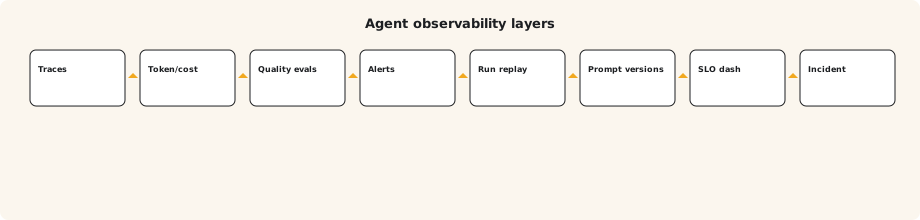
What We Deliver in an AI Agent Observability Engagement
Not just dashboards. A working operating system for AI reliability.
Many teams ask for observability when what they really need is decision visibility: what context the agent had, which tool call failed, which prompt version drifted, and why costs spiked on Tuesday but not Monday. We build for those concrete questions. We rely on standards such as OpenTelemetry and vendor-native AI instrumentation like Google Cloud AI agent observability, but we adapt the stack to your architecture and team habits.
Distributed Tracing
for Agent Runs
End-to-end traces connecting user input, planner steps, model calls, tool execution, retries, and final response. You can inspect one failed ticket and see exactly where quality collapsed instead of guessing from logs.
Quality Evaluation
Pipelines
Offline and online evaluation sets, regression alerts after prompt or model changes, and scorecards tied to business KPIs. We help product and engineering agree on what good means, then measure it continuously.
Cost and Latency
Analytics
Token consumption by route, tool, tenant, and model. Latency waterfalls by phase. We do not stop at reporting. We usually implement caching, routing, and retry policy changes in the same engagement.
Alerting and
Incident Workflows
Alerting thresholds that teams trust. We avoid generic alert floods by using SLOs per agent workflow and severity rules tied to user impact, not just technical noise.
Governance and
Audit Evidence
Retention policies, access controls, and immutable audit trails for regulated teams. This is where observability connects to compliance, especially for SOC 2 and HIPAA-focused companies.
Enablement for
Your Team
Runbooks, on-call playbooks, and practical training so your product team, SRE team, and platform team all read the same signals the same way.
Who This Service Is For
Three real buying scenarios we see every quarter.
Scenario 1: Product team scaled from one agent to six. What worked in the pilot now breaks weekly. They have one dashboard for API latency and zero visibility into planner behavior, tool retries, or quality degradation by model version. They need reliability fast and cannot pause roadmap delivery.
Scenario 2: CTO preparing for enterprise sales. Prospects ask for observability posture, incident history, and quality controls. Without evidence, deals stall. They do not need another consultant deck. They need telemetry and auditability implemented in production.
Scenario 3: Engineering manager facing cost drift. Token spend doubled in two months. The team knows something is off but cannot attribute the increase by workflow. We usually fix this by combining granular cost telemetry with routing and prompt policy updates. When the goal is to lower the bill, not only chart it, see our LLM cost optimization practice.
If your problem is broader than observability, we can support adjacent work through our AI testing practice and platform engineering team.
How We Implement Observability in 5 Steps
This process is opinionated because too many observability initiatives fail by trying to instrument everything at once.
1. Reliability and business baseline
We map your current agent flows and define a short set of baseline metrics: success rate, escalation rate, p95 latency, and cost per resolved interaction. This takes around one week and gives everyone the same starting point.
2. Trace schema and telemetry architecture
We design event schemas for user intent, model output, tool invocation, and guardrail outcome. This is the most important technical decision and where many teams get it wrong. Good schemas make future analysis cheap. When you need enforcement before bad outputs reach users, pair observability with our LLM guardrails development practice.
3. Instrumentation rollout
We instrument one high-impact workflow first, usually customer support automation or internal operations triage. Once signal quality is proven, we expand to the rest. We avoid large-bang launches because they usually generate noisy telemetry nobody trusts.
4. Evaluation and alerting
We add score-based quality checks and incident thresholds. We include response ownership: who gets paged, who triages, and what first response should look like. Without clear ownership, alerting quickly turns into decoration.
5. Handoff and optimization cadence
At handoff, your team gets runbooks, dashboards, and a monthly optimization ritual. We can stay embedded through dedicated team support or transfer fully to your in-house team.
Typical timeline: 4 to 6 weeks for one team, 8 to 12 weeks for a multi-team rollout with compliance constraints.
You cannot improve what your agents do not reveal.
Engagement Models and Pricing Ranges
Buyers usually compare us with freelancers, internal hiring, and large consulting firms. Here is the practical view.
Project Build
4 to 12 weeks
Best when you need a clear implementation with handoff. Most projects land between USD 45,000 and USD 140,000 based on workflow count, stack complexity, and governance requirements.
Dedicated Pod
ongoing
For teams scaling multiple agent products. A nearshore pod usually starts around USD 16,000 monthly and can include an observability engineer, platform engineer, and technical lead.
Staff Augmentation
flexible
Ideal if you already have architecture direction but need execution power. We embed senior engineers into your existing squad through our staff augmentation model.
Comparison buyers ask for
In-house only: strong long-term ownership, slower ramp, expensive hiring, and high risk of tooling fragmentation if AI expertise is thin.
Freelancers: useful for tactical setup, risky for long-running operations and incident accountability.
Large agencies: broad capacity, but often expensive and heavily process-driven for teams that need quick iteration.
Siblings Software nearshore model: balanced speed and continuity, direct engineer-to-engineer communication, and same-day collaboration from Argentina (UTC-3).
Mini Case Study: E-Commerce Support Agent Operations
A US retail platform with around 1.8 million monthly visits ran support agents for order status, refund triage, and catalog questions. They had model-level logs but no run-level traces. When failures happened, engineering could not explain root cause quickly enough, and customer support escalations grew.
We deployed an observability stack in eight weeks for two production workflows first, then expanded to five. The team was four engineers from Siblings Software and two internal platform engineers from the client side.
What we changed
We instrumented end-to-end traces for planner, retrieval, and tool calls. We added quality evals on answer relevance and policy compliance, then linked token cost reporting to specific interaction types. Finally, we implemented alert routing and an on-call runbook that support and engineering both used.
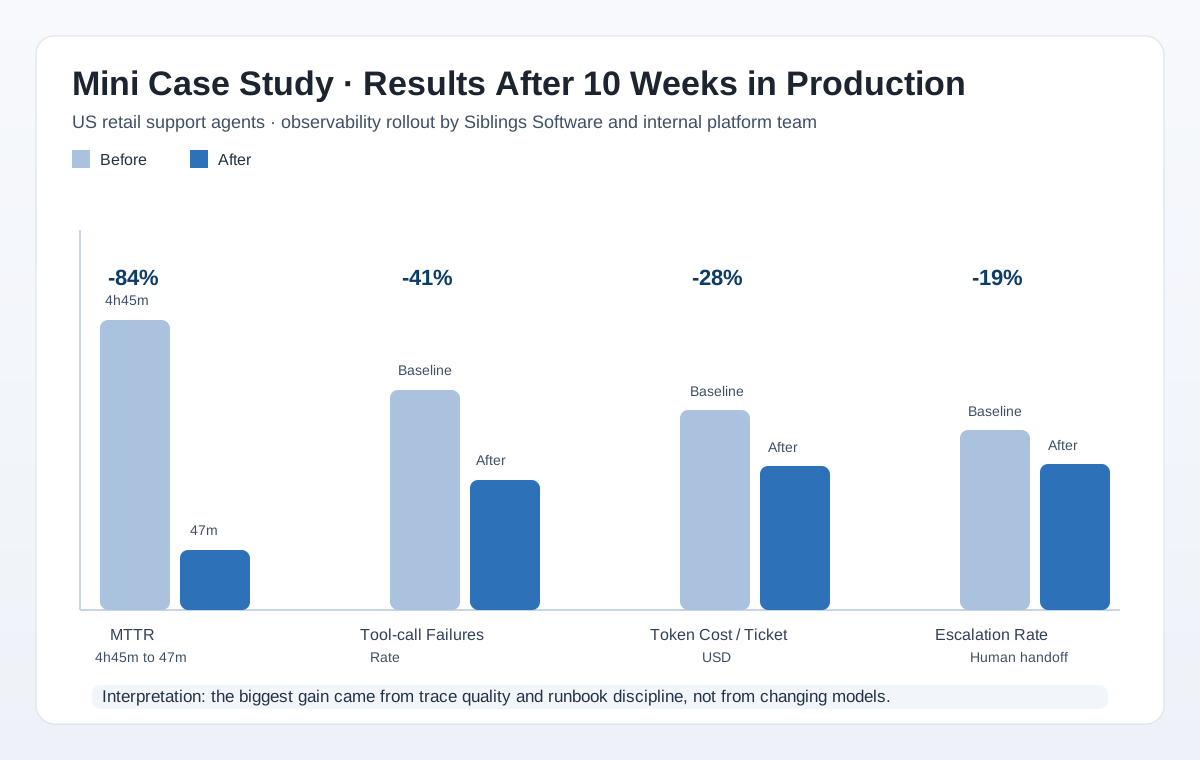
Results after 10 weeks in production
MTTR: from 4h45m to 47m.
Failed tool-call rate: down 41%.
Token cost per resolved ticket: down 28%.
Escalation to human agent: down 19% without quality loss.
No miracle claim here. The biggest gain came from disciplined instrumentation and weekly review rituals, not from switching to a trendy model.
Common Risks and How We Mitigate Them
Risk 1: telemetry overload. Teams capture everything and trust nothing. We mitigate with a minimal signal set first, then expand only when those signals drive decisions.
Risk 2: no product ownership. Observability sits in platform, product teams ignore it. We assign owners by workflow and tie quality metrics to business goals.
Risk 3: expensive monitoring bills. High-cardinality traces can explode costs. We apply sampling strategy, retention policy tiers, and lifecycle controls from day one.
Risk 4: compliance theater. Teams log data they should not keep. We define sensitive field policies and redact where needed before data leaves the runtime boundary.
Frequently Asked Questions
A practical implementation includes traces, evaluation pipelines, quality and cost dashboards, and operational runbooks. We include enablement so your team can run the system without depending on us for every change.
A single-team rollout can be done in 4 to 6 weeks. Multi-team or heavily regulated environments usually take 8 to 12 weeks.
In most cases, no. We integrate with your current stack and add AI-agent-specific telemetry and evaluation layers. Replacing tools is usually unnecessary and slows delivery.
Project-based engagements are commonly between USD 45,000 and USD 140,000. Dedicated pods start around USD 16,000 per month. Final pricing depends on workflows, scale, and governance scope.
Yes. We define retention, access, and audit evidence flows aligned with your controls and your auditor's expectations.
Related Services