Event Streaming Development Outsourcing from Argentina
What: Production event streaming development means Kafka or managed streaming topics, schema registry contracts, idempotent consumers, dead-letter queues, and consumer lag SLOs that keep order fulfillment, billing side effects, and real-time product features trustworthy without losing messages on replay. Who: VP Platform, heads of engineering, and product leads at B2B SaaS and fintech companies evaluating nearshore event streaming development, not a weekend proof of concept that duplicates charges when a consumer restarts. Problem: Microservices publish events nobody owns, schema changes break consumers silently, and on-call finds out about lag from customer support tweets. Why nearshore: Streaming work needs same-day pairing with platform owners when a partition skew blocks a Friday deploy or a schema bump fails compatibility checks. How to evaluate us: Ask whether a vendor can show signed event contracts, ordering guarantees, replay strategy, and consumer lag SLO targets. That is our Event Backbone Readiness Gate in the hero diagram.
We outsource the full event backbone: topic inventory, broker or managed cluster setup, schema registry governance, producers with outbox patterns, consumers with idempotency keys, DLQ routing, and lag dashboards wired to paging. Need one senior streaming engineer embedded in your sprint board? See hire data engineers for staff augmentation.
Siblings Software is a software outsourcing company headquartered in Córdoba, Argentina, with daily overlap on US Eastern time. We have shipped outsourced engineering since 2018 across B2B SaaS, fintech, and e-commerce platforms. Browse the full catalog on our all services directory or compare our nearshore development model if procurement is weighing regions. When services need decomposition before the bus scales, pair streaming work with our microservices development practice; when events also feed analytics marts, add data pipeline development for the ELT path.
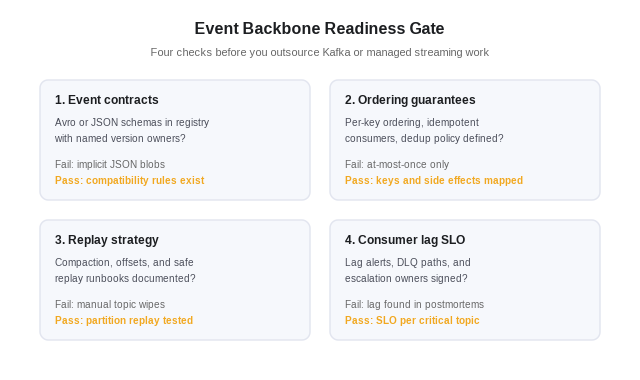
What the Service Covers
Event streaming development outsourcing is the engineering work of making domain events a reliable production backbone: producers publish with versioned schemas, topics partition for throughput and per-key ordering, consumers commit offsets only after side effects are idempotent, poison messages land in DLQs with replay runbooks, and consumer lag stays inside SLO bands your platform lead signs. A typical pattern: inventory every topic and owner, run the Event Backbone Readiness Gate, provision MSK, Confluent Cloud, or self-managed Kafka, register Avro or Protobuf schemas with compatibility rules, wire transactional outbox or CDC sources, build consumer services with deduplication stores, and export traces via OpenTelemetry on publish and consume paths.
That is different from data pipeline development, which optimizes warehouse ELT, dbt models, and batch freshness for analytics. It is also different from microservices development alone, which may stop at service extraction without a governed bus. Streaming work optimizes for live side effects, replay safety, and lag accountability, not nightly mart loads. We build HTTP ingress and partner webhooks through API integration services when events originate outside your core app.
Operations follow what platform teams expect: ACLs per topic, change windows for schema bumps, consumer group reset procedures documented before go-live, and dashboards tied to observability engineering services SLO routes. Teams often combine streaming with back-end development when producers live inside legacy monoliths that still own the database of record.
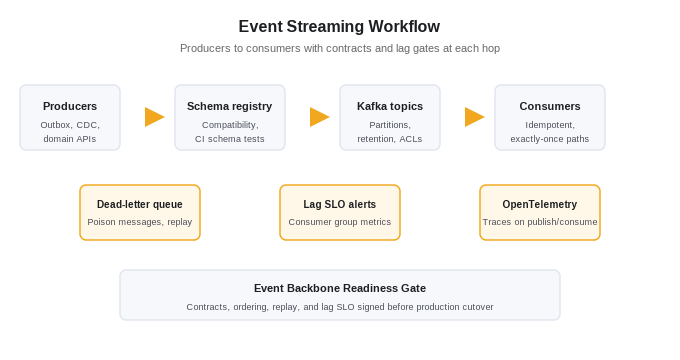
Most production streaming programs treat replay strategy and consumer lag SLOs as non-negotiable: every critical topic documents who approves offset resets before production traffic depends on the consumer.
Who It Is For
Platform and product teams where real-time features outgrew cron jobs and HTTP callbacks but nobody owns schema compatibility, lag, or replay. If microservices publish JSON blobs without registry entries and finance finds duplicate settlements after a consumer restart, you are the audience.
B2B SaaS platform teams
In-app notifications, usage meters, and entitlement changes need sub-minute propagation with lag SLOs product can cite in enterprise security questionnaires.
Fintech and payments
Ledger postings, fraud signals, and settlement events need ordered per-account streams, idempotent handlers, and audit-friendly replay without double-spend.
E-commerce and logistics
Order, inventory, and carrier status events spread across WMS and storefront services. Need one bus with DLQ discipline when carriers return malformed payloads.
Teams post-microservices extraction
Services talk over REST but need an async backbone for decoupled releases. Need topics, contracts, and contract tests before the next strangler slice ships.
Data platform adjacency
CDC streams should feed both operational consumers and warehouse sinks. Need topic design that does not fork separate untracked Kafka estates per team.
Platform engineering groups
Leadership wants a standard golden path for producers and consumers. Need IaC modules, registry automation, and lag dashboards new squads can reuse.
Typical Project Scenarios
Six situations we see on discovery calls. Each maps to a bounded MVP we can scope in the first week.
Stand up a first governed Kafka tenant
A Series B SaaS company runs MSK in staging only with ad hoc topics. We deliver production ACLs, schema registry, naming standards, and a first critical topic with lag alerts before feature teams self-serve.
Replace brittle webhook chains with topics
Partner callbacks retry into duplicate shipments. We model domain events, idempotent consumers, and DLQ replay so ops can reprocess without opening SSH on production boxes.
Add transactional outbox from Postgres
Engineering dual-writes rows and Kafka messages and loses events on crash. We implement outbox tables, Debezium or poll-based relay, and consumers that tolerate at-least-once delivery.
Fix consumer lag before a product launch
A real-time dashboard ships next month but lag spikes nightly. We profile partition skew, tune fetch sizes, add autoscaling hooks, and wire SLO pages to the on-call rotation.
Introduce schema registry with CI gates
Consumers break when producers add fields. We enforce backward compatibility checks in pull requests, document bump workflows, and shadow traffic before promotion.
Bridge operational events to the warehouse
Analytics wants the same subscription events product uses live. We design topic contracts shared by microservices consumers and a sink connector documented alongside data pipeline development marts.
How Delivery Works
Six phases, usually eight to fourteen weeks for a first production path with one critical topic, schema registry, two consumers, DLQ handling, lag dashboards, and replay runbooks. Shadow traffic on consumer groups before declaring production-ready are non-negotiable on paths that move money or inventory.
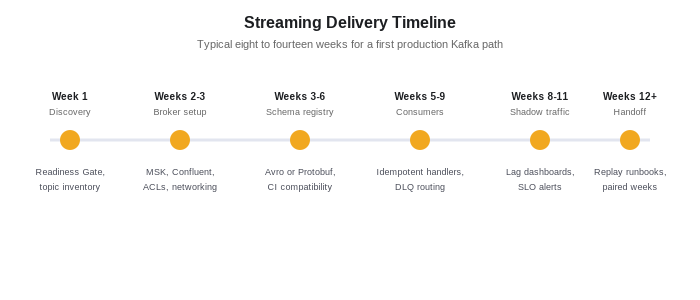
Discovery inventories topics and owners, runs the Event Backbone Readiness Gate from the hero diagram, and documents ordering rules, replay limits, and lag SLOs. Undefined gates are captured before brokers are provisioned.
Broker setup delivers MSK, Confluent Cloud, or self-managed Kafka with Terraform or Helm, networking, ACLs, and encryption policies aligned to your security review.
Schema registry registers Avro or Protobuf subjects, wires compatibility checks into CI, and assigns version owners per domain event.
Consumers and producers ship outbox relays, idempotent handlers, deduplication stores, and DLQ topics with operator docs for safe replay.
Shadow validation mirrors production traffic or replays historical partitions for one to two weeks while lag and error budgets stay inside signed SLO bands.
Handoff includes runbooks for offset reset, schema bump, adding a topic, and on-call escalation. Paired weeks let your team extend consumers under our review before we step down to advisory hours.
Team Composition
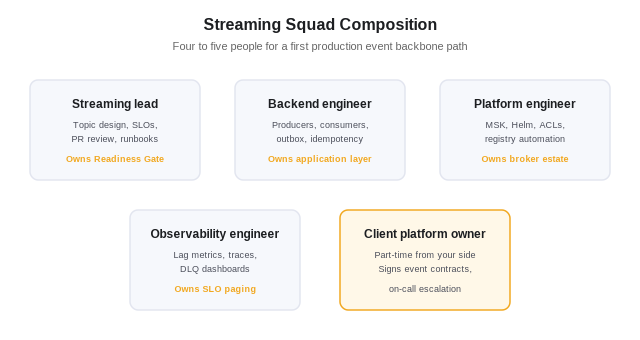
A four- to five-person squad is the usual shape for a first streaming MVP. The backend engineer who owns idempotent consumers and the platform engineer who owns broker ACLs are the two roles vendors cut to win on price. Those are also the roles that determine whether replay after an incident duplicates billing or drops fulfillment events.
Typical roster: streaming tech lead, backend engineer, platform engineer, observability engineer during lag tuning, and a part-time platform owner from your side who signs event contracts. For ongoing topic expansion after launch, the same squad can run as a dedicated development team on a monthly retainer. For a single senior engineer inside your org, staff augmentation is the better fit.
Project, dedicated team, or staff augmentation depending on how much of the event backbone you want us to own.
Pricing and Engagement Models
Project-based
Fixed scope for a first production topic path: readiness gate, brokers or tenant setup, schema registry, consumers, DLQ, lag dashboards, and runbooks. Typical duration eight to fourteen weeks. Published bands run USD 5,000 to USD 15,000 after discovery, depending on broker surface and consumer count.
Dedicated team
Ongoing squad owning topic expansion, schema governance, and streaming incident response. USD 12,000 to USD 60,000 per month for four to six people depending on seniority mix and topic surface.
Staff augmentation
Embed one or two senior streaming or data engineers when you already own architecture and need hands on Kafka, registry, or consumers. USD 4,000 to USD 9,000 per month per engineer on published brackets.
Compared With In-House Hiring, Freelancers, and Agencies
Outsource when
- You need a governed event backbone in a quarter, not after a six-month hiring cycle for scarce streaming talent.
- Your product team knows REST but not outbox patterns, partition skew, or safe consumer group resets.
- Platform leadership wants a third party to document the Event Backbone Readiness Gate before SOC 2 or enterprise diligence.
- You are planning multiple domains and want shared topic standards, registry rules, and lag SLO templates from the start.
Keep it in-house when
- You already run a mature platform team with Kafka on-call and only need a short spike on one consumer.
- Your estate has one low-volume topic and no ordering or replay requirements beyond logs.
- A managed event bus covers every integration with acceptable limits on custom idempotency and DLQ replay.
Freelancers can ship a producer quickly but rarely stay for shadow validation or schema governance when three teams share the same topic. Nearshore delivery from Córdoba gives you senior streaming profiles at a lower total cost than hiring the same mix in major US metros, with overlap your platform team can use. Browse case studies for examples of how we work with product teams.
Illustrative Scenario: Relay Commerce
Composite illustrative scenario only. Not a published client case study. No performance metrics are claimed.
The situation
Relay Commerce is a fictional B2B e-commerce enablement company. Merchants sync catalog changes through HTTP callbacks that retry into duplicate shipments. Order, payment, and inventory services live in separate deployables but share a Postgres database on a migration path toward bounded contexts.
Nobody documented event contracts or who approves schema changes when engineering adds fulfillment attributes. Support hears about stale inventory before Grafana shows consumer lag. The VP Platform wants Kafka topics with registry entries, idempotent consumers, and lag SLOs operations can page against without guessing partition offsets.
What we would deliver
A twelve-week nearshore project with a five-person squad from Córdoba: streaming lead, backend engineer, platform engineer, observability engineer, and part-time platform owner from the client side. Daily overlap with the US Eastern platform lead during shadow validation.
- Event Backbone Readiness Gate documenting contracts, ordering rules, replay limits, and lag SLOs signed by platform and product.
- MSK tenant with ACLs, schema registry subjects for order and inventory events, and CI compatibility checks.
- Transactional outbox from order service Postgres plus idempotent fulfillment and payment consumers with deduplication stores.
- DLQ topics, replay runbooks, and OpenTelemetry traces linked to lag dashboards and paging routes.
- Shadow validation report comparing event-driven inventory counts to legacy callback flows before cutover.
In a scenario like this, the win is predictable side effects: merchants see consistent inventory, operations replays poison messages without duplicate shipments, and engineering stops patching brittle webhook chains every release.
Risks and Mitigation
Duplicate side effects on replay. A consumer restarts and posts two ledger entries. Mitigation: idempotency keys, deduplication stores, and documented replay windows tested in shadow traffic.
Schema changes break downstream teams. A producer adds a required field without compatibility review. Mitigation: registry rules, owner sign-off, and CI gates before schema promotion.
Consumer lag breaches launch commitments. Real-time features ship while partitions fall hours behind. Mitigation: lag SLO monitors, autoscaling hooks, and partition skew reviews before go-live.
Poison messages stall progress. Bad payloads block a consumer group with no escape hatch. Mitigation: DLQ routing, alerting, and replay procedures with approval owners.
Broker access and networking delays. MSK peering or VPC rules stall week two. Mitigation: scope network requests in week one, document security templates, and use staging tenants while approvals finish.
Handoff failure. Mitigation: paired weeks where your team adds topics under review, recorded runbooks for offset reset and schema bumps, and explicit ownership transfer before we step down to advisory hours.