API Integration Services Outsourcing from Argentina
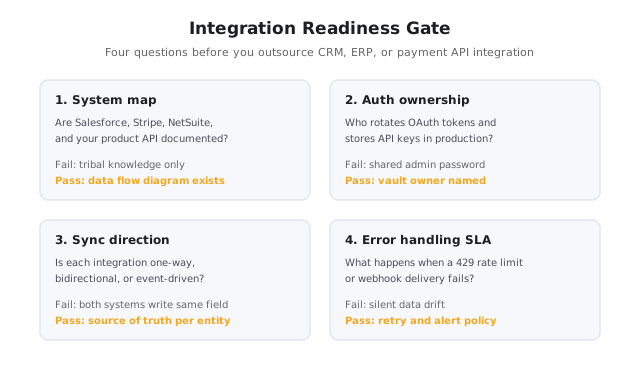
What: Production API integration services connect your product to Salesforce, Stripe, ERPs, payment gateways, and partner systems through middleware, webhooks, OAuth flows, retry logic, and monitoring that keeps billing and CRM state aligned without brittle point-to-point scripts. Who: VP Engineering, platform leads, and integration owners at B2B SaaS companies evaluating nearshore API integration services, not a weekend script that breaks when a vendor changes a field. Problem: Customer records disagree between CRM and product, webhooks double-fire charges, and every new vendor means another undocumented cron job. Why nearshore: Integration delivery needs same-day pairing with platform owners when OAuth token refresh fails before a demo or a webhook backlog blocks checkout. How to evaluate us: Ask whether a vendor can show a system inventory, auth model map, idempotency pattern, and error-handling runbook. That is our Integration Readiness Gate in the hero diagram.
We outsource the full integration layer: discovery, middleware build, OAuth 2.0 flows, Stripe and Salesforce connectors, webhook receivers, dead-letter queues, and alerting. Need a single senior back-end engineer embedded in your sprint board? See hire back-end developers for staff augmentation.
Siblings Software is a software outsourcing company headquartered in Córdoba, Argentina, with daily overlap on US Eastern time. We have shipped outsourced engineering since 2014 across B2B SaaS, fintech, and e-commerce platforms. Browse the full catalog on our all services directory or compare our nearshore development model if procurement is weighing regions. This service is distinct from API development, which builds your own public APIs, and from data pipeline development, which moves analytics data into warehouses.
What the Service Covers
API integration services outsourcing is the engineering work of connecting your product to third-party and internal systems so customer, billing, and operational data stay consistent without manual CSV uploads or one-off scripts. A typical pattern: inventory every system and owner, document auth models and rate limits per vendor, build middleware that normalizes payloads, implement webhook receivers with signature verification, apply idempotent writes with retry and dead-letter handling, and wire dashboards that alert when queues backlog or token refresh fails.
That is different from building your own REST API surface, which our API development practice covers. It is also different from analytics ELT, which our data pipeline development team handles when events need warehouse marts. Integration work optimizes for transactional correctness, OAuth lifecycle, and vendor schema evolution, not batch reporting. We pair with back-end development when your core app needs new domain services to consume integration events.
Security and reliability follow OWASP API Security guidance: scoped credentials, input validation on webhook payloads, structured logging without secret leakage, and circuit breakers when vendors throttle. E-commerce teams often combine integration work with our e-commerce development practice when checkout, inventory, and carrier APIs must stay in sync. Ops teams route failed sync jobs to internal tools development when they need admin panels to replay messages or inspect connector state.
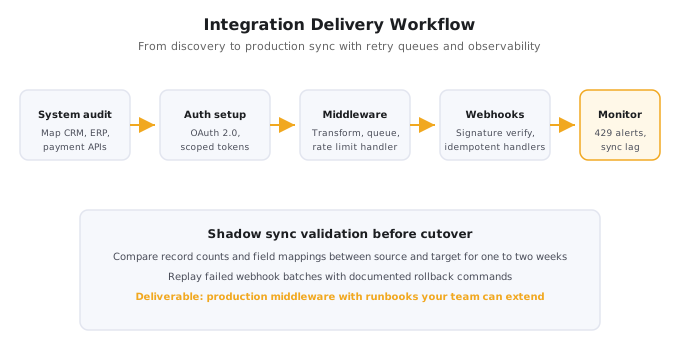
Most production integration programs treat idempotent writes and documented auth models as non-negotiable: every connector records who approves schema changes before production traffic routes through middleware.
Who It Is For
Product and platform teams where CRM, billing, and product databases disagree but engineering is focused on the customer app. If Salesforce account IDs do not match your user table and nobody owns webhook retry policy, you are the audience.
B2B SaaS platform teams
Subscription billing, CRM sync, and partner APIs need middleware with known retry behavior so customer success and finance trust the same account status.
Fintech and payments teams
Payment gateways, KYC vendors, and core ledger systems need webhook verification, idempotent settlement, and audit-friendly event logs, not ad hoc polling scripts.
E-commerce and retail ops
Orders, inventory, and fulfillment data spread across Shopify, ERP, and carrier APIs. Need unified sync with replay when a carrier webhook arrives out of order.
Integration and platform engineering
Microservices emit events but nobody owns the middleware layer between vendors and your domain model. Need OAuth token stores, rate-limit handling, and on-call runbooks.
Enterprise sales and RevOps
Deal desk, provisioning, and billing handoffs trapped between Salesforce, Stripe, and internal admin tools. Need one integration map with documented ownership.
Teams automating workflows with AI
LLM agents trigger actions in CRM and ticketing systems. Pair connector work with AI workflow automation when bots need guarded API access and human approval gates.
Typical Project Scenarios
Six situations we see on discovery calls. Each maps to a bounded MVP we can scope in the first week.
Replace brittle cron jobs syncing Salesforce accounts
RevOps runs nightly scripts that miss updates and duplicate contacts. We build middleware with OAuth token refresh, incremental sync with cursor pagination, idempotent upserts, and alerts when CRM schema changes break field mappings.
Wire Stripe billing webhooks to product entitlements
Checkout succeeds but feature flags lag because webhook handlers are not idempotent. We implement signed webhook receivers, dead-letter queues, retry with backoff, and reconciliation jobs that compare Stripe subscription state to your database.
Connect ERP inventory to e-commerce storefront
SKU counts disagree between NetSuite and Shopify during peak season. We deliver bidirectional sync with conflict rules, rate-limit aware polling, and admin replay tools through our e-commerce development coordination.
Stand up middleware for a new partner API program
A Series B SaaS company launches a partner marketplace but has no shared auth or payload normalization layer. We deliver OAuth client credentials flows, API gateway rules, sandbox-to-production promotion checklists, and vendor onboarding documentation.
Migrate off point-to-point integrations to an event bus
Every new vendor adds another direct database write. We introduce a message bus, schema registry for integration events, and consumers that your back-end development team can extend without touching vendor SDKs.
Feed operational data to analytics without forking pollers
Product wants CRM events in the app database and analytics wants the same events in Snowflake. We design integration events once and coordinate with data pipeline development so warehouse ingestion does not duplicate middleware.
How Delivery Works
Six phases, usually six to ten weeks for a first production integration program with one to four system connections, middleware layer, webhook handlers, monitoring, and handoff runbooks. Shadow validation against staging traffic before declaring production-ready are non-negotiable on integrations that touch billing and CRM.
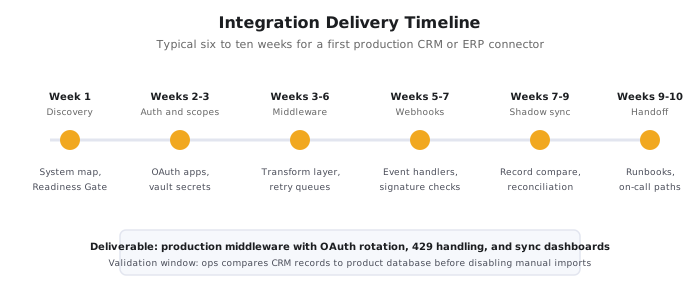
Discovery inventories systems, runs the Integration Readiness Gate from the hero diagram, and documents auth models, idempotency keys, rate limits, and error-handling expectations. If any gate is undefined, we capture it before writing connectors.
Middleware build delivers normalized services between vendors and your domain model: OAuth token stores, payload mappers, and API clients with circuit breakers. Credential and sandbox requests go to security in week one.
Webhook and event setup implements signed receivers, async workers, retry policies with jitter, and dead-letter queues. We document replay procedures before production cutover.
Sandbox validation exercises happy paths, rate-limit responses, and token expiry against vendor sandboxes. Platform engineering reviews security headers and logging redaction.
Shadow traffic mirrors a subset of production events to staging middleware for one to two weeks. Product and finance flag mismatches before traffic routes through the new layer.
Handoff includes runbooks for token rotation, dead-letter replay, onboarding a new vendor, and on-call escalation paths. Paired weeks let your team extend connectors under our review before we step down to advisory hours.
Team Composition
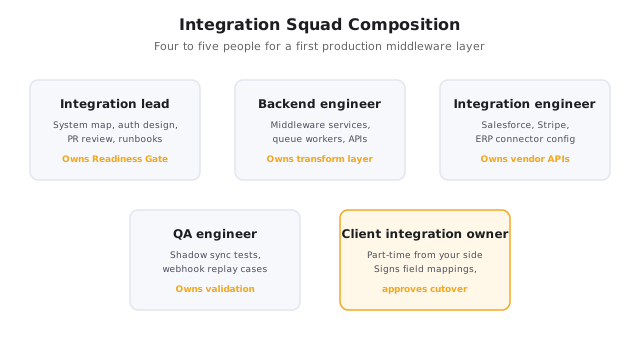
A four- to five-person squad is the usual shape for a first integration MVP. The integration lead who owns idempotency and auth lifecycle and the back-end engineer who owns middleware services are the two roles vendors cut to win on price. Those are also the roles that determine whether billing still matches CRM after the next vendor API version change.
Typical roster: integration lead, back-end engineer, platform liaison during discovery, QA engineer for webhook and retry test suites, and a part-time integration owner from your side who signs the system inventory. For ongoing vendor onboarding after launch, the same squad can run as a dedicated development team on a monthly retainer. For a single senior back-end engineer inside your org, staff augmentation is the better fit.
Project, dedicated team, or staff augmentation depending on how much of the integration layer you want us to own.
Pricing and Engagement Models
Project-based
Fixed scope for a bounded integration program: system inventory, middleware, one to four vendor connectors, webhook handlers, monitoring, and runbooks. Typical duration six to ten weeks. Published bands run USD 20,000 to USD 120,000 after discovery, depending on system count and auth complexity.
Dedicated team
Ongoing squad owning new vendor onboarding, connector maintenance, and integration incident response. USD 12,000 to USD 52,000 per month for four to six people depending on seniority mix and vendor surface area.
Staff augmentation
Embed one or two senior back-end engineers when you already own architecture and need hands on middleware, OAuth, or webhook handlers. USD 5,500 to USD 10,500 per month per senior engineer on published brackets.
Compared With In-House Hiring, Freelancers, and Agencies
Outsource when
- You need production middleware and vendor connectors in a quarter, not after a six-month hiring cycle for scarce integration talent.
- Your product team knows the app database but not OAuth refresh patterns, webhook idempotency, or vendor rate-limit handling.
- Platform leaders want a third party to document the Integration Readiness Gate before SOC 2 or enterprise diligence.
- You are onboarding multiple vendors and want shared middleware libraries and retry patterns from the start.
Keep it in-house when
- You already run a mature integration platform team and only need a short spike on one new OAuth provider.
- Your product connects to two stable internal services with no webhook or billing correctness requirements.
- An iPaaS catalog covers every vendor with acceptable limits on custom transforms and error replay.
Freelancers can wire endpoints quickly but rarely stay for shadow validation or schema evolution when Salesforce changes object shapes during launch month. Nearshore delivery from Córdoba gives you senior integration profiles at a lower total cost than hiring the same mix in major US metros, with overlap your platform team can use. Browse case studies for examples of how we work with product teams.
Illustrative Scenario: Northline Connect
Composite illustrative scenario only. Not a published client case study. No performance metrics are claimed.
The situation
Northline Connect is a fictional B2B SaaS company selling workflow automation to mid-market logistics firms. Customer accounts live in the product database, sales maintains Salesforce separately, and billing runs on Stripe. The VP Engineering inherited three cron scripts that sync contacts nightly and a webhook handler that occasionally double-applies subscription upgrades.
Customer success sees account tiers in the app that do not match Salesforce opportunity stages. Nobody documented OAuth scopes, idempotency keys, or who approves field mapping changes when product ships a new plan type. The platform lead wants middleware with Stripe webhook verification, Salesforce incremental sync, and replay tools finance can audit without opening tickets.
What we would deliver
An eight-week nearshore project with a five-person squad from Córdoba: integration lead, back-end engineer, platform liaison, QA engineer, and part-time integration owner from the client side. Daily overlap with the US Eastern platform lead during discovery and shadow validation.
- Integration Readiness Gate documenting system inventory, auth models, idempotency patterns, and error-handling runbooks signed by platform and finance.
- Middleware services with OAuth token refresh for Salesforce, signed Stripe webhook receivers, and idempotent subscription state writes to the product database.
- Dead-letter queues, retry policies with exponential backoff, and dashboards alerting when webhook backlog or token refresh fails.
- Shadow validation report comparing middleware output to legacy cron scripts before production cutover.
- Handoff runbooks for token rotation, dead-letter replay, and onboarding a fourth vendor API without forking point-to-point code.
In a scenario like this, the win is operational trust: customer success and finance read the same account tier, and engineering stops firefighting webhook retries every release week.
Risks and Mitigation
Silent schema drift breaks field mappings. A vendor adds columns or deprecates fields and downstream sync jobs shift without notice. Mitigation: schema contracts, owner sign-off on mapping changes, and integration tests that block deployment when contracts break.
Duplicate or missing writes after webhook retries. Vendor retries double-charge subscriptions or drop refund events. Mitigation: idempotency keys, deduplication in middleware, and reconciliation jobs that compare vendor totals to your database daily.
OAuth token expiry during peak traffic. Refresh failures block CRM sync before a sales demo. Mitigation: proactive token rotation alerts, redundant refresh workers, and runbooks that platform on-call can execute without vendor support tickets.
Rate-limit storms from aggressive polling. Connectors hammer vendor APIs and get throttled across all tenants. Mitigation: centralized rate-limit budgets, circuit breakers, and backoff policies shared across middleware services.
Credential and sandbox access delays. Connector work stalls waiting for OAuth app approval or production scopes. Mitigation: scope requests in week one, read-only sandbox paths while write scopes are pending, and security documentation templates.
Handoff failure. Mitigation: paired weeks where your team extends middleware under review, recorded runbooks for replay and rotation, and explicit ownership transfer before we step down to advisory hours.
Questions buyers ask before the first discovery call
Frequently Asked Questions
A freelancer can wire two REST endpoints in a weekend, but production API integration needs a system inventory, documented auth models, idempotent writes, webhook verification, retry policies with dead-letter queues, and monitoring that survives the next vendor API version bump. Outsourced API integration services deliver middleware, OAuth flows, ERP and CRM connectors, event bridges, and runbooks your platform team can extend. The difference shows up at month three when Salesforce changes an object shape or Stripe retries a webhook and your billing state does not double-charge.
We connect SaaS platforms, payment gateways, CRMs, ERPs, and internal services: Salesforce REST and Bulk APIs, Stripe webhooks and billing objects, NetSuite and SAP connectors, Shopify and carrier APIs, custom Postgres and message queues, and middleware layers in Node.js, Python, or .NET. Patterns include OAuth 2.0 authorization code flows, signed webhook receivers, polling with cursor pagination, saga-style compensating transactions, and event-driven bridges to your product database. When analytics needs the same events, we coordinate with our data pipeline development practice so ingestion does not fork a separate poller.
OAuth flows follow RFC 6749 with secure token storage, refresh rotation, and scoped credentials per environment. Webhook endpoints verify signatures, enforce idempotency keys, and respond quickly while heavy work runs asynchronously. Retries use exponential backoff with jitter, circuit breakers on vendor rate limits, and dead-letter queues for manual replay. We align error handling with OWASP API Security guidance on authentication, input validation, and logging without leaking secrets.
A first production integration program with one to four system connections, middleware layer, webhook handlers, retry and monitoring setup, and handoff runbooks typically ships in six to ten weeks. That includes discovery with the Integration Readiness Gate, sandbox validation, shadow traffic against staging, and paired handoff weeks. Timelines stretch when vendor sandbox access is slow, OAuth app review is pending, or compliance blocks production credentials.
Project-based builds for a bounded integration scope typically land between USD 20,000 and USD 120,000 depending on system count, auth complexity, and compliance requirements. Dedicated squads run USD 12,000 to USD 52,000 per month for ongoing connector maintenance and new vendor onboarding. Senior staff augmentation for back-end engineers ranges from USD 5,500 to USD 10,500 per month per engineer on published brackets via hire back-end developers. We confirm pricing after discovery once we know your system inventory and idempotency requirements.
You do. Middleware services, connector modules, infrastructure-as-code, webhook handlers, retry configuration, and operator runbooks ship to your repositories under your IP. We document how to rotate OAuth tokens, replay a dead-letter message, and onboard a new vendor endpoint without paging us. Managed on-call for integration incidents is optional, not a requirement to keep product shipping.
Yes. Delivery teams are based in Córdoba, Argentina, with daily overlap on US Eastern business hours. API integration projects need same-day iteration with platform leads and product owners when a webhook storm blocks checkout or a CRM schema change lands in staging, so timezone alignment matters as much as it does for customer-facing product work.
Related Services