QA automation engineers who quiet your nightly build—not add brittle UI scripts
· Typical time to first merged test improvement: 10–12 business days
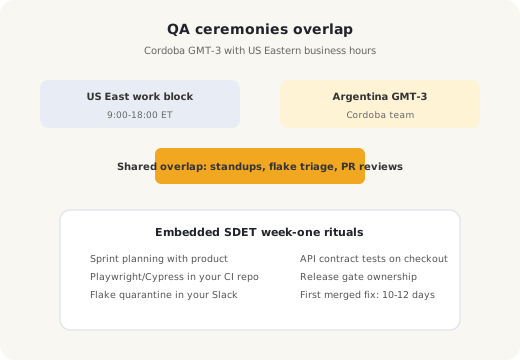
If you are comparing hire QA automation engineers options, you probably need three answers on one screen: who owns the failing nightly build, what it costs per month in plain numbers, and how you avoid the contractor who writes four hundred brittle UI tests and disappears before the flake rate becomes your problem. This page answers those directly. We staff SDETs from Córdoba, Argentina with full-time engineers who overlap US Eastern business hours and join your ceremonies from sprint planning through release.
QA automation in 2026 is not a separate phase at the end of a sprint. Product teams run Playwright or Cypress in GitHub Actions or Azure DevOps, gate merges on API contract tests, and still carry manual regression when compliance workflows resist automation. We match that reality instead of sending a manual tester who lists Selenium on a resume. For broader engineering capacity, see multi-role staff augmentation; for timezone context, read nearshore developer hiring; when pipelines need hardening alongside tests, explore embedded DevOps engineers.
If you need Siblings to own the full Playwright suite, CI gates, and release evidence rather than individuals in your standups, compare QA automation services. For agentic test generation or ML evaluation pipelines, see AI-powered software testing from the same leadership team.
"The expensive QA hire is not the one who writes slow tests. It is the one who teaches the team to ignore red builds."
Prefer numbers before a call? Jump to monthly pricing bands for solo SDETs, pairs, and small pods.
What QA automation engineers do in your squad
Embedded quality work, not a ticket queue at the end of the sprint.
A strong SDET on staff augmentation joins planning, writes acceptance criteria with the product owner, and ships tests in the same pull requests as feature code when your team allows it. Day to day that means framework ownership, API coverage on money-moving seams, and flake triage with a named owner—not a mute button on red builds.
Framework and CI ownership
Page-object boundaries, test data factories, parallel sharding, and merge gates that fail for real regressions instead of environmental noise. Your pipeline config stays in your repo.
API and contract coverage
Postman collections, Pact or schema-validated HTTP tests, and queue consumers exercised before UI suites run. Critical for checkout, billing, and permissions seams.
Flake triage and release hygiene
Quarantining unstable specs, fixing root causes, and publishing a short flake budget report each sprint. Red builds get an owner within hours, not a re-run loop until green.
This role differs from a generic software developer because judgment matters as much as syntax. The same engineer who can write a Playwright spec must know when a unit test or API test is the cheaper seam. It also differs from a manual QA analyst who files bugs after the fact. Embedded SDETs shift testing left without turning every story into a three-day automation side quest.
When companies hire QA automation engineers
Five situations cover most discovery calls. Yours may combine two.
Velocity outran coverage
Series A or B SaaS teams that doubled headcount in a year often have happy product metrics and a regression suite that still reflects the MVP. Releases depend on a manual spreadsheet and a nervous engineering manager.
The suite became the bottleneck
Forty-minute PR checks, double-digit flake rates, and developers who re-run jobs until green. The fix is not more tests. It is ownership, parallelization, and deleting specs that stopped earning their CI minutes.
Compliance or audit pressure
SOC 2, HIPAA, or PCI programs that ask for traceable test evidence on access control and money-moving flows. Manual checklists do not scale across weekly releases.
Platform migration with a calendar
Shopify replatforms, Angular upgrades, or monolith extractions where parity tests are the rollback plan. You need someone who can write characterization tests before the first cutover weekend.
Internal QA lead without hands-on bandwidth
A director of quality who owns strategy but cannot also rescue a Cypress repo while running hiring loops. Staff augmentation adds execution capacity without reorganizing the department chart.
The Release Confidence Test
Before we recommend a hire shape, we run three questions we call the Release Confidence Test. If two or more answers are negative, you need framework rescue or leadership, not another script writer.
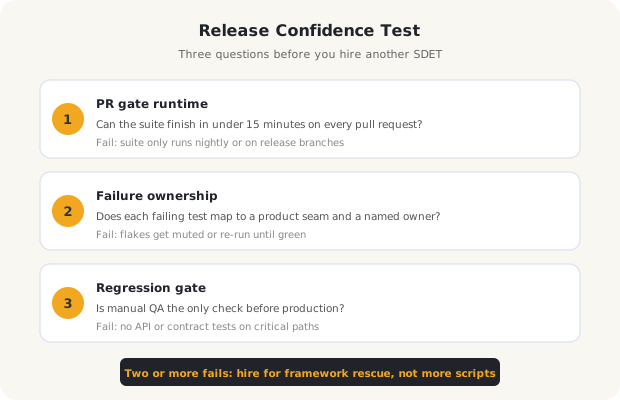
We use the same test in vetting. Candidates who only describe happy-path UI tours rarely survive the live exercise where we ask them to stabilize a race-prone spec and delete two redundant cases.
How Siblings vets QA automation candidates
Resume keywords are cheap. We screen for signals that predict whether your nightly build gets quieter in month one.
- Framework judgment: Can they explain when to delete a UI test and replace it with an API check? Engineers who only add layers rarely fix flake rates.
- CI fluency: GitHub Actions, GitLab CI, Azure DevOps, or CircleCI with caching, sharding, and artifact uploads. We ask how they would cut a forty-minute suite in half without dropping coverage on checkout.
- Selector discipline: data-testid contracts, role-based queries in Playwright, and refusal to chain brittle CSS paths copied from DevTools.
- Communication: Clear bug reports with reproduction steps, environment notes, and severity that product can act on. QA that speaks only in test-case IDs frustrates engineering managers.
- Red flags: Suites with zero API tests on a service-heavy product, "100% coverage" claims without defining what is excluded, or inability to read a stack trace from a failed CI job.
Roughly three in ten applicants pass all gates. Senior profiles with mobile automation (Appium) or performance tooling (k6) take a few extra days to source because the qualified pool is thinner.
Engagement models and pricing context
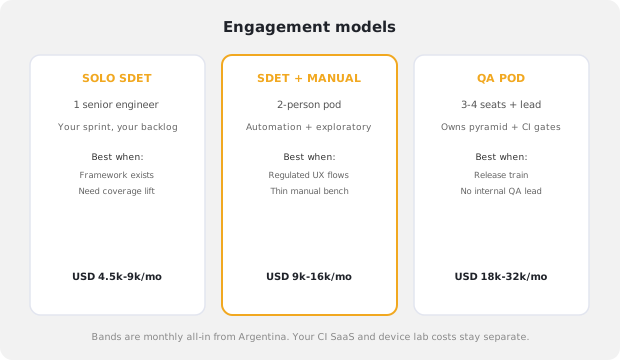
Staff augmentation pricing depends on seniority, compliance scope, on-call expectations for production verification, and whether the engineer owns mobile or performance layers. These bands reflect nearshore delivery from Argentina on full-time monthly engagements:
Single senior SDET
Best when you have a QA lead who can prioritize the backlog. One engineer, your ceremonies, your Definition of Done.
Typical band: USD 4,500–9,000/month.
Automation plus manual pair
Regulated enrollment, benefits, or healthcare flows that still need exploratory passes alongside CI gates.
Typical band: USD 9,000–16,000/month.
QA pod with fractional lead
When you need pyramid ownership across web, API, and mobile without hiring a full internal department. Compare with dedicated agile squads that include QA seats by default.
Typical band: USD 18,000–32,000/month.
Figures align with our published staff augmentation brackets with a modest premium when SDETs also write production helper code or own performance gates. Your CI minutes, BrowserStack or Sauce Labs spend, and device hardware stay on your accounts.
Compared to freelancers, in-house hiring, and QA agencies
vs. freelance marketplaces
Marketplaces optimize for profile volume. We trade speed of listing for engineers who already fixed a flaky suite in a live exercise and can join your Slack with a fifteen-day notice window after the minimum term.
vs. in-house FTE
Full-time hires make sense when QA leadership and career paths are mature. Augmentation fits headcount freezes, six-month bridge roles while recruiting closes, or specialty spikes before audit season.
vs. outsourced QA agencies
Agencies that run tests in a separate toolchain create a second backlog. Embedded SDETs work in your repositories, your CI, and your definition of done. If you want Siblings to own delivery end to end, that is a different conversation on our AI testing or dedicated team pages.
Mini case study
Benefits administration SaaS: PR suite from 38 minutes to nine
Composite scenario based on a US mid-market benefits platform engagement. Numbers are representative, not a published client case study.
Context. Frostline Benefits (composite) sells enrollment and COBRA administration software to regional employers. Their Angular SPA and .NET API shipped weekly, but a 1,200-case Cypress suite took thirty-eight minutes on pull requests and failed on environment flakes roughly eleven percent of the time. Manual regression before open enrollment still consumed three tester-days per release.
What we did. Siblings placed one senior SDET and one mid-level QA automation engineer through staff augmentation in eleven business days. Over ten sprints they parallelized the suite, moved eligibility rules to API contract tests, introduced stable data-testid contracts with the frontend team, and added a quarantine policy for flaky specs.
Outcome. Illustrative results: PR suite runtime thirty-eight minutes to nine minutes, flake rate eleven percent to two point one percent, manual regression window three days to same-day for standard releases, escaped defects per sprint seven to two as reported by their engineering manager.
For a published reference with a named client and QA automation on the squad, see the Viking Services payment operations case study (Angular dashboard with Cypress automation in a five-person dedicated squad).
At a glance
Stack: Cypress, Angular, .NET API
PR runtime: 38 min → 9 min
Flake rate: 11% → 2.1%
What changed for QA teams in 2025–2026
Playwright 1.4x trace and UI mode improvements made flake diagnosis faster for teams willing to store artifacts in CI. If candidates have never opened a trace file, they will struggle on the first intermittent failure your squad files.
Component testing in Cypress and Playwright component modes reduced the need for full end-to-end passes on design-system changes, but only when frontend teams expose stable mount contracts.
AI-assisted coding increased PR volume on many squads. QA automation engineers now spend more time on diff-aware test selection and contract tests on generated code paths. We screen for judgment about what not to automate when AI output changes daily.
Security-minded buyers also ask about test data handling. We follow OWASP testing guidance for auth and session seams when scope includes security regression, without claiming certifications Siblings does not hold.
Risks and how we reduce them
- Integration risk: Week one includes pairing with a developer on a real story so test ownership is visible, not a separate Jira board nobody reads.
- Code quality risk: We require page-object or fixture patterns checked in CI, not copy-pasted specs in a personal folder.
- Communication risk: GMT-3 overlap with Eastern through Pacific is real time in Slack. EU-hours coverage is staffed explicitly when you ask in the brief.
- Continuity risk: Runbooks for test data, environment URLs, and quarantined specs live in your wiki or repo, not a vendor portal.
- Repository access risk: Least-privilege accounts, NDAs before clone access, and no production credentials in test fixtures without your security sign-off.
Why Siblings for QA automation staff augmentation
Small bench, direct access, engineers who have shipped under audit pressure.
30+
Engineers in-house
Córdoba-based team; fintech, health, collaboration, logistics clients
Dozens
QA-shaped placements
Playwright, Cypress, API contracts, regulated release trains
GMT-3
Argentina overlap
Same-day with US East; workable with most US zones
We are deliberately not a fifty-person recruiting shop. Founders still review new QA engagements, and engineers talk to clients without a telephone game of account managers. That is why the process above stays short.
Reviewed by Javier Uanini, Founder & CEO, Siblings Software — technical discovery on QA automation engagements, pricing bands, and fit decisions. Last reviewed 16 June 2026.
Frequently Asked Questions
Senior and mid-senior SDETs employed full-time by Siblings and embedded in your squad. They join sprint planning, maintain suites in your repositories, tune CI gates, and triage flakes in your chat tools. We cover recruiting, payroll, hardware, benefits, and Argentine employer obligations. You keep product priorities and intellectual property.
A senior SDET is usually USD 4,500 to 9,000 per month all-in for nearshore talent from Argentina. Pairs and pods scale from there. Quotes are monthly with clear notice windows, not surprise bench fees. Your CI SaaS and device lab costs stay separate.
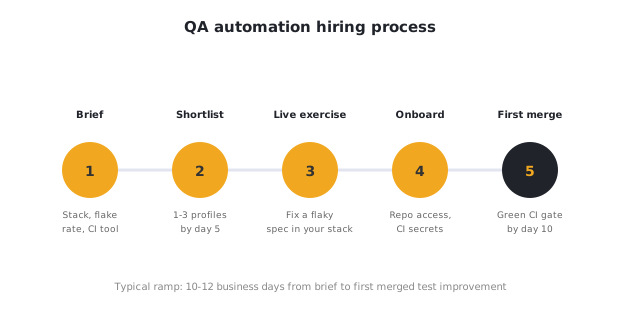
Most engagements reach a first merged improvement in roughly 10 to 12 business days: shortlist by day five, live exercise before day eight, onboarding by day ten. Regulated clients with device certificates may add a few days for paperwork.
We staff all three and match on your stack. Playwright is the default for new web suites. Cypress remains common on React products. Selenium appears in Java and .NET estates. We will not send a profile whose last hands-on work does not match your brief.
Choose a solo SDET when you have internal QA leadership and a working framework. Choose a pair when regulated UX needs exploratory coverage. Choose a pod when you lack a QA lead, run parallel release trains, or need full pyramid ownership.
This page covers individuals embedded in your rituals. AI testing outsourcing is for agentic generation, evaluation datasets, and ML-heavy quality systems owned by Siblings. Many teams start with one SDET here, then explore AI testing when the baseline suite is stable.
Raise it early. We replace the engineer at no additional placement fee on standard agreements and run overlap so your sprint does not stall. Either side may exit with fifteen days notice after the minimum term.
OUR STANDARDS
What "done" means when you hire QA automation engineers through Siblings.
- CI is a product surface: Red builds get an owner and a fix window. Muted tests require a ticket with an expiry date.
- Coverage is prioritized: Checkout, permissions, and billing paths before tertiary settings screens.
- Tests are maintained: Deleting obsolete specs is as important as writing new ones.
- Honest release advice: If the suite is not ready, we say so before the deploy button, not after customer support lights up.
Contact Siblings Software Argentina
Tell us about your flake rate, CI tool, and release cadence. We will shortlist accordingly.