AI Testing Services for Product and SaaS Teams
AI testing services from Siblings Software help engineering leaders close the gap between release speed and quality confidence. We are a software outsourcing company based in Córdoba, Argentina, and we deliver hybrid QA programs: stable automation in your CI, AI-assisted test design where it saves maintenance time, and human judgment on the paths that actually matter to revenue and compliance.
Most buyers landing here already have Playwright or Cypress suites, a growing backlog of flaky tests, or new LLM features shipping without a repeatable evaluation process. The problem is rarely "no tests." It is slow feedback, brittle selectors, and QA capacity that does not scale with weekly releases. This page explains what our AI testing service covers, who it fits, how we deliver, typical team shapes, pricing drivers, risks, and how we compare with in-house hiring or a generalist agency.
Need a managed Playwright or Cypress program with CI gates and flake stabilization instead of individual SDETs? See QA automation services. Need individual SDETs in your standups instead of a managed program? Compare hire QA automation developers. For verification layers around AI coding agents in the repo, see harness engineering. Model and feature work pairs with our AI development practice and LLM evaluation engineering when prompts and outputs need structured scoring, not only UI regression.
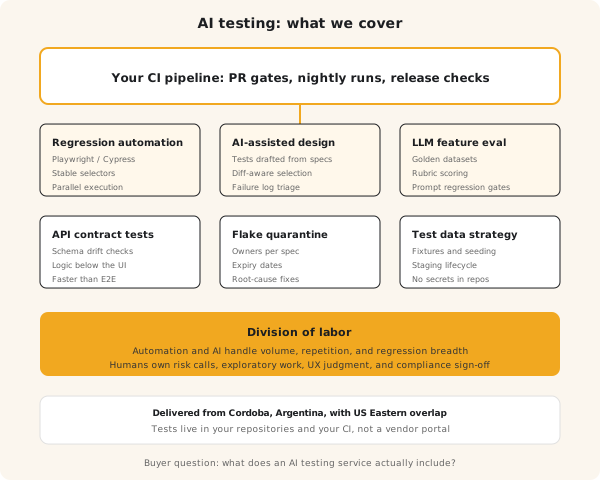
What AI Testing Covers
Automation first, AI where it reduces maintenance or expands coverage, humans where judgment is non-negotiable.
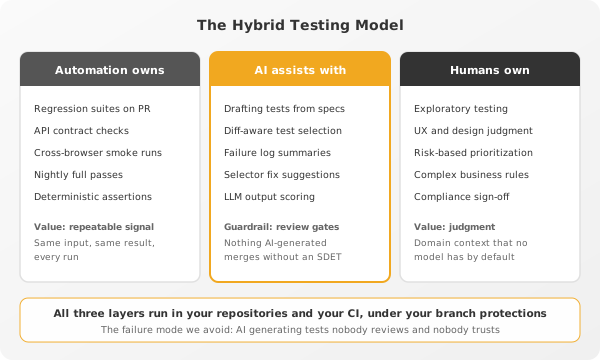
AI testing is not a separate product category from good QA engineering. It is how modern teams combine deterministic automation with AI-assisted workflows: generating candidate tests from user stories, summarizing failure logs, suggesting selector fixes, prioritizing runs after diffs, and building evaluation sets for chat or agent features. We implement the parts that survive review, run in your pipelines, and stay owned by your team after handoff.
Our work sits on the same execution engines your developers already trust. We align with Playwright or Cypress for browser flows, contract tests for microservices, and pipeline stages in GitHub Actions, GitLab CI, Jenkins, or Azure DevOps. When your platform team owns golden paths, we coordinate with platform engineering so test jobs, secrets, and environments match how developers actually ship.
Regression and
release automation
End-to-end and API suites wired into pull-request and pre-release gates. We focus on stable selectors, realistic test data, parallel execution, and quarantine rules so red builds mean something again.
AI-assisted
test design and triage
LLM-assisted drafting of test cases from specs, diff-aware test selection, and failure summarization that cuts time spent reading logs. Every AI-generated change goes through the same review and CI gates as human-written tests.
LLM and agent
feature evaluation
Golden datasets, rubric-based scoring, regression checks for prompt changes, and guardrail tests for unsafe outputs. Pairs naturally with LLM evaluation engineering when quality is model behavior, not only UI state.
Who AI Testing Is For
SaaS teams shipping weekly with Cypress or Playwright suites that break every sprint and erode trust in CI. You need maintenance discipline plus selective AI assistance, not another tool demo.
Product orgs adding LLM features (support bots, copilots, document Q&A) without golden questions, scoring rubrics, or release gates for prompt changes.
Fintech and regulated workflows where payment, eligibility, or audit paths need repeatable automation and human sign-off on exceptions. We scope compliance testing with your legal and risk owners; we do not invent certification claims on your behalf.
Engineering managers post-acquisition merging codebases and test stacks who need a neutral squad to stabilize regression before feature velocity returns.
Teams adopting AI coding agents who see throughput rise but defect clusters in agent-touched modules. Verification pipelines from our harness engineering practice and AI testing often deploy together.
US and European buyers who want nearshore delivery from Argentina with daily overlap on US Eastern hours, English documentation, and engineers embedded in your repos rather than a black-box vendor portal.
How Delivery Works
We treat AI testing like any other engineering program: assess what you have, agree on priorities, deliver in slices that merge to main, and hand off runbooks so your team can extend the system. Typical phases:
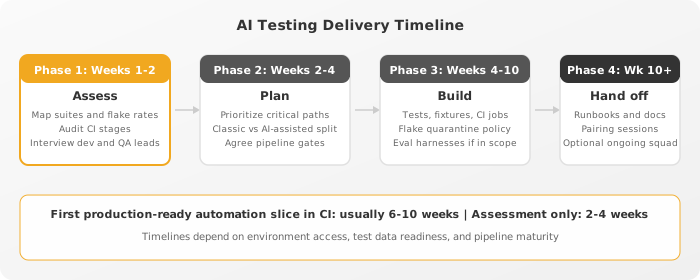
1. Assess
Map suites, flake rates, CI stages, coverage gaps, and release blockers. Interview dev and QA leads to learn where tests help and where they are theater.
2. Plan
Prioritize critical paths, define what gets classic automation vs AI-assisted maintenance, and align pipeline gates with your definition of done.
3. Build
Implement tests, fixtures, and CI jobs in your repositories. Introduce AI-assisted workflows only where we can show reduced maintenance or faster triage in the first sprint.
4. Hand off
Documentation, pairing sessions, and ownership transfer. Optional ongoing squad for teams that want us to stay on regression and eval pipelines.
Typical Team Composition
Team shape depends on engagement model and scope. These are common starting points, not fixed packages.
Assessment squad
QA architect plus one senior SDET for two to four weeks. Delivers audit, roadmap, and a thin vertical slice in CI if environments are ready.
Delivery squad
Two SDETs, one manual or exploratory QA, and a fractional lead. Covers web and API automation, flake reduction, and pipeline hardening across one product surface.
AI feature program
Adds an engineer from LLM evaluation or AI development when chat, search, or agent behavior needs scored datasets and release gates alongside UI regression.
Pricing and Engagement Models
What drives cost: surface area, pipeline maturity, regulated paths, and whether LLM evaluation is in scope.
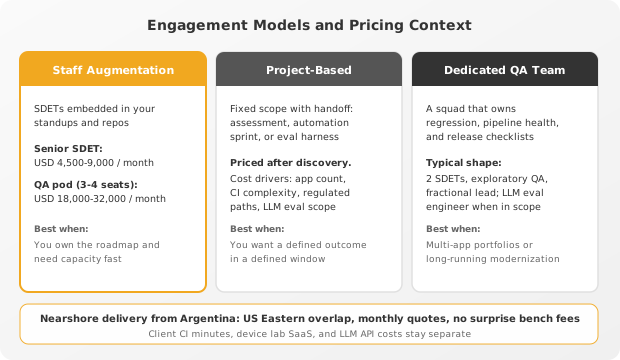
Staff augmentation
Embed SDETs or a small QA pod in your team. Published nearshore bands on our hire QA automation developers page: roughly USD 4,500 to 9,000 per month for a senior SDET, USD 18,000 to 32,000 per month for a three-to-four seat pod. Best when you own the roadmap and need capacity fast.
Project-based outsourcing
Fixed scope: assessment, automation sprint, or LLM eval harness delivery. Priced after discovery based on repos, environments, and compliance scope. See project-based outsourcing for how we structure statements of work.
Dedicated QA team
A squad that owns regression and release confidence for a product line. Fits multi-app portfolios or long-running modernization. See dedicated development teams for squad sizing and governance patterns.
TODO for Siblings team: confirm whether to publish fixed USD project bands for AI testing programs on this page (similar to harness engineering ranges).
Siblings vs In-House vs Generalist Agency
Fair comparison helps you pick the right model. None of these options is wrong for every company.
Siblings Software
- Engineers in your repos, CI, and ceremonies
- Nearshore from Argentina with US Eastern overlap
- AI testing plus classic SDET depth on one team
- Adjacent practices: harness, LLM eval, platform CI
In-house hiring
- Strongest when you have QA leadership and time to recruit
- Full institutional knowledge over years
- Slower to scale for spikes or new AI eval skills
- Higher fully loaded cost in US and Western EU markets
Generalist QA agency
- Can work for bounded manual test cycles
- Often uses separate tooling from engineering
- May sell AI testing labels without pipeline ownership
- Handoffs can recreate a second backlog
Example: Stabilizing Regression Before Release Confidence Returns
Illustrative shape based on recurring engagement patterns. Not a single client metric sheet.
Context
A B2B SaaS team with weekly releases had hundreds of Cypress specs and a nightly job that failed more often than it passed. Developers stopped trusting red builds and skipped the suite before production pushes. Leadership wanted AI-assisted maintenance explored, but only if flake rate dropped first.
For a published client story with a dedicated QA automation seat in a product squad, see the Viking payment console case study (Cypress on reconciliation paths, Azure DevOps gates).
What we did
- Two-week assessment: tagged flaky specs, moved eligibility rules to API contract tests, agreed data-testid contracts with frontend.
- Parallelized PR smoke suite; quarantined unstable specs with owners and expiry dates.
- Introduced LLM-assisted failure summaries for long CI logs after humans approved the prompt template.
- Documented runbooks and paired with internal QA so maintenance stayed in-house.
Outcome framing we aim for: developers treat CI signal as actionable again, critical paths run on every PR, and AI assists triage without bypassing review. Specific numbers depend on your baseline and are agreed in discovery.
Risks and How We Reduce Them
Flaky automation erodes trust
We quarantine with owners, fix root causes before un-quarantine, and prefer API and contract tests for logic that UI tests duplicate poorly.
AI-generated tests without review
Generated cases stay in draft until a human SDET merges them. Same branch protections as production code.
Vendor lock-in on tooling
Tests live in your repositories. We avoid proprietary runners that only work on our infrastructure.
Knowledge walks out at handoff
Runbooks, pairing, and recorded walkthroughs of pipeline changes. Optional retainer for teams that want a fractional QA lead after go-live.
OUR STANDARDS
Tests that match how your team ships, documented so the next engineer is not guessing.
Every AI testing engagement includes explicit definition-of-done for automation: what runs on PR, what runs nightly, what requires manual sign-off, and how flakes get triaged. We align with your security rules for test data and never commit secrets to repositories.
When LLM features are in scope, evaluation datasets and rubrics are version-controlled alongside application code. We coordinate with AI code security when tests touch prompt injection or data-handling boundaries.
Three ways to work with us, depending on how much of QA you want to own internally.
How to Work With Us
Project-Based
Outsourcing
Assessment, automation sprint, or LLM eval harness with fixed scope and handoff. Best when you want a defined outcome in a defined window.
Dedicated
Teams
A QA squad that owns regression, pipeline health, and release checklists for your product line. Works as an extension of engineering with shared rituals.
Staff
Augmentation
Embed SDETs or manual QA into your existing team when strategy is set but capacity is not. Fastest path when you already know the backlog.
Frequently Asked Questions
AI testing services combine traditional test automation with AI-assisted workflows: generating test cases from requirements, prioritizing runs based on code changes, triaging flaky failures, and validating LLM-powered product features. The goal is faster feedback in CI without sacrificing human judgment on risk, UX, and compliance-sensitive paths.
We cover functional and regression automation, API and contract testing, CI pipeline integration, test data strategy, flake quarantine policies, accessibility checks where scoped, and evaluation harnesses for LLM features. We also help teams decide which flows stay manual, which get classic automation, and which benefit from AI-assisted generation or maintenance.
No. AI-assisted automation handles volume, repetition, and regression breadth well. Human testers remain essential for exploratory work, UX judgment, complex business rules, compliance sign-off, and edge cases that require domain context. Most engagements we run use a hybrid model: automation and AI for speed, people for strategy and exceptions.
A focused assessment and roadmap usually takes two to four weeks. A first production-ready automation slice in CI often lands in six to ten weeks depending on environment access, test data, and pipeline maturity. Larger programs that span multiple apps, mobile surfaces, and LLM evaluation pipelines typically run three to six months in phased delivery.
We work with Playwright, Cypress, Selenium, and Appium for execution, plus API tools such as Postman collections or custom scripts where that fits your stack. AI-assisted layers may use LLM APIs for test ideation, log summarization, or failure triage, always behind review gates. We choose tools based on your existing repositories and CI, not a fixed vendor stack.
Embedded SDETs through staff augmentation typically run USD 4,500 to 9,000 per month for a senior engineer from Argentina, with QA pods from roughly USD 18,000 to 32,000 per month depending on size. Project-based AI testing programs are scoped after discovery. We quote after a short assessment, not from a generic rate card.
Outsourcing fits when release cadence outpaces your QA capacity, flaky automation is blocking trust in CI, you are adding LLM features without an evaluation strategy, or you need a nearshore squad with US Eastern overlap without a six-month hiring cycle. Building in-house makes more sense when you already have strong SDET leadership, stable suites, and time to iterate internally.
Related Services
Contact Siblings Software Argentina
Tell us about your QA backlog, CI pain points, or LLM features that need evaluation gates.