Engineers who orchestrate AI coding agents inside your repo—not demo prompts
· Typical time to first merged PR: 10–14 business days
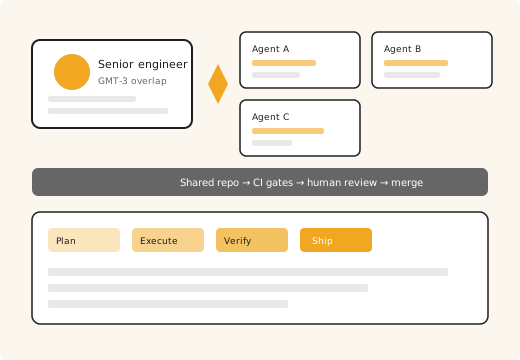
If you are comparing options to hire agentic coding developers, you probably already bought Cursor or Claude Code seats and noticed the gap: juniors ship fast until something breaks in production, and seniors are skeptical because nobody owns the harness. This page is for that second problem. We staff full-time engineers from Argentina who treat coding agents as orchestration tools inside your repositories—with human merge authority, CI gates, and overlap with US Eastern hours.
Agentic coding in 2026 is not "let the model write the app." Anthropic's 2026 agentic coding trends report frames it clearly: teams that scale human oversight without bottlenecks win; teams that treat agents as unsupervised authors accumulate drift. We embed engineers who have shipped under that reality—updating Cursor rules, running multi-agent splits on brownfield modules, and pairing with your leads on what still requires a human signature. For ML model work, see hire AI developers; for internal workflow automation with n8n and LLM steps in ops pipelines, see hire AI automation developers; for building the harness as a managed project, compare harness engineering; for customer-facing agents, open AI agents development.
Need extra PR throughput without re-teaching fundamentals? Layer TypeScript developers or full-stack developers beside the agentic lead. Need timezone context first? Read nearshore developer hiring.
Prefer numbers before a call? Jump to monthly pricing bands for embedded seniors, pairs, and small pods.
Who hires agentic coding engineers through us
Four buyer shapes from discovery calls; yours may blend two.
CTOs with agent seats but flat velocity
You rolled out Copilot or Cursor company-wide. Junior output spiked; senior review queues did not shrink. You need one or two engineers who can encode architectural guardrails in AGENTS.md, split work across agents without losing traceability, and teach the team what "done" means when a model wrote half the diff.
Platform leads inheriting brownfield refactors
A legacy module needs a framework migration and the board wants it this quarter. Agents can accelerate extraction work if someone senior scopes boundaries, writes acceptance tests first, and refuses the "rewrite everything" trap. That orchestration role is what we staff—not a generic "AI enthusiast" resume line.
Engineering managers bridging skill gaps
Half the team never touched agent mode; the other half treats it like Stack Overflow with confidence. You want an embedded senior who runs pairing sessions, documents PEV loops, and keeps security reviewers calm about data leaving the VPC.
Product companies piloting multi-agent workflows
You read the same trend pieces about coordinating specialist agents on one codebase. Piloting that without a staff engineer who has done it twice before usually ends in conflicting PRs and silent context loss. We staff the conductor, not the orchestra rental.
If you only need a one-week prompt workshop, we are the wrong partner. Say so on the call—we turn down engagements that do not need embedded delivery.
What an embedded agentic coding engineer does week to week
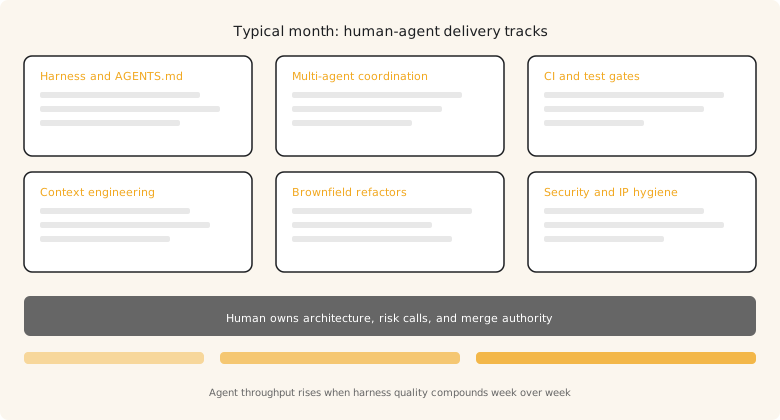
Parallel tracks in a typical month—not a reprint of our harness engineering outsourcing page.
The job title on LinkedIn still says "Senior Software Engineer." The difference is how they work: they plan in tickets, delegate bounded slices to agents, verify with tests and review, and merge only when a human can defend the change in prod. The diagram is schematic; your mix depends on whether you are greenfield, brownfield, or cleaning up after an agent free-for-all.
Harness and context engineering
AGENTS.md, Cursor rules, MCP server wiring where appropriate, and context budgets that stop agents from reading half the monorepo per task. We align with the Model Context Protocol when your stack already standardizes on it—not as ideology, as plumbing.
Multi-agent task splitting
One agent on tests, another on implementation, a third on docs—only when boundaries are explicit and merge order is defined. We refuse setups where three agents touch the same file without a lock model.
CI gates agents cannot bypass
Lint, typecheck, unit and integration suites, and optional AI-output scanners on PRs. Agents propose; pipelines dispose. If your CI is flaky, we fix that before pretending agents made you faster.
Brownfield refactors with rollback paths
Framework upgrades, module extractions, and dependency sweeps where agents accelerate typing but humans own blast-radius calls. Every slice ships behind a feature flag or reversible migration when the domain allows it.
Agentic Delivery Readiness Gate (how we match seniority)
A decision model you can reuse even if you never hire us.
Most failed agentic pilots are a seniority mismatch, not a model mismatch. Before we shortlist, we score three signals with your tech lead on a thirty-minute call.
- Signal A — harness maturity. If AGENTS.md is empty and CI is optional, we send someone who has bootstrapped harnesses twice—not a fast typist who will amplify chaos.
- Signal B — review bandwidth. If seniors cannot spare ninety minutes a week for agent output review, staff aug will not fix policy. We say that out loud and suggest a smaller pilot scope.
- Signal C — data boundary clarity. If legal has not ruled on what may leave the VPC, we pause agent tooling expansion and staff an engineer who can work air-gapped or with local models until policy catches up.
Across agentic-shaped placements for US and UK SaaS teams in the last eighteen months, shortlists that used those three signals had the lowest swap rate. That is how we reduce guesswork before anyone signs paperwork.
Engagement models and monthly ranges
Published bands beat "contact us" when finance is modeling agent-assisted throughput.
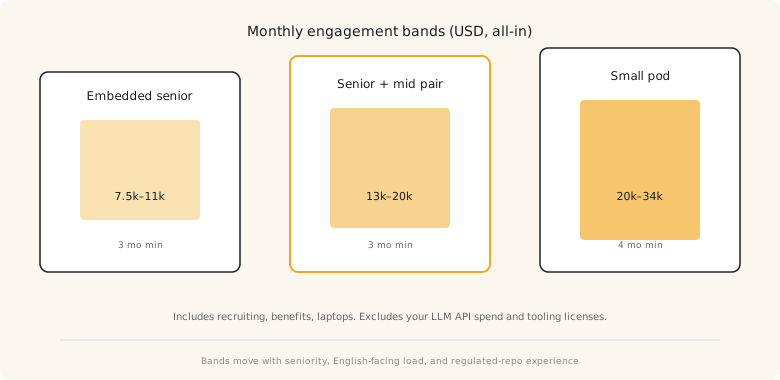
AI tools decoupled hours from output; that does not mean staff aug is free. It means you pay for an engineer who compounds harness quality week over week. The point inside each band moves with seniority, stakeholder-facing English, and experience in regulated repos where agent logs matter for audit.
Embedded senior
One senior in your ceremonies, code review rotation, and harness maintenance. Strong when culture is healthy and you need orchestration more than headcount.
Monthly: USD 7,500–11,000. Minimum: three months.
Senior + mid pair
The senior sets agent boundaries and review standards; the mid-level absorbs bounded tasks once context lands, usually by week three. Common when you want sustained refactor throughput.
Monthly: USD 13,000–20,000. Minimum: three months.
Small pod (three to four engineers)
Covers vacations internally and can split harness work from parallel feature tracks. If you want vendor-owned delivery instead, compare dedicated AI development teams.
Monthly: USD 20,000–34,000. Minimum: four months.
Figures include recruiting, benefits, laptops, and employer costs. LLM API usage, IDE agent seats, and security scanners stay on your accounts.
How hiring an agentic coding engineer through us works
Inspectable steps that end with a merged PR, not a slide deck.
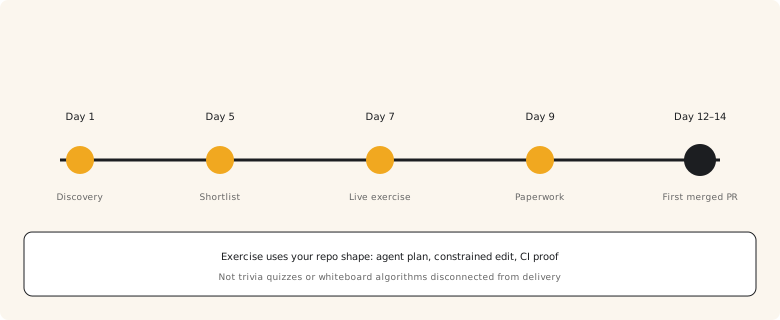
- Discovery (day 1). Stack, agent tools in use, harness maturity, data boundaries, budget envelope. We decline on the call when staff aug is the wrong shape.
- Shortlist (by day 5). Two or three profiles with repos showing agent-assisted delivery—not only traditional commits. You receive a written plan for a scoped task before any live call.
- Live exercise (days 5–8). Ninety minutes with your tech lead: constrain an agent, execute a small change, prove CI. No LeetCode wall.
- Paperwork (days 8–9). Master services agreement, monthly statement of work, fourteen-day swap clause in plain language.
- First merged PR (days 10–14). Onboarding pairs on a reversible change so you see integration speed and review discipline, not theater.
Agentic coding staff aug versus freelancers, in-house, and agencies
Each option wins sometimes; pretending otherwise wastes quarters.
Freelance marketplaces
Win on narrow spikes under roughly eighty hours. Lose on harness continuity when the incentive is ticket closure. Agentic work without documented guardrails often leaves toxic diffs for your seniors to untangle.
In-house hiring in the US or UK
Wins on five-year ownership. Loses on funnel length for a skill profile that barely existed in job boards eighteen months ago—and on regret cost when the hire cannot teach the team.
Large offshore agencies
Win when you need ten mid-level seats with a PM layer. Lose when the interviewee is not the engineer in your repo, or when "AI expertise" means a certification badge.
Where we sit
Small senior bench in GMT-3, full overlap with US Eastern hours, fifteen-day notice after the minimum, and the person you interview merges the PR. We optimize for compounding harness quality, not demo velocity.
Composite scenarios (anonymised, rounded numbers)
Shapes we have shipped multiple times; details blended to protect clients.
Cursor rollout without review-queue collapse
US B2B SaaS, forty engineers, Cursor seats for everyone, senior review time up 22%. Embedded senior wrote team-level rules, introduced PEV pairing hours, and cut median PR review time 31% over ten weeks while story throughput rose. Agents stayed on scoped tasks.
Angular-to-React slice with agent assist
UK logistics platform, one module at a time. Senior plus mid pair used agents for boilerplate and tests; humans owned routing and data contracts. Four modules migrated in eleven weeks versus the internal estimate of six months solo.
Mini case study
Fintech API layer: lead time down 44%, agent-generated code under 35% of merged lines
One senior, four months, anonymised metrics from a real engagement pattern.
Context. Payments API on Node and TypeScript, twelve internal engineers, Claude Code and GitHub Copilot licensed, no shared harness. Juniors merged agent output that broke idempotency keys; seniors stopped reviewing. Compliance wanted evidence that humans still owned risk decisions.
What we did. Weeks one and two: AGENTS.md with non-negotiables, CI rule that failed PRs missing test deltas for agent-touched files, and a weekly "agent retrospective" where the team tagged good and bad diffs. Weeks three to ten: bounded refactors on webhook handlers and retry logic with agents on tests and typings only. Every merge had a named human approver in the audit log.
Outcome. Median story lead time fell 44% from the week-two baseline; agent-generated lines stabilized below 35% of merged code; zero Sev-1 incidents tied to agent merges in the four-month window. The client kept the engineer for a second track on documentation automation.
Caveat. Week one looked slower than "just let Copilot rip." That trade was explicit: we optimized for auditability and senior sleep, not LinkedIn screenshots.
At a glance
Stack: Node, TypeScript, Claude Code, Copilot
Lead time: −44%
First merged PR: 11 days
Risks of agentic coding—and how we mitigate them
Honest controls beat "move fast" slogans.
Silent drift in brownfield code
Mitigation: scoped agent tasks, mandatory test deltas, weekly diff tagging so bad patterns get named early.
IP and data leaving policy
Mitigation: work inside your VPC rules, document what each tool logs, refuse engagements where legal has not ruled on boundaries.
Seniors disengage from review
Mitigation: cap agent-generated line ratios per sprint, rotate pairing so review load is shared, track review latency as a team metric.
Tool churn every quarter
Mitigation: harness patterns that survive vendor swaps—PEV loops and CI gates outlive whichever IDE is fashionable in Q3.
Why Siblings for agentic coding staff augmentation
Small bench, direct access, engineers who have merged agent-assisted code under audit.
30+
Engineers in-house
Córdoba-based; fintech, SaaS, health-adjacent clients in NA and EU
Since 2014
Nearshore delivery
Agentic workflows layered on a decade of embedded staff aug discipline
GMT-3
Argentina overlap
Same-day with US East; workable with most US zones
We are deliberately not a fifty-person recruiting shop. Founders still review new agentic engagements, and engineers talk to clients without a telephone game of account managers. That is why the process above stays short—and why we cross-link to AI code security when your security team asks hard questions about generated diffs.
Reviewed by Javier Uanini, Founder & CEO, Siblings Software — technical discovery on agentic coding engagements, pricing bands, and fit decisions.
Frequently Asked Questions
Full-time senior engineers employed by Siblings and embedded in your team who orchestrate AI coding agents inside your repositories. They join your stand-ups, own harness files like AGENTS.md, run Plan-Execute-Verify loops with Cursor or Claude Code, coordinate multi-agent tasks, and keep merge authority with humans. We cover recruiting, payroll, hardware, and Argentine employer obligations. You keep architecture direction, IP, and tool licensing on your accounts.
A single senior engineer is usually USD 7,500 to 11,000 per month all-in. A senior plus mid pair lands around USD 13,000 to 20,000 per month. A three-to-four person pod with shared repo context is typically USD 20,000 to 34,000 per month. Figures assume a full-time month, include recruiting and local taxes, and exclude your LLM API spend and IDE agent licenses.
Hire AI developers covers ML engineers, data scientists, and model integration. Agentic coding staff aug is about delivery throughput: senior software engineers who use coding agents as power tools inside your existing codebase. If you need customer-facing autonomous agents, compare our AI agents development lane. If you need us to design the harness infrastructure as a project, see harness engineering.
Most engagements reach a first merged PR in roughly 10 to 14 business days: discovery on day one, a two-or-three-person shortlist by day five, a ninety-minute live exercise using your repo shape before day eight, paperwork by day nine, then onboarding with your tech lead. We can compress toward eight days when you already interviewed a candidate we employ.
We end on a live exercise drawn from production-shaped problems: constrain an agent with AGENTS.md rules, execute a scoped refactor with Cursor or Claude Code, and prove CI passes without hand-waving. Candidates submit a short written plan before the call. We track swap rate inside a fourteen-day window—in the last year we replaced one placement on agentic-shaped roles.
Whatever your team already standardized: Cursor Agent mode, Claude Code, GitHub Copilot Workspace, OpenAI Codex, JetBrains Junie, and Amazon Q Developer are common in 2026. We do not force a vendor. The engineer adapts to your harness, CI gates, and security policy—not the other way around.
We replace the engineer at no placement fee during the first fourteen days and cover reasonable handover overlap. After that, either side may exit with fifteen days notice. We ask your tech lead a simple day-fourteen fit question so quiet mismatches do not drift for a quarter.
Our standards for agentic coding work
What we hold ourselves to once embedded.
- Humans own merge authority. Agents propose; named engineers approve every production-bound change.
- Harness files stay in version control. AGENTS.md and tool rules are reviewed like application code.
- CI is non-negotiable. No "agent exception" paths that skip tests or type checks.
- Scoped tasks beat repo-wide prompts. Boundaries are written before execution, not discovered in review.
- Security questions get written answers. Data flow, logging, and retention documented for your reviewers.
- Knowledge compounds. Retrospectives tag good and bad agent diffs so the team learns, not just the embedded engineer.
Contact Siblings Software Argentina
Describe your stack, agent tools in use, and harness maturity. We reply within one business day—or tell you we are not the right partner.