Hire Full-Stack Developers
Most buyers searching for full-stack developers are not looking for a definition. They are comparing ways to add reliable engineering capacity without creating more handoffs, meetings, or half-owned code. Siblings Software helps companies hire full-stack developers from Argentina for staff augmentation, product squads, and long-running modernization work.
Our engineers work across frontend, backend, data, testing, and deployment, but we do not pretend that "full-stack" means one person should be an expert in every tool ever invented. The point is practical ownership: a developer who can take a feature from a product conversation to a reviewed, observable release.
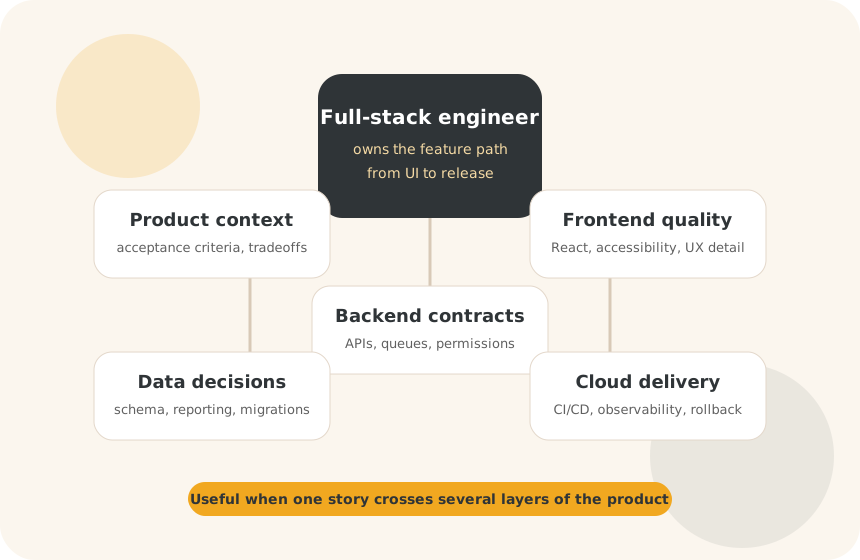
A good fit when the work crosses layers
A form, a checkout flow, a dashboard, or a workflow that touches several parts of the system.
Full-stack augmentation works best when a user story touches several parts of the system: a form that needs validation and permissions, a checkout flow tied to inventory and payments, a dashboard backed by slow queries, or a customer workflow that needs a new API and a polished interface.
Feature delivery is stuck
Your team has product direction, but every story waits on frontend-backend coordination.
The codebase is mixed
You have React plus Node, Django, .NET, Java, or PHP and need someone comfortable crossing the boundary.
Hiring is too slow
You need production help this month, not after a quarter of recruiting and onboarding.
You need overlap
Argentina gives strong overlap with US teams and workable overlap with many European schedules.
It is not always the right answer. If the frontend is a large design system with deep accessibility requirements, you may want a specialist front-end developer. If the hard part is queueing, integrations, or infrastructure, a back-end developer may be a cleaner match.
Full-stack does not mean "anything, somehow"
Range to reduce handoffs, judgment to ask for specialist help before risk piles up.
A useful full-stack developer has enough range to reduce handoffs and enough judgment to ask for specialist help before risk piles up. We screen for that judgment as much as for syntax.
Product features
Build flows in React, Next.js, Vue, or Angular, wire APIs, handle states and errors, and turn acceptance criteria into testable behavior.
Backend contracts
Create REST or GraphQL APIs, improve permissions, handle background jobs, and use TypeScript when it helps make contracts explicit.
Release health
Work with CI/CD, database migrations, logging, feature flags, smoke tests, and security basics such as the OWASP Top 10.
Common stacks include React, Next.js, Node.js, Python, Django, .NET, Java, PostgreSQL, MySQL, MongoDB, AWS, Azure, Google Cloud, Docker, GitHub Actions, Playwright, and Cypress. We match by the work in front of you, not by a generic checklist.
A short process, but not a lazy one
Start with the work, then shape the role.
The biggest mistake buyers make is asking for "three senior full-stack resumes" before explaining the codebase. That usually produces interviews that sound fine and first sprints that feel messy. For standard roles, clients usually interview within five to eight business days. More specialized work, such as regulated fintech, high-volume ecommerce, or a migration from a large monolith, deserves a bit more patience. A rushed match is expensive later.
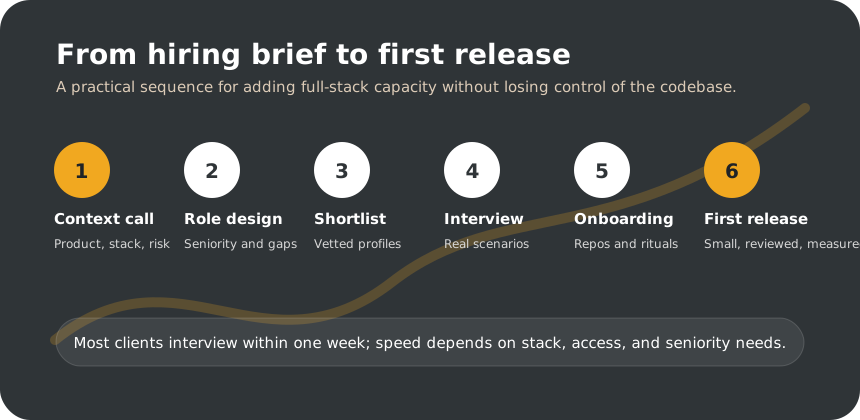
1. Context and constraints
We review product goals, stack, architecture, team rituals, timezone needs, security restrictions, and the first 30-day outcomes.
2. Role design
We define whether you need one senior engineer, a lead, QA support, DevOps help, or a small squad.
3. Shortlist and interviews
You meet the actual people who may join. Interviews focus on situations close to your codebase, not trivia.
4. Onboarding and first PR
We enter your repos, issue tracker, CI/CD, Slack or Teams, and review standards. The first task is intentionally small.
Budget ranges you can use before a sales call
Planning numbers, not a fixed quote.
Rates change with seniority, stack, contract length, and whether you need only delivery capacity or also technical leadership.
One full-stack developer
Typical range: USD 6,500 to 9,800 per month.
Best when your team already owns product, architecture, and QA but needs one reliable contributor who can ship across layers.
Senior lead or architect
Typical range: USD 10,500 to 13,500 per month.
Best when the codebase needs architecture decisions, migration planning, code review standards, and mentoring for other engineers.
Small full-stack squad
Typical range: USD 24,000 to 48,000 per month.
Best when you need two to four engineers, QA automation, and fractional delivery or technical leadership for a product area.
A common budgeting error is comparing a monthly retainer with salary only. The real comparison includes recruiting time, benefits, management load, turnover, unused capacity after launch, and the cost of slow delivery.
Full-stack staff augmentation vs freelancers, in-house hiring, and agencies
There is no universal best option.
Freelancers
Where it works: short tasks, isolated fixes, prototypes, and narrow expertise.
Where it gets risky: continuity, code ownership, backup coverage, and production accountability can be fragile.
How we fit: you get vetted engineers with team support, replacement coverage, and escalation paths.
In-house hiring
Where it works: permanent strategic roles and deep company knowledge.
Where it gets risky: recruiting can take months, and a wrong hire is expensive to unwind.
How we fit: we add capacity while your internal hiring continues at a realistic pace.
Large agencies
Where it works: big programs, procurement requirements, and broad account structures.
Where it gets risky: senior people may disappear after sales, and delivery can become process-heavy.
How we fit: you stay close to the people making technical and staffing decisions.
Full-stack augmentation
Where it works: roadmap acceleration, modernization, feature ownership, and long-running product work.
Where it gets risky: it fails when expectations are vague or when one generalist is asked to cover too many specialist gaps.
How we fit: we define role boundaries, review cadence, and when to add QA, DevOps, or specialist support.
Where full-stack engineers usually create leverage
Specific scenarios because "build web apps" is too broad to help anyone decide.
A SaaS company needs product experiments without breaking the core app
A full-stack developer can implement the UI, API changes, tracking events, feature flags, and rollout checks without splitting the story across three teams.
A legacy platform needs modernization while still shipping
The work may include strangling old routes, adding tests, moving slow pages to a modern frontend, and keeping migrations small enough to review.
A B2B workflow depends on messy integrations
Orders, inventory, billing, and permissions often cross several systems. Our API development work helps when integrations become the real product.
A CTO needs a senior pair, not another ticket taker
A strong full-stack engineer can surface tradeoffs, write useful pull request context, and reduce the number of decisions sitting on the CTO's desk.
Mini case study: Bari, a B2B commerce platform
Bari needed a wholesale commerce platform that connected distributors and retailers. The work was full-stack in the plainest sense: React purchasing workflows, a .NET Core REST backend, GraphQL decisions, account-specific pricing, and enough operational care that distributors could keep selling while the product changed.
The important lesson was ownership. A feature might start as a retailer UI question, expose a pricing edge case, require a backend contract change, and then need QA around order totals. Splitting that into disconnected frontend and backend tickets would have hidden risk until late in the sprint.
The platform reached 12 distributors and 230 retailers. You can read the original Bari case study or browse more software outsourcing case studies.
12
distributors supported
230
retailers on the platform
B2B products rarely fail because a button is missing. They fail when pricing, permissions, inventory, and UX drift apart. Full-stack ownership keeps those connections visible.
The risks are real, so we name them early
One person cannot rescue a broken roadmap.
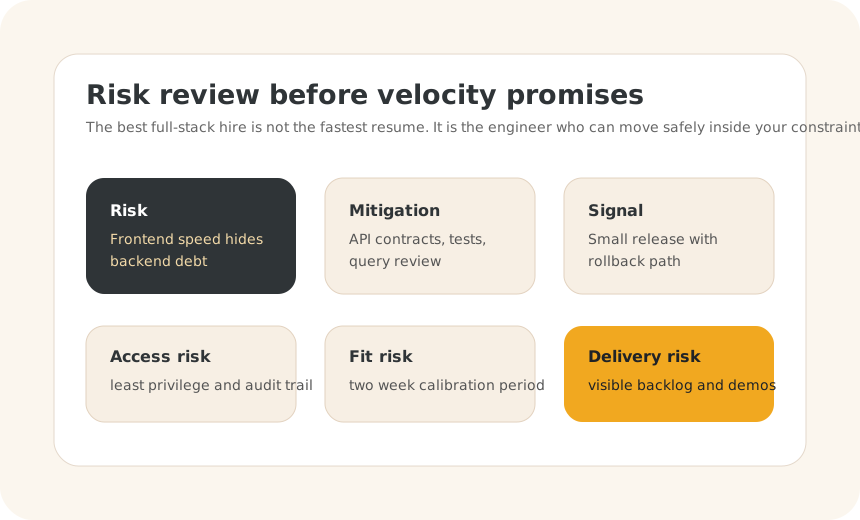
Full-stack hiring can go wrong when the role is used as a shortcut for planning. One person cannot rescue a broken roadmap, own security, redesign the frontend, rebuild the API, and manage releases at the same time. We push back when the scope sounds like a department disguised as a developer.
- Skill mismatch: we screen against your actual stack and first projects, not a generic list of technologies.
- Shallow onboarding: we define access, documentation, review rules, and communication habits before velocity is promised.
- Production risk: first tasks are small, reviewed, tested, and released with rollback in mind.
- Knowledge loss: engineers document decisions, leave pull request context, and can run handover sessions if the engagement ends.
What clients experience day to day
We join your tools, keep decisions visible, and calibrate weekly.
We join your tools
GitHub, GitLab, Jira, Linear, Slack, Teams, CI/CD, cloud consoles, and documentation systems. We avoid parallel processes unless there is a reason.
We keep decisions visible
Architecture notes, pull request context, release notes, and tradeoff discussions stay close to the work so your team can challenge or extend them.
We calibrate weekly
Early reviews cover delivery pace, communication, quality, blockers, and whether the role still matches the real work emerging from the codebase.
Siblings Software was founded in 2014 in Cordoba, Argentina. Our team has worked across fintech, healthcare, logistics, construction, B2B commerce, SaaS, and internal operations software. We are a better fit for companies that care about continuity and code ownership than for one-week task lists.
Frequently Asked Questions
A senior full-stack developer is usually planned between USD 6,500 and 9,800 per month. A lead or architect is typically USD 10,500 to 13,500 per month. A small squad with two to four engineers, QA, and leadership often ranges from USD 24,000 to 48,000 per month.
For common stacks, most clients see a shortlist within five to eight business days. Starting in roughly two weeks is realistic when interviews, security approvals, repository access, and onboarding materials are ready.
Sometimes, but not always. A strong full-stack developer can own many product stories end to end. Specialist-heavy work, such as complex design systems, infrastructure, security, or large data workloads, may still need focused help.
Yes. Engineers can work in your repositories, sprint rituals, issue tracker, pull request workflow, CI/CD, and communication channels. The goal is to behave like part of your product organization, not a separate vendor queue.
We review the first two weeks closely. If the issue is skill match, communication, or domain fit, we address it directly and replace the profile when needed instead of letting the engagement limp along.
Yes. Staff augmentation is best when your team owns product and direction. If you need Siblings Software to own delivery for a product area, modernization stream, or integration program, a dedicated squad is usually the better model.
OUR STANDARDS
Full-stack engineers who own real product work, not just write across two languages.
Every full-stack developer we place has shipped real product features in production teams. We screen for the judgment to know when to call a specialist, the discipline to write reviewable pull requests, and the habit of leaving the codebase a little better than they found it.
We define role boundaries, review cadence, and when to add QA, DevOps, or specialist support. The work belongs to your team; we provide capacity, calmer release weeks, and a vendor relationship close to the people making decisions.
Contact Siblings Software Argentina
Tell us what your full-stack developer needs to own.