Outsourcing de servicios de ingenieria de observabilidad desde Argentina
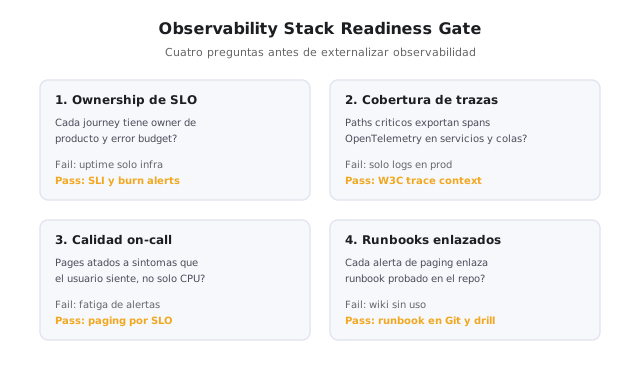
Que hacemos: Los servicios de ingenieria de observabilidad vuelven debuggeables los incidentes: trazas OpenTelemetry entre servicios, SLOs con error budget, metricas y logs con trace ID compartido, paging atado a sintomas visibles para el usuario y runbooks en Git enlazados desde cada alerta. Para quien: VP Engineering, heads of platform y lideres SRE en SaaS B2B, fintech y marketplaces donde el MTTR se mide en horas porque on-call solo tiene grep y graficos de CPU. Problema: Hay dashboards pero nadie confia, las alertas despiertan sin runbook, checkout o latencia de API se rompen sin un span que muestre donde se fue el tiempo, y la gerencia pide SLOs que ingenieria no puede defender. Por que nearshore: La entrega de observabilidad exige pairing el mismo dia cuando un burn-rate alert dispara antes de un release, la propagacion de trazas se rompe en staging, o on-call necesita un ingeniero del vendor en el bridge de un game day. Como evaluarnos: Pregunta si el proveedor pasa la Observability Stack Readiness Gate del diagrama: ownership de SLO, cobertura de trazas, calidad de senales on-call y runbooks enlazados.
Externalizamos desde discovery hasta handoff: auditorias de instrumentacion, IaC de collectors OpenTelemetry, definicion de SLI y SLO con burn-rate alerts, ajuste de dashboards y alertas, drills on-call y documentacion de handoff alineada a OpenTelemetry documentation, el capitulo de SLO del Google SRE Book y la documentacion de Grafana alerting. Pipelines CI/CD y confiabilidad de deploy quedan en DevOps engineering; golden paths y portales en platform engineering; trazas de agentes LLM en AI agent observability development. Necesitas un SRE senior embebido? Mira contratar ingenieros SRE para staff augmentation.
Siblings Software es una empresa de outsourcing de software con sede en Cordoba, Argentina, con traslape diario a US Eastern. Entregamos ingenieria externalizada desde 2014 en SaaS B2B, fintech y plataformas enterprise. Catalogo completo en todos los servicios o compara nuestro modelo de nearshore development si procurement compara regiones.
Que cubre el servicio
Observability engineering services outsourcing is the work of making production behavior legible to the people who page: traces that cross services and queues, metrics tied to SLIs, logs correlated by trace ID, and alerts that fire on error budget burn rather than raw CPU. A typical program runs the Observability Stack Readiness Gate, rolls out OpenTelemetry in application and platform repos, defines SLOs product owners sign, tunes paging routes, links runbooks in Git, and rehearses incidents before handoff.
That is different from DevOps engineering, which optimizes pipeline speed, IaC modules, and cluster operations rather than SLI design and trace propagation. It is also different from AI agent observability development, which focuses on LLM spans, eval regressions, and agent tool latency. Observability engineering optimizes for MTTR, defensible SLOs, and on-call signal quality. We pair with platform engineering when collectors belong in golden paths and with QA automation services when synthetic checks feed SLIs.
Quality gates follow what SRE teams expect: no new paging alert without a linked runbook, no SLO change without a product owner signature, and a staging game day before production alert routes change. Teams often combine observability with project-based outsourcing for a first instrumentation wave, then an dedicated development team retainer for ongoing SLO tuning.
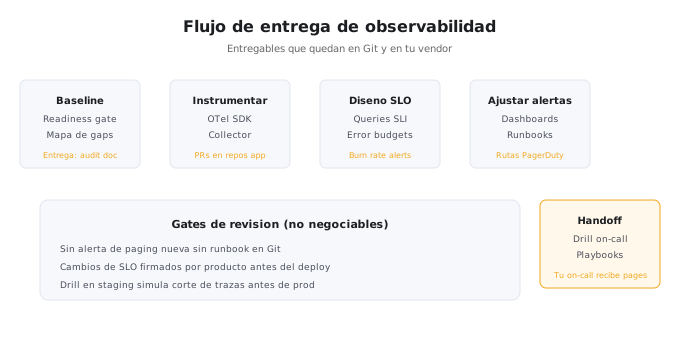
Most production observability programs treat runbook linkage and product-signed SLOs as non-negotiable: on-call should not guess which dashboard to open when error budget burn pages at 2 a.m.
Para quien es
Platform and product leaders where incidents take too long to triage, dashboards sprawl without SLOs, and every postmortem ends with "we need more logs." If nobody can name who owns error budget for checkout or the public API, you are the audience.
B2B SaaS with SLA pressure
Multi-tenant APIs where enterprise contracts reference uptime and leadership wants SLOs tied to real user journeys, not ping checks alone.
Fintech and regulated products
Payment and ledger flows need traceable incidents, audit-friendly runbooks, and paging that respects change windows.
Microservices after a split
Teams that decomposed a monolith but still debug with single-service logs and no shared trace context.
Kubernetes-heavy platforms
Clusters with Prometheus installed but alerts that page on node CPU instead of checkout latency or queue depth.
Vendor migration in flight
Moving from a legacy APM to OpenTelemetry without losing historical SLO baselines or duplicating alert noise.
Teams after a noisy on-call quarter
Alert fatigue drove engineers to mute channels. You need delivery that removes pages, not another dashboard seat.
Escenarios tipicos de proyecto
Six situations we see on discovery calls. Each maps to a bounded observability wave we can scope in the first week after the Observability Stack Readiness Gate.
Instrument checkout after microservice split
Latency regressions hide between cart, tax, and payment services. We add W3C trace propagation, span attributes for payment provider, and an SLO on successful checkout duration.
Replace CPU paging with SLO burn alerts
On-call mutes Prometheus rules that fire every deploy. We define multi-window burn rates on availability and latency SLIs and retire noisy infra thresholds.
Roll out OpenTelemetry without dual-write forever
A legacy APM agent still runs on every pod. We migrate service by service to OTel collectors with a documented cutover and dashboard parity checklist.
Link runbooks from every PagerDuty route
Pages arrive without context. We move runbooks into Git, link them from alert annotations, and rehearse one failure mode in staging.
Build executive SLO views without vanity charts
Leadership wants one screen for error budget by product line. We tie SLIs to journeys product owners already name in roadmap reviews.
Separate general observability from AI agent traces
LLM tool calls need different cardinality rules. We keep platform observability on this engagement and route agent eval work to AI agent observability development.
Como funciona la entrega
Six phases, usually six to ten weeks for a first observability program with instrumented critical paths, signed SLOs, tuned paging, a game day, and paired handoff documentation. Game days with documented escalation paths are non-negotiable when on-call rotation is already strained.
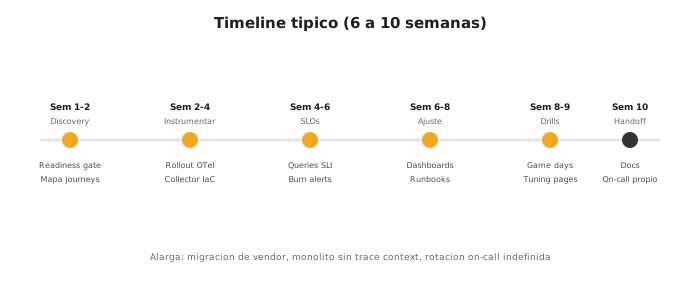
Discovery maps critical user journeys, runs the Observability Stack Readiness Gate, and documents trace gaps, SLO owners, and on-call pain. If any gate answer is undefined, we capture owners before changing alert routes.
Instrumentation delivers OpenTelemetry SDK changes, collector IaC, and sampling policies validated in staging before production traffic.
SLO design implements SLI queries, error budgets, and burn-rate alerts product owners sign in writing.
Alert and dashboard tuning retires noisy rules, links runbooks from routes, and aligns Grafana or vendor dashboards to journeys.
Drills rehearse one failure mode in staging, measure time-to-mitigate, and tune pages based on outcomes.
Handoff includes instrumentation guidelines, SLO change process, and game day checklist. Paired weeks let your on-call merge changes under our review before we step down to advisory hours or transition to project-based outsourcing for wave two.
Composicion del equipo
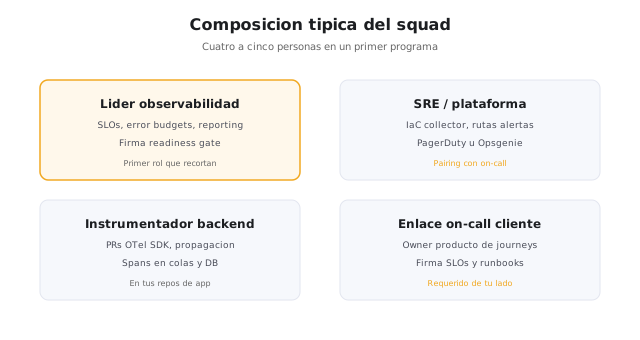
A four- to five-person squad is the usual shape for a first observability program. The observability lead who owns SLO design and readiness gate sign-off and the backend instrumenter who merges OpenTelemetry PRs are the two roles vendors cut to win on price. Those are also the roles that determine whether on-call trusts the next page.
Typical roster: observability lead, SRE or platform engineer for collectors and paging, backend engineer for trace propagation in app repos, part-time product owner from your side who signs SLO targets, and optional QA automation engineer when synthetic probes feed SLIs. For ongoing tuning after wave one, the same squad can run as an dedicated development team on a monthly retainer. For a single senior engineer inside your org, staff augmentation is the better fit.
Project, dedicated team, or staff augmentation depending on how much of the observability roadmap you want us to own.
Precios y modelos de engagement
Proyecto acotado
Fixed scope for a bounded observability program: readiness gate, OpenTelemetry rollout on critical paths, SLO and burn-rate alerts, runbook linkage, one game day, and handoff documentation. Typical duration six to ten weeks. Published bands run USD 28,000 to USD 110,000 after discovery, depending on service count, vendor migration, and regulated reporting.
Equipo dedicado
Ongoing squad owning SLO tuning, instrumentation backlog, alert hygiene, and game day support. USD 20,000 to USD 50,000 per month for four to six people depending on seniority mix and service surface area.
Staff augmentation
Embed one or two senior SRE engineers when you already own SLO rituals and need hands on collectors, instrumentation PRs, or burn-rate tuning. USD 6,500 to USD 12,500 per month per senior engineer on published brackets.
Comparacion con contratacion interna, freelancers y consultoras grandes
Externaliza cuando
- You need traces, SLOs, and runbooks in one or two quarters, not after a six-month search for a rare SRE plus backend hybrid.
- Dashboards exist but on-call still greps logs during every severity-one incident.
- Leadership wants a third party to document the Observability Stack Readiness Gate before an enterprise SLA renewal.
- OpenTelemetry migration stalled because no team owns collector IaC and app instrumentation together.
Mantenelo in-house cuando
- You already run weekly SLO reviews, error budget policy is enforced, and you only need a short spike on one service.
- Production is a single monolith with mature tracing and on-call rarely pages.
- A vendor delivers slides your engineers are not allowed to merge into repos or alert routes.
Freelancers can instrument one service quickly but rarely stay for game days or SLO governance at leadership level. Nearshore delivery from Cordoba gives you senior observability and platform profiles at a lower total cost than hiring the same mix in major US metros, with overlap platform and on-call can use. Browse case studies for examples of how we work with product teams.
Escenario ilustrativo: Ruta Andina Logistica
Composite illustrative scenario only. Not a published client case study. No performance metrics are claimed.
La situacion
Ruta Andina Logistica es una API B2B ficticia de logistica que conecta shippers con transportistas regionales. Los microservicios reemplazaron un monolito hace un ano, pero los incidentes siguen empezando con grep. Prometheus pagea memoria de nodos; los clientes se quejan primero por latencia de reservas. Producto quiere SLOs sobre reservas exitosas y generacion de etiquetas antes de renovar contratos enterprise.
Necesitan pasar la Observability Stack Readiness Gate, OpenTelemetry en reservas y rating, burn-rate alerts firmados por producto y runbooks enlazados desde PagerDuty antes de las pruebas de carga de temporada alta.
Que entregariamos
Un proyecto nearshore de ocho semanas con un squad de cinco personas desde Cordoba: lider de observabilidad, SRE, instrumentador backend, ingeniero de QA automation para probes sinteticos de reservas y un product owner del lado cliente. Traslape diario con el platform lead US Eastern durante rollout de collectors y game day.
- Observability Stack Readiness Gate documenting SLO owners, trace gaps, on-call signal quality, and runbook linkage signed by platform and product.
- OpenTelemetry instrumentation PRs on booking, rating, and label services with W3C propagation through the API gateway.
- SLO and multi-window burn alerts on booking success rate and p95 latency with noisy infra rules retired.
- Runbooks in Git linked from alert annotations with a rehearsed carrier timeout failure in staging.
- Handoff checklist for extending instrumentation to the remaining legacy batch jobs.
En un escenario asi, la victoria es respuesta predecible: on-call abre una traza, producto ve impacto en error budget y la gerencia confia en reportes de SLO en QBRs.
Riesgos y mitigacion
Cardinality explosion after instrumentation. High-cardinality labels blow vendor bills or crash collectors. Mitigation: attribute budgets, review in PRs, and staging load tests on trace volume.
SLO targets set without product input. Engineering picks numbers leadership rejects later. Mitigation: product owner sign-off before alert routes go live.
Dual-write migration never ends. Legacy APM and OTel run forever. Mitigation: service-by-service cutover checklist with dashboard parity gates.
Alert fatigue returns after handoff. Teams add rules without retiring old ones. Mitigation: alert review ritual and runbook requirement in CI for new pages.
Trace breaks at the gateway or message bus. Mitigation: explicit propagation tests in CI and pairing with microservices development when contracts change.
Observability and platform timelines fight. Mitigation: explicit sequencing with platform engineering and DevOps engineering, with collectors treated as platform code.
Preguntas que los compradores hacen antes de la primera discovery call
Preguntas Frecuentes
Staff augmentation embebe uno o dos ingenieros SRE en tu backlog y rituales. El outsourcing de servicios de observabilidad entrega un programa gobernado: Observability Stack Readiness Gate, rollout OpenTelemetry, alertas SLO y burn-rate, ajuste de dashboards y alertas, runbooks en Git y drills on-call. Vos seguis siendo dueno de cuentas del vendor y repos. Elegi augmentation cuando ya tenes revisiones de SLO y necesitas manos. Elegi esta pagina cuando los incidentes tardan horas porque las trazas cortan en el edge, las alertas no tienen runbook y la gerencia pide SLOs defendibles.
Trabajamos con collectors y SDKs OpenTelemetry, Grafana Cloud o Grafana self-hosted, Prometheus, Loki, Tempo, Datadog, Honeycomb, New Relic, y CloudWatch o X-Ray cuando ya estan licenciados. Alineamos con contratos de vendor existentes en lugar de imponer rip-and-replace la primera semana. Workloads Kubernetes, ECS y serverless entran en scope cuando el trace context propaga entre ingress, servicios y colas.
Discovery documenta la Observability Stack Readiness Gate: ownership de SLO, cobertura de trazas, calidad de senales on-call y runbooks enlazados. Entrega incluye queries SLI y error budgets, PRs de instrumentacion OpenTelemetry, IaC de collectors, alertas burn-rate y multi-window, dashboards atados a journeys, runbooks enlazados desde rutas PagerDuty u Opsgenie y un game day ensayado antes del handoff.
Seis a diez semanas es tipico para un primer programa: dos semanas de discovery y readiness gate, dos a cuatro de instrumentacion y rollout de collectors, dos de SLOs y ajuste de alertas, una a dos de drills y handoff. Se alarga cuando un monolito legacy bloquea propagacion de trazas, la rotacion on-call no esta definida o producto no puede firmar targets de SLO.
Proyecto acotado observability programs typically land between USD 28,000 and USD 110,000 depending on service count, vendor migration scope, and regulated reporting needs. Dedicated observability squads run USD 20,000 to USD 50,000 per month for ongoing SLO tuning, instrumentation backlog, and game day support. Senior staff augmentation for SRE engineers ranges from USD 6,500 to USD 12,500 per month per engineer on published brackets via contratar ingenieros SRE. We confirm pricing after discovery once readiness gate answers are documented.
You do. Dashboard JSON, alert rules, collector configs, SLO definitions, and runbooks ship under your IP in your repositories and observability tenant. We document how to extend instrumentation, tune burn rates, and run the next game day without paging us. Ongoing CI/CD or platform operations stay separate engagements through DevOps engineering or platform engineering if you want managed ops after handoff.
Si. Equipos en Cordoba, Argentina, con traslape diario en horario laboral US Eastern. Observabilidad exige iteracion el mismo dia con plataforma y on-call cuando un burn-rate alert dispara antes de un release, la propagacion de trazas se rompe en staging o un game day necesita un ingeniero del vendor en el bridge.
Servicios Relacionados