Hire a Go development team that ships production backends, not slideware
· Average time to first merged PR: 10–14 days
Reviewed by Javier Uanini, CEO and delivery lead, Siblings Software.
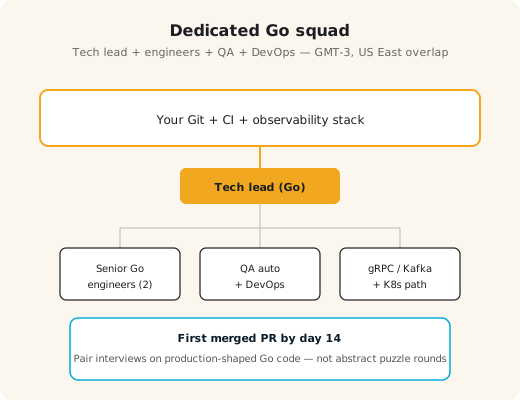
Most dedicated Go team conversations we take start after a spike broke the monolith, a senior Golang hire fell through, or the roadmap needs gRPC paths nobody on staff has shipped in production. If that is you, you probably want a managed squad under a tech lead—not another generic vendor deck. We assemble nearshore engineers in Argentina (GMT-3, strong overlap with US Eastern) through our dedicated teams practice, embed them in your repo and rituals, and aim for a small, real merged PR in about two weeks.
This page spells out squad composition, monthly bands, the fourteen-day hiring path, first-thirty-day governance, and when Go staff augmentation is the smarter move instead. We also screen against what changed in recent releases—for example the iterator patterns and tooling shifts called out in the Go 1.24 release notes—so you are not getting engineers who last touched the language three years ago.
Who actually hires a Go development team from us
Four buyer profiles account for almost every Golang engagement we close.
Platform and infrastructure teams hitting scale pains
A Rails or Node service that carried you from zero to a few million requests a day is now the bottleneck. You need a team that knows when to extract a service into Go, when to leave well enough alone, and how to do the extraction without a nine-month freeze on product work. Most of our platform squads start here.
Fintech, logistics and SaaS companies with latency budgets
Billing engines, trading bridges, dispatch systems, usage meters. Anything where a p99 above 300 milliseconds is a commercial problem. Go plus a team that treats latency as a first-class requirement, not a secondary optimisation, is usually the correct instrument. We bring that muscle memory pre-built.
Founders replacing a freelance Go engineer who left
A solo contractor built the backend, a round closed, and then they moved on. The code works, nobody on staff reads it fluently, and the next six features all touch concurrency or event consumers. You need a team that can read an unfamiliar codebase, map it honestly, and grow it into a real platform without a full rewrite.
Enterprises modernising off PHP, Java or legacy .NET
Decade-old monoliths, binders of compliance controls, and a legal team that reads every clause. We have shipped inside those environments and we like them, because they force the kind of contract testing, observability and rollback discipline that small teams tend to skip. The tradeoff is a slower first month and a more durable second year.
If you are building a greenfield prototype and have one part-time engineer, a dedicated team is probably the wrong shape. For that, a project-based project-based engagement or a single senior on Go staff augmentation fits better. We will say so on the first call.
What a dedicated Go team actually owns each sprint
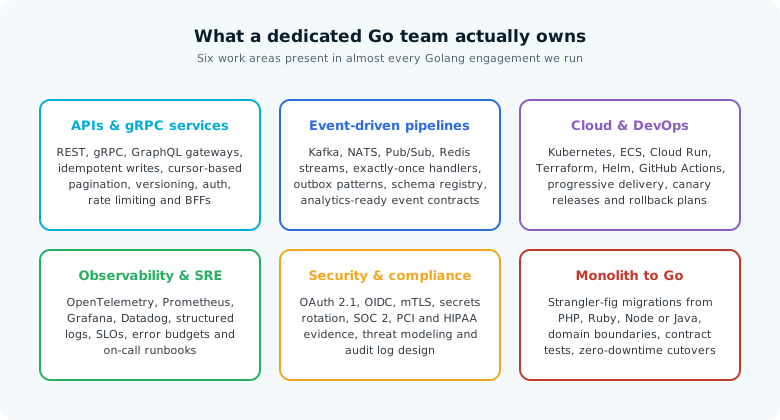
“We build backends in Go” does not help when you are evaluating three shortlisted vendors. The scope below is what a typical Go team at Siblings Software owns inside a sprint. Not every engagement uses every row, but it is rare to see fewer than four in play at any given moment.
High-throughput APIs and gRPC services
REST endpoints that behave the same under load as under demo traffic, gRPC services with proper deadlines and cancellation propagation, GraphQL gateways where they are genuinely useful rather than fashionable, and backends-for-frontends that keep your mobile and web clients thin. We write idempotent handlers, pay attention to context cancellation, and treat cursor-based pagination as the default.
Event-driven pipelines and async workers
Kafka, NATS, Redis streams and Google Pub/Sub consumers that survive network blips, reprocessing and schema drift. Outbox patterns when dual-writes would otherwise bite you. Exactly-once-effective semantics when the underlying broker only promises at-least-once. Workers that shut down gracefully when Kubernetes sends a SIGTERM rather than dropping half a batch.
Cloud-native infrastructure and DevOps
Kubernetes on EKS, GKE or AKS, serverless on Cloud Run and Lambda where the economics make sense, Terraform and Helm for everything that lives longer than a weekend, and GitHub Actions or Buildkite pipelines that actually reject bad builds. Canary and progressive rollouts with a documented rollback path, not a Slack thread.
Observability, SLOs and on-call
Structured logs with correlation IDs, OpenTelemetry traces that cross service boundaries cleanly, Prometheus and Datadog dashboards keyed to user-visible journeys, SLOs that mean something in a business conversation, and runbooks on-call engineers actually follow at three in the morning. We avoid the trap of instrumenting everything and alerting on nothing.
Security and compliance hardening
OAuth 2.1 and OIDC flows that survive real identity providers, mTLS between services, secrets handled through AWS KMS, HashiCorp Vault or GCP Secret Manager instead of env files in Slack. Evidence collection for SOC 2, PCI-DSS or HIPAA audits. Threat-model workshops for engineers who would rather write code, and audit-log schemas your security team can read.
Monolith-to-Go modernization
PHP, Ruby, Node or Java monoliths sliced into Go services using the strangler-fig pattern. We work bounded-context by bounded-context, keep the legacy app serving traffic every day of the migration, and land contract tests so cutovers are not a religious event. Reference material for the approach lives in the Effective Go guidelines and the gRPC documentation.
Every senior Go engineer we place has shipped at least one production Go service handling real traffic, owned at least one migration (Postgres upgrade, Kafka rewrite or a language migration into Go), and carried at least one service through an incident postmortem. Most have all three, across fintech, logistics, developer tools and B2B SaaS.
Engagement models and monthly pricing
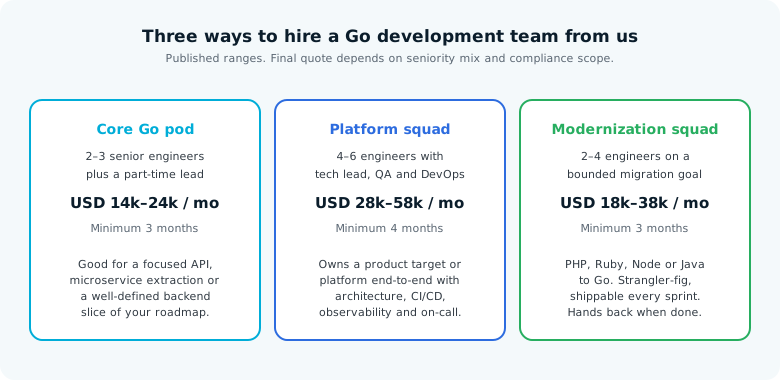
We publish price ranges because hidden pricing wastes everyone’s time. The final number depends on seniority mix, whether the team includes a dedicated SRE, and whether the brief carries a compliance envelope (SOC 2, PCI, HIPAA). Below is what we actually quote, not a teaser. If you are pairing Go services with an internal platform initiative, our platform engineering page describes how we collaborate with IDP and golden-path work in parallel.
Core Go pod
Two or three senior Golang engineers plus a part-time tech lead. Good when you already have a working backend and need a focused team to own a service extraction, a new API, or a clearly scoped slice of the roadmap. Best value for most Series A to Series B companies.
Price: USD 14,000 to 24,000 per month. Minimum: 3 months.
Platform squad
Four to six engineers with a full-time tech lead, QA automation and a DevOps profile. Owns a product target end-to-end: a new backend, a managed platform, a major greenfield rewrite. For pure product ownership without an internal engineering counterpart, pair this with our Go development outsourcing practice.
Price: USD 28,000 to 58,000 per month. Minimum: 4 months.
Modernization squad
Two to four engineers on a bounded goal: a PHP or Ruby to Go migration, a Node service rewrite, a Java monolith strangler-fig, or a Postgres upgrade plus schema cleanup. Runs alongside your existing team rather than replacing it. Hands back when the scorecard is green.
Price: USD 18,000 to 38,000 per month. Minimum: 3 months.
All ranges assume forty-hour weeks and include recruiting, benefits, laptops, paid time off and Argentine taxes. Cloud spend (AWS, GCP, Azure), observability tooling (Datadog, New Relic, Sentry), and on-call platforms (PagerDuty, Opsgenie) stay on your accounts so you keep control of data, billing and rotation. If you genuinely need a solo engineer instead of a team, compare against Go staff augmentation.
Standard squad composition (and how we adapt it)
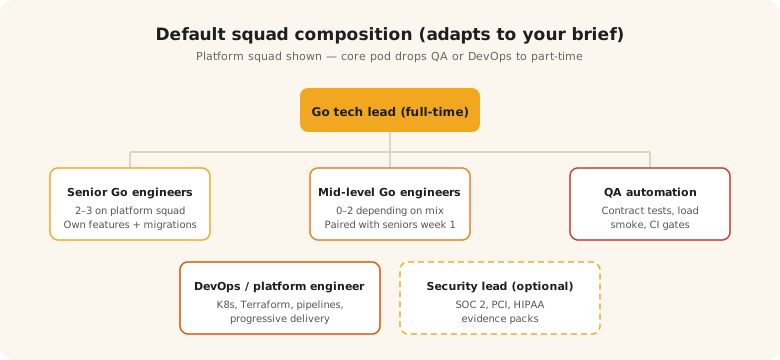
A dedicated team is not “N generic Go developers.” Roles exist because migrations and on-call fail when everyone is interchangeable.
The diagram shows our default platform squad. A core pod keeps the tech lead part-time and makes QA or DevOps fractional until traffic or compliance demands full-time coverage. A modernization squad often runs two seniors plus one mid under a full-time lead, with DevOps borrowed from your internal platform team until cutover week.
When a dedicated team beats staff augmentation
You lack a senior Go owner inside who can run architecture reviews, hiring bar, and production on-call for the language. You need a vendor accountable for a roadmap slice, not another ticket queue. You are mid-migration and cannot afford engineers who treat observability and contract tests as optional extras.
When staff augmentation is smarter
Your staff already has a strong Go tech lead and only needs throughput. The work is well-specified tickets with clear acceptance criteria. Compare our Go staff augmentation page for single-seat monthly bands and a faster seat-only ramp.
What we screen for that generic Go hiring misses
The last interview is always on production-shaped code, not puzzle libraries.
Most failed Go engagements we inherit share the same root cause: someone passed a whiteboard round but never owned a noisy service under load. Our bench process is built around signals you cannot fake in a thirty-minute trivia call. Roughly one in five internal Go profiles reaches a client shortlist; the rest fail on concurrency, migration depth, or operational habits.
- Concurrency under stress. Ninety-minute pair on our codebase: goroutine leaks, channel lifecycle,
contextcancellation races. We expectpprofand trace reading without hand-holding. - Migration scars. At least one bounded-context extraction, Kafka or Postgres cutover, or PHP/Node-to-Go strangler work—not only greenfield CRUD.
- Operational literacy. Engineers articulate SLO tradeoffs, write rollback steps, and instrument before merge—aligned with the Go 1.24 iterator and tooling shifts teams are adopting in 2026.
“We stopped asking whether candidates know Go syntax and started asking whether they have been paged for a goroutine leak at 2 a.m. That one filter removed more false positives than any Leetcode hard problem.” Javier Uanini, CEO and delivery lead
For a deeper view of how we run delivery once the squad is seated, see the fourteen-day path in the next section and our Go development outsourcing overview for project-shaped engagements.
The hiring process, end to end, in fourteen days
Long pipelines waste everyone’s time. We keep ours deliberately boring. Every step below is a deliverable with a named owner; nobody sits in limbo waiting for a recruiter to circle back.
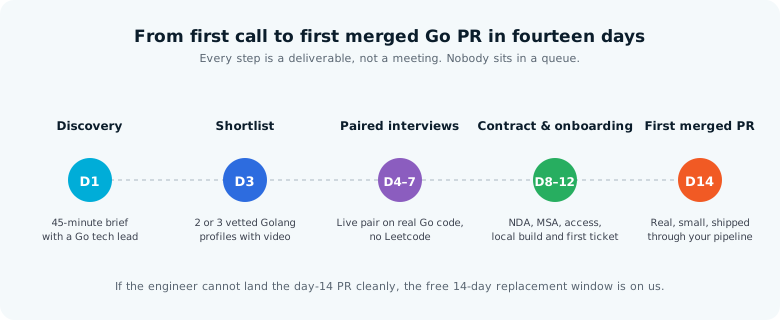
- Day 1 — Discovery call. Forty-five minutes with the account lead and a Go tech lead. We ask about current stack, service boundaries, traffic shape, seniority gaps, release cadence and the compliance envelope. You leave the call with a straight answer on whether we think the brief is a fit for us, and a one-page summary of what we heard.
- Day 3 — Shortlist. Two or three Golang engineers with matched seniority, plus a tech lead profile if the team includes one. You get a one-page profile per engineer, a public Git link where possible, a twenty-minute recorded technical interview, and a short write-up from our tech lead explaining specifically why each profile fits your brief.
- Days 4 to 7 — Paired interviews. A live ninety-minute pair session on a real Go problem from our codebase (usually a subtle goroutine leak, a concurrent map pitfall, or a context-cancellation race). No hidden Leetcode. Your lead sees how the engineer reads unfamiliar code, reaches for profiling tools, and pushes back when the question is wrong.
- Days 8 to 12 — Contract and onboarding. NDA and MSA signed digitally. Access provisioning: GitHub or GitLab, your project management tool, AWS or GCP, your observability stack. Architecture walkthrough with a senior on your side. By day twelve the team has a reproducible local environment, has run your test suite, and has triaged their first issue.
- Day 14 — First merged PR. Small and real: a bug fix, a minor refactor, a boring telemetry addition that lands in main and ships to production through your normal pipeline. Reviewed by your engineering lead, measured, and referenced in the day-14 check-in. If the team cannot land this first PR cleanly, the free fourteen-day replacement window is on us.
Most engagements run to this rhythm. A small number — typically enterprise legal reviews on the customer side — extend the contract step to day twenty or so. We do not pretend otherwise on the first call.
What the first thirty days look like with a dedicated Go team
A dedicated team fails when nobody agrees who owns architecture decisions, on-call, and the definition of “done” for migrations. The table below is the operating cadence we use on typical engagements so your internal leads are not guessing how we behave in week two.
Days 1–10: alignment and guardrails
Joint architecture map of services touching your critical path, written RACI for the tech lead versus your staff, and a single shared backlog column for “production risk” work. We pair with your SRE or platform contact on observability baselines before we touch hot paths. If you are still evaluating nearshore delivery models, this is the window where we prove overlap hours with real ceremonies, not slide promises.
Days 11–20: throughput without heroics
First merged PR is behind you; now we focus on repeatable releases. Error-budget language shows up in stand-ups, canary criteria are written down, and rollback drills happen on a non-production path. Typical pattern: two engineers own feature throughput, one engineer owns migration or performance risk, tech lead keeps the technical narrative coherent for your leadership.
Days 21–30: evidence, not vibes
We expect a short written scorecard: latency percentiles against the baseline you gave us on day one, incident count, PR cycle time, and test flakiness trend. If the numbers are flat or worse, we call a joint retro and adjust squad composition or scope before month two invoices accumulate.
The Go Delivery Readiness Check (three questions)
1. Who signs off on concurrency-sensitive changes? If the answer is “whoever is free,” you need a tech lead on the squad, not another mid-level hire.
2. Is your observability trustworthy today? If traces stop at the gateway, a Go rewrite will not fix trust—we sequence observability first.
3. Do you need ownership of a roadmap slice or staff for tickets? Roadmap slice → dedicated team. Tickets with internal architecture ownership → Go staff augmentation.
Dedicated Go team vs freelancers, in-house and large offshore vendors
Almost every buyer we talk to has already tried at least one alternative below. Here is the honest comparison. If a row does not match what you have seen, say so on the first call; we will adjust the framing rather than double down on a template.
Where freelance Go engineers win
Single-topic, scoped tasks with a clear definition of done. A one-off gRPC integration. A performance tuning pass on a stable service. A weekend prototype. Under roughly 80 hours of work, a seasoned freelancer from Toptal, Arc or Upwork is usually cheaper and faster than any team-based engagement.
Where freelancers hurt
Continuity and unglamorous work. Multiple concurrent clients, unannounced holidays, little appetite for dependency upgrades, flaky-test rescue, permission boundary reviews or audit preparation. You ship tickets fast, and the platform quietly rots around them.
Where an in-house Go team wins
Long-term ownership. If Go is the core of your product for the next three years and you can afford a three-month senior search, an internal team is irreplaceable. Plenty of our clients start with us, see what “good” looks like inside their stack, and then hire internally. That is a healthy outcome, not a lost account.
Where in-house hurts
Time-to-seat and cost. A senior Go engineer in San Francisco, Seattle or New York runs roughly USD 200k to 285k total comp. Hiring a full squad typically takes five to eight months. If one hire is wrong at month six, you pay severance and restart. For any twelve-month backend effort, a dedicated team is the right financial instrument first, with internal hiring following later.
Where large offshore agencies win
Warm bodies at low headline rates when the work is genuinely generic: CRUD services, simple adapters, well-specified ticket queues. If the brief really is “give us ten Go developers and assign them tickets” a big-five offshore firm is built for that shape.
Where large offshore hurts
The engineer you interview is rarely the one who commits. Timezone overlap with North America is two to four hours, at most. Modernization, observability and on-call are treated as extra scope. Notice periods run 30 to 90 days, which makes ramp-down painful when a project ends.
Where we fit in
Small, senior, full-time employees in a timezone that overlaps a full US business day. You interview the exact engineers who will work on your platform. Observability, on-call discipline, modernization work and compliance evidence are part of the default scope, not line-item add-ons. Minimum commitments are three to four months, notice is 15 days either side after that.
If you want project ownership rather than team augmentation, look at our Go development outsourcing service. Same engineers, different commercial model.
Real Go team scenarios we see repeatedly
These are composites from recent engagements. Details are anonymised, numbers rounded, but the shapes are accurate. They are here because buyers usually want to know whether their situation is something we have handled before, not a novelty we are improvising.
Scenario A — the Rails checkout that fell over on Black Friday
Context. US direct-to-consumer brand, Rails monolith since 2016, checkout started timing out at roughly 1,200 orders per minute. Internal team strong on Rails, zero Go experience.
What we did. Core Go pod of three engineers for five months. Extracted the inventory reservation and payment orchestration paths into two Go services, fronted by a thin Rails controller. Added OpenTelemetry traces, Prometheus dashboards and a proper idempotency key on every write.
Outcome. Checkout held 4,800 orders per minute during a stress test, then 3,100 on actual Black Friday without degradation. Rails team kept shipping features the whole time.
Scenario B — the logistics platform nobody wanted to own
Context. UK logistics SaaS, Go services built by two engineers who then left. No tests worth the name, goroutines spawned for every request, memory profile growing by a few hundred MB a day until the pods restarted.
What we did. Platform squad of five for six months. Stabilised the memory leak (a channel never closed inside a retry loop). Introduced context cancellation properly, moved hot paths to worker pools with bounded concurrency, added contract tests between services, and wrote runbooks the internal SRE team adopted.
Outcome. Pod restart frequency went from every 18 hours to every 21 days. p99 latency dropped by 43%. Two junior engineers on the client side learnt enough Go to own the services afterwards.
Scenario C — the usage-based billing rebuild
Context. B2B SaaS on Series C, billing ran on a Postgres-heavy Node service that double-charged roughly 0.3% of customers every month. Finance had lost faith in the reports.
What we did. Modernization squad of four for four months. Designed an event-sourced usage ledger in Go with Kafka as the event bus, ClickHouse as the analytical side, and a reconciliation job comparing ledger totals with Stripe and the legacy service nightly. Kept the Node service live until the Go ledger had one full billing cycle of clean reconciliation.
Outcome. Double-charge rate dropped to zero for three consecutive cycles before cutover. Finance trusted the reports again. Node billing service retired in month five with a written decommission plan.
Scenario D — the fintech audit deadline
Context. Canadian fintech, SOC 2 Type II audit window fourteen weeks out, Go backend with patchy logging, no centralised audit trail, and IAM roles built up ad hoc.
What we did. Core Go pod of three plus a part-time security lead for twelve weeks. Introduced a signed append-only audit log, normalised IAM through a policy-as-code layer, reworked the logging middleware to tag every request with tenant, actor and purpose, and produced the evidence pack the auditor asked for.
Outcome. Clean SOC 2 Type II report in month one of the next window. Zero findings on audit-log handling. Engineering team kept shipping features through the preparation; no freeze was needed.
Mini case study
How a logistics scale-up cut dispatch latency from 820 ms to 180 ms in twelve sprints
FleetPulse composite — numbers rounded, shape accurate.
Client. An Argentina-headquartered logistics scale-up we will call FleetPulse, operating in five Latin American countries with a daily peak of 25,000 dispatch decisions. Backend was a five-year-old PHP monolith with a small Go service doing routing. The monolith was fine for operators; it was painful for carriers and drivers, whose apps depended on real-time decisions.
Brief. Move the dispatch decision engine into Go, expose it through gRPC to the driver apps, and keep the PHP monolith as the system-of-record for operators. Target p99 latency below 200 ms. Ship in time for a peak-season contract with a new retail partner twelve sprints away.
What we did. A platform squad of six: four Go engineers, a tech lead, a DevOps engineer plus a part-time QA automation specialist. Week one produced a dependency map of every PHP code path that touched dispatch. Week two introduced a gRPC contract and a Go service that shadowed the PHP logic in dry-run mode, writing its decisions to a side Kafka topic for comparison. By sprint four, the shadow service matched PHP decisions on 99.6% of dispatches, with the divergences investigated one by one. Sprint five to eight hardened the service: bounded worker pools, structured logs tied to dispatch IDs, OpenTelemetry traces across driver app, gateway, Go service and Postgres. Sprint nine ran a 5% canary, then 25%, then 100%. PHP kept serving operators throughout; the driver flow moved to Go without a visible incident. The routing library, a thin wrapper around an open-source graph implementation, ended up as a small internal Go module the team could test in isolation.
Result. Dispatch p99 latency dropped from 820 ms to 180 ms, measured at the driver app. Carrier disputes fell by 22% in the first full month on the new service (a proxy for dispatch accuracy under load). The new retail partner went live on schedule. FleetPulse hired two of our engineers at month fourteen on a zero-fee conversion after the standard twelve-month window.
Honest caveat. Sprints 1 and 2 looked slow from the outside because the shadow service did not change any user-visible behaviour. The client’s CTO asked twice whether the pace was right. Once the dry-run parity data landed in sprint 3, that question stopped. If you compare features shipped in month one, this engagement looks worse than a feature-only squad; that is a property of migration work, not a failure mode.
At a glance
Industry: Logistics SaaS, LATAM
Engagement: 6-person squad, 6 months
Stack: Go, gRPC, Kafka, Postgres, OpenTelemetry
p99 latency: 820 ms to 180 ms
Dispute rate: -22%
Cutover: zero visible incidents
“Siblings Software felt like an extension of our own engineering org. They were the first partner to quantify the ROI of architectural decisions in a way our leadership could rally behind, and the first one who made me trust a cutover on a peak-season weekend.”
VP of Product, FleetPulse
Risks of hiring a Go development team, and how we actually handle them
Any vendor claiming a dedicated Go team is risk-free is either new to this work or selling. Here are the four failure modes we see most often, and the specific controls we use against each.
Risk: the engineer looks strong on paper and stalls in week three
How we handle it. Vetting ends in a live pair session on real Go code from our own codebase, not a puzzle library. Two-week free replacement window. On day 14 the account lead asks your engineering lead one question: “if this were a full-time hire, would you keep them?” In the last 18 months we have swapped two engineers on Go engagements, both inside the free window.
Risk: the migration stretches into a perpetual rewrite
How we handle it. We plan migrations screen-by-screen or bounded-context-by-bounded-context, keep the legacy system live every sprint, and refuse a big-bang cutover. Every slice has a written acceptance scorecard (latency, error rate, parity with the legacy path). Any slice still red after two sprints triggers a reassessment call with your leadership, not another silent extension.
Risk: knowledge walks out when the engagement ends
How we handle it. Documentation is a line item, not a favour. Architecture Decision Records for non-obvious choices (why this framework, why this message broker, why this concurrency pattern), READMEs per service, runbooks for deploy, rollback, hotfix and incident response. If you end the engagement tomorrow, your internal team inherits a map, not a scavenger hunt.
Risk: latency or error rates quietly drift after the “big push”
How we handle it. Latency and error-rate budgets wired into CI. A blown budget blocks merges the same way a type error would. SLO burn is reviewed in the weekly ops call alongside engineering progress, so regressions get triaged by the same people who ship features, not by a separate reliability team quarterly.
Why Siblings Software specifically
Decide based on facts, not slogans.
11+
Years shipping Go backends
Founded 2014 in Córdoba, Argentina
40+
Go engagements delivered
Fintech, logistics, SaaS, devtools
GMT-3
Argentina timezone
Full same-day overlap with US Eastern
We are deliberately small. There is no sales organisation chasing headcount. Javier Uanini still takes most discovery calls personally and reviews every Go engagement with the assigned tech lead. Our engineers speak with clients directly from week one. That is the real reason onboarding is fast: nobody in the middle translating requirements into and out of a project manager’s notes.
Things buyers usually get wrong when shopping for a Go team: asking for an hourly rate before explaining the work (you will be quoted the lowest possible number and the real cost will arrive as change orders), assuming any backend engineer will be productive in Go within a week (the garbage collector, context cancellation semantics and the concurrency pitfalls take longer than that to internalise), and treating bench depth as proof of capability (in Go specifically, small and senior beats large and generic, because the language punishes people who reach for a framework before they understand the standard library).
After twelve continuous months, most clients can hire an engineer they worked with directly without a conversion fee; before that window a modest placement fee applies. Ask on the first call if you know upfront that conversion is a goal so we structure the agreement cleanly.
For adjacent stacks where we also place full teams, compare against Node.js teams, Java teams, Python teams and our general back-end development practice.
Frequently Asked Questions
A tech lead, senior and mid-level Go engineers, QA automation and a DevOps profile, all full-time on your engagement. They use your Git repository, your Jira or Linear board, your CI pipelines and your incident channels. They attend your stand-ups, sprint plannings and retrospectives. Commercially they are on our payroll in Argentina, so you avoid local employment, benefits and payroll-tax overhead. Minimum commitment is three months, 15-day notice either side after that.
A core Go pod of 2 to 3 senior engineers plus a part-time tech lead is USD 14,000 to 24,000 per month. A full platform squad of 4 to 6 engineers with a dedicated tech lead, QA automation and DevOps is USD 28,000 to 58,000 per month. A modernization squad of 2 to 4 engineers for a PHP, Node, Ruby or Java to Go migration is USD 18,000 to 38,000 per month. Pricing is all-in: recruiting, benefits, laptops, paid time off and Argentine taxes are included. Third-party services such as AWS, Datadog, Sentry or PagerDuty stay on your accounts.
Discovery call on day one, 2 or 3 shortlisted Go profiles by day three, paired technical interviews between days four and seven, contract and onboarding by day twelve, first merged pull request by day fourteen. Full squads take one additional sprint to reach steady velocity, typically by day 28. Faster is possible when engineers are already on the bench; slower happens only when the brief changes mid-process.
All full-time employees of Siblings Software, based in Argentina. No rotating benches, no unnamed subcontractors. You interview the exact engineers who will work on your platform, and they stay on your engagement for the full term unless the fit is wrong.
Inside the first 14 calendar days, the replacement is free and we cover the handover overlap. After that the standard notice is 15 days either side. Replacements inside the free window are rare because vetting ends in a live pair session on real Go code from our own codebase, not abstract puzzles.
Staff augmentation supplies individual engineers who plug into your team; you manage them. A dedicated team is a managed unit: we supply the tech lead, the internal code-review culture, the delivery rituals and the accountability for the plan. Use augmentation when you have strong internal Go leadership and need extra hands. Use a dedicated team when you do not have someone senior inside who can own architecture, hiring and on-call for Go specifically.
Yes. Every engagement starts with a mutual NDA and a Master Services Agreement that assigns all source code, derivative rights and work product to the client on payment. We work inside your repositories, cloud accounts and tooling. We do not retain copies of client code once an engagement ends.
The last gate is always a ninety-minute pair session on production-shaped Go from our internal codebase: a goroutine leak, a context-cancellation race, or a concurrent map pitfall. We watch for pprof habits, honest pushback when the prompt is wrong, and migration scars (Postgres cutover, Kafka rewrite, strangler-fig). Roughly one in five bench profiles reaches a client shortlist. Engineers who last touched Go only in tutorials rarely pass.
OUR STANDARDS
Go engagements run like production software, not a staffing spreadsheet.
- Latency and error-rate budgets are code. Per-service budgets wired into CI. A blown budget blocks merges the same way a failing test would.
- Context cancellation is non-negotiable. Every handler, every worker, every outbound call honours
context.Context. We reject PRs that spawn goroutines without a documented exit path. - Pull requests are reviewed by your lead. Our engineers are embedded in your process, not reviewing each other in a parallel bubble.
- Observability ships with the feature. A new endpoint lands with its traces, metrics, structured logs and dashboard entry from the first commit, not retrofitted the sprint after launch.
- Secrets live in a vault, not env files. AWS KMS, HashiCorp Vault or GCP Secret Manager by week two. No “one senior has the credentials” dependencies.
- Written artefacts. Architecture Decision Records for non-obvious choices, READMEs per service, runbooks for deploy, rollback, hotfix and incident response. Handover is a file tree, not a phone call.
Contact Siblings Software Argentina
Tell us about the backend, the current stack and what you need to ship next quarter. We reply within one business day, or say so on the first call if we are the wrong fit. Prefer the US site? Use siblingssoftware.com for the same page on the .com host.