Hire a Dedicated Java Development Team
· Typical time to first merged change: 10 to 14 days
Hire a dedicated Java development team when you need a nearshore squad to co-own a Spring Boot domain, enterprise API layer, or migration stream without running separate recruiting, QA, and tech-lead searches. Siblings Software is a software development outsourcing company in Córdoba, Argentina. We staff squads with four to eight hours of overlap with US and Canadian product teams under our dedicated teams practice.
Most buyers on this page already run Java in production. The question is whether a managed squad with tech lead, engineers, QA, and delivery contact fits better than adding individuals through staff augmentation or waiting six months to hire in-house. This page explains when a squad makes sense, standard composition, how we vet Java engineers, the first thirty days, governance, quality gates, published monthly bands, comparison with alternatives, risks we contract against, and an illustrative engagement. For one or two embedded engineers, see Java staff augmentation. For broader outsourcing context, see Java development outsourcing and back-end development.
Reviewed by Javier Uanini, CEO and delivery lead, Siblings Software.
When a dedicated Java team makes sense
Situations where a managed squad solves better than adding Java developers one by one.
Spring monolith with slow releases and rising incident load
Internal teams are firefighting. You need a squad to own a bounded domain (billing, inventory, onboarding) with tests, runbooks, and weekly merges without freezing the rest of the roadmap.
Microservices extraction or Java version upgrade
Strangler migrations and Java 11 to 21 moves need dual-track delivery, Testcontainers coverage, and a tech lead who treats the upgrade as a scheduled program, not a side project.
Engineering lead without bandwidth to manage contractors
You have product direction but no senior Java tech lead locally. The squad brings architecture review, module QA, and a delivery contact from sprint one.
Event-driven backend beside a separate front-end squad
Kafka topics, idempotent consumers, and REST contracts need an accountable backend unit that does not share standups with your React team by accident.
Java Platform Readiness Test (3 questions)
1. Will the stream run at least four months with continuous backlog, not a six-week patch?
2. Do you need ownership of a domain (service, module, or platform area) rather than ticket execution?
3. Can a client-side technical approver review architecture and merges within forty-eight hours? Three yes answers usually mean a dedicated team; otherwise start with nearshore staff augmentation or hire software developers for individual seats.
Standard squad composition
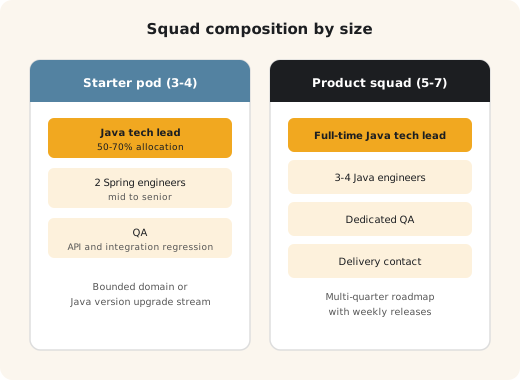
Typical roles by engagement size.
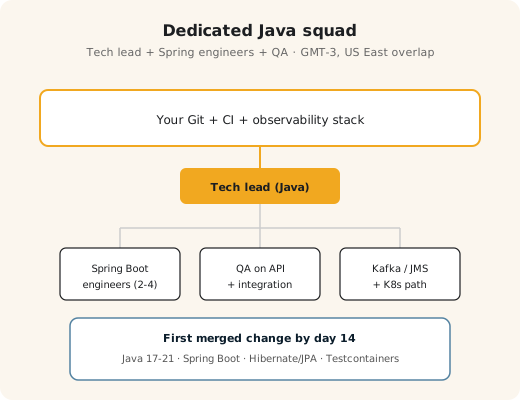
Starter pod (3 to 4 people): senior Java tech lead (50 to 70 percent allocation), two mid-to-senior Spring engineers, QA focused on API and integration regression. Fits a bounded domain or upgrade stream.
Product squad (5 to 7 people): full-time tech lead, three to four Java engineers, dedicated QA, delivery contact. Fits multi-quarter roadmap with weekly releases.
The tech lead sets standards (Spring Boot conventions, checkstyle, dependency policy), reviews critical pull requests, and pairs with your architects. Engineers ship features, fixes, and refactors; QA validates business flows and async jobs before each release. Adjacent JVM work often pairs with our Kotlin dedicated team when Android or shared service layers need parallel coverage.
How we vet Java engineers before squad assignment
Dedicated squads fail when the wrong seniority lands on production Spring code. We screen for engineers who have shipped and maintained Java services, not only completed training modules.
Initial screen: production Spring Boot or Jakarta EE experience, familiarity with your general stack (messaging, SQL, CI), and clear written communication in English for standups and pull request reviews.
Technical session: live work on production-shaped problems: an N+1 query on a JPA repository, a Testcontainers integration test for a REST endpoint, or explaining transaction boundaries on a money path. We look for Hibernate session awareness, honest pushback when a design is wrong, and habits around logging and observability.
Tech lead gate: the squad lead interviews finalists on module boundaries, dependency upgrade policy, and how they would document a Kafka topology change. Your engineering lead can join this session before contract signing.
Red flags we filter out: résumés with only tutorial or greenfield projects, inability to explain connection pool or thread-pool tuning, skipping integration tests on touched services, or treating Spring annotations as a substitute for understanding the underlying JVM behavior.
The first 30 days
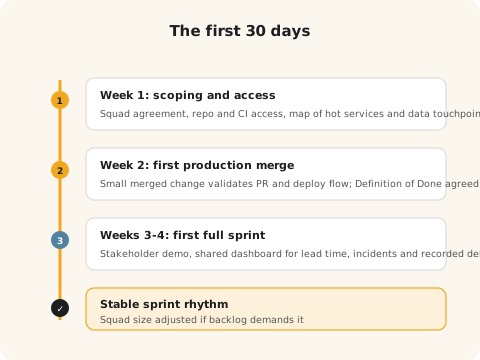
Clear ramp: access, first merge, stable sprint rhythm.
Week 1: scoping call, squad agreement, repo and CI access, read of existing ADRs, map of hot services and database touchpoints.
Week 2: first small production merge (fix, endpoint, or pipeline hardening) to validate pull request and deploy flow. Agree Definition of Done, minimum test coverage on new code, and feature-flag policy if needed.
Weeks 3 and 4: first full sprint with stakeholder demo. Shared dashboard for lead time, module incidents, and recorded debt. Adjust squad size if backlog demands it.
Slow client onboarding (legal review, VPN setup, architecture approver availability) is the most common delay we see. We flag that in the discovery call instead of promising unrealistic start dates.
Governance and communication
Shared ceremonies, readable reporting, one delivery contact.
Weekly rhythm
Shared standup when time zones overlap, async updates in Slack or Linear otherwise, weekly module demo, biweekly retrospective with concrete actions.
Architecture and pull requests
Critical changes reviewed by tech lead plus a second engineer. ADRs for schema changes, public API contracts, and messaging topology shifts.
Leadership reporting
Monthly summary with stream velocity, domain incidents, open debt, and release risks using metrics your CTO already tracks.
Java quality standards
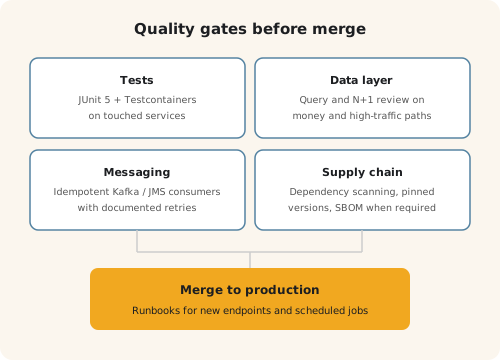
What we enforce before merge on production Java code.
- JUnit 5 and Testcontainers on touched services; no silent skipping of integration paths.
- Query and N+1 review on money and high-traffic endpoints.
- Idempotent consumers and documented retry behavior for Kafka or JMS jobs.
- Dependency scanning and pinned versions in CI; SBOM export when compliance requires it.
- Runbooks for on-call on new endpoints and scheduled jobs.
For long-lived enterprise modules we align with Jakarta EE platform guidance where your codebase still depends on it, rather than forcing a rewrite to match our preferred stack.
Pricing and monthly bands
Published nearshore ranges from Argentina.
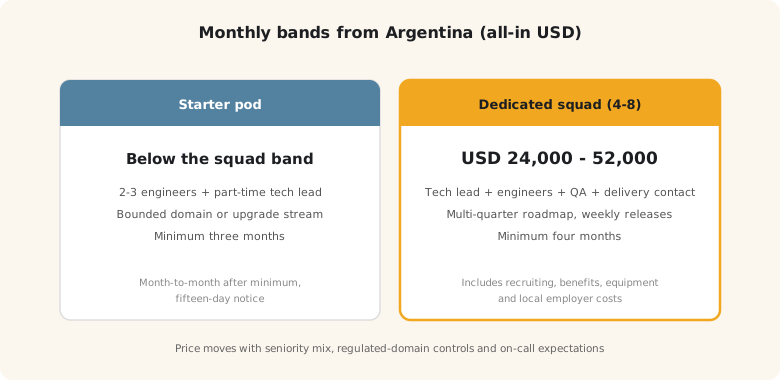
Dedicated squad (4 to 8 people)
USD 24,000 to 52,000 / month all-in, aligned with nearshore development dedicated-team bands including tech lead, QA, and delivery contact.
Includes recruiting, benefits, equipment, and local employer costs. Excludes your cloud, observability SaaS, and paid middleware licenses.
Starter pod
Two to three engineers plus part-time tech lead typically sits below the band above. Minimum recommended: four months for a product squad, three months for a bounded upgrade or rescue stream. After the minimum, month-to-month with fifteen-day notice.
Cost drivers: seniority mix, regulated-domain controls (audit trails, segregation of duties), on-call rotation, and US-hours coverage beyond standard overlap.
Request a written quote through our dedicated teams hub; we respond on business days.
Dedicated Java team vs in-house hiring, freelancers, and staff augmentation
Each option is valid depending on horizon, leadership bandwidth, and how much ownership you need on the module.
In-house hiring
Best when you will fund a Java tech lead and QA bench for years and can wait three to six months to hire. A dedicated squad is faster when a domain backlog is already late and you need a managed unit on your repo within weeks.
Freelancers
Useful for a short fix or spike. Weak fit for multi-quarter Spring work that needs consistent review standards, Testcontainers discipline, and continuity through releases.
Staff augmentation
Right when you already have a strong Java lead who only needs extra senior hands. A dedicated team adds tech lead, QA, and delivery contact when that leadership does not exist locally. Compare models on the dedicated teams hub or hire Java developers for individual seats.
Example engagement
Illustrative scenario based on common Spring Boot squad patterns. Not a named client case study.
Context (illustrative): B2B logistics platform on Spring Boot 2.7, roughly 220k lines, twelve internal engineers. Order fulfillment latency spiked on peak days. The team suspected JDBC pool exhaustion and Kafka consumer lag but lacked tracing to confirm without pausing roadmap work.
Work delivered: five-person squad (Java tech lead, three Spring engineers, QA). Two-week sprint zero mapped fulfillment services, connection pools, and consumer groups. Then domain ownership: HikariCP tuning, consumer rebalancing, distributed tracing on critical paths, contract tests on REST APIs, and an operator runbook for peak-load incidents.
Outcome: the fulfillment module returned to predictable weekly releases with incidents under operational control and internal capacity freed for customer-facing features. For documented client work see case studies and our Java development service page.
Fit signals
- Four-plus month domain backlog
- Async jobs without clear owner
- Releases blocked by regression fear
- No local Java tech lead available
Risks and how we reduce them
Knowledge concentration
Light ADRs from week one, weekly architecture notes in your wiki, and pairing with any internal engineer you still have. Even a few hours of overlap per week reduces bus factor on a critical Spring module.
Slow client approvals
We agree a named architecture approver and merge SLA in the squad charter. If reviews stall, we surface it in the weekly report instead of letting the sprint quietly slip.
Scope creep across domains
The squad agreement names the bounded module, repositories, and out-of-scope areas. Expanding ownership requires a written change, not an informal Slack ask mid-sprint.
Security and IP
Engagements start with mutual NDA and MSA assigning deliverables to you. Engineers work in your repositories and cloud accounts. We do not host production data on Siblings infrastructure.
Frequently Asked Questions
A nearshore squad working full-time on your Java product: Spring Boot services, Jakarta EE modules, batch jobs, and integration layers. It includes a tech lead, backend engineers, and QA with shared ceremonies. It is a managed unit with delivery contact, not single-seat staff augmentation or a fixed-scope project quote from day one.
A product squad of four to eight people with tech lead, QA, and delivery contact typically runs USD 24,000 to 52,000 per month all-in from Argentina, aligned with our published nearshore dedicated-team bands. A smaller starter pod of two to three engineers plus part-time tech lead sits below that range. Price moves with seniority, regulated-domain controls, and on-call expectations.
Expect three to five weeks from first call to the first sprint with production-shaped merges. Week one is scoping and access; week two lands a small merged change; weeks three and four complete sprint zero with agreed Definition of Done. Your onboarding speed (repo access, CI credentials, architecture approver) is usually the bottleneck.
Choose a dedicated team when you need ownership of a backend domain for four or more months, a tech lead to set Spring and data-layer standards, and QA covering regression on the module. Choose staff augmentation when you already have a strong Java lead and only need extra senior capacity for a short horizon.
Java 17 to 21, Spring Boot, Spring Cloud, Jakarta EE, Quarkus, Hibernate/JPA, Maven and Gradle, JUnit and Testcontainers, Kafka and RabbitMQ, PostgreSQL and Redis, Docker and Kubernetes, and CI/CD on GitHub Actions, GitLab, or Jenkins. We match engineers to your existing stack rather than forcing a greenfield template.
Yes. We present a filtered shortlist, typically three to five candidates per role. Your engineering lead interviews finalists. The squad tech lead joins the scoping call so you meet the people who will review production pull requests.
We replace them. Within the first fourteen calendar days the swap is free with overlap for context transfer. After that, fifteen-day notice either side. Squad continuity is part of the model so you are not dependent on a single contractor mid-release.
We start with a production-experience screen on Spring Boot or Jakarta EE, then run a live technical session on production-shaped problems such as N+1 queries, Testcontainers coverage, or transaction boundaries. The squad tech lead interviews finalists on module design and messaging changes. Your engineering lead can join before signing. We filter out profiles with only tutorial work, weak integration-test habits, or shallow JVM understanding.
OUR STANDARDS
Measured delivery, honest reporting, code your team can maintain.
On Java squads we track lead time on the owned module, integration test pass rate on touched services, and open debt tied to release risk. If a metric moves the wrong way, we say so in the weekly report with a concrete mitigation plan, not a polished slide deck.
Contact Siblings Software Argentina
Tell us your Spring version, domain boundaries, and release cadence; we reply with squad shape and next steps.