Hire Go Developers for Your Software Team
· Typical time to first merged PR: 12 to 15 business days
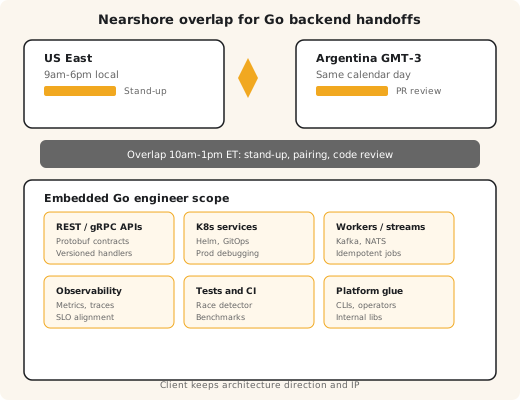
Hire Go developers through Siblings Software when you need senior Golang engineers embedded in your squads without a six-month local search. We place full-time engineers from Córdoba with four to eight hours of overlap on US Eastern hours. Buyers use this page to compare pair vetting on production-shaped code, published USD monthly bands, module and protobuf onboarding, and when a single seat beats a vendor-owned pod.
On this page you can evaluate buyer scenarios, weekly scope for embedded Go work, go.mod and protobuf hygiene, vetting and seat-level fit signals, engagement models and pricing, the 12 to 15 day hiring path, alternatives to freelancers and in-house hiring, illustrative migration shapes, the NetApp engagement, risks we contract around, and eight FAQs including monorepos with private modules. When you need a self-contained squad instead of individuals, see our dedicated Go development team page. Parent service: staff augmentation. Related: multi-stack hiring, nearshore developers, Go outsourcing, API outsourcing, platform engineering.
Prefer numbers before a call? Jump to monthly pricing bands for embedded seniors, pairs, and small pods.
Who hires embedded Go engineers through us
Four buyer shapes from October 2026 discovery calls; yours may combine two.
Platform teams with a broken hiring funnel
Go services in production, healthy internal culture, and requisitions open long enough that roadmap bets slip. Staff aug bridges the gap while you close an in-house hire, or becomes the steady state when recruiting cost is not where you want margin to go.
Teams modernizing toward Go without pausing delivery
You are not chasing a rewrite fantasy. You need someone who can own a strangler path from Java, Node, or Ruby into Go services, keep protobuf contracts honest, and ship weekly while dependencies move.
Leaders who inherited Go they did not write
Post-acquisition or post-departure, you need a calm audit: which packages are liabilities, where goroutine patterns are unsafe, which services lack tracing. The goal is a written map before anyone suggests a big bang migration.
Products where Go is the backend spine
gRPC between services, workers on Kafka or NATS, CLIs for operators, controllers beside Kubernetes. The work is idiomatic Go under real SLO pressure. We screen for that explicitly because a tutorial-level resume often misses production scars.
None of the above? Say so on the call. We turn down engagements when the fit is wrong, which keeps our bench credible.
What Go developers do in real client teams
Day-to-day work, not a Wikipedia definition of Golang.
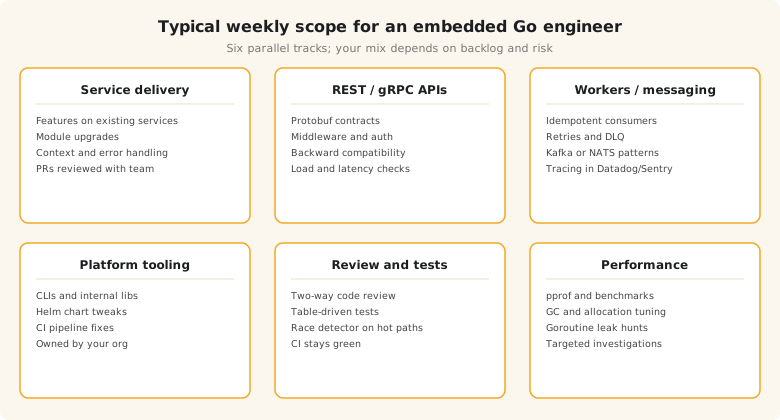
Senior Go developer is an overloaded title. In a typical month, an embedded engineer might ship gRPC handler changes, harden a worker that consumes Kafka events, review module upgrades, pair on a race surfaced in staging, and document a runbook for the service that pages when queue lag spikes. The diagram below is a schematic of those parallel tracks; your mix depends on backlog and risk.
REST and gRPC services
Handlers, middleware, auth, protobuf versioning, and backward-compatible API changes. We align with the official Go documentation and your team's lint and review rules.
Kubernetes and cloud-native delivery
Deployments on EKS, GKE, or AKS, Helm or GitOps, secrets, health checks, and production debugging with your platform team. For cluster-heavy gaps, see Kubernetes staff augmentation.
Workers and streaming pipelines
Idempotent consumers, retries, dead-letter queues, and tracing hooks compatible with observability tools you already pay for.
Platform glue owned by your org
CLIs, shared internal libraries, CI fixes, and small operators. We treat this as first-class engineering, not throwaway scripts.
Modules, protobuf contracts, and repo hygiene
Decisions an embedded Go engineer touches in week one, not abstract language trivia.
Buyers often hire Go for throughput but discover the real friction is dependency policy: which modules live in a shared monorepo, how protobuf packages version, whether CGO is allowed in CI, and who approves a major Go toolchain bump. Our engineers align with your existing rules from day one and document exceptions in ADRs instead of silently forking patterns.
go.mod, workspaces, and private code
We work with single-module repos, go.work layouts, and private module proxies. Onboarding covers GOPRIVATE, checksum DB exceptions you already run, and how renovate or dependabot tickets are triaged on your team.
Protobuf and gRPC compatibility
Field additions, reserved numbers, and breaking JSON gateway changes are negotiated with your API owners before merge. We treat generated code as a contract surface, not a throwaway build artifact.
CGO, cross-compile, and release targets
Some teams forbid CGO in containers; others need it for SQLite or crypto bindings. We confirm your Dockerfile and CI matrix before promising static binaries or multi-arch builds.
Reference material we align to
Module semantics and versioning follow the Go module reference and your internal platform docs, not personal preference.
How Siblings vets Go developers
Resume screens miss the failures that show up in week three. We end on live pair work.
Before anyone joins your stand-up, we run a written scoping answer on a small design question, then a ninety-minute pair session on production-shaped Go: a goroutine leak, a context-cancellation race, or a concurrent map pitfall. We check communication in English or Spanish, how they explain tradeoffs to a tech lead, and whether they reach for tests and the race detector before refactors on money paths. Red flags we screen out: candidates who cannot read an existing module tree, who treat goroutines as free parallelism, or who need a rewrite to show value in week one. Roughly one in five bench profiles reaches a client shortlist.
External reference: we align with the official Go documentation and current release notes such as Go 1.24, not outdated tutorial patterns.
Three signals before you add a Go seat
Staff augmentation fit checks, distinct from the squad-level readiness model on our dedicated Go team page.
Before we shortlist, we walk through three seat-level questions with your tech lead on a thirty-minute call. They are about whether one embedded engineer can succeed in your repo, not whether you need a full vendor-owned pod.
- 1. Is there a named reviewer for Go pull requests? Staff aug works when someone on your side can approve concurrency, module, and protobuf changes. If nobody owns that queue, a dedicated Go team with its own lead is usually safer.
- 2. Can on-call absorb another service owner? Adding a seat often means another runbook and escalation path. We confirm paging rules before start so your embedded engineer is not the silent default for every Go binary.
- 3. Is the backlog ticket-shaped for four to twelve weeks? Clear acceptance criteria and existing patterns favor staff aug. A greenfield platform rewrite with no internal Go leadership is a different commercial shape; we say so on the call.
For the squad-level version of this decision tree, see the Go Delivery Readiness Check on our dedicated Go development team page. Here we stay focused on single-seat and small-pod staff augmentation.
Engagement models and monthly ranges
Published bands beat “contact us for a quote” when you are budgeting a quarter.
We publish ranges because hidden pricing wastes cycles. The point inside the band moves with seniority, how much stakeholder-facing English you need, and rare depth such as service mesh depth, regulated environments, or multi-cluster operations.
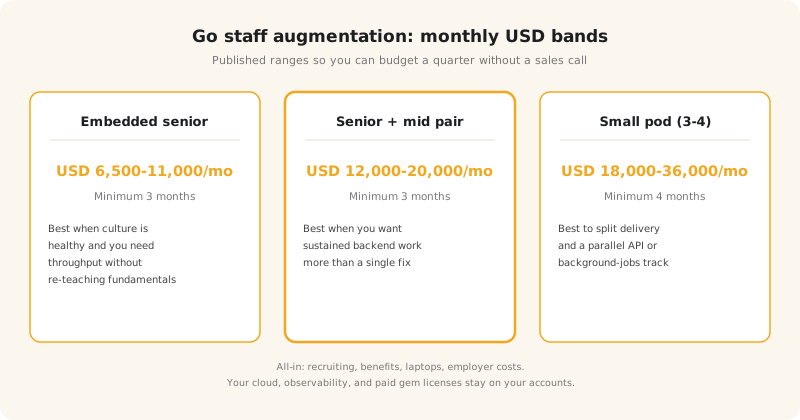
Embedded senior
One senior in your ceremonies and code review rotation. Strong when your engineering culture is healthy and you need additional throughput without re-teaching basics.
Monthly: USD 6,500 to 11,000. Minimum: three months.
Senior + mid pair
The senior sets quality and architecture guardrails; the mid-level absorbs tickets quickly once context lands, usually by week four. Common when you want sustained velocity more than a single niche specialist.
Monthly: USD 12,000 to 20,000. Minimum: three months.
Small pod (three to four engineers)
Covers vacations internally and can split between API work and a parallel workers or platform track under your tech lead. If you want a vendor-owned roadmap instead, a dedicated Go team is usually the better commercial shape.
Monthly: USD 18,000 to 36,000. Minimum: four months.
Figures include recruiting, benefits, laptops, and Argentine employer costs. Infra and SaaS (AWS, GCP, Azure, Datadog, Sentry, PagerDuty) stay on your accounts.
How hiring a Go engineer through us works
Short, inspectable steps that end with you meeting the person who will commit.
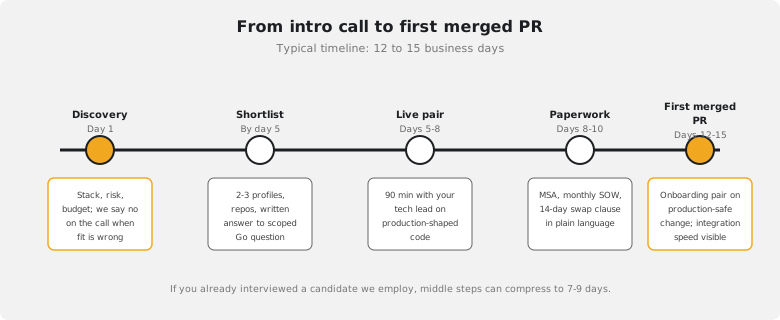
- Discovery (day 1). Stack, team topology, risk areas, hard nos on tooling, budget envelope. We say no on the call when we are the wrong partner.
- Shortlist (by day 5). Two or three profiles from our bench plus, when needed, engineers we have tracked for years who are finishing notice elsewhere. You receive repos, talk recordings where available, and a written answer to a scoped Go design question.
- Live pair (days 5 to 8). Ninety minutes with your tech lead on a sanitised slice of work: failing job, sneaky N+1, or API contract mismatch.
- Paperwork (days 8 to 10). Master services agreement, monthly statement of work, fourteen-day swap clause in plain language.
- First merged PR (days 12 to 15). Onboarding pairs on a small production-safe change so you see integration speed, not slide decks.
Go with us versus freelancer, in-house, or large offshore bench
Each option wins sometimes; pretending otherwise wastes your time.
Freelance marketplaces
Win on narrow spikes under ~80 hours. Lose on continuity, gem audits, and queue hygiene when the incentive is ticket throughput.
In-house hiring in the US or UK
Wins on five-year ownership. Loses on funnel length and regret cost when the hire misses at month six while incidents continue.
Large offshore agencies
Win when you truly need ten mid-level ticket takers with a PM layer. Lose when the engineer in the interview is not the engineer in the repo, or when gRPC and Kubernetes depth are treated as change-order territory.
Where we sit
Small senior bench, GMT-3, full overlap with US Eastern hours, fifteen-day notice after the minimum, and the person you interview is the person who commits. That is the trade we optimize for.
Illustrative scenarios (anonymised composites)
Shapes we have shipped multiple times; details blended to protect clients. Not named case studies with verified metrics.
Strangler migration from Node to Go
US logistics SaaS carving event ingestion out of a Node monolith. Embedded senior plus mid pair, protobuf contracts first, Kafka consumer with idempotent writes, feature flags per route. Internal team kept shipping UI work while backend risk moved in controlled slices.
gRPC latency under load
UK data platform with p95 spikes on a hot gRPC path. Six-week engagement: pprof-led allocation fixes, connection pool tuning, context timeouts enforced consistently, dashboards wired to SLOs the team already tracked. On-call noise dropped without a rewrite.
Example engagement
NetApp: eight senior Go developers on platform engineering
Published case study. Enterprise platform delivery through staff augmentation.
Context. A global intelligent data infrastructure company needed to scale delivery of cloud-native services without pausing roadmap commitments. Hiring eight senior Go engineers locally on short timelines was unrealistic.
What we did. We placed eight senior Go developers through staff augmentation. Engineers embedded with platform teams, adopted internal standards, and owned vertical slices spanning REST and gRPC APIs, background workers, and observability aligned to enterprise SLOs.
Outcome. The engagement emphasized predictable latency, production ownership, and collaboration across time zones. Read the full snapshot on our NetApp case study. For API-heavy product work in a different domain, see the BinSensors case study (REST API and smart city platform).
At a glance
Model: Go staff augmentation
Scale: eight senior Go engineers
Focus: platform APIs, workers, observability
Risks of outsourcing Go developers and how we reduce them
Honest controls beat “risk-free” slogans.
Interview star, week-three stall
Mitigation: pair on real code, fourteen-day swap window, explicit day-fourteen check-in with your lead.
Shadow contractor behavior
Mitigation: refuse “side lane” engagements; our engineer joins your reviews both directions, not only outbound PRs.
Knowledge leaves with the engagement
Mitigation: ADRs for non-obvious calls, runbooks for jobs we touch, handover notes at month three even if you extend.
Vanity refactors instead of metrics
Mitigation: monthly scorecard on three to five numbers your leadership actually tracks: error budget, p95 on money paths, queue depth, lead time.
Why Siblings for Go staff augmentation
Small bench, direct access, no parallel sales organization inventing capacity.
30+
Engineers in-house
Córdoba-based team; fintech, health, retail, logistics clients
Dozens
Go staff aug placements
APIs, workers, Kubernetes, and platform services
GMT-3
Argentina overlap
Same-day with US East; workable with most US zones
We are deliberately not a fifty-person recruiting shop. Founders still review new Go engagements, and engineers talk to clients without a telephone game of account managers. That is why the process above stays short.
Reviewed by Javier Uanini, Founder & CEO, Siblings Software. Technical discovery on Go engagements, pricing bands, and fit decisions.
Frequently Asked Questions
Senior and mid-senior Go engineers employed full-time by Siblings and embedded in your team. They join your stand-ups, open pull requests in your repository, review code with your engineers, and work in your Slack or Teams. We cover recruiting, payroll, hardware, benefits, and Argentine employer obligations. You keep product direction, backlog priority, and intellectual property. Typical scope spans REST and gRPC services, Kubernetes deployments, background workers, observability aligned to your SLOs, module upgrades, and performance work with pprof and benchmarks.
A single senior Go engineer is usually USD 6,500 to 11,000 per month all-in. A senior plus mid pair lands around USD 12,000 to 20,000 per month. A three-to-four person pod with shared platform context is typically USD 18,000 to 36,000 per month. Figures assume a full-time month, include recruiting and local taxes, and exclude your own cloud, observability, and third-party licenses so you keep billing and data custody.
Most engagements reach a first merged production change in roughly 12 to 15 business days: discovery on day one, a two-or-three-person shortlist by day five, a ninety-minute live pair session on real Go code before day eight, paperwork by day ten, then onboarding with your tech lead. Security-heavy environments can take longer because access and compliance reviews need to be done properly.
The last gate is a ninety-minute pair session on production-shaped Go: a goroutine leak, a context-cancellation race, or a concurrent map pitfall. We watch for pprof habits, honest pushback when the prompt is wrong, and migration scars on real systems. Roughly one in five bench profiles reaches a client shortlist. If the match is wrong in the first fourteen days, we replace the engineer at no placement fee with overlap for handover.
Staff augmentation adds individuals who report to your leads and slot into your existing squads. A dedicated team is a self-contained pod with its own delivery lead, QA, and DevOps, better when you need a full product unit or lack internal Go leadership. We offer both models and will say which fits on the first call.
Yes. Our developers routinely work with EKS, GKE, AKS, and self-managed clusters. They help with Helm charts, GitOps, secrets management, and production debugging alongside your platform team. For cluster-heavy work without enough internal platform leadership, also see hire Kubernetes developers for staff augmentation.
We replace the engineer at no placement fee during the first fourteen days and cover reasonable handover overlap. After that, either side may exit with fifteen days notice. We track fit with a simple day-fourteen question to your tech lead so quiet failure modes do not drift for a quarter.
Yes. We routinely work inside go.work workspaces, private Git hosts, and module proxies behind your VPN. Onboarding covers GOPRIVATE patterns, checksum database exceptions you already approved, and how you tag semver for protobuf packages. We follow the module reference in the official Go documentation rather than inventing a parallel dependency workflow.
Our standards for Go work
What we hold ourselves to once embedded.
- Idiomatic before clever. Small interfaces, explicit errors, context propagation on outbound calls.
- Tests that protect money paths. Table-driven tests and race detector runs on hot packages.
- Services you can operate. Health checks, metrics, and traces that match how your team pages today.
- Module hygiene. Dependabot or Renovate on, vulnerable dependencies flagged with an owner.
- Concurrency reviewed. Goroutine lifetimes, channel boundaries, and shutdown paths reviewed like any other API change.
- Graceful shutdown tested. SIGTERM handling, drain timeouts, and in-flight request completion exercised in staging before production rollouts.
- Written artifacts. ADRs, short runbooks, README files on modules we introduce.
Contact Siblings Software Argentina
Describe the services, team topology, and risk areas. We reply within one business day, or tell you we are not the right partner.