Hire a Python Development Team
If you are searching for a Python development team, you are probably not looking for a language tutorial. You need people who can join a roadmap, understand an existing system, and ship backend or data features without creating a maintenance problem six months later.
Siblings Software builds dedicated Python teams for companies that need more than one developer but do not want to spend a quarter recruiting, onboarding, and replacing people. Our engineers work from Argentina across US-friendly time zones and are used to long-running product work in fintech, logistics, healthcare, ecommerce, and internal operations software.
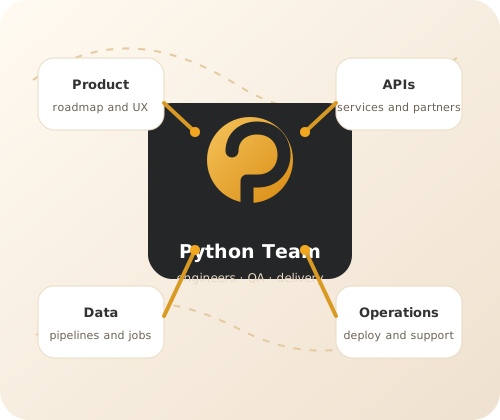
What buyers usually need to decide
Add headcount, hire freelancers, augment, or bring in a managed delivery team.
By the time a company looks for a Python development team, the question is rarely "what is Python?" The decision is more practical: add internal headcount, hire freelancers, use staff augmentation, or bring in a managed delivery team. Buyers want cost, speed, responsibility, and proof that the provider understands Python work beyond buzzwords.
Python is a good fit when your roadmap mixes backend product work, APIs, data processing, and automation. It is less magical when teams ignore architecture boundaries, add packages without ownership, or treat tests as something to add later.
Siblings Software is a good fit when you need steady product capacity and a team that can stay close to your own engineers. If you only need a one-week script or a cheap ticket closer, a freelancer may be enough. If you need people who can join planning, review tradeoffs, improve reliability, and still write code every day, a dedicated team is usually the better model.
Common buyer scenarios
- A CTO needs Python engineers faster than local hiring can deliver.
- A product team has a Django monolith that needs steady feature work and cleanup.
- A data-heavy company needs APIs, ETL, and dashboards owned by the same technical group.
- A US company wants nearshore collaboration without overnight handoffs.
When freelancers are enough
If the work is a one-week script, a single bug fix, or a contained migration that nobody plans to maintain, a single freelancer is usually faster and cheaper. The dedicated team model becomes useful when continuity, coverage, and shared responsibility matter more than the lowest hourly rate.
What your Python team can own
Specific work, not a generic list of technologies.
Product backends
Django, Django REST Framework, Flask, or FastAPI applications that support customer-facing products. This includes permissions, billing flows, admin tooling, background jobs, reporting, and backend support for React, mobile, or third-party frontends.
APIs and integrations
REST and GraphQL APIs, partner integrations, payment providers, CRM sync, healthcare interfaces, and internal service contracts. If API design is the main need, our API development practice can join the engagement.
Data pipelines
ETL jobs, data validation, scheduled imports, analytics exports, document processing, and operational dashboards. Python is strong here because the same team can work with pandas, SQLAlchemy, Celery, PostgreSQL, queues, and cloud storage.
Modernization
Framework upgrades, slow query fixes, test suite repair, monolith decomposition, Python 2 to Python 3 migrations, and dependency cleanup. We prefer staged modernization because full rewrites often become expensive rediscovery projects.
AI and automation
Document classification, workflow automation, model integration, human-in-the-loop review tools, and internal copilots. When the work moves deeper into AI products, we can connect the team with our AI development specialists.
Production support
CI/CD, logging, alerts, performance profiling, incident fixes, and cloud deployment support. Python work is rarely just Python; it touches containers, databases, queues, secrets, and release discipline.
For general Python outsourcing without a dedicated-team structure, see our Python development service page.
Engagement models and pricing guidance
Final cost depends on seniority, responsibility, and geography.
Competitors often publish broad hourly ranges because final cost depends on seniority, responsibility, and geography. That is fair, but not very useful by itself. In Latin America, senior Python engineering commonly sits below US in-house cost and above low-cost offshore markets. The value is not just the rate; it is the overlap, retention, and lower coordination drag.
Staff extension
Best for: teams with strong internal leadership.
You interview Python engineers, they join your ceremonies, and your technical leads own prioritization. This is the closest model to adding full-time employees without local recruiting delays.
Typical start: 1-3 engineers.
Managed Python pod
Best for: products that need delivery ownership.
A pod can include senior Python engineers, QA, DevOps support, and a delivery lead. You still guide the roadmap, but we help manage execution, quality gates, and weekly visibility.
Typical start: 3-6 people.
Focused build sprint
Best for: a defined module or rescue effort.
Useful for a FastAPI service, reporting module, integration batch, or test stabilization push. Once the sprint proves fit, the team can continue as a dedicated unit.
Typical start: 2-6 weeks.
What affects price most: seniority mix, production ownership, QA and DevOps coverage, regulatory context, US-hour overlap, and niche experience such as healthcare integrations or financial workflows. A compact nearshore Python team often starts in the low five figures per month. Larger managed teams are scoped transparently before kickoff.
How the hiring process works
A controlled ramp-up beats filling seats too quickly.
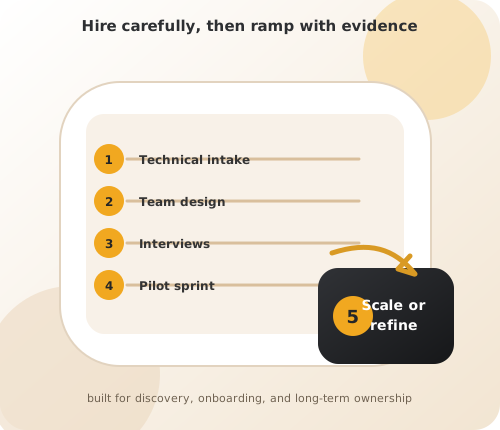
1. Technical intake
We review your product, codebase shape, backlog, stack, and team gaps. This is where we decide whether you need Django depth, FastAPI async experience, data engineering, DevOps, QA, or a simpler staff extension.
2. Team design
We propose roles, seniority, overlap, and responsibilities. A good plan may start smaller than requested; adding five engineers before the first sprint is sometimes a sign nobody understands the work yet.
3. Candidate review and interviews
You meet the people who will do the work. We keep interviews practical: architecture conversation, code review, API design tradeoffs, or a short technical exercise based on your real needs.
4. Pilot sprint
The first sprint proves fit. We set repository access, branch strategy, pull request rules, Definition of Done, test expectations, release path, and communication rhythm.
5. Scale or refine
After the pilot, we adjust team size, add QA or DevOps if needed, and agree on monthly reporting. Velocity matters, but escaped defects, cycle time, and production incidents tell the fuller story.
6. Monthly governance
We review velocity, quality signals, capacity, risks, and whether the team should stay the same, shrink, or grow. The goal is making decisions with evidence, not impressions.
Dedicated team vs freelancers, in-house, and agencies
Where each option works best.
Freelancers
Useful for isolated tasks, prototypes, or short scripts. Risk rises when the work needs continuity, shared architecture, QA coverage, and production ownership. One excellent freelancer can outperform a weak team, but one person is still a single point of failure.
In-house hiring
Best when Python is a permanent core competency and you have months to recruit. It gives maximum control, but it is slow and expensive when the need is immediate. Many clients use Siblings Software while they build internal capacity.
Traditional agencies
Good for fixed-scope delivery when requirements are stable. Less ideal when discovery continues during development, priorities change, or your team wants daily collaboration inside its own tools.
Dedicated Python team
Best when you need sustained capacity, direct collaboration, and a team that learns the business context. You can scale up or down more easily than in-house hiring while keeping more continuity than ad hoc contracting.
Mini case study: compliance workflow modernization
A realistic example of the work a dedicated Python team can own.
A financial services client had a familiar problem: compliance analysts were reconciling data from loan systems, spreadsheets, and third-party reports by hand. The old Django app had useful business logic, but it had grown around the process instead of replacing it. Reports took most of a day, failures were hard to trace, and every new rule created another spreadsheet.
We assigned a Python team with two senior backend engineers, one mid-level engineer, QA support, and a part-time delivery lead. The first month was not glamorous: data mapping, characterization tests, audit logging, and slow-query cleanup. Only then did the team move into new FastAPI endpoints and Celery jobs.
Within four months, report preparation dropped from roughly 14 hours to under 4, the operations team had a searchable audit trail, and product leadership had enough confidence to retire three manual steps. For a public example of our long-term product work, read the HighSide case study.
Team shape and stack
Team: 2 senior Python engineers, 1 mid-level Python engineer, QA support, part-time delivery lead.
Stack: Django, FastAPI, Celery, PostgreSQL, Redis, Docker, pytest, Azure services.
Risks we watch closely
Predictable failure modes, addressed early.
The codebase has hidden rules
Older Python systems often contain business logic nobody fully remembers. We start with tests, logs, and small changes before heavy refactoring. It feels slower for a week; it prevents expensive surprises later.
The team is staffed too broadly
More people do not automatically mean more output. We prefer a senior-heavy pilot, then add capacity once backlog quality, review bandwidth, and release cadence can support it.
Package choices become long-term debt
Python makes it easy to add dependencies. We review library health, maintenance activity, license fit, and operational impact. Official references such as the Python documentation, Django project, and FastAPI docs are part of the working baseline, not decorative links.
Nearshore still needs management
Time-zone overlap helps, but it does not replace clear ownership. We define who approves architecture, who merges pull requests, who can deploy, and what happens when production breaks.
How we work day to day
Visible work, named ownership, no theatrical ceremonies.
Siblings Software teams usually work inside the client's stack: GitHub or GitLab, Jira or Linear, Slack or Teams, existing CI/CD, and your preferred review process. We do not force ceremonies if your team already has working ones.
We do insist on visible work. Pull requests should explain intent. Tests should protect important behavior. Technical debt should be named instead of hidden. Releases should have a rollback path.
Clients often get one thing wrong: they ask for "a Python developer" when the real gap is ownership. A backend engineer, a data engineer, and a DevOps-minded developer may all write Python, but they solve different problems. We help separate those needs before staffing so you do not pay the wrong person to struggle in the wrong role.
Our company has been building software from Argentina for more than a decade, with teams used to US collaboration hours and long client relationships. Senior people stay close to delivery, which matters when the work is messy.
Questions buyers usually ask
The decisions that come up before the engagement starts.
Can we interview the engineers?
Yes. For dedicated teams, you should know who is joining and how they think. We recommend practical interviews around your architecture, not abstract trivia.
Do you take over an existing codebase?
Yes, if there is enough access and context to do it responsibly. We usually start with a short audit, dependency review, test assessment, and first backlog slice.
Can the team overlap with US hours?
Yes. Argentina's UTC-3 time zone makes collaboration practical with US East Coast and workable with Central and Pacific teams. We define core overlap hours during onboarding.
Who owns the code?
You do. Work is done in your repositories or transferred to them. We can follow your security, IP, and access requirements before kickoff.
Do you only provide Python developers?
No. Python teams often need QA, DevOps, frontend, data, or product support. If your need is broader, our dedicated development teams page explains the wider model.
What if the first sprint shows a mismatch?
We adjust quickly. The point of a pilot is to validate fit, workflow, and role mix before a larger commitment. A clean correction early is healthier than pretending the first plan was perfect.
OUR STANDARDS
Python engineers who treat your backlog like their own product.
Every Python engagement we lead is anchored by a senior engineer who has shipped Django and FastAPI applications, integrations, and data pipelines under real release pressure. We design teams around the decisions you actually need made, not job titles, and we keep the work visible through demos, written status, ADRs, and risk notes you can read in five minutes.
We document trade-offs in your repository, keep credentials in your accounts, prefer feature flags and staged rollouts over hero launches, and write the runbooks your future hires will rely on. The goal is not heroics. It is releases that stop feeling like events.
Contact Siblings Software Argentina
Tell us what your Python team needs to own.