Internal Tools Development Outsourcing from Argentina
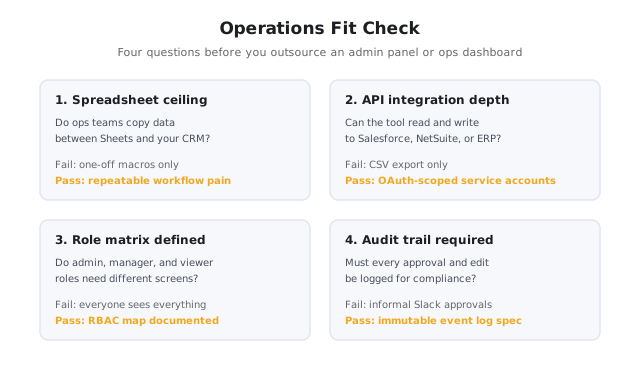
What: Production internal tools development means custom admin panels, ops dashboards, approval workflows, role-based access control, and API integrations that replace spreadsheet copy-paste with software your operators trust. Who: VP Operations, Head of RevOps, and engineering leads at B2B companies evaluating nearshore internal tools development, not a low-code prototype that breaks at the first compliance question. Problem: Ops teams juggle five systems, approvals live in Slack threads, and every new workflow means another Google Sheet nobody maintains. Why nearshore: Internal tool delivery needs same-day pairing with ops owners when an integration write fails in staging. How to evaluate us: Ask whether a vendor can show a documented role matrix, OAuth-scoped connectors, an immutable audit log, and code you own after handoff. That is our Operations Fit Check in the hero diagram.
We outsource the full internal tools stack: workflow discovery, RBAC design, React or Next.js admin UI, CRM and ERP connectors, approval engines, and operator runbooks for launch day. Need a single senior full-stack engineer embedded in your sprint board? See hire full-stack developers for staff augmentation.
Siblings Software is a software outsourcing company headquartered in Córdoba, Argentina, with daily overlap on US Eastern time. We have shipped outsourced engineering since 2014 across B2B SaaS, fintech, and logistics platforms. Browse the full catalog on our all services directory or compare our nearshore development model if procurement is weighing regions.
What the Service Covers
Internal tools development outsourcing is the engineering work of turning operational friction into software your team runs every day. A typical pattern: map the workflow ops already perform in spreadsheets, design a role matrix so admin, manager, and viewer see different screens, wire OAuth connectors to CRM and ERP systems, build an approval queue with an immutable event log, and hand off runbooks operators can follow without paging engineering.
That is different from buying a low-code admin builder. You own the repositories, RBAC policies, and integration code. It is also different from customer-facing product work: internal tools optimize for operator speed, audit trails, and write safety, not marketing polish. We build on stacks your team can extend through our full-stack development practice when you need both admin UI and service layer in one squad.
Security is part of the build, not a post-launch patch. We implement role-based access control at the API layer, not only in the UI, and follow OWASP authorization guidance for session handling and privilege escalation checks. Connector work pairs with our back-end development team when write paths need queueing, retries, or reconciliation jobs.
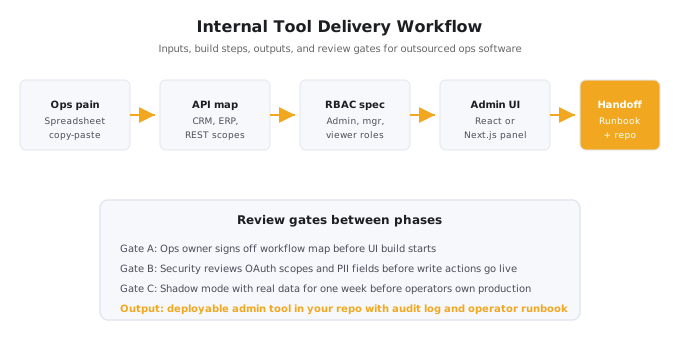
Most production internal tool programs treat audit logs and role gates as non-negotiable: every approval and data edit is recorded before operators get write access to production systems.
Who It Is For
B2B teams where operations outgrew spreadsheets but product engineering is focused on the customer app. If approvals still happen in Slack and nobody trusts the last Google Sheet version, you are the audience.
B2B SaaS operations teams
Customer success, support, and account management need admin consoles that read and write to your product database without giving everyone production SQL access.
RevOps and sales ops leads
Pipeline hygiene, quote approvals, and commission adjustments trapped between Salesforce and finance spreadsheets. Need a single workflow with an audit trail.
Logistics and fulfillment ops
Warehouse coordinators copy order data between ERP, WMS, and carrier portals. Need dashboards with exception queues and one-click status updates.
Finance and procurement
Invoice approval chains, vendor onboarding, and budget reallocation requests need multi-step workflows with role gates, not email forwards.
HR and people ops
Onboarding checklists, equipment requests, and access provisioning spread across Notion, Jira, and IT tickets. Need one internal portal with status tracking.
Product ops and platform teams
Feature flags, tenant configuration, and data corrections that engineering handles through ad hoc scripts. Need self-service tools with guardrails.
Typical Project Scenarios
Six situations we see on discovery calls. Each maps to a bounded MVP we can scope in the first week.
Replace a spreadsheet ops workflow
Customer success copies account data between your product admin, Salesforce, and a shared Google Sheet. We build an admin panel with filtered views, inline edits, and Salesforce sync so operators stop context-switching.
Stand up an approval queue for finance
Procurement requests bounce through email with no audit trail. We build a multi-step approval workflow with manager and finance gates, email notifications, and an immutable event log for compliance review.
Build a support console with write guardrails
Support agents need to issue credits, reset passwords, and update subscriptions without full database access. We build role-scoped actions with confirmation dialogs and logged side effects.
Connect ERP and warehouse systems
Order status lives in three systems and nobody sees the same number. We build an ops dashboard that aggregates reads and routes writes through idempotent API calls with retry queues.
Migrate off a low-code admin prototype
Retool or Airtable proved the workflow but cannot handle custom RBAC, audit requirements, or ERP write orchestration. We rebuild in your stack with code you own and connectors that pass security review.
Launch an internal portal for onboarding
New hires trigger tasks across HR, IT, and facilities with no single status view. We build a portal that tracks checklist progress, integrates with identity providers, and notifies owners when steps stall.
How Delivery Works
Six phases, usually six to ten weeks for a first production admin panel or ops dashboard. Shadow mode with real operators before declaring the tool production-ready is non-negotiable on workflows that write to billing or ERP systems.
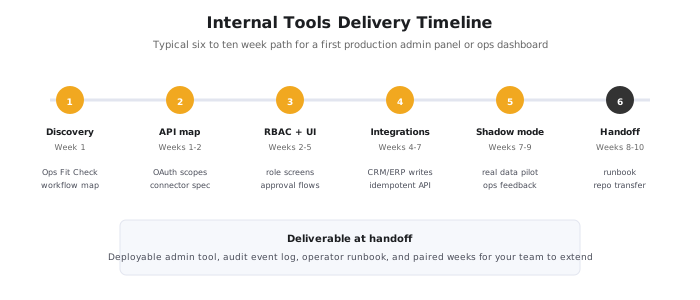
Discovery maps operator workflows, inventories existing spreadsheets and scripts, and runs the Operations Fit Check from the hero diagram. If the role matrix or audit log requirement is undefined, we document it before writing code.
API mapping defines OAuth scopes, read vs write endpoints, rate limits, and idempotency keys for each connector. Service account requests go to your security team in week one, not week six.
RBAC and UI implements role screens, approval queues, data tables, and search filters in React or Next.js. Permissions are enforced server-side following your documented role matrix.
Integrations builds CRM, ERP, and payment connectors with retry queues and dead-letter handling. We pair with back-end development when write paths need background jobs or reconciliation.
Shadow mode runs the tool alongside existing spreadsheets for one to two weeks. Operators flag mismatches before we cut over write access to production APIs.
Handoff includes operator runbooks, credential rotation steps, and paired weeks where your team extends screens under our review. Rollback paths are documented so on-call can act without paging us.
Team Composition
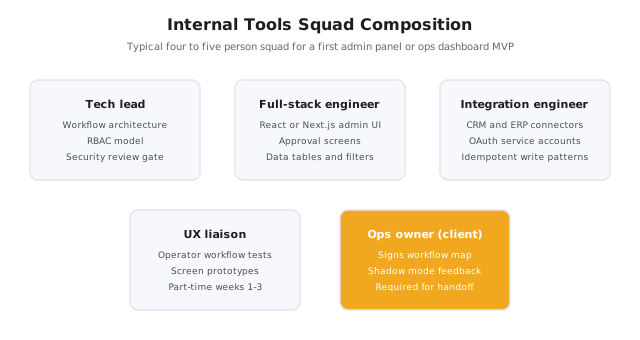
A four- to five-person squad is the usual shape for a first internal tool MVP. The integration engineer and the tech lead who owns RBAC are the two roles vendors cut to win on price. Those are also the roles that determine whether operators trust write actions after your next ERP schema change.
Typical roster: tech lead, full-stack engineer, integration engineer, UX liaison during discovery, and a part-time ops owner from your side who signs the workflow map. For ongoing tool expansion after launch, the same squad can run as a dedicated development team on a monthly retainer. For a single senior full-stack engineer inside your org, staff augmentation is the better fit.
Project, dedicated team, or staff augmentation depending on how much of the internal tools platform you want us to own.
Pricing and Engagement Models
Project-based
Fixed scope for a first internal tool: workflow map, RBAC, admin UI, two to three API connectors, audit log, operator runbooks. Typical duration six to ten weeks. Published bands run USD 25,000 to USD 150,000 after discovery, depending on integration count and compliance requirements.
Dedicated team
Ongoing squad owning tool expansion, new connectors, and operator feedback loops. USD 12,000 to USD 55,000 per month for four to six people depending on seniority mix and integration surface.
Staff augmentation
Embed one or two senior full-stack engineers when you already own architecture and need hands on admin UI, API connectors, or approval logic. USD 5,500 to USD 9,500 per month per senior engineer on published brackets.
Compared With In-House Hiring, Freelancers, and Agencies
Outsource when
- You need a first production admin panel in a quarter, not after a six-month hiring cycle for scarce full-stack-plus-integration talent.
- Your product team knows the customer app but not OAuth connector patterns, RBAC at the API layer, or audit log design for compliance.
- Ops leaders want a third party to document the Operations Fit Check and write paths before SOC 2 or enterprise diligence.
- You are planning multiple internal tools and want shared connector libraries and role patterns from the start.
Keep it in-house when
- You already run a mature internal platform team and only need a short spike on one new screen.
- Your workflow is a simple CRUD form with no multi-system writes and no compliance audit requirement.
- A low-code admin builder covers the workflow with acceptable limits on customization and logging.
Freelancers can ship a React admin quickly but rarely stay for connector hardening or shadow mode with operators during launch week. Nearshore delivery from Córdoba gives you senior full-stack profiles at a lower total cost than hiring the same mix in major US metros, with overlap your ops team can use. Browse case studies for examples of how we work with product teams.
Illustrative Scenario: Northline Operations
Composite illustrative scenario only. Not a published client case study. No performance metrics are claimed.
The situation
Northline Operations is a fictional B2B company selling field service scheduling software to commercial property managers. Customer success, billing, and fulfillment each maintain separate spreadsheets that copy data from the product database, NetSuite, and Salesforce. Approval for contract changes happens in Slack threads with no audit trail.
Support agents request credit adjustments through a shared inbox. Finance cannot reconcile which changes reached NetSuite. The VP Operations wants a single admin console with role-based screens, logged approvals, and write paths that do not require engineering tickets for routine account updates.
What we would deliver
A nine-week nearshore project with a five-person squad from Córdoba: tech lead, full-stack engineer, integration engineer, UX liaison, and part-time ops owner from the client side. Daily overlap with the US Eastern operations lead during discovery and shadow mode.
- Operations Fit Check documenting spreadsheet ceiling, API scopes, role matrix, and audit log requirements signed by ops and security.
- Admin console with admin, manager, and viewer roles: account search, subscription edits, and credit requests gated by approval queue.
- Salesforce and NetSuite connectors with idempotent write patterns, retry queues, and dead-letter alerts for failed syncs.
- Immutable event log for every approval, edit, and API write with export for compliance review.
- Operator runbook documenting shadow mode cutover, credential rotation, and how to add a new approval step without breaking existing workflows.
In a scenario like this, the win is operational: operators stop copying data between systems, finance trusts the audit trail, and engineering stops fielding ad hoc account change requests.
Risks and Mitigation
Operators reject the new tool. Shadow mode is skipped and the spreadsheet stays the source of truth. Mitigation: run parallel workflows for one to two weeks, assign an ops champion, and fix mismatches before cutting over writes.
Integration writes corrupt production data. Retries double-charge or duplicate records. Mitigation: idempotency keys on every write, dry-run mode in staging, and dead-letter queues with operator alerts.
RBAC gaps expose sensitive actions. UI hides buttons but API endpoints stay open. Mitigation: server-side permission checks on every route, automated tests per role, and security review before launch.
OAuth and service account delays. Connector work stalls waiting for security approval. Mitigation: scope requests in week one, document minimum permissions, and ship read-only views while write scopes are pending.
Vendor lock-in on connectors. Mitigation: integration code in your repositories, documented API contracts, and runbooks that do not require our login to operate.
Handoff failure. Mitigation: paired weeks where your team extends screens under review, recorded runbooks, and explicit ownership transfer checklist before we step down to advisory hours.
Questions buyers ask before the first discovery call
Frequently Asked Questions
Retool and low-code platforms ship fast for simple CRUD screens but hit limits on custom approval logic, multi-system write orchestration, audit trails, and role matrices that do not map to vendor widgets. Outsourced internal tools development builds custom admin panels and ops dashboards in your repositories with RBAC, API connectors, and compliance logging your security team can review. Low-code fits prototypes; custom code fits production workflows that touch CRM, ERP, and billing with idempotent writes and operator runbooks.
Admin panels for customer support and account management, ops dashboards for fulfillment and logistics, approval workflows for finance and procurement, data entry consoles that replace spreadsheet copy-paste, internal portals for HR and onboarding, and configuration tools for product ops. Most projects combine a React or Next.js front end, a Node or Python API layer, and connectors to Salesforce, NetSuite, Stripe, or your own REST services through our API development practice.
Common integrations include Salesforce, HubSpot, NetSuite, SAP, Stripe, Shopify, Zendesk, Jira, Slack, Google Workspace, and internal REST or GraphQL APIs. We use OAuth-scoped service accounts, webhook listeners, and idempotent write patterns so retries do not double-charge or duplicate records. When a system only exposes CSV exports, we design a staging import path and document the manual fallback until an API is available.
A first production-ready admin panel or ops dashboard with two to three API integrations, RBAC for three roles, and an audit log typically ships in six to ten weeks. That includes discovery, workflow mapping, connector build, UI implementation, shadow mode with operators, and handoff runbooks. Timelines stretch when OAuth approvals are slow, the role matrix is undefined, or security review blocks service account scopes.
Project-based builds for a first internal tool typically land between USD 25,000 and USD 150,000 depending on integration count, RBAC complexity, and compliance requirements. Dedicated squads run USD 12,000 to USD 55,000 per month for ongoing tool expansion and connector maintenance. Senior staff augmentation for full-stack engineers ranges from USD 5,500 to USD 9,500 per month per engineer on published brackets via hire full-stack developers. We confirm pricing after discovery once we know your workflow map and API surface.
You do. Application code, API connectors, infrastructure-as-code, RBAC policies, and operator runbooks ship to your repositories under your IP. We document how to add a role, rotate OAuth credentials, and replay a failed write without paging us. Managed on-call for the internal tool is optional, not a requirement to keep operators productive.
Yes. Delivery teams are based in Córdoba, Argentina, with daily overlap on US Eastern business hours. Internal tools projects need same-day iteration with ops owners and engineering leads when an approval workflow blocks a launch, so timezone alignment matters as much as it does for customer-facing product work.
Related Services