Managed iOS App Development Outsourcing for Product Teams
We build native iOS apps end to end for founders, product teams and enterprises that would rather ship than manage a mobile practice from scratch. Under this model Siblings Software owns scope, architecture, delivery and the App Store release. You own the product, the IP and the roadmap.
Most clients come to us after a prototype stalled, a freelance contractor disappeared, or a first vendor missed an App Store review deadline. We take the code, finish the product and put it in a shape your future in-house team can actually maintain.
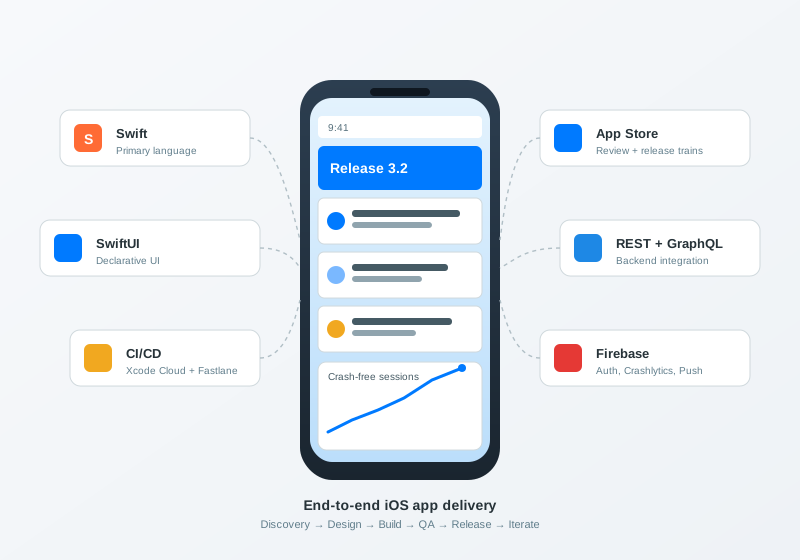
Who actually outsources iOS development to us
In roughly a decade of work we have noticed four profiles that benefit most from a managed iOS engagement rather than hiring individual contractors or a local agency.
Seed and Series A founders without a mobile CTO
You have product-market-fit signal on the web or on Android, but your iOS build was skipped or outsourced to a freelancer who moved on. You need a team that writes Swift the way your future hires will write it.
Product-led scale-ups with a stretched mobile team
Your internal Android and backend engineers are strong, but iOS has fallen behind: crash-free sessions are slipping, you are stuck on an old deployment target, and nobody wants to own a SwiftUI migration. You need a managed squad that absorbs the iOS roadmap without taxing internal leaders.
Enterprises with regulated delivery constraints
Banking, insurance, logistics and healthcare clients come with security questionnaires, penetration testing windows and a legal team that reads every clause. We have shipped inside those environments and we like them because they force good engineering practice.
Non-tech brands that need a flagship mobile presence
Retailers, media groups and service companies whose core business is not software but whose customers expect a native iOS experience. For these clients we usually deliver a fixed-scope build and hand it to a lightweight internal owner.
What iOS outsourcing really means in 2026
Managed delivery, not a body shop.
There is a version of iOS outsourcing that deserves its bad reputation: a hundred CVs, an unclear scope, and a folder of half-working builds three months later. That is not what we do. When we take an iOS project we take the result: a signed build in your App Store Connect account, a dashboard that shows crash-free sessions above 99 percent, and a codebase that a future engineer can read without a translator.
Practically, that means your engagement always includes an iOS tech lead as the single point of accountability, senior Swift developers doing the actual work, a QA engineer owning automation and release hygiene, and a product-minded delivery lead on our side. We write modern iOS: Swift with async/await and structured concurrency, SwiftUI where it is stable, UIKit where legacy screens require it, MVVM or VIPER architecture, Core Data or SwiftData for offline storage, URLSession or Alamofire for networking, and Xcode Cloud or Fastlane for CI/CD. For apps that share logic with Android we use Kotlin Multiplatform when it honestly pays off, not because it is fashionable.
We also invest in the parts that are easy to skip: a working app architecture, instrumentation, release documentation, a reproducible build, and a README that actually helps a new developer. The goal is that any in-house engineer you hire six months later can take over without a full-day walkthrough. For legacy Objective-C codebases that need a managed squad, see our dedicated Objective-C development team service.
Engagement models and honest pricing
We work under three iOS outsourcing models. They differ in scope control, risk distribution and how commercial terms are structured.
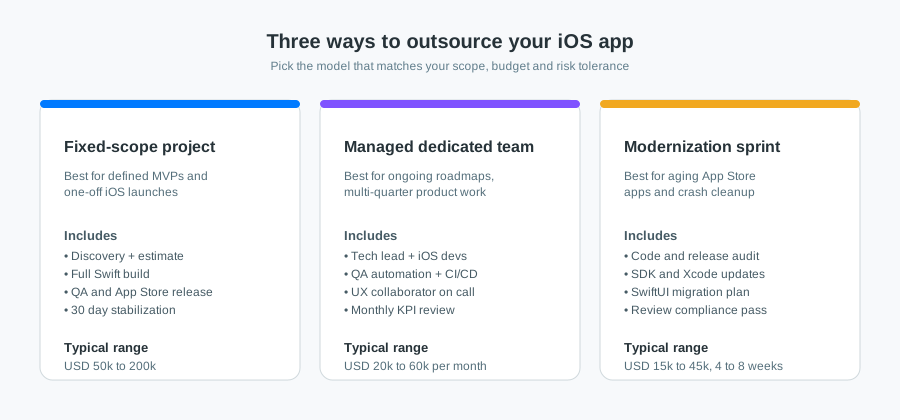
Fixed-scope project
You have a clear brief or we write one during a paid discovery. We quote a deliverable, a release date and a change-control process. You pay in milestones tied to demos, not to calendar days. Typical range: USD 50,000 to 200,000 for a production iOS MVP with backend integration, analytics and a phased App Store rollout.
Managed dedicated team
A multi-quarter retainer with a tech lead and a team sized to your roadmap. Good fit when you plan at least two quarters of iOS work, need flexibility in scope, or want the same people deep in your domain. Typical range: USD 20,000 to 60,000 per month depending on seniority mix and team size.
Modernization sprint
A short, fixed engagement for apps that exist but are drifting: deployment target behind policy, SwiftUI migration debt, crash spikes, dropped release trains. We audit, stabilize the top 20 percent of issues that cause 80 percent of the pain, and hand you a prioritized plan. Typical range: USD 15,000 to 45,000 over 4 to 8 weeks.
Note on pricing: We share ranges because we have seen clients waste months because nobody would give them a number. These are the bands we actually quote, anchored in senior nearshore rates. A precise estimate requires a brief call and, for larger projects, a short discovery sprint.
How we deliver an iOS project end to end
Every engagement follows the same seven-step arc. The depth of each step scales with scope, but none of them is ever skipped.
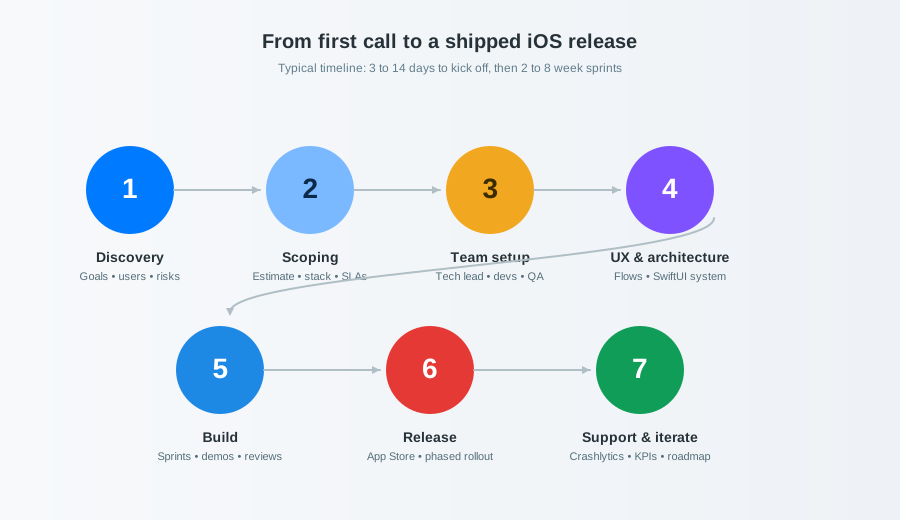
- Discovery. A focused 2 to 5 day engagement with product, design and engineering stakeholders. We map user flows, non-functional constraints, integration points, device targets and success metrics. Output is a written brief that both sides sign.
- Scoping. A written estimate with assumptions, risks, an architecture sketch and a proposed release plan. If you accept, the estimate becomes the baseline for change control.
- Team setup. We name the iOS tech lead, the senior developers and the QA owner, share their profiles and set up access. You meet them. Onboarding usually takes 3 to 7 working days.
- UX and architecture. We translate the brief into flows, component inventory, SwiftUI design system, data model and API contracts. This is where we push back if something will hurt later.
- Build. Two-week sprints with written goals, a mid-sprint check-in, a demo, a retrospective and a release candidate at the end. Every pull request is reviewed. Every merge runs the full test suite.
- Release. TestFlight internal testing, then external beta, then phased App Store rollout with Crashlytics monitoring and a rollback plan. We write the release notes. We keep the internal tester list small and honest.
- Support and iterate. 30 days of stabilization on fixed-scope engagements, or an ongoing cadence on retainers. We review KPIs monthly and propose what to work on next based on evidence, not opinion.
Realistic iOS projects we deliver
A sample of the shapes of work that fit our iOS outsourcing practice. These are the scenarios that come up in almost every discovery call.
Consumer and subscription apps
Onboarding flows, paywalls, StoreKit 2 subscriptions, push-driven re-engagement and analytics tuned to retention, not just installs. We design for App Store review from day one.
E-commerce and marketplace apps
Storefronts with personalized home screens, complex cart and checkout flows, saved addresses, Apple Pay and third-party payments. Paired with our back-end team when a new API is needed.
Fintech and regulated banking features
Face ID and Touch ID login, tokenization, device attestation, PCI-conscious flows, consent screens and detailed audit trails. We work alongside the client security team through penetration testing and remediation.
Healthcare and telehealth apps
Appointment booking, video consultations, HIPAA-aware data handling, and integrations with EHRs and HealthKit. Special care around background limits, notification reliability and accessibility.
Media and streaming apps
AVPlayer-based video, offline downloads with FairPlay DRM, AirPlay support, and adaptive layouts for iPhone and iPad. Analytics designed around playback quality metrics rather than just sessions.
Internal enterprise tools on managed devices
MDM deployments, supervised mode, SSO integrations and offline-first field workflows. Typically paired with a slim admin web app built by our front-end team.
A grounded case study: B2B payments iOS app
A venture-backed B2B payments platform came to us after a failed attempt to replace their Objective-C networking layer. Their iOS release train had been paused for three months. The revenue team needed virtual card issuing live before conference season and operations wanted SOC 2 friendly audit trails.
We ran a two-week discovery, wrote a brief, and proposed a fixed-scope modernization plus a three-month managed retainer. Concretely, we stabilized the legacy networking layer, migrated high-traffic screens to SwiftUI incrementally, introduced feature flags for risky changes, and rebuilt the release pipeline on Fastlane with TestFlight gates. Crash-free sessions climbed past 99 percent inside two months, releases moved to a biweekly cadence, and App Store ratings recovered from 3.1 to 4.5.
The full technical story, including how we handled Objective-C and Swift interop, is on our Objective-C development team page. It is a useful reference for teams that sit between a prototype and a real production product.
Engagement snapshot
Model: modernization sprint + 3-month retainer
Team: 1 tech lead, 2 senior iOS devs, 1 QA
Stack: Swift, SwiftUI, Objective-C, Fastlane, Firebase Crashlytics
Outcome: biweekly releases restored, App Store rating 3.1 to 4.5
Outsourcing vs freelancers, in-house and staff augmentation
Most buyers are really choosing between four ways to get an iOS app built. Here is how we actually see the trade-offs, including the cases where outsourcing is the wrong answer.
Freelancers
Lowest sticker price, highest variance. Works for a one-person marketing experiment. Falls over when you need code review, release hygiene, bus-factor resilience or someone to answer the phone during an App Store review rejection.
In-house iOS team
The right long-term answer for any company where iOS is core to the business. Wrong answer if you need to ship in six months, you do not have a mobile lead to hire and mentor, or you cannot compete for senior iOS talent in your market.
Staff augmentation
You manage the work, we supply senior engineers. Ideal if you already have strong internal iOS leadership. We run this model under our hire iOS developers service. Wrong fit when nobody internal has time to lead.
Managed outsourcing (this page)
We own scope, delivery and release. Best when you need a finished product on a schedule without building a mobile practice first. The cost per hour is higher than raw staff augmentation, because the rate includes architecture, coordination, QA and accountability.
Risks of outsourcing iOS, and how we mitigate them
Outsourcing has real failure modes. We have run into every one of these and we talk about them up front.
Scope drift and budget surprises
Mitigation: a written brief, a signed estimate, and a lightweight change-control document. Every scope change is logged with a cost delta before it is built.
Code that is hard to hand over
Mitigation: architecture decision records, living README, code reviews open to your engineers, and a documented build from day one. We assume someone else will maintain the app.
Communication gaps across time zones
Mitigation: Argentina sits in UTC-3, overlapping US business hours. We keep written async updates, and we hold one weekly 30-minute demo with stakeholders who actually care about outcomes.
App Store review and release risk
Mitigation: deployment targets tracked as a first-class task, App Store Connect reviews on a schedule, phased rollouts by default, and a documented rollback procedure.
IP and confidentiality
Mitigation: mutual NDA at first conversation, IP assignment on payment, ability to work inside your repositories and SSO. We have been through plenty of enterprise security reviews.
Vendor lock-in
Mitigation: standard open source stack, no proprietary platform, documented handover. If you want to replace us with an in-house team in a year, we will help you do it.
What most buyers get wrong before signing
We run roughly one scoping call per week where the buyer is about to make a decision they would regret in three months. A few patterns repeat.
- Picking a vendor purely on hourly rate. The cheapest quote almost always costs more after a year, because the true cost is rework, missed releases and a codebase nobody wants to touch.
- Skipping discovery. A one-page brief is never enough. The cheapest hour in the project is the hour spent writing down what the app must do before a line of Swift is written.
- Defining success as "feature parity with Android". iOS is not a translation of Android. Human Interface Guidelines, background limits and iPad layouts have to be first-class requirements.
- Asking for SwiftUI everywhere "just in case". UIKit still earns its keep in brownfield apps. Forcing a full rewrite to justify a smaller team usually backfires.
- Treating App Store approval as the last day. The first three weeks after launch are where most crashes and review issues happen. Plan for them.
iOS stack we work with
Languages and runtime
Swift with async/await and structured concurrency as primary. Objective-C where legacy code requires it. Kotlin Multiplatform when iOS and Android truly share logic.
UI and design
SwiftUI, UIKit for legacy screens, Human Interface Guidelines compliance, accessibility-first components, iPhone and iPad layouts, animations with motion-friendly defaults.
Architecture and state
MVVM, MVC and VIPER, SwiftUI observation and Combine, dependency injection, modularization by feature, build configurations per environment.
Data and networking
Core Data, SwiftData, Realm, URLSession, Alamofire, GraphQL when it fits, certificate pinning, offline-first sync with BackgroundTasks.
Quality and release
XCTest, XCUITest, snapshot tests, TestFlight, Fastlane, Xcode Cloud, signed builds, phased App Store rollouts.
Observability and security
Firebase Crashlytics, Sentry, App Attest, biometric APIs, Keychain, encrypted local storage, audit logging.
Frequently Asked Questions
Discovery, UX, architecture, Swift and Objective-C development, QA, App Store release and post-launch support. You get a tech lead, developers and testers coordinated by Siblings Software, with a single point of contact and a written scope.
In staff augmentation you manage the engineers. In outsourcing we manage the delivery. If you already have a strong internal iOS lead, consider our hire iOS developers service instead.
A production native iOS MVP usually lands between USD 50,000 and 200,000. A managed dedicated team runs USD 20,000 to 60,000 per month. A modernization sprint is USD 15,000 to 45,000 over 4 to 8 weeks. Final numbers depend on integrations, compliance and offline behavior.
Yes. Mutual NDA before the scoping call, Master Services Agreement at engagement start, and assignment of all work product and source code on payment. We are comfortable working inside your repositories, SSO and security tooling.
Yes. We start with a short paid audit, stabilize the highest-impact crashes, update deployment targets and dependencies, and then plan modernization. You keep shipping during the audit.
Siblings Software is headquartered in Córdoba, Argentina, with developers across several Argentine cities. Our working hours overlap with US Eastern and Central time, which makes live collaboration straightforward for North American clients.
OUR STANDARDS
Ship iOS apps that a future team will be happy to inherit.
Every engagement is run by a Siblings Software tech lead who has shipped production iOS apps for clients in the US, Argentina and Europe. We write Swift that reads like someone on your team wrote it. We keep crash-free sessions above 99 percent as a baseline, not as a stretch goal. We document what we build as we build it.
Our broader practice, described on the Siblings Software outsourcing and app development pages, exists because our own engineers asked for a place to work on real problems without the chaos. Your iOS project benefits from that standard, not from a marketing claim about it.
References and further reading
- Apple Developer Documentation, for platform behavior, background limits and permission changes we account for in every release.
- Human Interface Guidelines, the design system we implement through SwiftUI and UIKit for new iOS apps.
- App Store Review Guidelines, the source of truth we track for release compliance and policy deadlines.
- Swift language documentation we use as reference for concurrency, observation and modern standard library features.
Contact Siblings Software Argentina
Tell us about your iOS project. We will reply with a scoping plan.