Hire an Objective-C team that keeps legacy iOS shipping without a rewrite
· Average time to first TestFlight build: 10–12 days
Reviewed by Javier Uanini, CEO and delivery lead, Siblings Software.
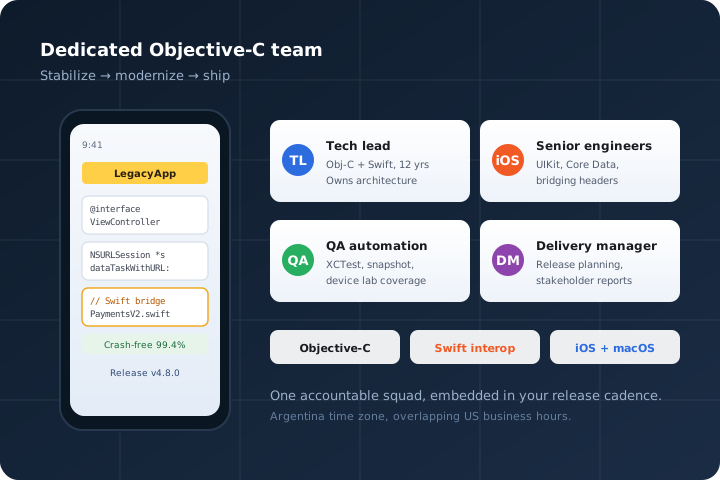
Most dedicated Objective-C team conversations we take start after App Review rejected a build, a senior iOS hire fell through, or leadership paused a Swift rewrite that was already three months in. If that is you, you probably need a managed squad with a tech lead who still reads .m files fluently—not another generic mobile agency deck. We assemble nearshore engineers in Argentina (GMT-3, strong overlap with US Eastern) through our dedicated teams practice, embed them in your Xcode project and rituals, and aim for a small, real TestFlight build in about twelve days.
This page spells out squad composition, published USD bands, the twelve-day hiring path, first-thirty-day governance, and when Objective-C staff augmentation is the smarter move. We also screen against what changed in 2025–2026—Xcode 16 build defaults, privacy manifests, and Swift 6 strict concurrency at language boundaries—so you are not getting engineers who last touched Objective-C only in tutorials.
Who actually hires an Objective-C development team from us
In the last two years we have noticed four buyer profiles who benefit the most from a dedicated Objective-C squad, rather than freelancers, a generic mobile agency or a premature rewrite in Swift. If you recognize yourself in any of them, the rest of this page is written for you.
Product teams with a 6 to 10 year old iOS app
You have a mature customer base, an App Store rating people trust and a codebase where most of the interesting logic still lives in .m and .h files. Hiring senior Objective-C engineers in your local market has become hard or expensive; most candidates now only want to write Swift.
Enterprises with AppKit or mixed macOS products
Banks, insurers, industrial software vendors and regulated SaaS companies that still run Objective-C on the Mac desktop. You need compatibility with new macOS versions, hardened signing, and compliance trails, without interrupting the workflows your users depend on.
Healthtech and medtech companies on regulated release trains
Your Objective-C iPad or iPhone app talks to Bluetooth devices, EHRs or clinical back ends. Every release is bound to regulatory approvals and audit evidence. You cannot afford a rewrite, but you cannot afford a stall either.
Teams that inherited an acquisition or a failed rewrite
Your company bought the product, the original team scattered, the rewrite attempt was paused six months in, and nobody is sure how the payments or auth flows actually work. You need engineers who are not afraid of method swizzling, associated objects and ten-year-old category files.
What a dedicated Objective-C team actually owns each sprint
“We maintain legacy iOS apps” does not help when you are evaluating three shortlisted vendors. The diagram below is what a typical Objective-C squad at Siblings Software owns inside a sprint.
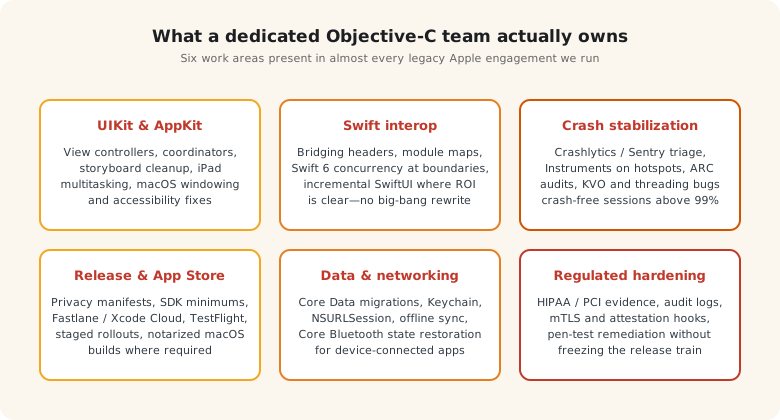
Every senior Objective-C engineer we place has shipped at least one production iOS or macOS app still in the store, owned at least one Core Data migration or App Review firefight, and carried at least one release through a pen-test window. Our Apple platform guild has delivered more than thirty legacy iOS engagements since 2016; roughly one in six bench profiles reaches a client shortlist after the pair gate.
For broader delivery context, see our Objective-C development outsourcing and mobile app development practices.
Engagement models and monthly pricing
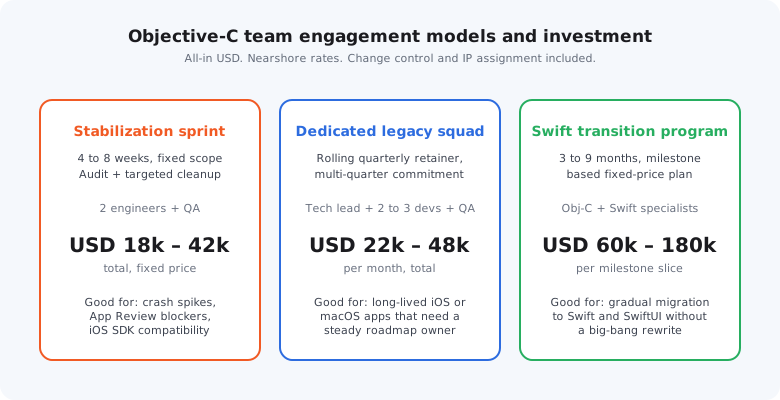
We publish price ranges because hidden pricing wastes everyone’s time. The bands below are what we actually quote for North American and European clients—not teaser numbers. If you need a single senior engineer inside an existing iOS org, compare against Objective-C staff augmentation instead.
Stabilization sprint
Fixed-price engagement of 4 to 8 weeks. Two senior Objective-C engineers plus a QA owner perform a paid code audit, stabilize the top crash signatures, refresh targetSdkVersion and the riskiest dependencies, and deliver a written modernization plan. Typical investment: USD 18,000 to 42,000. Good fit when App Review is rejecting your builds or crash-free sessions dipped below 98 percent.
Dedicated legacy squad
Multi-quarter retainer with a tech lead, two to three senior developers and a QA engineer. The squad owns the full Objective-C roadmap, runs biweekly releases and reports monthly KPIs. Typical investment: USD 22,000 to 48,000 per month. Good fit when Objective-C work is a permanent line in your budget and you need one accountable team behind it.
Swift transition program
A milestone-based, fixed-price program that migrates an Objective-C app to a hybrid Swift and SwiftUI codebase over 3 to 9 months. We move one feature module at a time. Typical investment per milestone slice: USD 60,000 to 180,000. Good fit when leadership is done with firefighting and wants a structured, boring path off Objective-C.
All ranges assume forty-hour weeks and include recruiting, benefits, laptops, paid time off and Argentine taxes. Apple Developer fees, physical device lab hardware and third-party SDK licences stay on your accounts.
The hiring process, end to end, in twelve days
Long pipelines waste everyone’s time. We keep ours deliberately boring. Every step below is a deliverable with a named owner.
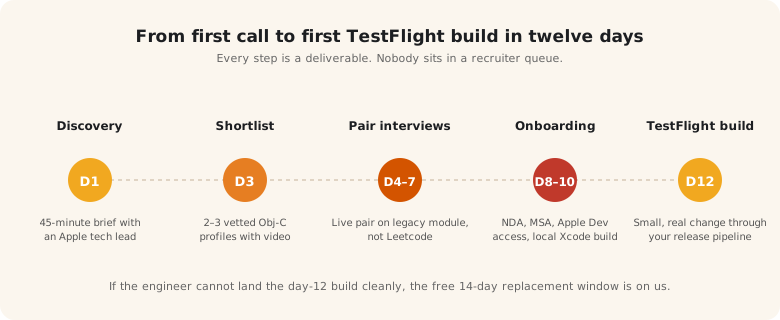
- Day 1 — Discovery call. Forty-five minutes with the account lead and an Apple tech lead. We ask about minimum OS version, crash trends, Swift migration politics, compliance envelope and release cadence. You leave with a straight fit/no-fit answer.
- Day 3 — Shortlist. Two or three Objective-C engineers plus a tech lead profile when the squad includes one. Each profile includes a twenty-minute recorded pair excerpt and a written note on why they match your codebase shape.
- Days 4 to 7 — Paired interviews. A live ninety-minute pair on a legacy module from our sample app: a retain cycle in a view-controller graph, a Core Data migration that fails on device, or a KVO observer that fires after dealloc. No Leetcode.
- Days 8 to 10 — Contract and onboarding. NDA and MSA signed. Apple Developer access, device lab, Xcode Cloud or Fastlane credentials, Crashlytics projects. Local build and test suite green by day ten.
- Day 12 — First TestFlight build. Small and real: a crash fix, a privacy-manifest update, or a dependency bump that ships through your normal pipeline. If the engineer cannot land it cleanly, the free fourteen-day replacement window is on us.
What the first thirty days look like with a dedicated Objective-C team
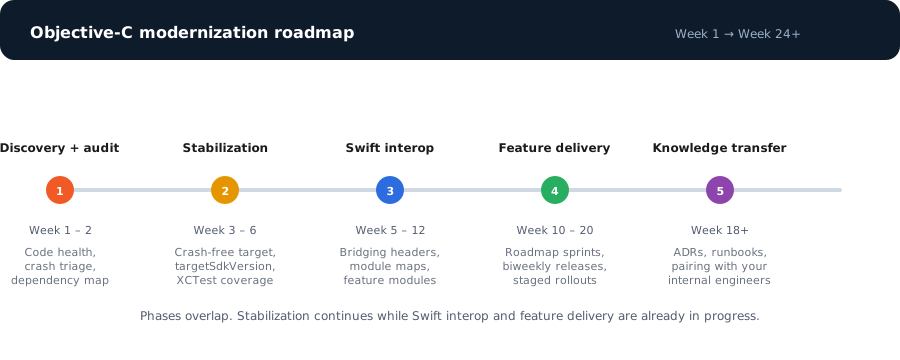
Dedicated teams fail when nobody agrees who owns architecture, App Review escalations and the definition of “done” for a Swift migration slice. The cadence below is what we use so your internal iOS lead is not guessing in week two.
Days 1–10: alignment and guardrails
Joint map of modules touching payments, auth or regulated flows. Written RACI for the tech lead versus your staff. Crash-free baseline from the last thirty days of production telemetry. If you are still evaluating nearshore delivery, this is the window where we prove ceremony overlap, not slide promises.
Days 11–20: throughput without heroics
First TestFlight build is behind you; now biweekly releases get predictable. XCTest coverage grows around the scariest Objective-C files. Roughly thirty percent of capacity stays on features even during stabilization—because stakeholders still need visible progress.
Days 21–30: evidence, not vibes
Written scorecard: crash-free rate versus baseline, App Review status, PR cycle time, TestFlight rejection count. If numbers are flat, we call a joint retro and adjust squad composition before month two invoices stack up.
The Legacy Continuity Test (three questions)
1. Is the app still earning revenue in Objective-C? If yes, optimize for continuity and module-by-module Swift—not a rewrite repo.
2. Does anyone inside own App Review and crash KPIs? If no, you need a delivery manager on the squad, not another mid-level hire.
3. Do you need a managed roadmap slice or extra hands? Roadmap slice → dedicated team. Hands with internal architecture → staff augmentation.
Realistic hiring scenarios we have delivered
A representative sample of the shapes of Objective-C work that actually come into our scoping calls. If your situation is not on the list, you will still recognize a neighbour.
Long-lived consumer iOS apps
High-traffic apps with millions of installs, where the product is fine but the codebase has drifted. We clear crash backlogs, modernize the networking stack on top of NSURLSession, and slowly introduce Swift for new features like widgets, App Intents or Live Activities.
Enterprise AppKit desktop tools
Internal macOS applications used daily by ops, trading or clinical teams. We keep them compatible with new macOS versions, sandbox and notarize where required, and add Swift-based reporting or settings screens alongside the legacy AppKit UI.
Regulated healthcare and medtech apps
Objective-C apps that integrate with medical devices over Core Bluetooth or talk to EHRs. We harden state restoration, add encrypted local storage, improve audit logging and introduce Swift modules for reporting, without touching the regulated flow.
Fintech and payments apps
Card issuers, PSPs and wallets whose original Objective-C stack still powers checkout. We refactor background sync, introduce device attestation, add Swift modules for virtual card provisioning or SCA flows, and work with the security team during penetration testing.
Media and streaming apps
Video apps built on AVFoundation with Objective-C view controllers that are painful to change. We replace brittle DRM or offline download modules, tighten telemetry and migrate the player UI to SwiftUI where the ROI is clear.
Acquisitions and inherited codebases
You just acquired a product and the mobile team is not coming along. We onboard, document, stabilize and keep the app shipping while your new internal owners get up to speed. Often paired with our staff augmentation service later in the year.
A grounded case study: PolarisPay payments app
PolarisPay, a venture-backed B2B payments platform, came to us after a failed attempt to replace their Objective-C networking layer. Their iOS release train had been paused for three months. The revenue team needed virtual card issuing live before conference season and operations wanted SOC 2 friendly audit trails. The legacy code was fine. The rewrite was not.
We proposed a two-week paid discovery followed by a dedicated legacy squad: one tech lead with deep Objective-C background, two senior Objective-C engineers, one Swift specialist and a QA engineer embedded in their compliance workflow. Concretely, we rebuilt the payments sync stack on NSURLSession background tasks, shrank sync times from roughly 22 seconds to 6 seconds, and cut failed requests by about 71 percent. We also added a Swift module for virtual card provisioning while leaving the Objective-C view controllers intact, which satisfied the board's “no big-bang rewrite” mandate.
By week ten, PolarisPay was shipping on a biweekly cadence again, cleared an external penetration test without rework and published the long-awaited release ahead of the customer summit. App Store ratings climbed from 3.1 to 4.5, and churn from their top 50 accounts reversed within a quarter. The full technical breakdown is on the PolarisPay case study page.
Engagement snapshot
Model: dedicated legacy squad + Swift interop
Team: 1 tech lead, 2 Objective-C devs, 1 Swift dev, 1 QA
Stack: Objective-C, Swift, NSURLSession, Core Data, XCTest, Fastlane
Outcome: 3.1 to 4.5 App Store rating, biweekly releases restored, clean pen-test
Dedicated team vs freelancers, in-house hires and agencies
Most buyers choose between four ways to cover Objective-C work. Here is how we actually see the trade-offs, including cases where a dedicated team is the wrong answer.
Freelancers
Cheapest sticker price, highest variance. Acceptable for a one-off fix. Fails when you need continuity, code review, a QA owner or someone to answer the phone during an App Review appeal. Bus factor is one.
In-house Objective-C hire
The long-term answer if Objective-C work is core to your product and budget. Usually wrong in practice: senior Objective-C engineers are now rare in most markets, and a single hire still leaves you with a bus factor of one for a 200,000-line codebase.
Generalist offshore agency
Low cost, broad supply, but rarely specialized in Apple platforms. Teams change between sprints, Objective-C depth is shallow, and subtle iOS bugs tend to survive releases. Works if you have strong internal leadership and only need hands.
Dedicated Objective-C team (this page)
Same people, every sprint, with a tech lead who owns the codebase. More expensive per hour than raw offshore, cheaper over 12 months than freelancers plus rework plus rewrites. Wrong if your only need is a one-week hotfix or a pure Swift greenfield build.
If what you actually need is individual engineers plugged into your existing iOS team, our Objective-C staff augmentation service is usually the better fit.
Risks of hiring an Objective-C team, and how we mitigate them
Outsourcing legacy iOS work has real failure modes. We have seen each of these first hand and we prefer to describe them up front.
Scope drift and surprise invoices
Mitigation: written brief, signed estimate, and a lightweight change-control document. Every scope change is logged with a cost delta before a line of code is written.
A team that writes code nobody can maintain
Mitigation: ADRs, a living README, documented build, code reviews open to your engineers, and paired debugging sessions. We write Objective-C the way your future hires will want to read it.
A Swift rewrite that never ships
Mitigation: migrate by feature module, never by “fresh repo”. Keep Objective-C paths healthy during the transition. Measure hybrid stability with the same crash-free KPI you measure today.
Communication gaps across time zones
Mitigation: Argentina is in UTC-3, overlapping US Eastern and Central business hours. Written async updates daily, one 30-minute live demo per week with stakeholders who actually care about outcomes.
App Review and release risk
Mitigation: targetSdkVersion, privacy manifests and App Review policy reviewed every quarter, TestFlight regression cycles, staged rollouts by default, and a documented rollback procedure per release.
IP, confidentiality and vendor lock-in
Mitigation: mutual NDA before technical calls, IP assignment on payment, plain open-source stack, full documentation and no proprietary tooling. If you replace us with an internal team next year, we help with the handover.
What most buyers get wrong before signing
We run about one Objective-C scoping call per week where the buyer is about to make a decision they would regret in three months. A few patterns repeat so consistently that it is worth naming them.
- Choosing the cheapest quote. Objective-C work on a ten-year-old codebase is unforgiving. A vendor who quotes half the market rate is almost always planning to learn on your project. The rework will cost you more than the senior rate would have.
- Treating Swift migration as the goal. The goal is a shippable product. Swift is a tool. Migrating every file without a reason creates risk without value. Migrate where Swift helps you do something Objective-C cannot, or where recruiting forces your hand.
- Skipping the discovery phase. Old codebases hide things: a custom KVO implementation, an abandoned category on
NSArray, a fork of a dead third-party SDK. A paid one to two week audit almost always pays for itself in the first month. - Underestimating Apple's release pressure. targetSdkVersion, privacy manifests, App Tracking Transparency, App Store Review changes: Apple moves every quarter. A team that is not tracking this will surprise you.
- Confusing “cheap hours” with “low total cost”. A freelance marketplace hour is cheap. Twenty freelancers over two years, without continuity or a tech lead, is expensive. The total cost of ownership is the number that matters.
The Objective-C and Apple platform stack we work with
Languages and runtime
Objective-C with ARC as primary. Legacy manual retain-release audits when needed. Swift 5.x and Swift 6 for new modules. C and C++ through bridging where the product needs it.
UI and design
UIKit, AppKit, Auto Layout, legacy XIB and storyboard cleanup, incremental SwiftUI adoption, accessibility-first components, support for iPad multitasking, Stage Manager and macOS windowing behaviours.
Data, networking and storage
Core Data, SQLite, NSURLSession, Reachability patterns, Keychain, encrypted local storage, offline-first sync, REST, GraphQL and WebSocket integrations.
Architecture and modules
MVC with discipline, coordinators, VIPER where it already exists, feature modules, bridging headers, module maps, CocoaPods and Swift Package Manager coexistence, custom frameworks.
Quality and release
XCTest, snapshot testing, UI tests with Earl Grey or XCUITest, Instruments, Xcode Cloud, Fastlane, GitHub Actions, code signing hygiene, TestFlight pipelines, staged App Store releases.
Observability and security
Firebase Crashlytics, Sentry, Datadog RUM for mobile, privacy manifests, App Tracking Transparency, device attestation, biometric APIs and Keychain access groups.
Team composition you can actually hire
A dedicated Objective-C squad has roles, not job titles. The composition below is the one we propose on most kickoff calls. We shrink or grow it based on your scope, not on our capacity plans.
Objective-C tech lead
A principal-level engineer with 10+ years on Apple platforms. Reads every pull request, owns architecture decisions, runs the technical side of the release. Your single point of contact for anything engineering related.
Senior Objective-C engineers
Two to three engineers comfortable with retain cycles, method swizzling, category ordering, Core Data migrations and the quirks of the UIKit view controller lifecycle. Most also write modern Swift daily.
QA automation engineer
Owns XCTest coverage, snapshot tests, device lab scripts, regression plans and the pre-release checklist. Coordinates TestFlight cycles with your compliance and product teams.
Delivery manager
Runs sprint rituals, keeps the risk log, manages stakeholder communication and writes the monthly KPI report. Not a translator: a manager who has shipped mobile products before.
Swift specialist (optional)
Added when a Swift transition is part of the roadmap. Focused on bridging code, module design and SwiftUI. Pairs with Objective-C engineers so knowledge flows both ways.
Design and product support
When needed, we plug in UX and research from our broader mobile app practice to validate flows, prototype screens and run usability tests with real users of your legacy app.
Experience and working standards
Siblings Software is headquartered in Cordoba, Argentina. For about a decade we have been building and maintaining iOS and macOS software for clients in the United States, Canada, Spain and Latin America, with a strong focus on long-lived products that real businesses depend on. Our Apple platform guild includes engineers who have shipped apps in fintech, healthtech, media, logistics and enterprise SaaS, and several have led Objective-C teams inside companies you would recognize.
We treat Objective-C the same way we treat any production language: with linting, static analysis, Instruments profiling, pull-request reviews, written ADRs and a code-of-conduct that rejects clever tricks in favour of boring, maintainable solutions. Our definition of done includes updated tests, release notes with real impact data and a short written summary a non-engineer can read.
Operating standards we commit to
- Crash-free sessions above 99 percent as a baseline, not a stretch goal.
- No unreviewed merges. No hotfix branches that do not run the test suite.
- Weekly written demo with metrics, not just slides.
- A runbook for every integration and every release action.
- Clear exit plan from day one, in case you move the work in-house later.
Frequently Asked Questions
A tech lead, senior Objective-C engineers, a QA owner and a delivery manager run as one squad. Siblings Software takes architecture, release hygiene, reporting and KPIs. You keep the product, repository, roadmap and full IP.
In staff augmentation we supply individual engineers and you manage them. In the dedicated team model we run the squad end to end. If you already have a strong internal iOS lead and just need more senior hands, consider our hire Objective-C developers service instead.
Stabilization sprint: USD 18,000 to 42,000 over 4 to 8 weeks. Dedicated legacy squad: USD 22,000 to 48,000 per month on a quarterly retainer. Swift transition program: USD 60,000 to 180,000 per milestone slice across 3 to 9 months. Final numbers depend on scope, compliance and team seniority.
Yes. We wire bridging headers, module maps and build phases so the two languages coexist without drama, then migrate one feature module at a time. No big-bang rewrites. We document the pattern so your internal team can repeat it.
Regularly. We start with a paid audit, stabilize the worst crash signatures and release blockers, update targetSdkVersion and dependencies, and then plan modernization. The app keeps shipping throughout.
The team sits in Argentina, UTC-3. Working hours overlap US Eastern and Central time. We join your standups, PR reviews and planning sessions, keep written async updates and run a weekly live demo. Onsite visits are available when they accelerate trust.
The last gate is a ninety-minute pair session on a legacy module from our sample app: a retain cycle, a Core Data migration that fails on device, or a KVO observer that fires after dealloc. We watch for Instruments habits and honest pushback when the prompt is wrong. Roughly one in six bench profiles reaches a client shortlist.
Mutual NDA at the first serious conversation, MSA at engagement start, IP assignment on payment. We work inside your repositories, SSO, device management and security tooling. We have been through enterprise and financial services security reviews.
OUR STANDARDS
Legacy code deserves the same craft as a greenfield app.
Every Objective-C engagement is led by a Siblings Software tech lead who has shipped production iOS or macOS apps for clients in the United States, Argentina and Europe. We write Objective-C that reads like something your future hires would be willing to inherit. Crash-free sessions above 99 percent is our baseline, not a stretch goal. We document what we build as we build it.
Our broader practice, described on the Siblings Software outsourcing and dedicated development team pages, exists because our own engineers wanted a place to work on real problems without the noise. Your Objective-C project benefits from that standard, not from a marketing claim about it.
References and further reading
- Apple Objective-C runtime documentation, the canonical reference we use for language and runtime behaviour.
- Apple's guide on importing Objective-C into Swift, followed closely when designing hybrid architectures.
- App Store Review Guidelines, tracked every quarter to avoid release surprises.
- objc.io, a long-running community resource on advanced iOS and Objective-C topics.
Prefer Spanish? Ver esta página en español.
Contact Siblings Software Argentina
Tell us about your Objective-C app, crash trends and target release. We reply within one business day.