Ship production UI from Argentina without drowning in handoff debt
· Typical time to first merged UI PR: 10–18 business days after kickoff
Reviewed by Javier Uanini, CEO and delivery lead, Siblings Software.
If you landed here from search, you probably already tried posting roles for senior React or TypeScript engineers, got flooded with résumés that say “expert,” and still do not know who can actually ship inside your design system. Front-end development outsourcing with us means nearshore engineers in Córdoba and Buenos Aires (GMT-3) who join your pull requests, your accessibility checklist, and your release train—not a parallel track that invents its own stack.
This page is the commercial brief: what we deliver, who it fits, how the first thirty days are governed, what it costs in realistic USD bands, and where hiring individual front-end developers or a dedicated front-end team is the sharper move. We bias to outcomes you can measure—Core Web Vitals, WCAG failures closed, story cycle time—not vanity commits.
What “front-end outsourcing” means here (deliverables, not buzzwords)
We own the browser surface: typed components, client-side routing, data hydration against your APIs, optimistic UI where it is safe, error boundaries that do not spew stack traces to customers, and the glue between Figma variables and code tokens. Delivery includes the QA automation that protects those choices—visual regression on components, smoke flows in Playwright or Cypress, and accessibility assertions on the paths that matter for revenue.
Three buyer shapes keep showing up in our pipeline: (1) a B2B SaaS team that outgrew two front-end engineers right after a pricing-page experiment proved incremental ARR; (2) a fintech or healthtech org sitting on AngularJS or Knockout that cannot risk a big-bang rewrite without a staffed cutover plan; (3) a platform group launching a new module while the core team protects the mainline branch. If you are somewhere adjacent, you are still the audience—those profiles just map cleanly to how we staff risk.
The Surface Continuity Gate (three questions before we take the work)
We borrowed this from years of cleaning up “almost done” UI handoffs. Before we staff a squad, we score your engagement on three yes-or-no questions: (1) Do design tokens or equivalent live next to components—not only in Figma? (2) Is there a single owner for API contracts on the features we touch? (3) Can we block merges on performance and accessibility regressions without a week-long politics cycle? Two yes answers usually means staff aug wins. Zero yes answers means we propose a short discovery sprint to fix the inputs before anyone writes production JSX.
Roughly one in five inbound front-end leads we evaluated in the last two quarters failed that gate on token discipline alone. Saying no early is cheaper than rescuing a six-month rewrite where every button radius is still “designer’s choice.”
Tooling moves fast; buyers should care about release hygiene, not logo bingo. We still ship a lot of React and TypeScript, but we also plan around React 19 defaults (including the compiler path where it fits), partial prerendering in Next.js App Router deployments, and the reality that Baseline coverage now decides whether a feature ships behind a flag.
Who actually hires front-end outsourcing from us
Four profiles cover most signed UI engagements. If you see yourself in one column, the engagement model section below maps cleanly.
Series B SaaS with a thin UI bench
Pricing experiments worked; the design system did not keep up. You need seniors who ship inside existing tokens, not a parallel Figma-only agency. Staff aug or a two-person pod is usually enough.
Fintech or healthtech on legacy SPA stacks
AngularJS, Knockout, or early React still carry revenue. You need a cutover plan, not a rewrite slide deck. A managed pod with QA and a delivery lead owns the strangler path.
Platform teams publishing golden paths
Your IDP scaffolds services; product still needs customer-facing UI that matches portal standards. We pair with platform engineering squads so component libraries and runtime policy stay aligned.
AI product teams shipping copilot surfaces
Streaming tokens, tool-call UIs, and guard-railed admin panels need the same accessibility and performance discipline as classic CRUD. We coordinate with AI development outsourcing when models and browser UX share a release train.
Typical nearshore UI bench: about 14 front-end specialists with active client histories in our network; shortlists for staff aug usually land in 3–5 business days after a scoped brief.
How delivery works from kickoff to a sustainable merge cadence
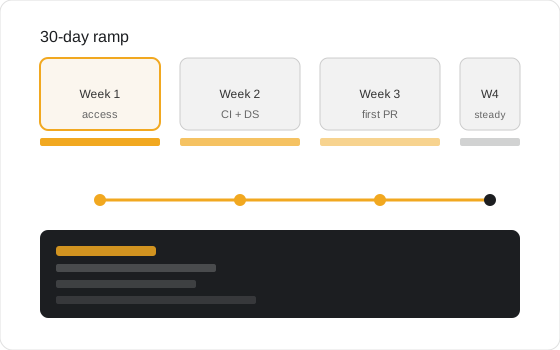
Week one is access and threat modeling: SSO, repo permissions, secrets, branch protections, and a read-only architecture walkthrough so we do not “discover” your legacy webpack config on day twenty. Week two locks CI guardrails—lint, typecheck, Storybook build, and the first Playwright smoke against staging. Week three targets a small merged PR that users can actually touch, not a spike branch. Week four is when velocity numbers become honest: retro, backlog hygiene, and a decision on whether the pod stays lean or adds QA hours for release week.
Governance is intentionally boring: weekly scorecards (lead time, PR size, reopened bugs), a shared risk log for cross-team dependencies, and a single Slack bridge to your EM—not a game of telephone through three account managers. If you already run SAFe or Shape Up, we mirror your language; if you run plain Kanban, we match that too.
Need single-role velocity instead of a managed lane? Compare this page with software staff augmentation and the project-based outsourcing brief—each optimizes for a different kind of risk transfer.
Engagement models, USD bands, and what moves the number
Pick the shape before you pick the framework. Staff augmentation is the right default when you already have a staff-plus principal who can own UI architecture and you simply need throughput. Dedicated pods earn their cost when nobody internal wants to be accountable for the cutover plan. Fixed scope wins when the acceptance tests can be enumerated upfront—otherwise you are funding change orders.
Staff augmentation
Engineers join your standups, Jira, and on-call rotation patterns. You steer priorities; we carry payroll, hardware, and bench depth.
Hire individual front-end engineers when your tech lead already owns the system map.
Dedicated UI pod
Two to four seniors, fractional QA, and a delivery lead who runs the communication budget. Best when the roadmap mixes greenfield routes with legacy screens nobody wants to touch alone.
Hire a managed front-end team when you need ownership, not extra hands.
Fixed-scope slice
Bounded modules—checkout refresh, analytics shell, marketing site on a static pipeline—with milestones tied to automated acceptance tests. We quote after a paid or unpaid scoping workshop, depending on complexity.
Read how project-based outsourcing handles statements of work.
Figures are indicative Latin American nearshore rates for senior ICs as of mid-2026. Narrow quotes depend on regulated industries (HIPAA, PCI), on-call expectations, and how exotic your client-side runtime is—WASM-heavy editors, canvas-heavy data viz, or WebRTC rooms all shift the seniority mix.
Outsourcing vs. freelancers vs. in-house hiring (where we actually win)
Freelancers are unbeatable for a sharp spike of well-bounded tickets. They lose when your product needs shared rituals, a living style guide, and someone who will sit in the blameless postmortem when a CSS change fans out into an outage. In-house hiring wins on domain context; it loses on calendar time—sixteen weeks from req to offer is still optimistic in many US metros in 2026.
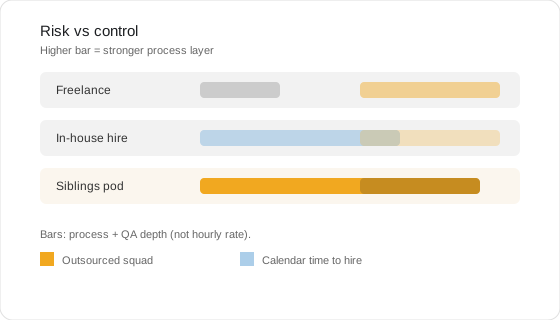
We win the middle: enough structure that your EM stops babysitting, enough proximity that GMT-3 overlap with US Eastern is usable for pairing, and enough cost headroom that you can fund QA automation instead of treating it as a luxury. If you only need a single IC and you already have design + QA covered, we will tell you to stay on software developer staff augmentation instead of a pod.
Stack depth, screening signals, and the 2025–2026 UI bar
Most active client work still lands in React 18/19 with TypeScript strict mode, TanStack Query or RTK for server cache, and Vite or Next.js depending on SEO pressure. We still run production Angular teams where enterprises demand it, and Vue/Nuxt where the founding team started there first. What we refuse to do is pretend every engineer is interchangeable across those mental models—we match profiles to the repo you already have.
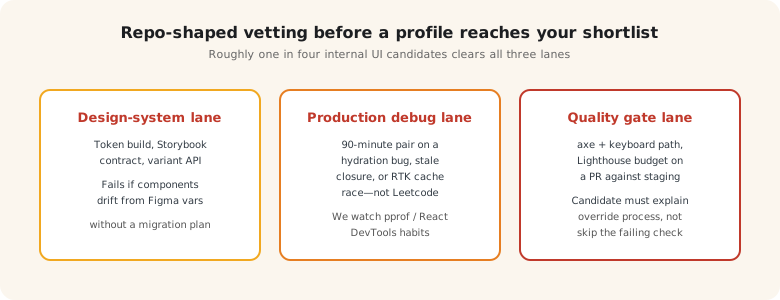
Vetting ends in your repo style: a scoped pull request against a sanitized module, a live pairing session on a bug that resembles your backlog, and an explicit checklist for testing and accessibility. “Leetcode on a whiteboard” does not predict whether someone can tame your legacy Sass architecture—and we stopped pretending it does.
The UI Performance Budget Ladder (how we prioritize fixes)
When INP and LCP budgets conflict with a marketing carousel, we sort work into three rungs instead of debating taste: Rung 1—blockers on revenue paths (checkout, signup, paywall); Rung 2—regressions that fail axe on those paths; Rung 3—everything else. Overrides need a ticket link in CI, same as accessibility waivers. That ladder is how we keep Interaction to Next Paint improvements from turning into endless design review.
We anchor accessibility and performance work to public standards—not opinion blogs—including WCAG guidance summarized on MDN Web Docs accessibility and the measurement model behind Core Web Vitals. Framework-only hires who have never shipped production React inside someone else’s design system rarely pass our production-debug lane.
Mini case study: analytics shell that stopped leaking trial users
A US fintech team approached us with a polished mobile app but a web analytics experience still built on AngularJS. Navigation felt fine in demos; in production, time-to-interactive on mid-tier laptops crossed six seconds and trial users bounced before charts hydrated. Internal front-end capacity was tied up keeping parity with banking regulators on the core app.
We stood up a four-person pod—two senior React engineers, automation QA, and a part-time delivery lead—inside their AWS accounts within nine calendar days of contract signature. We preserved REST contracts so the API team stayed focused on ledger work, introduced Redux Toolkit with RTK Query for cache coherence, and wired Chromatic plus axe into GitHub Actions so design and compliance could review asynchronously.
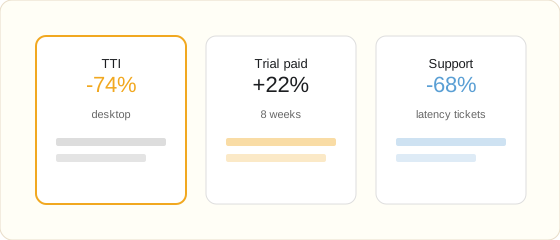
Eight weeks later desktop time-to-interactive dropped from about 6.5 seconds to 1.7 seconds, trial-to-paid conversion rose roughly twenty-two percent, and support tickets tagged “data stale” fell by more than two thirds. Handoff included ADRs, Loom walkthroughs, and two pairing weeks with their incoming hire—so the knowledge did not evaporate when we shrank the pod.
More narratives live in our case studies hub; this scenario is anonymized on purpose because the metrics matter more than the logo slide.
Risks buyers should plan for—and how we contract around them
Design churn without versioning. Mitigation: Figma library linked to token build artifacts, designer attendance at sprint planning when UI shifts, and a WIP limit on in-flight screens.
Silent performance debt. Mitigation: Lighthouse CI or equivalent on critical URLs, server timing headers for SSR paths, and explicit budgets on bundle growth.
“Almost accessible” shortcuts. Mitigation: axe checks on PRs plus manual keyboard passes on flows that touch money or health data; VPAT support when procurement demands it.
Vendor-side turnover. Mitigation: pair rotation baked into the statement of work, documented runbooks from week two onward, and a bench policy that keeps at least one shadow contributor aware of your module.
Why teams keep the engagement past the first quarter
Siblings has been a deliberately small Argentine firm since 2014—big enough to run mature delivery playbooks, small enough that leadership still joins architecture reviews when a client is stuck. We are not trying to win a slide deck beauty contest; we win when your EM says the Wednesday retro finally stopped being about “who broke CSS again.”
We are opinionated where it saves money: we will argue against shipping a client-rendered dashboard when static generation or server components would cut hosting cost and error surface. We are flexible where taste matters: if your brand team insists on a custom cursor interaction, we document the accessibility test matrix and ship it anyway.
Explore the parent outsourcing practice, meet people on the leadership and engineering team pages, or map how AI development outsourcing pairs with modern UI when models ship inside existing products.
OUR STANDARDS
UI that is fast by default, accessible by contract, and observable in production.
Security starts in the client: Content Security Policy headers that match how you load third-party scripts, dependency review on major bumps, and secrets that never touch browser bundles. Observability is not “backend only”—we instrument real user monitoring on critical routes so you see hydration failures as they happen, not when a customer tweets.
We expect designers and engineers to share a language about state: what is optimistic, what is authoritative, and what happens when the websocket drops mid-checkout. That alignment is cheaper than another redesign six months later.
Front-end development outsourcing
Frequently Asked Questions
It is the managed delivery of everything users touch in the browser: reusable components, client-side data fetching, routing, performance work tied to Core Web Vitals, accessibility fixes that survive refactors, visual regression coverage, and documentation so your in-house team can operate the UI after handoff. We embed in your repositories, CI, and design tokens—not a separate Figma-only lane.
Freelancers optimize for ticket throughput on their schedule. We optimize for continuity: a delivery lead, shared code review culture, QA that owns the UI test pyramid, and a written ramp plan. When someone rolls off, we run a two-engineer handover window so tribal knowledge does not live in one head. Typical replacement for staff aug lands in 7 to 12 business days because we keep a short bench of engineers who have already passed our internal product bar.
Series B teams with a working design system and strong internal tech lead usually win with staff augmentation: one or two seniors plug into your rituals inside a week. Legacy rewrites where nobody wants to touch the AngularJS layer anymore tend to need a dedicated pod with a tech lead, QA, and a delivery manager who owns the cutover plan. Fixed-scope project outsourcing fits when the slice is bounded—an onboarding redesign, a new analytics module, or migrating a marketing site to a static pipeline with agreed acceptance tests.
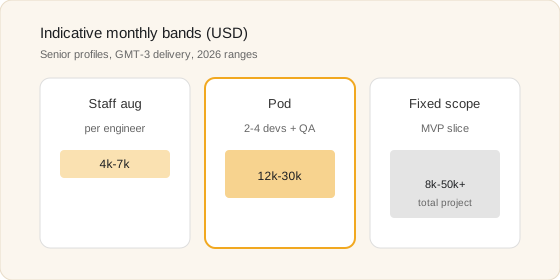
For senior engineers based in Argentina, staff augmentation usually lands between USD 4,000 and 7,000 per month per full-time equivalent. A two-to-four-engineer pod with QA and part-time delivery management is commonly USD 12,000 to 30,000 per month depending on seniority mix and how much on-call coverage you need. Fixed-scope UI rebuilds we have scoped recently ranged from about USD 8,000 for a tight marketing slice to USD 50,000 and up for multi-surface dashboards with compliance constraints. Every quote is tied to acceptance tests, not a vague statement of work.
We treat regressions as CI failures, not meeting reminders: Storybook or Ladle for component contracts, Chromatic or Percy for visual diffs, axe-core or Playwright accessibility assertions on critical flows, and Lighthouse or Web Vitals budgets on pull requests. Your design tokens live next to the components that consume them. When product wants to ship fast, the pipeline forces an explicit override with a ticket link—so shortcuts stay visible instead of silently rotting the codebase.
Yes. That is the default. We join your SSO, VPN, and secrets manager, mirror branch protection rules, and follow your SOC 2 friendly onboarding checklist. If you are still maturing standards, sprint zero is where we co-author lint rules, PR templates, and architecture decision records so the first month sets the tone—not the exception.
Contracts include a 15-day notice window either side after the initial ramp. We deliver a handover pack: recorded walkthroughs, open risk list, backlog grooming notes, and open pull requests reduced to mergeable units. If you pause mid-quarter, we park documentation in your wiki or Notion space so restarting does not mean archaeology.
Yes, when your team already uses them—but generated JSX still goes through the same PR gates: typecheck, visual diff, axe on critical paths, and a human reviewer who owns the design-system contract. We treat AI output as a draft, not a merge. If your policy forbids certain models in the pipeline, we follow your procurement rules and document which paths are human-only.
Related services
Back-end development outsourcing — keep API contracts aligned while UI squads move.
Full-stack development outsourcing — when you want one vendor accountable for browser and server.
Web development outsourcing — marketing sites, CMS builds, and content-heavy experiences.