Software development outsourcing with numbers on the first call, not the third
Technical review: Juan Pablo Licera, CTO, Siblings Software (LinkedIn).
If you are comparing software development outsourcing vendors, you probably need one of three things: a production-grade MVP on a written estimate, a multi-quarter squad that can run without a full-time VP of Engineering, or a calm takeover of a codebase another team dropped. This page is the umbrella for how Siblings Software delivers all three from Córdoba, Argentina, with daily overlap into US Eastern and Central time.
We publish ranges because buyers tell us they lose months when nobody names a price band. Typical nearshore engagements in 2026 land around USD 35k–220k for fixed-scope MVPs, USD 22k–70k per month for managed squads, and USD 55–95 per hour when you only need senior staff augmentation inside your rituals. If you already know the stack, the faster paths are web development, mobile, back end, AI features, or hiring individual engineers.
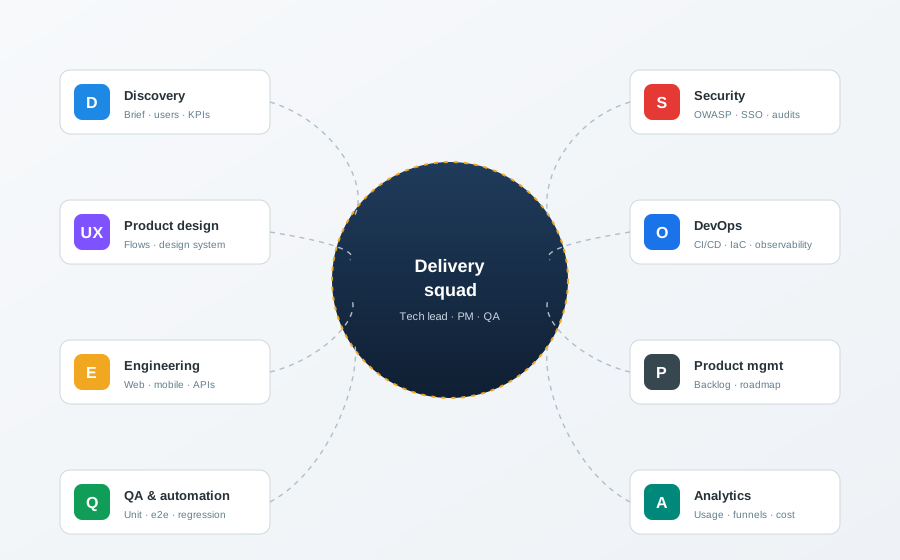
Who sends the RFP when outsourcing is the right move
Since 2015 we have shipped for B2B SaaS, fintech, logistics, climate-tech hardware adjacency, and regulated internal tools. Across managed outsourcing engagements in 2025–2026, roughly seven in ten fixed-scope builds converted to a retainer or phase-two squad within nine months—usually because the first release exposed a longer platform tail than the original RFP admitted. The buyers who get the most leverage usually match one of these four profiles.
Founders between MVP and Series B
You have a working prototype or a thin v1 and you need something investors can diligence. You may not yet have a full-time CTO. You need a squad that writes the tests, owns the observability story, and does not disappear after the demo.
Product-led scale-ups with a stretched core team
Your internal engineers are strong but underwater. There is a modernization track, a legacy service nobody wants to touch, or a platform migration that slipped two quarters. You need a slice of roadmap absorbed without stealing your leads for every decision.
Enterprises with real procurement and security gates
Banks, insurers, logistics operators, healthcare networks. You bring questionnaires, audit expectations, and legal that reads the MSA. We have passed enough reviews that we front-load the boring paperwork instead of treating it as a surprise phase six.
Non-tech brands shipping serious digital products
Retail, media, manufacturing, professional services. Software is not your core business, but your customers expect a credible experience. We often ship a fixed-scope build, hand ownership to a lightweight internal product owner, and stay on a thin retainer for incidents.
The Ship Criteria Readiness Gate: how we pick an engagement shape on day one
Buyers often ask for a quote before they know whether they need outsourcing, a dedicated squad, or staff augmentation. We run a short internal checklist on the first call—we call it the Ship Criteria Readiness Gate—so we do not sell you the wrong model.
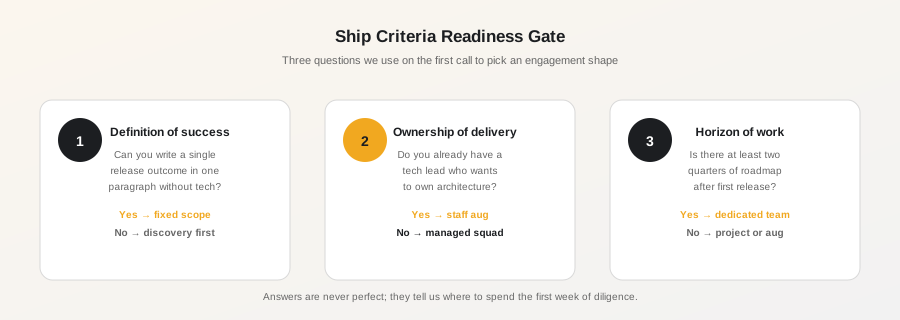
- Can you describe success in one paragraph without naming a framework? If yes, a fixed-scope statement of work is realistic. If no, we book a paid discovery slice before anyone commits headcount.
- Do you already have a tech lead who wants to own architecture? If yes, staff augmentation is usually cheaper and faster. If no, you need a managed squad with a named delivery lead on our side.
- Is there at least two quarters of work after the first release? If yes, a dedicated software team retainer tends to beat a sequence of fixed bids. If no, optimize for a clean handoff after a project milestone.
That gate is not a gimmick; it keeps us from staffing a six-person pod when you only needed two seniors in your ceremonies, or quoting a fixed MVP when your integrations are still unknown.
What “software development outsourcing” means on a sprint board here
A delivery partner accountable for production outcomes—not a bench you rent by the hour without oversight.
Outsourcing earned its bad reputation honestly: opaque change orders, juniors billed as seniors, and repos that fall apart the moment a real security scanner runs. We compete with that failure mode by keeping squads small, senior-heavy, and led by someone whose job is to say no to scope that will hurt you in month five.
Concretely, you get typed languages where they buy safety, tests at the seams that matter, pull requests reviewed against OWASP ASVS-style expectations, CI from the first merge, and dashboards before production traffic. In 2025–2026 we also treat AI coding agents as part of the toolchain, not a party trick: policies aligned with the NIST AI Risk Management Framework for generated-code review, license scanning on dependencies suggested by assistants, and human ownership of architecture decisions. Industry surveys such as Stack Overflow’s 2024 developer survey still show a gap between teams that use AI assistants and teams that ship safely with them; we close that gap with checklists, not hope.
We still publish a lightweight engineering radar influenced by ThoughtWorks Technology Radar patterns so defaults stay modern without chasing every headline runtime. The point is blunt: when you hire your own VP of Engineering, they should open our handoff and find something operable, not a museum of demos.
Engagement models and the numbers we actually quote
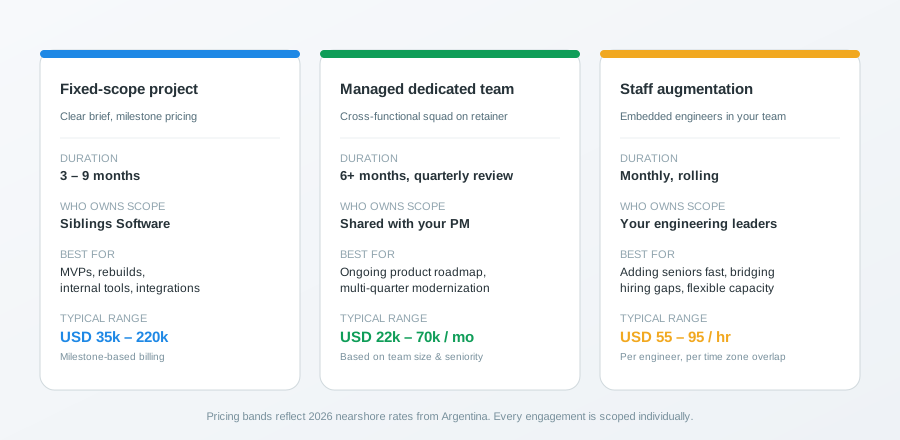
Pick the model based on who owns scope, not which word sounds cheaper. The bands below are what we signed in 2025–2026 for senior nearshore work from Argentina; your quote still needs a call because integrations and compliance depth move the needle.
Fixed-scope project
You have a clear brief, or we write one during a short paid discovery. We quote a deliverable, a release window, and change control in writing. Milestones tie to demos, not calendar padding. Typical range: USD 35,000–220,000 for a production MVP or rebuild with a sane integration surface.
Best for: MVPs, internal tools, regulated one-off builds, vendor takeovers after an audit.
Managed dedicated team
A cross-functional squad on a retainer with a delivery lead who owns sequencing, risk, and communication upward. Typical range: USD 22,000–70,000 per month depending on seniority mix and how much on-call coverage you need.
Best for: multi-quarter roadmaps, platform modernization, enterprise backlogs where scope shifts weekly. See dedicated software team composition for typical squad shapes.
Staff augmentation
Senior engineers inside your ceremonies; your leads own priorities. We handle recruiting, bench backup, and payroll overhead. Typical range: USD 55–95 per hour. If this is closer to your reality, start on the nearshore hiring page for time-zone specifics.
Best for: adding proven seniors fast when you already have architecture and QA discipline internally.
Note on pricing. We share bands because RFP cycles deserve anchors. A precise number needs a short call and, for larger surface areas, a paid discovery sprint—usually 2–5 days—so we are not guessing at hidden integrations.
How delivery runs after the contract is signed
Every engagement follows the same seven-phase spine. Depth changes; nothing is skipped to “save two weeks” because that is how rescues get born.
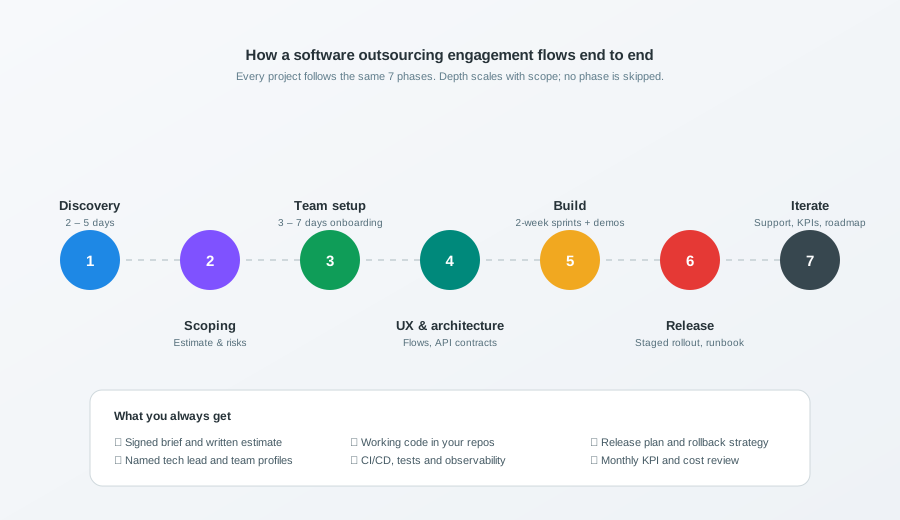
In our typical dedicated-team ramp, profiles are shared within 3 business days of contract, access is granted within 5–7 business days, and the squad targets a first merged pull request inside two weeks even on brownfield codebases—usually a telemetry fix, a flaky test cleanup, or a small customer-facing bug that proves we can ship through your pipeline.
- Discovery. 2–5 days with product, design, and engineering in the room. Output: a signed brief and explicit non-goals.
- Scoping. Estimate with assumptions, risks, architecture sketch, and release plan. This becomes the baseline for change control.
- Team setup. Named delivery lead, seniors, QA owner, access checklist, and security onboarding.
- UX and architecture. Flows, component inventory, data model, API contracts—and written pushback when something will be expensive later.
- Build. Two-week sprints, mid-sprint check-in, demo, retro, release candidate. Mandatory review on every merge.
- Release. Feature flags, monitoring, rollback plan, honest release notes.
- Iterate and support. Thirty-day stabilization on fixed scope, or monthly KPI review on retainers.
The first thirty days after kickoff
Buyers worry about the “dead air” between signature and velocity. We publish a default ramp so you know what should happen before sprint two, regardless of stack.
Week 1
Access checklist closed (repos, cloud, trackers, SSO). Delivery lead named. Risk register started. No feature work until CI runs on a hello-world merge.
Week 2
First production-shaped pull request merged—telemetry, test fix, or narrow bug. Sprint-zero backlog ranked with your product owner. ADR template agreed for architecture decisions.
Weeks 3–4
First demo with release notes. Burn and scope dashboard shared with stakeholders. If we are off pace, we say so in writing and resize before invoices surprise anyone.
“The expensive mistake is picking staff augmentation when you needed a delivery lead, or a fixed bid when integrations were still unknown. We would rather lose a deal on the first call than staff the wrong shape.”
Juan Pablo Licera, CTO, Siblings Software
What we outsource-deliver in practice
These are the shapes that hit our pipeline most often. They are intentionally specific so you can pattern-match your own roadmap.
Custom SaaS and internal platforms
Multi-tenant apps with RBAC, billing hooks, usage metering, and admin consoles. Common pairings include Next.js or React on the front, Node.js or Python services, and Postgres—often alongside platform engineering when teams want paved-road deployments.
E-commerce and marketplaces
Headless storefronts, complex carts, payments, and personalization. When recommendations or agents enter the picture we coordinate with AI e-commerce specialists so prompts, catalog data, and checkout integrity stay aligned.
Fintech and regulated workflows
KYC flows, consent capture, audit trails, tokenization, and pen-test remediation loops. We assume third-party scanners, not happy-path demos.
Mobile on Android and iOS
Kotlin and Swift when the platform matters; cross-platform when business logic dominates. Standards live on Android and Swift pages.
Data, APIs, and AI features
Warehouse feeds, analytics surfaces, and targeted LLM features with retrieval and evaluation hooks. For LLM-heavy builds see AI development outsourcing.
Takeovers and rescue work
We inherit repos with missing tests and nervous ops teams. Paid audit first, stabilize the top risk drivers, then modularize behind flags. Project-based outsourcing is the usual wrapper for the first slice.
Case snapshot: logistics partner portal under a deadline
Binsensors, a logistics scale-up monitoring waste-collection fleets in Europe, came to us after a partner portal missed two consecutive release windows. Firmware was strong; the web stack had bounced between contractors; automated tests covered less than ten percent of critical paths; ops no longer trusted uptime charts.
We ran two weeks of discovery, proposed a six-month managed squad (delivery lead, three senior full-stack engineers, QA automation, part-time DevOps), and rebuilt trust by shipping the existing backlog as-is in sprint one. Contract tests against the device API, staged telemetry refactors, and an SRE-style error budget followed.
By month four, carrier onboarding time dropped roughly forty percent, releases moved from quarterly to weekly, and field telemetry matched dashboards. Full write-up: Binsensors case study. Browse the full case studies hub for fintech, platform, and staff-aug stories sorted by contract shape.
Engagement snapshot
Model: managed dedicated team (6 months)
Team: 1 lead, 3 senior full-stack, 1 QA auto, part-time DevOps
Stack: TypeScript, Next.js, Node.js, Postgres, AWS
Outcomes: weekly releases, ~40% faster onboarding, telemetry trust restored
Managed outsourcing versus the alternatives you are already tab-comparing
Most evaluations boil down to four options. Here is where we win, lose, and refuse to bid.
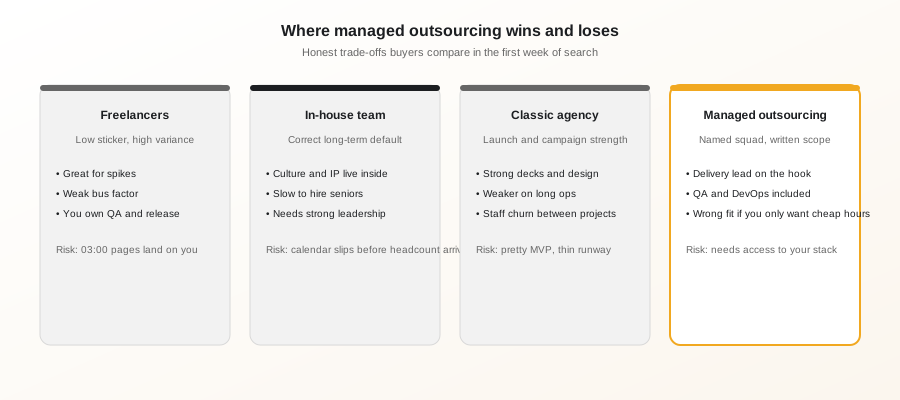
Freelancers
Cheapest sticker, highest variance. Fine for bounded scripts or marketing microsites. Weak when you need on-call rotation, shared code review culture, or someone to own a production incident across services.
Full in-house org
The right long-term answer when software is the company. A slow short-term answer if hiring markets are frozen or you need shipping inside two quarters without a CTO to mentor yet.
Traditional agencies
Often optimized for launches and campaigns, not for multi-year product operations. If your question is how the system evolves for three years, an agency retainer is usually the wrong shape.
Managed outsourcing (what we do)
We own delivery while staying inspectable: your repos, your cloud accounts, your trackers. Wrong fit if you want unmanaged hourly bodies—that belongs on freelance marketplaces, not here.
Risks we name up front—and how we contract around them
Outsourcing fails in predictable ways. Pretending otherwise is how you end up in litigation instead of retros.
Scope drift and surprise invoices
Written brief before code, lightweight change-control notes with effort estimates, weekly burn visibility, and the option to stop at sprint boundaries without exit penalties on fixed work.
Key-person risk
At least two engineers know each critical path. Runbooks, ADRs, and README updates are part of Definition of Done, not a week-thirteen scramble.
Security and IP
Mutual NDA, MSA with IP assignment on payment, SSO and least privilege, written offboarding. We map to ISO 27001 control families even when formal certification is not in scope.
Quality decay after launch
Mandatory review, static analysis, dependency scanning, and a monthly engineering health note: flaky tests, crash trends, latency percentiles, cloud cost drift. You see smoke before it becomes fire.
What buyers get wrong before the first workshop
Patterns we have seen across hundreds of scoping calls:
- Optimizing for hourly rate instead of time-to-safe-release. The expensive projects are the ones that restart after a failed cheap attempt.
- Leading with a stack instead of a user constraint. “We must use Next.js and Supabase” is a solution; the brief should start from data residency, latency, and team skills.
- Skipping discovery to save two weeks. It almost always costs a sprint when hidden integrations surface.
- Treating a PDF spec as a substitute for a delivery lead. Specs do not argue with production; engineers do.
Why Argentina is the default delivery center for this practice
Strong public engineering education, English in daily standups for North American clients, and at least six hours of overlap with US Eastern for most of the year. The differentiator clients cite most often is cultural: Argentine leads tend to challenge vague requirements early—annoying in week one, invaluable by week twelve. For a full geographic comparison, read nearshore software development and the nearshore hiring guide.
OUR STANDARDS
Shipping is not enough—the software has to stay operable when the original authors rotate.
We treat accessibility, performance budgets, and observability as part of the feature, not a backlog bucket labeled “polish.” Security reviews reference OWASP ASVS levels explicitly; cloud access is least-privilege with break-glass documented; dependency updates are scheduled, not ignored until a CVE forces panic.
When your internal team grows, we want the handoff to feel boring: architecture diagrams that match reality, CI pipelines that new hires can extend, and postmortems that already exist instead of being invented under pressure.
Software Development Outsourcing
Frequently Asked Questions
From a first call to a signed brief is typically 5 to 10 business days for fixed-scope projects, and 3 to 7 days for retainers. We do not pre-staff teams we have not scoped, so the bottleneck is always shared understanding, not availability.
Yours, whenever possible. We prefer GitHub, Jira or Linear, AWS, Azure or GCP, with SSO and least-privilege roles. The only tools we insist on are a CI we can trust and a pull request workflow with mandatory review.
In staff augmentation you hire individual engineers and your leaders manage them day to day. In outsourcing we manage delivery end to end, including scope, estimates, architecture decisions, team composition and releases. Use outsourcing when you lack an internal tech lead or want a fixed outcome rather than just extra hands. Pricing differs: augmentation is hourly or monthly per engineer; outsourcing is milestone or squad retainer.
For a production-quality custom software MVP expect USD 35,000 to 220,000 depending on scope and integrations. A managed dedicated team is typically USD 22,000 to 70,000 per month based on seniority and team size. Staff augmentation runs between USD 55 and 95 per hour per engineer for senior nearshore roles from Argentina. Integrations, compliance depth, and data migration volume move quotes inside those bands.
Yes, after a reasonable notice period and a buyout clause that reflects hiring and training cost. We would rather keep the relationship transparent than pretend the option does not exist, and a few long-term clients eventually hired former Siblings engineers into permanent roles.
We write a short architecture decision record (ADR) for anything non-trivial, present options with trade-offs, and you decide. If we think a chosen path is risky, we say so in writing so the decision is traceable. Arguing by memory six months later is where projects die.
Yes. We routinely sign client security addenda, BAAs for HIPAA-adjacent work, and align operational controls to ISO 27001 families. Formal certification is scoped per engagement when it is required by your compliance team.
Thirty days of warranty and stabilization are included: we fix defects attributable to the delivered scope at no cost. After that you can move to a thin support retainer, a managed team for the next phase, or take it fully in-house. We write a structured handover document regardless.
Related services
Go deeper when you already know the shape of the problem:
- Web development outsourcing — front-end and full-stack web.
- Mobile app outsourcing — native and cross-platform.
- API development — REST, GraphQL, events.
- Back-end development — services, data, platforms.
- AI development — LLM features, RAG, agents.
- Staff augmentation hub — embedded senior engineers.
- Dedicated development teams — multi-quarter squads.
Contact Siblings Software Argentina
Describe what you need to ship, what stalled, and which model you are leaning toward. We will reply with a written estimate or a candid redirect if we are not the right partner.