Hire C# Developers for Your Software Team
· Typical time to first merged PR: 10-12 business days
Hire C# developers through Siblings Software when you need senior or semi-senior engineers embedded in your team without running a full recruiting cycle. We help engineering managers, CTOs, and founders add C# capacity for ASP.NET Core APIs, Entity Framework work, desktop clients, and brownfield maintenance, with screening focused on language fluency, application surface fit, and safe data-access habits. This page covers role scope, how we vet candidates, engagement models, timelines, pricing factors, and when staff augmentation is or is not the right fit.
Developers join your repos, standups, and review process from Córdoba, Argentina, with overlap for US Eastern business hours. For ecosystem-wide .NET platform hiring, see hire .NET developers. For managed squad ownership, see our dedicated C# development team. Broader options live on staff augmentation, hire software developers, and hire nearshore developers.
Reviewed by Javier Uanini, Founder and CEO at Siblings Software.
Prefer numbers first? Jump to monthly pricing bands for seniors, pairs, and small pods.
What C# developers do in real client teams
Day-to-day delivery in your repo, not a Wikipedia tour of the language.
Most teams that hire C# developers already have a product owner, a backlog, and a codebase that pays the bills. The gap is usually feature throughput, brownfield risk, or a missing senior who can review async and data-access changes without slowing the sprint. Embedded engineers work in your tools and standards; we do not run a parallel science project.
APIs and services
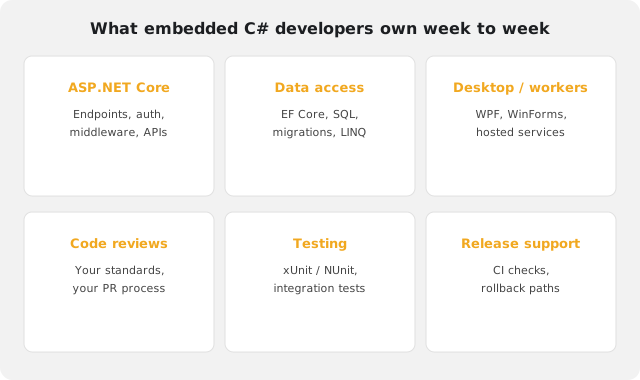
ASP.NET Core endpoints, authentication and authorization hooks, middleware, background hosted services, and integration with existing message or HTTP clients. Work usually lands as reviewed pull requests against your CI pipeline.
Data access and performance
Entity Framework Core queries, migration discipline, SQL review when LINQ hides cost, and careful handling of transactions. Candidates need to explain when they would drop to SQL and how they would prove a change is safe.
Desktop and line-of-business clients
WPF or WinForms maintenance, MVVM cleanup, and packaging issues that still matter for internal tools. When you need a full Windows squad instead of one seat, compare our Windows app development team.
Language-level craft
Modern C# features used with judgment: nullable reference types, async and await with cancellation, records and pattern matching where they clarify intent. Official language guidance lives in the Microsoft C# documentation; we care how those features show up in your production paths.
When companies hire C# developers
Concrete situations we see on discovery calls.
Roadmap pressure on an ASP.NET Core API
Your product lead has a committed release train, internal recruiting is still interviewing, and one senior leaving would freeze integrations. Staff augmentation adds a seat that can ship under your existing tech lead.
Brownfield EF Core or SQL debt
Features keep shipping, but query cost and migration risk grow each sprint. You need someone who can read execution plans, tighten LINQ, and document seams without pausing the product calendar.
Desktop client still in production
A WPF or WinForms tool still runs operations while a web replacement is years away. You need careful maintenance and packaging work, not a rewrite pitch in week one.
Mixed Framework and modern .NET estate
Services have moved to modern .NET while older apps remain. You need incremental strangler work with clear ownership boundaries. For Azure and Framework-fork questions, also read .NET development outsourcing.
Staff augmentation is a weak fit when there is no internal owner for reviews, no backlog for the next quarter, or the ask is a one-week ticket better handled by a freelancer. In those cases we say so on the call.
How Siblings vets C# developers
Language Surface Gate plus a live exercise in your shape of work.
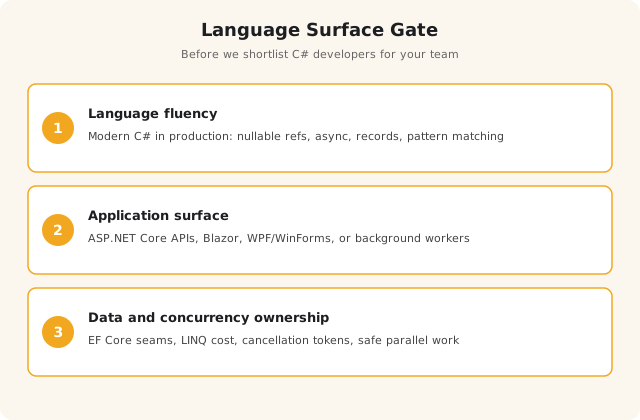
Resume screens that list "C# / .NET / SQL" are not enough. Before we shortlist, we score three signals with your tech lead on a short discovery call, then validate them in a live exercise.
- Language fluency. Can the engineer use modern C# correctly in production paths: nullable reference types, async with cancellation, and patterns that clarify domain code without cleverness for its own sake.
- Application surface. Does their recent work match your surface: ASP.NET Core APIs, Blazor, WPF/WinForms, or background workers. A strong API engineer is not automatically the right WPF maintainer.
- Data and concurrency ownership. Can they own EF Core seams, explain LINQ cost, and handle shared state or parallel work without introducing race conditions.
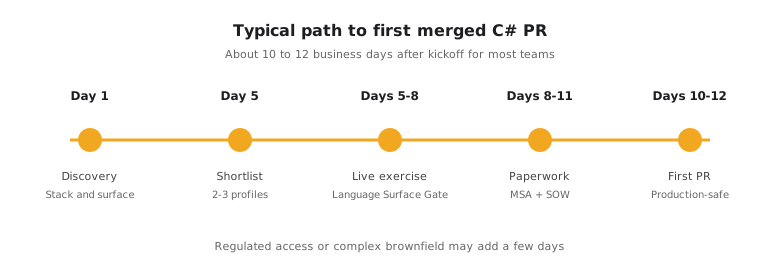
- Stack and risk map (day 1). Target frameworks, ORM choices, desktop vs web mix, CI deploy path, regulated data boundaries, seniority and English bar.
- Shortlist (by day 5). Two or three profiles matched to your surface, with notes on what we would and would not assign in sprint one.
- Live exercise (days 5-8). Ninety minutes with your lead on a sanitised slice: extend an ASP.NET Core endpoint, diagnose an EF query, or propose a safe change in a desktop client.
- Communication and seniority check. We screen for clear written English in PR comments and the ability to disagree early when a change is unsafe.
- Red flags we screen out. Framework name-dropping without ownership stories, "rewrite first" as the only plan, inability to discuss rollback, or no evidence of working inside someone else's coding standards.
Engagement models
Choose based on ownership, throughput, and how much context you can share.
Embedded individual
One senior inside your ceremonies. Best when architecture is stable and you have a tech lead who can prioritize and review. Minimum engagement is usually three months.
Pair or small pod
Senior plus semi-senior, or a three-person pod, when you need parallel streams and shared context so delivery does not depend on one person. Useful for API plus data-access work moving at the same time.
Project-based alternative
When you want a scoped deliverable with vendor-managed execution instead of seats in your standups, start from C# development outsourcing or project-based outsourcing.
Timelines and pricing context
Published monthly bands so you can budget a quarter.
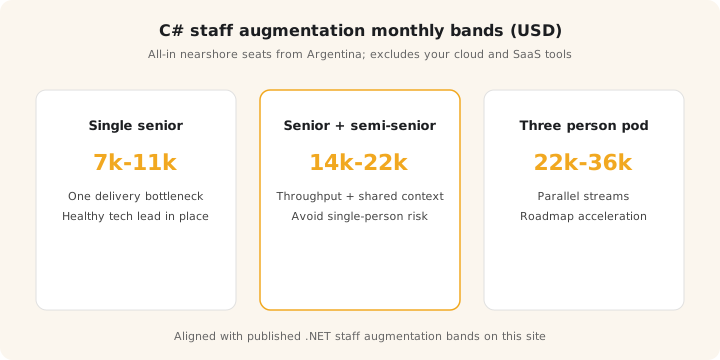
These ranges match the published C# / .NET staff augmentation bands used elsewhere on this site. The point inside the band moves with seniority, English needs for stakeholder work, and rare depth such as mixed Framework migrations or regulated access.
- Shortlist: around five business days for two or three profiles.
- First merged production PR: around day ten to twelve after kickoff for most teams.
- Monthly bands: USD 7,000-11,000 (single senior), USD 14,000-22,000 (pair), USD 22,000-36,000 (pod).
- What drives cost: seniority, application surface rarity (for example long-lived WPF), regulated onboarding friction, and how much pairing your lead can offer in week one.
Comparison: Siblings vs freelancers vs in-house hiring
Fair tradeoffs; each option wins in some situations.
Siblings staff augmentation: full-time embedded engineers, structured vetting, payroll and Argentine employer obligations handled by us, you keep architecture direction and IP. Strong when you need continuity inside your process for months, not days.
Freelance marketplaces: fast for isolated tickets or spikes. Weaker when the work is core roadmap, shared ownership, or long-lived brownfield context that must survive handoffs.
In-house hiring: best long-term ownership when you can wait for recruiting, onboarding, and benefits cycles. Staff aug often bridges that gap or covers surge capacity while a permanent search runs.
Dedicated outsourced team: better when you want vendor-managed delivery for a whole stream. Compare hire a C# development team when you lack internal tech leadership for day-to-day reviews.
Example engagement
Composite scenario: API backlog plus EF cleanup for a B2B product team
Illustrative example based on repeated C# staff aug patterns; not a named client case study.
A US B2B team needed to ship integration endpoints while reducing Entity Framework regressions that slowed releases. A senior C# engineer joined their Azure DevOps board within two weeks, took ownership of a bounded API area, paired on query reviews, and kept changes behind the team's existing CI checks. Product milestones stayed on the calendar while the internal lead kept architecture decisions.
For published delivery stories with named clients, see Bari and the broader case studies index. Those pages are the source of truth for verified outcomes; we do not invent metrics on this hire page.
Risks and how we reduce them
Real failure modes for C# staff augmentation, with practical controls.
- Risk: language-fluent candidate who does not match your surface (API vs desktop). Mitigation: Language Surface Gate signal 2 before shortlist.
- Risk: onboarding delays from missing repo, CI, or environment access. Mitigation: access checklist and a small reversible first PR so integration speed is visible early.
- Risk: silent EF or concurrency defects. Mitigation: live exercise on data-access and cancellation patterns; pairing expectations with your lead in week one.
- Risk: knowledge loss at transition. Mitigation: written handover notes, shared ownership docs, and a fourteen-day swap window when fit fails.
- Risk: treating staff aug as a substitute for product ownership. Mitigation: we decline when there is no internal owner for priorities and reviews.
Frequently Asked Questions
Most teams receive two or three shortlisted profiles in about five business days and reach a first production pull request in about ten to twelve business days after kickoff. Complex brownfield access or regulated environments may add a few days.
It evaluates three signals before we shortlist: modern C# language fluency in production code, fit to your application surface (ASP.NET Core, Blazor, desktop, or workers), and ownership of data access plus concurrency patterns such as Entity Framework, LINQ cost, and cancellation tokens.
Typical monthly ranges are USD 7,000 to 11,000 for one senior engineer, USD 14,000 to 22,000 for a senior plus semi-senior pair, and USD 22,000 to 36,000 for a three person pod. Figures are all-in nearshore seats and exclude your cloud accounts and SaaS tools.
This page is language and application-surface focused: C# fluency, ASP.NET Core or desktop work, and EF or concurrency ownership inside your repo. Our hire .NET developers page emphasizes stack continuity across Framework versus modern .NET, Azure delivery, and broader platform seams. Many buyers need both signals; choose the page that matches the bottleneck you are hiring for.
Yes. We commonly embed engineers in mixed estates where ASP.NET Core services sit next to older Framework apps or WPF clients. The goal is safe incremental delivery, not a forced rewrite in the first sprint.
Choose staff augmentation when you already have product ownership, tech leadership for reviews, and want individuals inside your ceremonies. Choose a dedicated C# development team when you want vendor-managed delivery for a backlog stream with a tech lead and clearer squad ownership.
We run an early fit checkpoint and replace within a fourteen-day swap window when needed, with documented handover so sprint progress is preserved.
OUR STANDARDS
Delivery discipline for embedded C# engagements.
- Production-safe pull requests with an explicit rollback path.
- Clear handoff artifacts so your internal team can continue without lock-in.
- Direct communication between embedded engineers and your technical lead.
- Respect for your coding standards, review tools, and release cadence.
Contact Siblings Software Argentina
Share your C# surface (ASP.NET Core, desktop, EF), seniority needs, and timeline. We reply within one business day.