Hire .NET developers for enterprise application teams
US product teams usually hire .NET developers when roadmap pressure is rising and internal recruiting is slower than delivery needs. This page explains where staff augmentation helps, what pricing looks like, and how our Stack Continuity Test reduces mismatch risk.
We work with teams building and maintaining ASP.NET Core APIs, line-of-business applications, and enterprise integrations. When the bottleneck is C# language fluency, desktop clients, or EF ownership inside an existing team, see hire C# developers. For broader hiring options, see staff augmentation services, hire software developers, and hire nearshore developers.
Reviewed by Javier Uanini, Founder and CEO at Siblings Software.
What .NET developers do when embedded in your team
Practical day to day delivery on existing production systems.
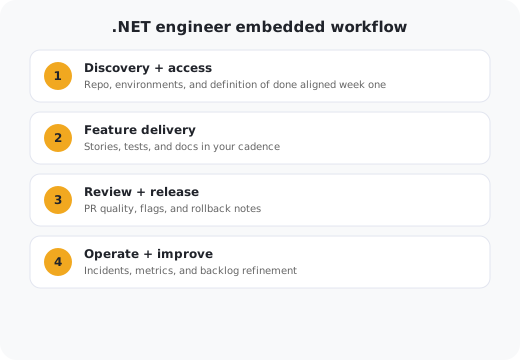
Most engagements include API work, backlog feature development, bug triage, code reviews, and release support. Our engineers work in your repos and follow your standards, with explicit ownership boundaries from week one.
Typical activities include ASP.NET Core endpoint implementation, C# service refactoring, SQL query optimization, and CI workflow updates for safe deploys. This is usually combined with sprint planning participation and clear documentation to support continuity.
When to hire .NET developers through staff augmentation
Clear use cases where this model saves time and protects delivery cadence.
Good fit: you have product ownership in place, technical leadership available for reviews, and backlog pressure that internal hiring cannot absorb in time.
Not ideal: no clear roadmap, no internal owner, or a one week micro task that is better served by a short freelancer engagement.
For managed ownership instead of embedded seats, compare .NET development outsourcing and platform engineering.
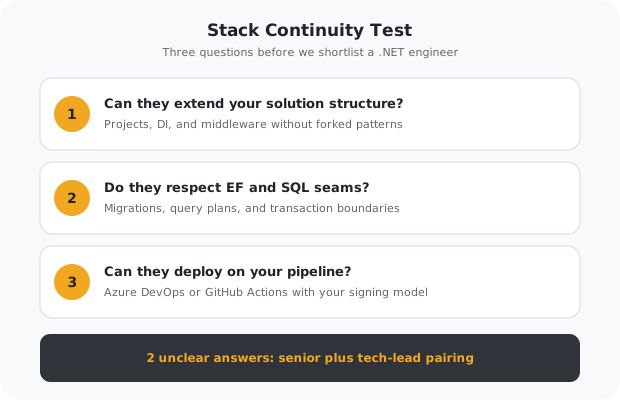
Stack Continuity Test
The vetting framework we use before presenting candidates.
- Solution continuity: can the engineer extend your existing architecture without forcing a restructuring first.
- Data continuity: can the engineer handle your SQL and ORM choices safely in production constraints.
- Release continuity: can the engineer ship through your current CI and deployment process with predictable rollback options.
Engagement models
Three common structures based on delivery scope.
Single senior
Best for teams with healthy architecture and one delivery bottleneck.
Senior plus semi-senior
Best when you need throughput plus shared context to avoid single-person dependency.
Three person pod
Best for roadmap acceleration where parallel streams need to move at the same time.
Timelines and pricing expectations
Published monthly ranges and onboarding timeline checkpoints.
- Shortlist delivery: around 5 business days.
- First merged production PR: around day 10 to 12.
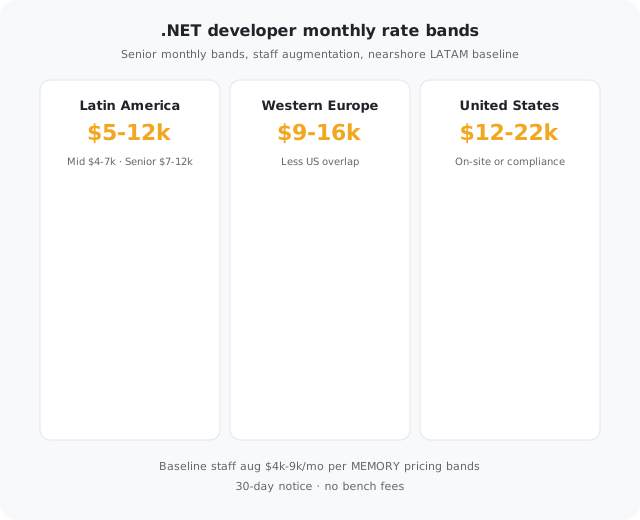
- Monthly bands: USD 7k to 11k (single senior), USD 14k to 22k (pair), USD 22k to 36k (pod).
Comparison with other hiring options
Choose based on control, speed, and ownership model.
Staff augmentation: fast onboarding, high control by your team, strong continuity with internal process.
Freelance marketplace: fast for isolated tasks, weaker continuity for core roadmap work.
In-house hiring: strong long term ownership, slower recruiting cycle.
Dedicated outsourced team: useful when you prefer vendor-managed execution.
Mini case study
Lockport and Bari style delivery pattern for a manufacturing software team
Composite scenario based on repeated .NET engagements.
A US manufacturing platform needed to modernize internal APIs without pausing operations. A senior .NET engineer plus a semi-senior profile joined within two weeks, stabilized release flow, and reduced integration rework while product milestones stayed on schedule.
The same engagement pattern appears in our published references such as Bari and cross-industry delivery stories in case studies.
Main risks and mitigation
Transparent constraints and controls for predictable outcomes.
- Risk: mismatch in seniority. Mitigation: Stack Continuity Test plus live technical review.
- Risk: onboarding delays. Mitigation: access checklist and sprint-zero scope lock.
- Risk: knowledge loss at transition. Mitigation: handover notes and shared architecture records.
Frequently Asked Questions
Most teams receive two or three shortlisted profiles in five business days and reach a first production pull request in about ten to twelve business days after kickoff.
It evaluates whether a candidate can extend your current solution structure, work safely with your data layer, and ship through your release pipeline without forcing a rewrite first.
Typical monthly ranges are USD 7,000 to 11,000 for one senior engineer, USD 14,000 to 22,000 for a senior plus semi-senior pair, and USD 22,000 to 36,000 for a three person pod.
Yes. We support mixed environments with .NET Framework and modern .NET, including staged migration plans that keep releases moving while technical debt is reduced.
You receive full-time embedded engineers who pass a structured vetting process and join your ceremonies, instead of isolated ticket execution without long term continuity.
Yes. Teams can work under NDA, role-based access, and documented release controls. We have delivered in compliance-sensitive environments where audit readiness is required.
We run an early fit checkpoint and replace quickly when needed, with documented handover so sprint progress is preserved.
OUR STANDARDS
Delivery discipline for enterprise .NET engagements.
- Production-safe pull requests with explicit rollback path.
- Clear handoff artifacts so your internal team can continue without lock-in.
- Direct communication between embedded engineers and your technical lead.
Contact Siblings Software Argentina
Share your current .NET stack and team goals. We reply within one business day.