Outsource a Xamarin squad that keeps App Store and Play reviews moving while you phase to .NET MAUI
· Typical time to first merged PR: 10–14 days
Reviewed by Javier Uanini, CEO and delivery lead, Siblings Software.
If you are reading this, you probably have a Xamarin codebase that still pays bills, still fails store validation in painful ways, and still scares away internal hires because the stack is officially past Microsoft support. A dedicated Xamarin team from Siblings is the shape we use when you need a managed unit—not a lone contractor—to own dual-track work: keep production green while .NET MAUI modules earn parity behind the same backlog. We run the squad from Córdoba, Argentina (GMT-3) under our dedicated teams practice, with overlap across a full US Eastern business day.
This page is intentionally specific: who buys this, what the first thirty days look like, published monthly bands, how vetting differs from generic “mobile developer” hiring, and when Xamarin staff augmentation is the cheaper right answer instead. “Most buyers we see in 2026 are not debating whether MAUI exists,” notes Javier Uanini; “they are debating how fast they can move without dropping store compliance on the legacy app that still funds the migration.”
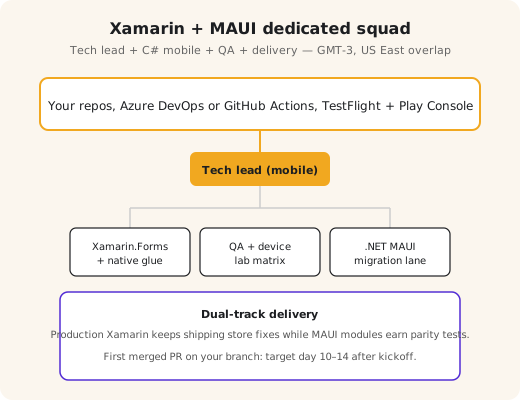
Who hires a dedicated Xamarin team (not staff aug)
Four patterns cover most signed engagements since Xamarin went out of support in May 2024.
The mobile lead left and nobody wants the repo
B2B SaaS and regulated health apps hit this constantly: the original author is gone, the backlog still mentions “Xamarin.Forms 5.x,” and every Google Play target-SDK bump feels like roulette. You need a team that treats store rejections as a KPI, not a surprise Friday.
You promised MAUI to the board but cannot freeze features
Dual-track is the only adult option: Lane A ships compliance fixes on Xamarin; Lane B ports screens with automated parity checks. We refuse pure rewrite bids without a week-one dependency audit—those are how migrations die quietly.
Compliance or procurement flagged unsupported frameworks
You need dated evidence of active remediation: build logs, penetration-test responses, patch cadence. A managed squad carries that narrative with artifacts, not adjectives.
You already tried freelancers and lost continuity
Xamarin expertise on marketplaces thinned fast after end-of-support. A dedicated team trades headline hourly savings for continuity, QA pairing and a tech lead who will still be there when renderer number seven fights the linker.
If you only need one senior for eight weeks, say so—we will steer you to Xamarin staff augmentation or a scoped project-based slice instead of a squad.
What the squad owns each sprint
Below is the real checklist—not a generic “we do mobile” list. Most engagements activate at least five rows at once because Xamarin maintenance and MAUI migration refuse to stay neatly separated.
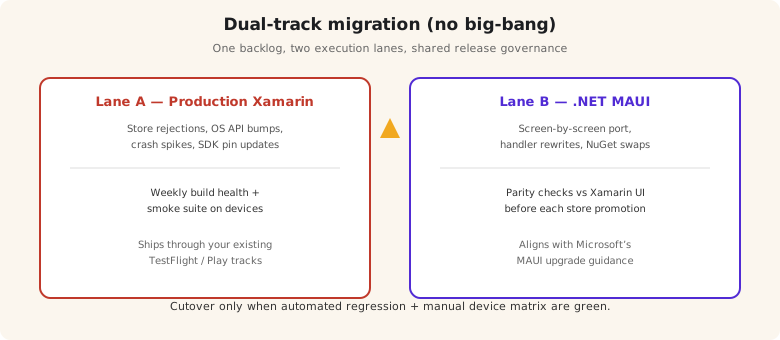
Store pipeline and SDK pins
Android API level targets, iOS minimum versions, linker flags, dSYM and symbol uploads, ProGuard or R8 mapping files, internal TestFlight tracks, staged Play rollouts. We document the exact SDK pair per release tag.
Renderer and handler migration
Custom renderers rewritten to MAUI handlers with behavioural parity tests, platform effects untangled, dependency injection containers mapped so you are not double-registering services at startup.
Quality and device matrix
Physical devices for the long tail of OEM Android skins, UITest or Appium smoke suites, crash analytics baselines, memory regressions on older OS versions buyers still use in LATAM and US rural markets.
Backend and platform adjacency
When your shell talks to .NET APIs or Azure B2C, we pull from the same bench as our .NET dedicated teams so auth, push and billing SDK mismatches do not bounce between vendors. For broader mobile strategy (Flutter or React Native) we cross-link honestly to our cross-platform app development page.
Microsoft’s own migration material lives in the .NET MAUI migration guide; we treat that as the baseline spec and overlay our internal checklists for NuGet dead-ends, third-party push providers and enterprise MDM constraints.
Monthly pricing bands (published, not hidden behind a form)
Xamarin work is lumpy: one renderer can burn a week. Publishing ranges upfront filters mismatched RFPs and keeps procurement friendly. Final quotes move inside these brackets based on renderer count, regulated industry controls, and how many legacy Android API levels you still support.
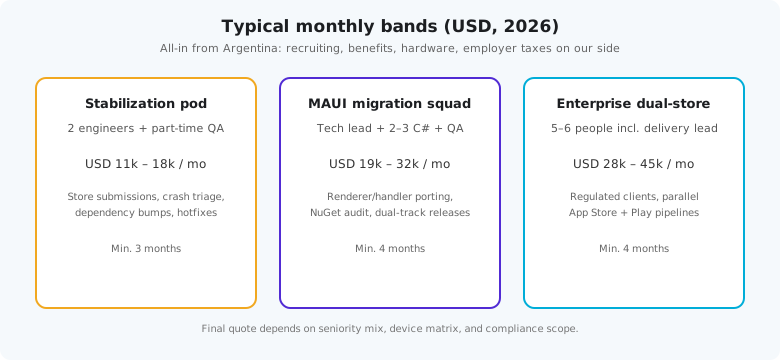
Stabilization pod
Two mid-to-senior engineers plus part-time QA. Best when migration is paused or only exploratory. Owns crash triage, dependency bumps, store resubmissions.
Band: USD 11k–18k per month. Minimum: 3 months.
MAUI migration squad
Tech lead, two or three engineers, QA embedded. Owns dual-track delivery, parity tests, NuGet audit, cut planning.
Band: USD 19k–32k per month. Minimum: 4 months.
Enterprise dual-store
Five or six people including a delivery lead and broader device matrix. For insurers, banks, or large logistics fleets with parallel audit and release trains.
Band: USD 28k–45k per month. Minimum: 4 months.
Apple and Google programme fees, cloud spend, HockeyApp or App Center successors, and paid third-party SDKs remain on your billing. If you need only project scoping without a squad, start from our Xamarin development services overview and we will right-size the model.
First thirty days: governance most vendors leave vague
Week one is deliberately boring: read-only access, dependency spreadsheet, risk-ranked backlog, and a single shared dashboard draft. No hero refactors. Week two lands a merged PR with your lead’s review—usually CI hardening, a targeted crash fix, or a store-blocker. By day thirty these four artefacts exist in writing: architecture diagram, test matrix per OS version, release checklist with rollback, and migration slice board with explicit “not started” rows so scope creep is visible.
Scorecard metrics (examples)
- Crash-free sessions vs baseline (target: non-regressing two weeks straight).
- Mean hours from pull request merge to TestFlight or internal track.
- Count of open store violations or policy warnings.
- MAUI parity stories closed vs planned for the rolling four sprints.
What we push back on
Big-bang cutovers without parity tests, silent scope additions to “just ship MAUI,” or skipping physical devices in favour of emulators-only. Those choices save calendar days and cost quarters.
Need a lighter model? Nearshore developers on staff aug can work when you already have a mobile lead—we are explicit about when that is enough.
Fourteen-day ramp to a real merged pull request
We mirror the same cadence we publish on our Go and .NET squads: short list fast, pair on real code, land something small in production-shaped flow. Enterprise legal can stretch contract signing; we say that upfront instead of marketing fantasy dates.
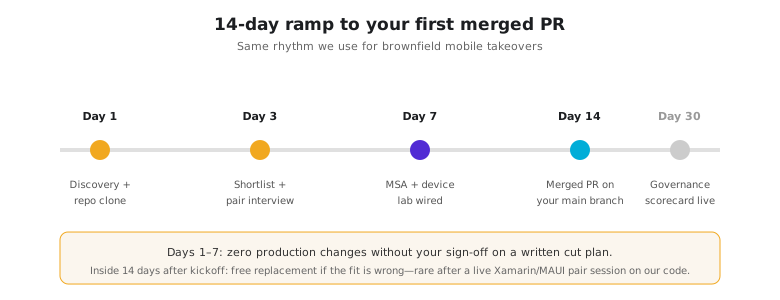
- Day 1 — Discovery. Mobile tech lead plus delivery lead. We inventory renderers, third-party SDKs, authentication flows, and your current store pain. You get a one-page go/no-go on whether we are the right firm.
- Day 3 — Shortlist. Profiles with production Xamarin.Forms or native Xamarin ship history, device-lab experience, and public code where NDAs allow.
- Days 4–7 — Pair interview. Ninety minutes on our internal training app: async ViewModel bug, renderer edge case, failing UITest. Your lead drives half the keyboard.
- Days 8–12 — Onboarding. Signed MSA, access to repos and CI, secret scanning rules acknowledged, first triage issue assigned.
- Day 14 — Merged PR. Small, reviewed, through your pipeline. If the fit is wrong, replacement inside fourteen calendar days is free with overlap—rare after the pair session.
The MAUI Readiness Scorecard (three yes answers mean dual-track)
We use this internally before proposing a migration squad; answering honestly saves budget.
- Renderer debt: Do you have more than six custom renderers or heavy platform effects? If yes, plan handler work as its own sub-roadmap, not as “part of the MAUI upgrade ticket.”
- NuGet survivability: Are more than twenty percent of your packages unmaintained or without a MAUI path? If yes, budget native bridge spikes early.
- Release pressure: Do you ship store-facing changes at least every twenty-one days? If yes, dual-track is mandatory; pause migration any sprint store risk spikes.
2026 freshness: Apple and Google continue tightening minimum OS and 64-bit requirements; Xamarin SDKs stay pinned while Android version timelines advance independently—that asymmetry is why maintenance-only contracts now carry explicit sunset clauses in our statements of work.
Dedicated team vs freelancers, in-house and big offshore benches
Xamarin is a shrinking talent pool; the comparison is not symmetric with React Native hiring.
Freelancers
Excellent for a two-week store emergency. Poor for eighteen-month migration plus compliance evidence because continuity and QA depth rarely survive together.
In-house
Ideal if you will fund mobile leadership for years. Slow in 2026 because senior Xamarin engineers negotiate like people who know they are maintaining a sunset stack.
Large offshore agency
Can flood tickets cheaply. Weak when interviewers are not the committers, overlap with US product is thin, and renderer expertise is a line item extra.
We sit in the middle on price, high on overlap and accountability: full-time employees in Argentina, you meet the actual engineers, tech lead included. Compare delivery philosophy with our AI development and platform engineering pages if you are evaluating multiple nearshore practices at once.
Two anonymised shapes we see in production
US fintech: store rejection loop
Start: Xamarin.Forms 5.x, twelve custom renderers, 180k MAU, two failed Play submissions.
Squad: migration shape (tech lead + three engineers + QA).
Twelve-week outcome: Play submissions returned to single-attempt approval cycle; parallel MAUI branch reached feature parity on onboarding and card display flows with automated screenshot diff tests.
LATAM logistics: crash spike on older Android
Start: Mixed Xamarin.Native shell, third-party telematics SDK, P95 startup 6.4s on API 26–28 devices.
Squad: stabilization pod first, then scaled to migration squad month four.
Outcome: Crash rate down 61% vs four-week baseline; startup P95 under 3s after lazy-loading refactor; MAUI pilot limited to dispatcher tablet SKU to de-risk driver phones.
Mini case study
Chronic care app: store rating climb while MAUI pilot shipped
Context. Composite from a 2025 engagement: Xamarin.Forms patient app, internal mobile lead departed, insurer demanded reliability improvements within ninety days.
Squad. Five people: tech lead, two C# engineers, QA lead, delivery lead part-time.
Moves. Month one only stabilization and telemetry; month two opened MAUI pilot for tablet-only clinician workflow; dual-track releases with shared regression suite.
Measured results (rounded). Store rating 3.8 to 4.4 stars, crash-free sessions +19 points, regression time from two days to under three hours, insurer sign-off obtained week eleven.
Caveat. Month one feature throughput looked flat because we refused cosmetic work until crash budgets stabilised—that trade is normal in brownfield medical apps.
At a glance
Shape: Dual-track
Duration: 6+ months extended
Stack: Xamarin.Forms, .NET MAUI pilot
Risks and how we contract against them
Knowledge concentration
ADR light templates week one, weekly architecture notes in your wiki, pairing with any internal engineer you still have—even four hours a week materially reduces bus factor.
Migration never finishes
Slice-based roadmap with explicit stop conditions; executive checkpoint when less than thirty percent of screens remain on Xamarin after agreed horizon.
Store emergency derails MAUI
Written rule: Lane A incidents preempt Lane B for a maximum of five business days before we escalate scope trade to your product VP in writing.
Security review surprises
Secret scanning and dependency licence report in week one deliverable list; no “we will add security later” backlog items for regulated clients.
Why Siblings for Xamarin specifically
We are a small firm: no enterprise sales army, no bait-and-switch bench.
11+
Years shipping mobile for clients
Founded 2014, Córdoba
GMT-3
Overlap with US Eastern
Same-day pairing for most US product teams
2
Free replacement window (days)
14 calendar days if fit misses
We deliberately keep the bench senior-heavy. That means we sometimes say no to RFPs that assume five mid-level engineers can absorb ten years of Xamarin debt—those projects need fewer, deeper people or they fail quietly.
Frequently Asked Questions
A mobile tech lead, senior and mid-level C# engineers with Xamarin.Forms or Xamarin.Native production hours, QA with a physical device matrix, and a delivery lead who owns sprint hygiene. Everyone is full-time on your engagement: your Git host, your Azure DevOps or GitHub Actions pipelines, your TestFlight and Play Console access. Commercially they sit on our payroll in Argentina, so you skip local hiring, benefits and payroll taxes. Minimum commitment is three months; after that, fifteen-day notice either side.
A stabilization pod of two engineers plus part-time QA is USD 11,000 to 18,000 per month. A MAUI migration squad with a tech lead, two to three C# engineers and QA is USD 19,000 to 32,000 per month. A larger enterprise dual-store squad with five to six people including a delivery lead is USD 28,000 to 45,000 per month. Figures are all-in from our side for salaries, hardware and employer taxes; Apple and Google program fees, cloud spend and third-party SDK licences stay on your accounts.
Week one is read-only discovery: architecture map, NuGet inventory with MAUI replacement notes, renderer count, and a written cut plan for store risk. Week two lands the first merged pull request, usually a low-risk fix or pipeline hardening. Days fifteen to thirty establish the governance scorecard: crash-free sessions, build success rate, mean time to TestFlight or internal track, and migration slice burndown. You get a single shared dashboard; if two metrics slip for two consecutive weeks, we schedule a thirty-minute executive readout with a blunt remediation proposal.
Staff augmentation drops individual engineers into your management chain; you still own architecture, code review culture and on-call for mobile edge cases. A dedicated team is a managed unit: we supply the tech lead, the internal review bar, the device lab discipline and accountability for the migration slice plan. Use augmentation when you already have a strong mobile lead who only needs capacity. Use a dedicated team when nobody inside wants to own renderer ports, store rejections and MAUI parity tests at the same time.
Yes for a bounded horizon. Some apps have twelve to twenty-four months of useful life left; a stabilization pod can keep them passing review while you sunset features. We will be direct when store mandates or third-party SDK abandonment make maintenance-only more expensive than a phased MAUI move. That threshold is a conversation backed by build logs, not a slide deck.
The last interview is always a ninety-minute pair session on a real Xamarin.Forms screen from our internal training codebase: threading around async ViewModel work, a custom renderer edge case, and a failing UITest. We watch for habits around Android API level bumps and iOS linker settings, not trivia. Engineers who have only watched MAUI tutorials but never shipped Xamarin to production rarely survive that session.
Yes. Engagements start with a mutual NDA and a Master Services Agreement that assigns source code, derivative works and deliverables to you on payment. We work inside your repositories and signing keys. We do not keep copies of client code after an engagement ends.
Our standards
Xamarin engagements ship like mobile products, not staffing spreadsheets.
- Store metrics are first-class. Crash-free sessions, submission success and startup latency sit next to story points on the sprint board.
- No silent framework jumps. Every SDK or package bump lands with a rollback tag and a release note your compliance team can file.
- Device lab, not emulator cosplay. Physical hardware for the Android long tail your analytics already prove you have.
- Parity before promotion. MAUI slices do not reach production tracks until automated UI parity passes against the Xamarin reference build.
- Honest scope. If a renderer rewrite will blow the timeline, we say it in week two, not week twenty.
Prefer the Argentina-hosted mirror? Open the .com.ar version of this page.
Contact Siblings Software Argentina
Send renderer count, target stores and whether you need dual-track; we reply within one business day.