Hire a Kotlin Development Team
Buyers searching for "hire Kotlin development team" are usually comparing vendors, prices, delivery models, and risk. They may already have an Android roadmap, a Java system that has become hard to change, or a backend group that wants Kotlin without gambling on a full internal hiring cycle.
Siblings Software builds dedicated Kotlin teams from Cordoba, Argentina for companies that need practical production work: Android applications, Spring Boot or Ktor services, Kotlin Multiplatform modules, QA automation, and careful Java-to-Kotlin modernization. The difference between adding bodies and hiring a team is who is keeping architecture, testing, and communication from drifting.
What buyers are really trying to decide
Commercial investigation, not Kotlin documentation.
A CTO wants to know whether a vendor can handle Android releases, whether backend Kotlin engineers can work inside an existing JVM ecosystem, whether Kotlin Multiplatform is being oversold, and what the budget looks like before wasting a week on calls.
Kotlin hiring is usually a business constraint, not a language preference. Maybe your mobile app still has Java screens that only one person understands. Maybe the backend team wants the safety of Kotlin, but the current release train is fragile. Maybe leadership wants shared mobile logic, while the iOS team is worried about maintainability. Those situations need senior judgement.
Siblings Software is a fit when you need a nearshore team that can join your process and improve delivery without turning the engagement into a black box. For broader context, compare this page with our dedicated development teams, staff augmentation, and Kotlin development services.
What a dedicated Kotlin team can actually do
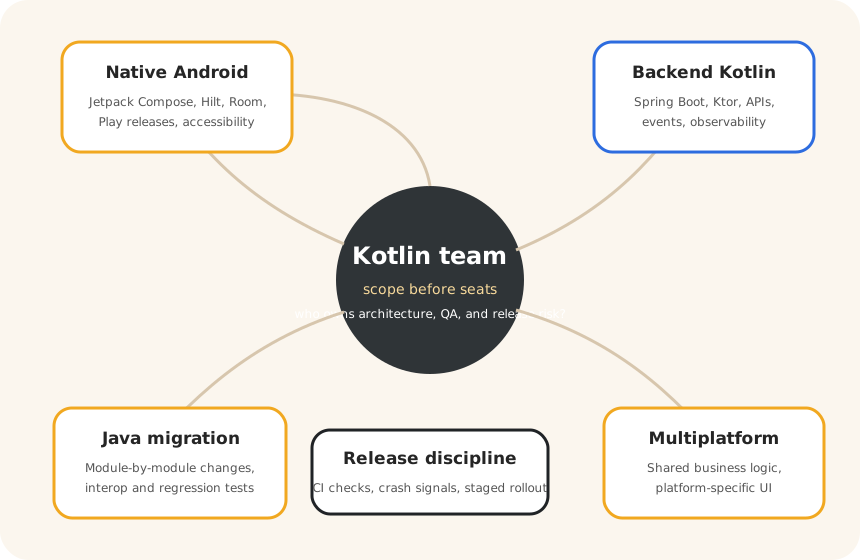
We define the team by ownership area first, then by stack.
Android product delivery
Native Android apps with Kotlin, Jetpack Compose, Hilt, Room, WorkManager, Firebase, Play Console release flows, accessibility checks, and device-specific regression coverage.
Server-side Kotlin
Spring Boot or Ktor services, API design, GraphQL, event consumers, background jobs, PostgreSQL, Redis, cloud deployments, and observability. We work well with teams already using Java, Node.js, or Python.
Kotlin Multiplatform
Shared business logic for Android and iOS when the economics make sense. We are careful here: sharing code is useful, but forcing every UI detail through a shared layer can slow teams down.
Java-to-Kotlin migration
Incremental conversion of legacy Java modules, null-safety cleanup, Gradle and KSP tuning, interop rules, regression tests, and a migration plan that does not freeze feature development.
QA and release support
JUnit, MockK, Espresso, Compose UI tests, smoke suites, staged rollout checks, crash monitoring, and release notes. Kotlin quality is not only code style; it is what happens after shipping.
Technical leadership
Architecture review, pull request standards, delivery cadence, mentoring, documentation, and escalation. Useful when your internal team has product context but not enough Kotlin depth.
For official platform references, we follow the Kotlin documentation, Android's Jetpack Compose guidance, and Spring's Kotlin support notes when those stacks are part of the engagement.
Good reasons to hire Kotlin capacity
Tied to delivery pressure, not a language fashion.
There are bad reasons to hire a Kotlin team. "We heard Kotlin is modern" is not enough. A good reason is tied to delivery pressure, product risk, or a gap your current team cannot cover fast enough.
We usually help funded startups, scaleups, and mid-market companies that already have a product in motion. They need senior engineers who can read an existing codebase, ask uncomfortable questions, and ship without treating the client as a ticket factory.
Common scenarios include an Android roadmap that is blocked by a small mobile team, a JVM backend that needs Kotlin services around a legacy core, a marketplace or fintech app that cannot tolerate sloppy releases, or a CTO who wants to test Kotlin Multiplatform with one module before committing the whole product.
The quick fit check
You are likely a fit if you can point to one of these problems:
- Your Android backlog is growing faster than your internal mobile team.
- Your Java application needs modernization, but a rewrite would be reckless.
- You need backend Kotlin engineers who understand production operations, not only syntax.
- You want nearshore overlap and named engineers instead of a rotating offshore bench.
- You need QA and release discipline around Kotlin work, not just development hours.
When Kotlin is the wrong call
It is not a fit when:
- The project is a weekend script or a prototype that will be thrown away.
- The mobile app needs heavy native iOS UI and almost no shared logic.
- The team has no plan to maintain a Multiplatform shared module after launch.
- The work is one-off contractor labor rather than ongoing product ownership.
- You want the cheapest possible hourly rate, not delivery quality.
How we move from first call to working code
A fast start is useful only if the first month is not chaotic.
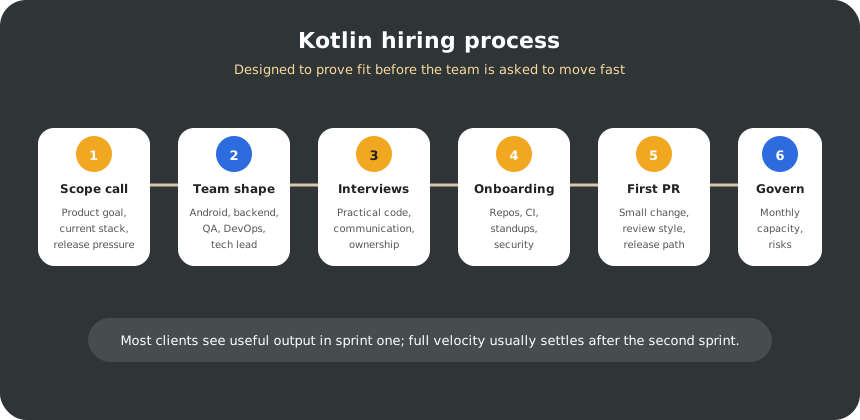
We treat the ramp-up as part of delivery. The goal is to expose assumptions early: who reviews architecture, who approves releases, how incidents are handled, and what "done" means in your product. The first pull request is intentionally small. A dependency upgrade, a low-risk endpoint, a test harness, or one Compose screen can reveal more about code review culture than a polished slide deck.
1. Scope and risk call
We review the product goal, current codebase, stakeholders, release pressure, and whether Kotlin is the right tool for the work.
2. Team design
You get a recommended shape: one senior engineer, a mobile pod, a backend pair, or a squad with QA and a fractional tech lead.
3. Practical interviews
You meet the actual engineers. We discuss Kotlin decisions, production incidents, communication habits, and the kind of ambiguity they have handled.
4. Onboarding
We enter your repositories, CI/CD, Jira or Linear board, Slack or Teams channels, Play Console process, and security workflow.
5. First sprint
The team ships small, reviews with your leads, calibrates estimates, and documents friction before adding more throughput.
6. Monthly governance
We review velocity, quality signals, capacity, risks, and whether the team should stay the same, shrink, or grow.
What Kotlin teams usually cost
Ranges that help you compare options before a call.
Exact pricing depends on seniority, duration, interview requirements, and whether Siblings Software owns delivery management. These ranges are meant to help you compare options before a call.
Embedded Kotlin engineer
USD 8,000 to 12,000 per month.
One senior Android or backend Kotlin developer working inside your sprint process. Best when you already have product management, technical leadership, and QA covered.
Kotlin product pod
USD 18,000 to 32,000 per month.
Two or three engineers plus part-time technical leadership. Best for a mobile roadmap, API layer, or product area that needs steady delivery over several months.
Managed Kotlin squad
USD 35,000 to 52,000 per month.
Four to six people, often including QA automation, DevOps support, a delivery lead, and a senior technical owner. Best when you want us accountable for a workstream.
These are fully loaded nearshore service ranges, not employee salaries. Recruiting, benefits, payroll, laptops, local taxes, replacement coverage, and management overhead are handled by Siblings Software. Third-party tools such as AWS, Firebase, Datadog, Sentry, or Play Console fees remain on your accounts.
Nearshore Kotlin team vs freelancers, in-house, and large agencies
Where each option works, and where it gets risky.
Freelancers
Where it works: short tasks, isolated bug fixes, one-off Android screens, small backend features.
Where it gets risky: continuity, code ownership, architecture decisions, and replacement coverage are fragile.
What we change: you hire named engineers inside a managed relationship, with backup standards and a lead watching quality.
In-house hiring
Where it works: permanent strategic roles and deep product knowledge.
Where it gets risky: recruiting takes months, especially for senior Kotlin and mobile profiles. A bad hire is expensive.
What we change: you get capacity now while keeping internal hiring focused on long-term roles.
Large agencies
Where it works: big procurement programs, multi-country account structures, very large transformation projects.
Where it gets risky: senior people often vanish after sales. Delivery can become heavy and slow.
What we change: you work closer to the people making staffing, architecture, and delivery decisions.
Nearshore Kotlin team
Where it works: roadmap acceleration, Java modernization, Android app delivery, backend Kotlin adoption.
Where it gets risky: it fails when ownership is vague, onboarding is rushed, or Kotlin Multiplatform is oversold.
What we change: we define responsibility, review rules, team composition, and release controls before promising velocity.
Realistic Kotlin work we would take on
Where the team is useful, and where it is not.
Rebuilding an Android app without pausing feature delivery
We might move legacy screens to Jetpack Compose one flow at a time, keep analytics stable, protect login and payment paths, and use staged Play releases so the rewrite does not become an all-or-nothing bet.
Adding Kotlin services around a JVM backend
A team can build a new API, worker, or integration layer in Kotlin while the existing Java or Spring system keeps running. This is common for payment flows, logistics events, and B2B workflow products. Our API development team handles this kind of boundary work often.
Testing Kotlin Multiplatform with one valuable module
Instead of committing the whole app, we start with pricing rules, offline sync logic, validation, or a domain module shared between Android and iOS. If it lowers maintenance, we expand. If not, we stop.
Stabilizing releases before a major launch
Kotlin work is not only writing features. We can add regression tests, crash dashboards, build checks, release checklists, and QA coverage before marketing or customer commitments raise the cost of mistakes.
A practical Kotlin rescue: Android checkout and backend reliability
A short mini case study.
A regional B2B commerce company came to us with a familiar problem. Their Android ordering app worked, but sales reps avoided the newest checkout flow because it froze on older devices and failed silently when the warehouse API was slow. The backend was mostly Java, with a few Kotlin files added by a previous contractor and no clear migration pattern.
We started with a two-person Kotlin pod and a part-time QA engineer. The first week was not glamorous: crash triage, API timeout mapping, device testing, and reviewing how orders moved from the app to the warehouse system. By the second sprint, we had isolated the checkout state machine, added explicit retry behavior, and moved the riskiest logic into a tested Kotlin module.
The client did not need a rewrite. They needed a path out of fear. Over twelve weeks, the team replaced the brittle checkout flow, added contract tests around the order API, introduced a staged release checklist, and documented where Java would stay for now. The visible result was fewer failed orders. The less visible result was that their internal team could make changes without asking, "Which part breaks if we touch this?"
What changed in the engagement
- Checkout logic moved into a Kotlin module with unit tests around price, discount, inventory, and retry behavior.
- Android release notes stopped being guesswork because QA had a regression list tied to actual device behavior.
- The backend team kept the Java core but accepted new Kotlin services where the boundary was clean.
- Stakeholders got a weekly risk note, not just a burndown chart.
Read related case studies or meet the people behind delivery on our team page.
What clients usually get wrong about Kotlin outsourcing
Three common mistakes worth catching early.
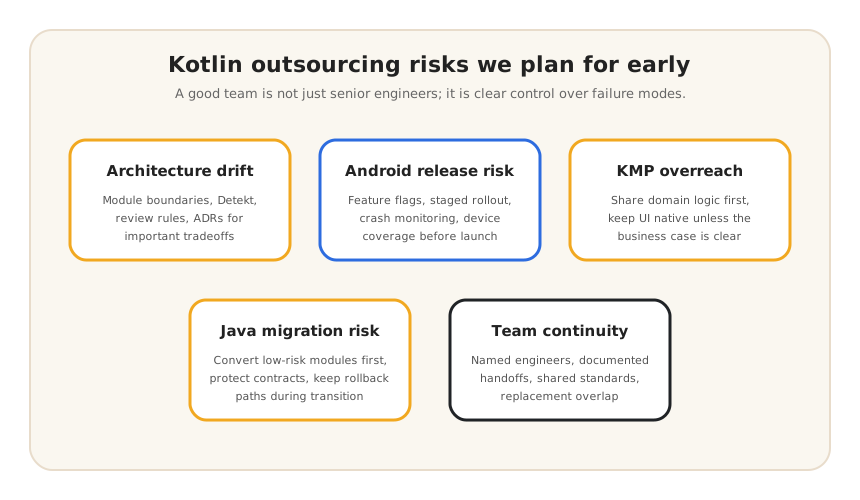
The most common mistake is treating Kotlin hiring as a keyword match. A resume can say Kotlin, but the real question is whether the engineer has worked with release failures, Java interoperability, Gradle pain, Android performance, or product managers changing scope mid-sprint.
The second mistake is trying to share too much code too early. Kotlin Multiplatform can be excellent, but only if the shared layer has stable business value. We prefer a narrow experiment with a clear rollback path over a broad platform decision that locks both mobile teams into a tool they do not trust yet.
The third mistake is skipping QA until the end. Android and backend Kotlin both fail in ways that look fine in a demo. Device differences, cancellation bugs, background jobs, and flaky network behavior need test strategy from the first sprint.
Questions buyers ask before hiring Kotlin developers
The decisions that come up before the engagement starts.
How quickly can we hire a Kotlin development team?
A single senior Kotlin engineer can often start in 10 to 15 business days after scope is clear. A full Kotlin squad usually needs two to four weeks because we confirm architecture needs, QA coverage, release process, and client interviews before ramping.
How much does a nearshore Kotlin team cost?
A senior Kotlin engineer from Argentina is commonly planned around USD 8,000 to 12,000 per month. A small product pod often lands around USD 18,000 to 32,000 per month. Larger squads with QA, DevOps, and delivery management can reach USD 35,000 to 52,000 per month.
Do your Kotlin developers work on Android only?
No. Android work is common, but Kotlin is also useful for backend services, Spring Boot applications, Ktor APIs, Kotlin Multiplatform shared modules, testing, and staged Java-to-Kotlin migration.
Can you migrate Java code to Kotlin without stopping feature work?
Yes, when the migration is planned module by module. We usually begin with low-risk utility and domain layers, add regression tests, keep Java interoperability intact, and avoid rewriting the entire application just because Kotlin is the target.
Is Kotlin Multiplatform a good fit for every mobile project?
No. Kotlin Multiplatform is strongest when shared business logic is stable and both mobile platforms need consistent behavior. It is a weaker choice when the project mainly needs highly custom native UI or when the team cannot maintain the shared module after launch.
Who owns the code and intellectual property?
The client owns the source code and work product under the services agreement. Siblings Software works in the client's repositories, issue trackers, and deployment process, and can sign NDAs before technical discovery.
OUR STANDARDS
Kotlin engineers who treat your release pipeline like their own.
Every Kotlin engagement is anchored by a senior engineer who has shipped Android applications, JVM services, and migrations under real release pressure. We design teams around the decisions you actually need made: when to migrate Java, when to delay Multiplatform, when to invest in QA before the next launch.
We document trade-offs in your repository, follow your security and access rules, prefer staged rollouts and feature flags over hero launches, and write the runbooks your future hires will rely on. The goal is not heroics. It is releases that stop feeling like events.
Contact Siblings Software Argentina
Tell us what your Kotlin team needs to own.