Hire a dedicated Ionic development team for Capacitor store releases
· Typical time to first merged PR: 10 to 14 days
Reviewed by Javier Uanini, CEO and delivery lead, Siblings Software.
A dedicated Ionic development team is the engagement shape we use when you need a managed hybrid mobile unit to own Capacitor builds, Angular upgrades, plugin debt, and App Store and Play submissions on one backlog. Siblings assembles full-time engineers from Córdoba, Argentina (GMT-3) under our dedicated teams practice, with overlap across a US Eastern business day.
This page states what is included, published monthly bands (USD 12K to 60K for squads, consistent with our Ionic development services overview), how the first thirty days are governed, and when Ionic staff augmentation is the better fit. References: Capacitor documentation and Ionic Framework docs.

Who hires a dedicated Ionic team (not staff aug)
Four patterns cover most signed hybrid mobile squads we staff from Argentina.
Field teams need offline Ionic on one Angular codebase
Inspection, logistics, and healthcare field apps need SQLite offline, camera capture, and GPS with WebView parity tests on every release candidate. You already have web engineers who know Angular and want one cadence to both stores.
Store rejections outpace your plugin backlog
Privacy Manifest gaps, Play Data Safety YAML drift, or a Cordova plugin that no longer builds on current Xcode blocks revenue work. You need a pod that treats submissions as a KPI, not a surprise Friday task.
Angular upgrade debt blocks Capacitor moves
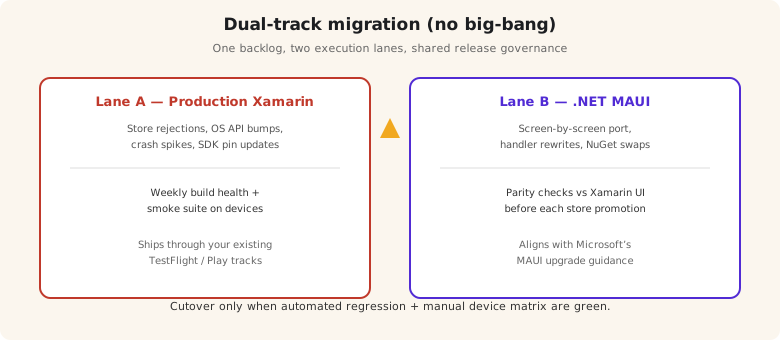
You are pinned on an older Ionic or Angular line while Capacitor 6 is the target. Dual-track delivery keeps Lane A shipping fixes while Lane B migrates plugins with automated smoke tests.
You evaluated React Native and chose Ionic deliberately
Your admin console is already Angular, store APIs are moderate, and hiring a second mobile stack is not funded. A dedicated squad owns the hybrid shell while your product team keeps web velocity.
If you only need one senior for eight weeks, say so, we will steer you to Ionic staff augmentation or a scoped project-based slice instead of a squad.
What the Ionic squad owns each sprint
Below is the real checklist, not a generic “we do mobile” list. Most engagements activate at least five rows at once because plugin work and store submissions refuse to stay separated.
Capacitor plugin engineering
Custom native bridges for camera, BLE, background geofencing, and secure storage when community plugins miss SLA or OS coverage. Each plugin ships with a rollback tag and a device matrix row.
Store and signing pipeline
Fastlane lanes, staged rollouts, Privacy Manifest and Play Data Safety YAML in source, and rejection runbooks the pod owns while you keep account ownership.
Quality and device matrix
Physical devices for the long tail of OEM Android skins, UITest or Appium smoke suites, crash analytics baselines, memory regressions on older OS versions buyers still use in LATAM and US rural markets.
Angular and Ionic modernization
Upgrade paths, lazy route splitting, WebView performance budgets, and selective native fork decisions documented before sprint one. We coordinate with our Angular dedicated teams when the web shell and mobile shell share auth.
Store policy timelines live in the Android version timelines; we treat that as the baseline spec and overlay our internal checklists for Cordova dead-ends, third-party push providers and enterprise MDM constraints.
Monthly pricing bands for Ionic squads (published, not hidden behind a form)
Hybrid squad work is lumpy: one custom plugin can burn a week. Publishing ranges upfront filters mismatched RFPs and keeps procurement friendly. Final quotes move inside these brackets based on plugin count, regulated industry controls, and how many legacy Android API levels you still support.
Lean squad (4 seats)
Ionic tech lead, two senior hybrid engineers, QA with OEM device lab. Best when plugin surface is mostly community-maintained.
Band: USD 12k to 22k per month. Minimum: 3 months.
Standard squad (6 seats)
Adds Capacitor native specialist and part-time mobile DevOps on Fastlane. Owns dual-track plugin replacement plus store cadence.
Band: USD 22k to 40k per month. Minimum: 4 months.
Program pod (8 seats)
Dual app flavors, shared Ionic core, designer, and release manager. For B2B suites shipping admin plus field SKU on one backlog.
Band: USD 40k to 60k per month. Minimum: 4 months.
Apple and Google programme fees, cloud spend, HockeyApp or App Center successors, and paid third-party SDKs remain on your billing. If you need only project scoping without a squad, start from our Ionic development services overview and we will right-size the model.
First thirty days: governance most vendors leave vague
Week one is deliberately boring: read-only access, dependency spreadsheet, risk-ranked backlog, and a single shared dashboard draft. No hero refactors. Week two lands a merged PR with your lead’s review, usually CI hardening, a targeted crash fix, or a store-blocker. By day thirty these four artefacts exist in writing: architecture diagram, test matrix per OS version, release checklist with rollback, and plugin debt board with explicit “not started” rows so scope creep is visible.
Scorecard metrics (examples)
- Crash-free sessions vs baseline (target: non-regressing two weeks straight).
- Mean hours from pull request merge to TestFlight or internal track.
- Count of open store violations or policy warnings.
- Capacitor plugin replacements closed vs planned for the rolling four sprints.
What we push back on
Big-bang cutovers without parity tests, silent scope additions to “just ship Capacitor,” or skipping physical devices in favour of emulators-only. Those choices save calendar days and cost quarters.
Need a lighter model? Nearshore developers on staff aug can work when you already have a mobile lead, we are explicit about when that is enough.
Fourteen-day ramp to a real merged pull request
We mirror the same cadence we publish on our Go and .NET squads: short list fast, pair on real code, land something small in production-shaped flow. Enterprise legal can stretch contract signing; we say that upfront instead of marketing fantasy dates.
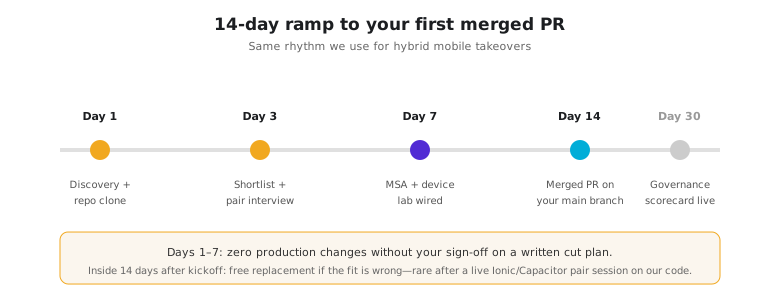
- Day 1 , Discovery. Mobile tech lead plus delivery lead. We inventory plugins, third-party SDKs, authentication flows, and your current store pain. You get a one-page go/no-go on whether we are the right firm.
- Day 3 , Shortlist. Profiles with production Ionic and Capacitor ship history, device-lab experience, and public code where NDAs allow.
- Days 4 to 7 , Pair interview. Ninety minutes on our internal training app: lazy route performance, plugin edge case, failing WebView parity test. Your lead drives half the keyboard.
- Days 8 to 12 , Onboarding. Signed MSA, access to repos and CI, secret scanning rules acknowledged, first triage issue assigned.
- Day 14 , Merged PR. Small, reviewed, through your pipeline. If the fit is wrong, replacement inside fourteen calendar days is free with overlap, rare after the pair session.
The Capacitor Shell Test (three yes answers mean dual-track)
We use this internally before proposing a migration squad; answering honestly saves budget.
- Plugin debt: Do you have more than eight Cordova plugins without a Capacitor replacement path or heavy platform effects? If yes, plan native bridge spikes early, as its own sub-roadmap, not as a single upgrade ticket.
- Offline criticality: Do field users lose money when SQLite sync fails? If yes, dual-track is mandatory; pause migration any sprint store risk spikes.
- Release pressure: Do you ship store-facing changes at least every twenty-one days? If yes, dual-track is mandatory; pause migration any sprint store risk spikes.
2026 freshness: Apple and Google continue tightening minimum OS requirements while your Ionic version may stay pinned while Android version timelines advance independently, that asymmetry is why maintenance-only contracts now carry explicit sunset clauses in our statements of work.
Dedicated Ionic team vs freelancers, in-house, and staff augmentation
Ionic hiring is not symmetric with React Native hiring; the comparison is not symmetric with React Native hiring.
Freelancers
Excellent for a two-week store emergency. Poor for eighteen-month migration plus compliance evidence because continuity and QA depth rarely survive together.
In-house
Ideal if you will fund mobile leadership for years. Slower when senior hybrid engineers are split across web and native emergencies.
Staff augmentation
Cheaper when you have a strong mobile lead and only need seats. Weak when nobody owns Fastlane, plugins, and Angular upgrades concurrently.
We sit in the middle on price, high on overlap and accountability: full-time employees in Argentina, you meet the actual engineers, tech lead included. Compare delivery philosophy with our AI development and platform engineering pages if you are evaluating multiple nearshore practices at once.
Risks and how we contract against them
Knowledge concentration
ADR light templates week one, weekly architecture notes in your wiki, pairing with any internal engineer you still have, even four hours a week materially reduces bus factor.
Migration never finishes
Slice-based roadmap with explicit stop conditions; executive checkpoint when less than thirty percent of plugins are migrated after the agreed horizon.
Store emergency derails Capacitor work
Written rule: Lane A incidents preempt Lane B for a maximum of five business days before we escalate scope trade to your product VP in writing.
Security review surprises
Secret scanning and dependency licence report in week one deliverable list; no “we will add security later” backlog items for regulated clients.
Frequently Asked Questions
A hybrid mobile tech lead, senior Ionic and Angular engineers with production Capacitor hours, QA with an OEM device matrix, and a delivery lead who owns sprint hygiene. Everyone is full-time on your engagement: your Git host, your CI pipelines, your TestFlight and Play Console access with you retaining account ownership. Commercially they sit on our payroll in Argentina, so you skip local hiring, benefits and payroll taxes. Minimum commitment is three months; after that, fifteen-day notice either side.
Dedicated hybrid squads typically run USD 12,000 to 60,000 per month depending on native plugin depth and QA coverage, aligned with the bands we publish on our Ionic development services page. A lean four-seat squad sits at the lower end; a six-seat squad with a Capacitor native specialist sits mid-band; an eight-seat program pod sits at the upper end. Figures are all-in from our side for salaries, hardware and employer taxes; Apple and Google programme fees, cloud spend and paid third-party SDKs stay on your accounts.
Week one is read-only discovery: plugin inventory, Angular and Ionic version map, store rejection history, and a written cut plan for the next two releases. Week two lands the first merged pull request, usually CI hardening, a targeted crash fix, or a store-blocker. Days fifteen to thirty establish the governance scorecard: crash-free sessions, build success rate, mean time to internal track, and Capacitor plugin debt burndown. You get a single shared dashboard; if two metrics slip for two consecutive weeks, we schedule a thirty-minute executive readout with a blunt remediation proposal.
Staff augmentation drops individual engineers into your management chain; you still own architecture, code review culture and on-call for hybrid edge cases. A dedicated team is a managed unit: we supply the tech lead, the internal review bar, the device lab discipline and accountability for the release train. Use augmentation when you already have a strong mobile lead who only needs capacity. Use a dedicated team when nobody inside wants to own plugin ports, store rejections and Angular upgrade work at the same time.
Yes, with dual-track delivery: Lane A ships user-facing fixes on the current shell; Lane B replaces plugins in slices with automated smoke tests on physical devices. We document each plugin with a keep, replace, or fork decision before sprint one. Big-bang rewrites without parity tests are something we push back on in discovery.
The last interview is a ninety-minute pair session on a real Ionic screen from our internal training codebase: lazy route performance, a Capacitor plugin edge case, and a failing WebView parity test. We watch for habits around Android API level bumps, iOS Privacy Manifest entries, and Angular dependency injection, not trivia. Engineers who have only watched framework keynotes but never shipped a store build rarely survive that session.
Yes. Engagements start with a mutual NDA and a Master Services Agreement that assigns source code, derivative works and deliverables to you on payment. We work inside your repositories and signing keys. We do not keep copies of client code after an engagement ends.
Our standards
Ionic engagements ship like mobile products, not staffing spreadsheets.
- Store metrics are first-class. Crash-free sessions, submission success and startup latency sit next to story points on the sprint board.
- No silent framework jumps. Every Ionic, Angular, or Capacitor bump lands with a rollback tag and a release note your compliance team can file.
- Device lab, not emulator-only. Physical hardware for the Android long tail your analytics already prove you have.
- Parity before promotion. WebView checks pass before production tracks move.
- Honest scope. If a plugin rewrite will blow the timeline, we say it in week two, not week twenty.
Contact Siblings Software Argentina
Send plugin count, target stores and whether you need dual-track; we reply within one business day.