LLM Red Teaming Development Outsourcing from Argentina
We outsource LLM red teaming as production security engineering: adversarial probe suites, manual exploit exercises, CI release gates, and audit-ready evidence wired into your delivery pipeline. This page is for CISO delegates, ML platform leads, and engineering directors who already have copilots or agents in staging and need defensible adversarial testing before the next enterprise security review or regulator questionnaire.
The problem we solve is unknown attack surface. A support agent that refunds the wrong account, a RAG pipeline that leaks another tenant's documents, or a copilot that follows injected instructions in uploaded PDFs will stall rollout faster than a quality regression. A handful of jailbreak prompts in a spreadsheet does not survive procurement scrutiny or model upgrades. Red teaming belongs in your repositories as versioned probes and retest gates, not as a one-time penetration test report that nobody reruns.
Siblings Software is a software outsourcing company headquartered in Córdoba, Argentina, since 2014. Our engineers work in US Eastern time overlap for threat modeling workshops, findings triage, and security reviews. When you evaluate partners, look for attack surface mapping discipline, probe libraries in CI, named remediation owners, and portable evidence packs. We publish pricing bands and delivery timelines on this page so you can compare us against in-house hiring and alternatives.
What the Service Covers
LLM red teaming is structured adversarial testing against production copilots, RAG pipelines, and tool-using agents. The work is not a generic penetration test. It is attack surface mapping, automated probe libraries, manual multi-turn exploit exercises, remediation retests, and evidence your GRC team can file without rewriting slides.
That is different from runtime policy enforcement. Our LLM guardrails development practice implements the controls that block attacks in production. Red teaming finds what to defend first. It is also different from quality scoring alone: LLM evaluation engineering measures faithfulness and relevance on golden datasets; red teaming hunts for security failures that pass quality rubrics. Pair findings with AI agent observability when you need trace replay on exploit chains.
We map exercises to frameworks buyers already reference, including the OWASP LLM Top 10 and the NIST AI Risk Management Framework, without turning the engagement into a slide deck.
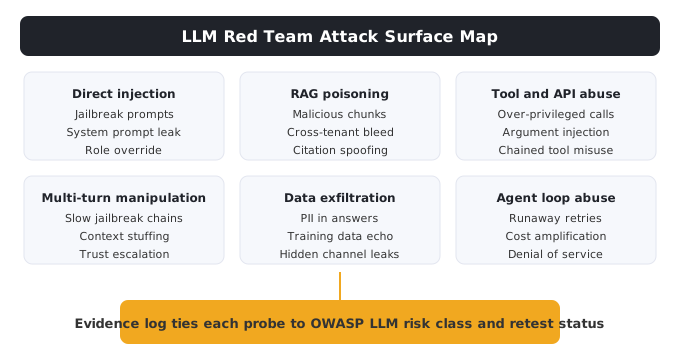
Six deliverable areas on most engagements: attack surface inventory, automated probe suite, manual exploit playbook, CI release gates, remediation retest log, and audit export schema.
Attack surface mapping
Inventory of prompts, retrieval paths, tool endpoints, and tenant boundaries so probes target real production risk, not toy jailbreaks.
Automated probe suites
Versioned adversarial cases in CI using frameworks such as Promptfoo, with failed runs blocking release like quality regressions.
Manual exploit exercises
Multi-turn injection chains, RAG poisoning attempts, and tool abuse scenarios that automation alone misses, with reproducible steps for engineering.
Who It Is For
Teams that already have AI in staging or early production and need adversarial evidence before the next enterprise contract, board review, or regulator call.
Regulated B2B SaaS
Finance, insurance, and healthcare products where customer-facing copilots must survive adversarial testing before procurement security reviews.
Agent platforms with tools
Multi-step AI agents that read tickets, query databases, or trigger workflows where tool abuse and data exfiltration are the primary risks.
Customer support AI
High-volume chat automation where prompt injection, refund fraud, and cross-account data leaks create reputational damage in minutes.
Enterprise procurement gates
Vendors blocked on security questionnaires that ask for adversarial test methodology, probe coverage, and remediation evidence, not model names.
Internal platform teams
Central AI platform groups that need one red-team playbook every product squad inherits instead of ad hoc jailbreak attempts before each launch.
EU AI Act readiness
Teams preparing high-risk AI documentation where documented adversarial testing and human oversight evidence must map to auditable controls.
Typical Project Scenarios
Six situations that show up when security joins the AI roadmap meeting and asks what you actually tested.
Staging without adversarial coverage
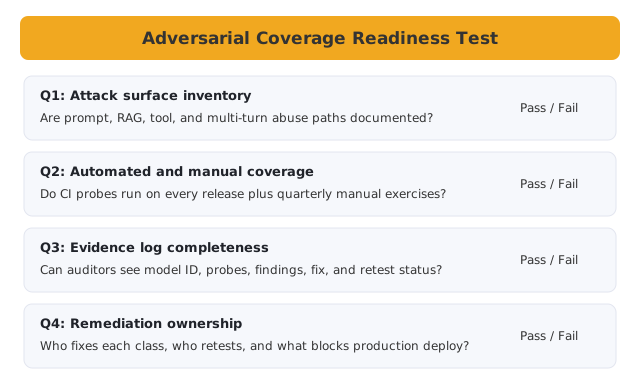
The copilot passed internal QA on happy-path prompts. Security blocked launch because nobody mapped injection paths through uploaded attachments or ticket history. We run the Adversarial Coverage Readiness Test, then ship probe suites and manual exercises against real attack surfaces before cutover.
Agent with dangerous tool combinations
An internal agent can query billing, issue refunds, and send email because prototyping was faster that way. We design tool abuse scenarios, cross-tenant leak probes, and rate-limit bypass attempts, then wire failed probes into CI release gates.
RAG poisoning blind spot
Retrieval quality looks fine on golden questions. Nobody tested whether a malicious document in the corpus can steer answers or leak neighbor chunks. We add corpus injection cases and retest after indexing pipeline changes, aligned with LLM evaluation engineering when scored rubrics are required.
One-time pen test, no CI gates
A vendor delivered a PDF of jailbreak examples. Engineering fixed three issues. The next model upgrade reintroduced two of them with no alert. We move probes into versioned repositories with release blocking, similar to how eval gates work on quality regressions.
Missing evidence for auditors
Compliance wants to show what was tested, what failed, and what was retested. Slack threads and spreadsheets do not suffice. We add findings logs, retest timestamps, and export schemas mappable to SOC evidence fields.
Code security without runtime testing
Application security ran AI code security on repositories but never probed the live inference path. We extend coverage to runtime behavior on the gateway and agent layer where exploits actually land.
How Delivery Works
Ten weeks for one customer-facing surface and one internal agent or workflow. Every finding ships with a retest gate so security gains do not become one-time paperwork. Daily standups run in US Eastern overlap from our Córdoba team.
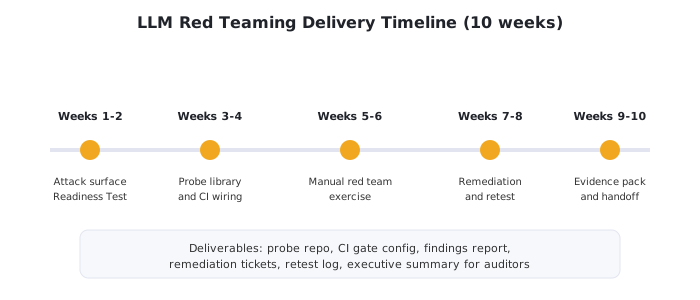
Weeks 1–2: Attack surface mapping
We run the Adversarial Coverage Readiness Test with security, product, and platform stakeholders. If evidence logging fails the readiness check, we fix logging before probe design begins.
Weeks 3–5: Automated probe libraries
Injection, jailbreak, data exfiltration, and tool abuse cases land in versioned repositories. Probes wire into CI with clear pass and fail thresholds. Engineering owns the merge gate.
Weeks 5–7: Manual exploit exercises
Red-team engineers run multi-turn chains, RAG poisoning attempts, and privilege escalation paths automation misses. Each exercise documents reproduction steps and severity.
Weeks 7–8: Remediation retests
Findings connect to engineering tickets with named owners. We retest after fixes land and update probe baselines so regressions fail CI on the next release.
Weeks 9–10: Evidence pack and handoff
Findings log, retest results, probe documentation, and audit export schemas transfer to your team. Your engineers own probe maintenance after launch. Retainer refresh is available when models or regulations shift risk.
Multi-tenant products with separate attack surfaces per customer, or regulated environments with HIPAA or SOC 2 evidence requirements, often extend into a second sprint cycle. Scoped engagements covering a single chat surface can compress to eight weeks when CI infrastructure already exists.
Team Composition
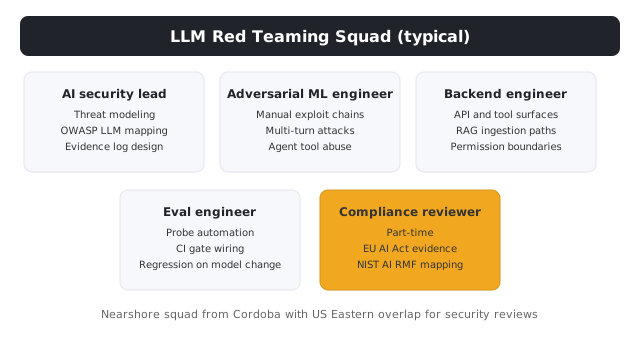
A four- to five-person squad is the usual shape: an AI security lead, a red-team engineer, an LLM engineer, a backend engineer, and a part-time compliance reviewer. The red-team engineer and compliance reviewer are the roles vendors skip to win on price. They are also the roles that keep a probe library from becoming a stale checklist or an audit finding.
For ongoing probe maintenance across multiple product lines, the same squad can run as a dedicated nearshore team. For one security-minded engineer inside your platform group, staff augmentation on an existing AI squad is often the better entry point.
Project delivery, dedicated squad, or embedded specialist depending on how much of the adversarial testing program you want us to own.
Pricing and Engagement Models
We scope every engagement after a discovery call. These bands reflect nearshore rates from Córdoba in 2026 and align with our published brackets on all services.
Project-based
Fixed scope for one red teaming pass: attack surface map, automated probe suite, manual exercises, CI gates, remediation retests, evidence export. Typical duration ten weeks. Most regulated multi-workflow products land between USD 28,000 and USD 115,000 after discovery.
Dedicated team
Ongoing squad maintaining adversarial suites, onboarding new workflows to shared probe libraries, and reviewing quarterly evidence with your security team. USD 14,000 to USD 55,000 per month depending on workflow count and compliance scope.
Staff augmentation
Embed one or two engineers when you own architecture and need hands on probe automation, manual exercises, or CI gate wiring. USD 7,000 to USD 11,000 per month per engineer depending on seniority and AI security specialization.
Compared With In-House Hiring, Freelancers, and Agencies
Adversarial testing SaaS dashboards can run canned probes. They rarely own the exploit chains in your agent runtime, RAG indexer, or escalation paths. The honest comparison depends on how much production pressure you are under right now.
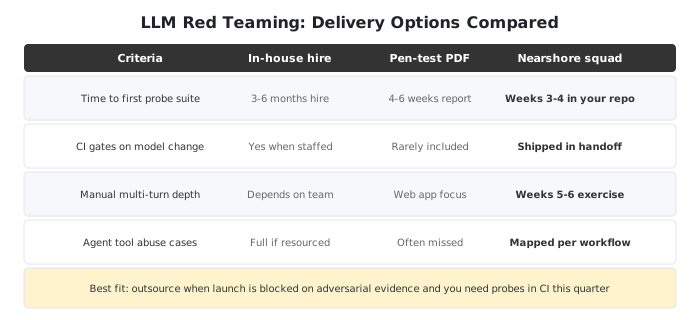
Outsource when
- Launch is blocked on adversarial test evidence and you cannot hire AI security plus LLM engineering in one hiring cycle.
- Multiple squads ship copilots with no shared probe library and security wants CI gates this quarter.
- You need manual exploit exercises and retest logs before an enterprise security review or regulator meeting.
- Agents with tool access need abuse scenarios your application team has not designed before.
Versus hiring in-house in the US. A senior AI security engineer plus an LLM platform engineer, fully loaded, runs well north of USD 500,000 per year in major US metros, assuming you can find both profiles. Our nearshore delivery from Córdoba typically lands at 40 to 55 percent of that for the same senior profiles, with US Eastern overlap.
Keep it in-house when
- You already operate a mature red-team cadence with probes in CI and quarterly manual exercises.
- The workload is an internal prototype with no external users and no compliance deadline.
- A single senior engineer can wire Promptfoo cases for one chat surface in a sprint.
Versus freelancers. Freelancers can run a jailbreak list or deliver a PDF. They rarely document retest gates across customer tiers and tool permissions. Versus large agencies. Big firms can staff you, but senior people rotate quickly. The engineers you meet on kickoff are the engineers writing probes and responding in Slack.
Illustrative Scenario: Riverbank Payments Support Agent
The following is a composite illustrative scenario, not a published client case study. No performance metrics are reported because we have not run this engagement.
The situation
Riverbank Payments is a fictional US fintech that sells payment processing and merchant support tools to mid-market retailers. Their product team built a support agent that answers billing questions, looks up transaction history, and can initiate refund requests through internal APIs. Pilot merchants liked the response speed. The CISO paused wider rollout when internal testers used injected instructions in ticket attachments to coax the agent into quoting another merchant's transaction details.
Engineering had run happy-path QA and a generic application pen test, but no adversarial probes on the live agent path, no RAG injection cases on uploaded PDFs, and no retest gates in CI. Legal wanted a findings log with named remediation owners before any enterprise merchant expanded access.
What we would deliver
A ten-week nearshore project with a five-person squad from Córdoba: AI security lead, red-team engineer, LLM engineer, backend engineer, and part-time compliance reviewer. Daily threat modeling workshops in US Eastern overlap.
- Attack surface map covering ticket ingestion, retrieval, refund API tools, and tenant isolation boundaries.
- Automated probe suite in CI with injection, jailbreak, and cross-tenant leak cases tied to releases.
- Manual exploit exercises for multi-turn refund fraud and attachment-based instruction injection.
- Remediation retest log with severity ratings and engineering ticket links.
- Evidence export schema mapping findings to SOC questionnaire fields, with pointers to follow-on guardrails development where runtime controls are required.
In a scenario like this, the expected outcome is an enterprise security review with reproducible adversarial evidence and named remediation owners, without freezing the product roadmap.
Risks and Mitigation
Red teaming programs fail in recognizable ways. We design around them up front rather than waiting to be surprised.
Checkbox testing with canned jailbreaks. Mitigation: attack surface mapping first, then probes tied to real data paths and tool endpoints in your stack.
Findings without retest gates. Mitigation: every critical finding ships with a CI probe that fails until remediation is verified and baselines update.
Manual exercises that cannot be reproduced. Mitigation: documented steps, recorded traces where policy allows, and engineering-owned reproduction scripts.
Probe sprawl across squads. Mitigation: shared probe library with ownership tags, exception registry with expiry dates, and quarterly coverage review in the handoff runbook.
Evidence packs auditors cannot parse. Mitigation: findings log with severity, retest timestamps, and export fields reviewed by the compliance reviewer before handoff.
Red team findings with no path to controls. Mitigation: prioritized remediation backlog and optional follow-on guardrails work when runtime enforcement is the fix, not another round of probing alone.
Frequently Asked Questions
Red teaming finds vulnerabilities before attackers do: prompt injection chains, RAG poisoning paths, tool abuse, and data exfiltration routes. Guardrails implement the controls that block those attacks in production. Most teams need red teaming first to know what to defend, then guardrails to keep defenses current as models and prompts change.
Evaluation engineering measures answer quality against golden datasets: faithfulness, relevance, and regression on product behavior. Red teaming searches for security failures: jailbreaks, unauthorized tool calls, cross-tenant leaks, and adversarial inputs that pass quality rubrics but violate policy. Eval suites can include some safety checks, but red teaming owns the attacker's mindset and exploit chains.
We fit your stack. Common patterns include Promptfoo or similar frameworks for CI adversarial probes, custom Python harnesses for agent tool abuse, and manual exercises for multi-turn chains automation misses. Probes live in your repositories. We do not deliver a PDF report and walk away without wiring gates into your release pipeline.
Ten weeks for one customer-facing copilot or agent workflow plus one internal tool-using agent. Weeks one and two run the Adversarial Coverage Readiness Test and map attack surfaces. Automated probe libraries and CI wiring land in weeks three through six. Manual exercises and remediation retests finish before the evidence pack ships. Multi-tenant products with separate policy packs per customer run longer.
Project-based red teaming engagements typically run USD 28,000 to USD 115,000 depending on workflow count, agent tool surface, and compliance scope. Dedicated nearshore squads for ongoing probe maintenance start around USD 14,000 per month and scale to USD 55,000 per month for larger multi-workflow programs. Staff augmentation for a single AI security or red-team engineer ranges from USD 7,000 to USD 11,000 per month. We confirm scope after reviewing your architecture and readiness test results.
Documented adversarial testing is increasingly expected for high-risk AI systems and enterprise security questionnaires. We map findings and retest status to frameworks buyers reference, including the OWASP Top 10 for LLM Applications and the NIST AI Risk Management Framework. We do not provide legal opinions. Your compliance team signs off on whether the evidence pack meets your obligations.
You do. Probe definitions, CI configuration, findings log, remediation tickets, and retest results ship to your repositories. We document how to add probes when new tools or data sources join the agent. Managed probe maintenance is optional if you want us to refresh adversarial cases as models and regulations change.
Related Services