Intelligent Document Processing Outsourcing from Argentina
What: Production intelligent document processing turns unstructured PDFs, scans, faxes, and email attachments into validated structured records with vision LLM extraction, confidence scoring, human review on low-confidence fields, and audited writes to ERP and claims platforms. Who: VPs of operations, revenue cycle leaders, and CTOs evaluating nearshore intelligent document processing outsourcing, not a one-off OCR pilot. Problem: Template OCR and brittle RPA break when vendor layouts change, handwritten fields appear, or compliance asks who approved an automated payment. Why nearshore: IDP delivery needs same-day iteration with ops owners and integration admins. How to evaluate us: Ask whether a vendor can show field-level confidence thresholds, shadow mode, reviewer queues your team can run, and extraction pipelines you own after handoff.
We outsource the full IDP stack: ingest from email and scan folders, document classification, OCR plus vision LLM field extraction, business-rule validation, HITL review consoles, and idempotent writes with durable audit logs. Need cross-system workflow orchestration beyond documents? See AI workflow automation for that layer. Need individuals embedded in your sprint board? See hire AI automation developers for staff augmentation.
Siblings Software is a software outsourcing company headquartered in Córdoba, Argentina, with daily overlap on US Eastern time. We have shipped outsourced engineering since 2014 across finance, insurance, healthcare, and B2B SaaS. Browse the full catalog on our all services directory or compare our nearshore development model if procurement is weighing regions.
What the Service Covers
Intelligent document processing is the engineering work of turning unstructured files into structured data your downstream systems can trust. A typical pattern: ingest from a shared mailbox or scan folder, classify the document family, run layout-aware OCR and vision LLM extraction, score confidence per field, route low-confidence rows to a human reviewer, then write to NetSuite, Epic, or a claims platform with idempotent APIs and a durable audit log.
That is different from buying another OCR seat. You own the classification taxonomy, extraction schemas, exception queues, and rollback story. It is also different from general AI workflow automation that orchestrates steps across many systems. IDP focuses on the document itself: the PDF attachment, the faxed referral, the scanned invoice.
We build on parsers your team can operate and extend. Managed services such as Google Document AI can accelerate early extraction when they fit your compliance posture. Custom vision LLM pipelines handle the layout variants no template covers. When documents need grounding before classification, see RAG development. When extraction quality must be measured before every release, we pair delivery with our LLM evaluation engineering practice.
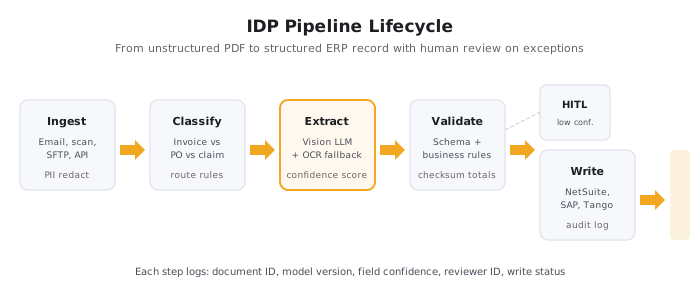
Most production IDP programs route exceptions at the field level, not the document level, so reviewers fix one line item instead of retyping an entire invoice.
Who It Is For
Teams drowning in attachments that never matched a single template. If your process still lives in shared inboxes, retyped spreadsheets, and "please resend as Excel" replies, you are the audience.
Finance and AP ops
Invoice intake from email and vendor portals, three-way match exceptions, and payment approval queues tied to your ERP without duplicate postings.
Insurance claims
First notice of loss intake, estimate extraction from attachments, and fraud flags routed to a review desk before claim updates post.
Healthcare revenue cycle
Prior authorization packets, referral letters, and remittance advice with PHI boundaries enforced at ingest and field-level redaction.
Logistics and trade
Bills of lading, customs declarations, and proof-of-delivery scans reconciled against TMS records when carrier PDF layouts change weekly.
Legal and compliance
Contract intake, KYC packets, and policy forms with clause-level extraction and retention policies aligned to your DPA.
B2B SaaS platform teams
Embedding IDP inside your product: tenant-scoped ingest, configurable field schemas, and reviewer consoles.
Typical Project Scenarios
Six situations we see on discovery calls. Each maps to a bounded MVP we can scope in the first week.
Replace template OCR that breaks every quarter
Finance bought OCR that worked on one vendor layout. When three new suppliers changed PDF headers, AP went back to manual entry. We rebuild with vision LLM extraction, golden samples per layout family, and compensating holds when a write fails mid-batch.
Add extraction to an existing RPA bot
UiPath or similar bots still handle portal login and navigation. The variable part is reading attachments. We add an IDP service with per-field confidence thresholds and keep the bot only where APIs do not exist yet.
Consolidate email, fax, and scan intake
Three channels feed the same document type but different teams touch each inbox. One classification pipeline, one exception queue, one write path to your ERP or claims system.
Launch a field-level review console
Models cut manual work substantially but finance will not auto-post payments yet. We ship a reviewer UI with keyboard shortcuts, per-field accept and reject, audit reasons, and SLA timers so exceptions do not rot in a shared inbox.
Pass a compliance review before go-live
Regulated buyers ask who approved each automated write. We map extraction flows to the OWASP LLM Top 10, document PHI and PII paths, and wire eval gates when extraction regressions must block release.
Grow from one document type to a shared platform
The first document type proves ROI. The second and third should reuse classification and reviewer templates. We architect for that on day one. For customer-facing autonomous surfaces on extracted data, see AI agents development.
How Delivery Works
Six phases, usually eight to twelve weeks for a first production document type. Shadow mode before full cutover is non-negotiable on writes that touch money or patient records.
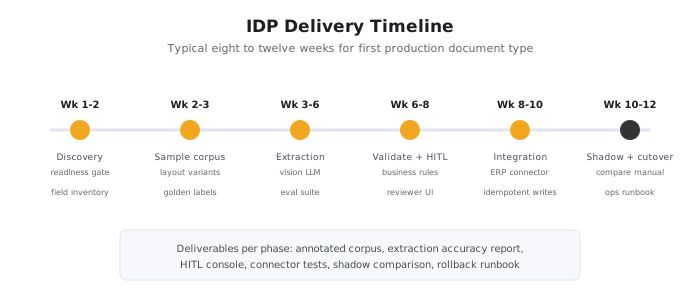
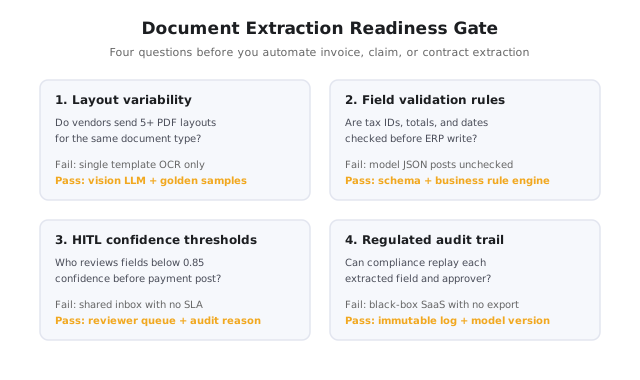
Discovery maps document families, collects a sample corpus, and runs the Document Extraction Readiness Gate from the hero diagram. If layout variability or audit trail ownership fails, we fix that before model work.
Sample corpus and schema defines field names, validation rules, and confidence thresholds per field. We label edge cases your ops team already handles manually.
Extraction models combine OCR, vision LLM prompts, and structured JSON outputs. Prompts are versioned. Golden cases cover layout variants. We do not wire extraction to production credentials until schema validation passes on the sample set.
Validation and HITL adds business-rule checks on tax IDs, totals, and dates before any write API call. Low-confidence fields route to a reviewer queue with accept, correct, or reject actions logged per field.
Integration lands with contract tests against sandbox APIs. Writes are idempotent with deduplication on document fingerprint so the same email attachment does not post twice.
Cutover runs shadow mode beside manual processing, compares outcomes for two to four weeks, then flips traffic with a rollback switch documented in the runbook your ops lead can execute without paging engineering.
Team Composition
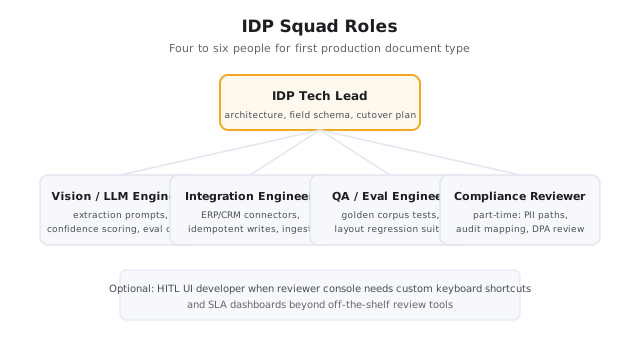
A four- to six-person squad is the usual shape for a first document type. The vision LLM seat and the compliance reviewer are the two roles vendors cut to win on price. Those are also the roles that determine whether extraction stays accurate when PDF layouts change next quarter.
Typical roster: IDP tech lead, vision LLM engineer, integration engineer, QA eval engineer, and a part-time compliance reviewer during architecture and cutover. For ongoing expansion after launch, the same squad can run as a dedicated AI development team on a monthly retainer. For a single extraction specialist inside your org, staff augmentation is the better fit.
Project, dedicated team, or staff augmentation depending on how much of the IDP platform you want us to own.
Pricing and Engagement Models
Project-based
Fixed scope for one production document type: ingest, classification, extraction, HITL queue, eval cases, runbooks. Typical duration eight to twelve weeks. Published bands run USD 25,000 to USD 180,000 per document type after discovery, depending on layout variability and compliance load.
Dedicated team
Ongoing squad owning a document portfolio: new types, model upgrades, layout drift fixes, on-call for failed extractions. USD 12,000 to USD 60,000 per month for four to six people depending on seniority mix and compliance review load.
Staff augmentation
Embed one or two senior IDP engineers when you already own architecture and need hands on extraction pipelines, reviewer consoles, or ERP connectors. USD 7,500 to USD 11,000 per month per senior engineer on published brackets.
Compared With In-House Hiring, Freelancers, and Agencies
Outsource when
- You need the first production document type in a quarter, not after a six-month hiring cycle for scarce vision-LLM-plus-integration talent.
- Your internal team knows the business process but not field-level confidence routing, idempotent ERP writes, or eval gates on extraction.
- Compliance wants a third party to document PHI paths, reviewer accountability, and rollback before auto-posting invoices or claims.
- You are planning three or more document families and want shared platform components from the start.
Keep it in-house when
- You already run a mature document platform team and only need a short prompt-tuning sprint on one stable layout.
- The document type is fully structured EDI or API JSON with no attachment variability.
- A vendor SaaS product covers most of your volume with acceptable exception handling and audit trails.
Freelancers can prototype extraction quickly but rarely stay for on-call or layout drift. Nearshore delivery from Córdoba gives you senior profiles at a lower total cost than hiring the same mix in major US metros, with overlap your ops team can use.
Illustrative Scenario: Summit Regional Health Prior Authorization Processing
Composite illustrative scenario only. Not a published client case study. No performance metrics are claimed.
The situation
Summit Regional Health is a fictional regional health network in the US Southeast. Referring physicians fax prior authorization packets and email referral letters with PDF attachments. Authorization coordinators retype member IDs, procedure codes, and clinical justification into the payer portal and EHR before schedulers can book specialty visits.
Peak referral volume creates backlog. Duplicate submissions happen when the same packet arrives by fax and email. Compliance blocked auto-posting until field-level review ownership and PHI logging were documented.
What we would deliver
A twelve-week nearshore project with a five-person squad from Córdoba: IDP tech lead, vision LLM engineer, integration engineer, QA eval engineer, and part-time compliance reviewer. Daily overlap with the US Eastern authorization lead during architecture and cutover.
- Unified ingest pipeline for fax, email, and scan-folder attachments with document classification into prior auth, referral, and medical record request families.
- Vision LLM extraction with structured JSON output and per-field confidence thresholds on member ID, procedure code, and diagnosis fields.
- Human review queue for low-confidence fields, handwritten clinical notes, and multi-page tables with keyboard shortcuts and audit reasons.
- Idempotent writes to the internal EHR and payer portal staging tables with deduplication on member plus procedure fingerprint.
- Shadow mode for three weeks comparing automated vs manual authorization entry before full cutover.
In a scenario like this, the win is operational: less retyping for routine referrals and a runbook the authorization lead can execute without paging engineering.
Risks and Mitigation
Silent field corruption. Models return plausible values with wrong digits in account numbers or totals. Mitigation: schema validation, checksum rules on money fields, shadow mode, and automatic hold when confidence drops below threshold.
Layout drift. Vendors change PDF headers without notice. Mitigation: golden sample regression on every release, weekly sampling on production extractions, alerts when classification confidence drops across a batch.
Exception queue starvation. Humans ignore the review inbox. Mitigation: SLA timers, escalation to named backup, weekly sampling audit on auto-approved fields.
PHI and PII leakage into model logs. Mitigation: redact at ingest, separate logging streams, retention policies aligned with your DPA. We follow OWASP LLM Top 10 guidance on input handling and tool permissions.
Vendor lock-in on extraction. Mitigation: exportable prompts and schemas, infrastructure-as-code, and documentation that does not require our login to operate.
Handoff failure. Mitigation: paired on-call weeks, recorded runbooks, and explicit ownership transfer checklist before we step down to advisory hours.
Questions buyers ask before the first discovery call
Frequently Asked Questions
Classic OCR reads text positions on a fixed template and breaks when layouts change. RPA bots click through screens but still struggle with unstructured attachments. Intelligent document processing combines OCR, vision LLM extraction, document classification, field-level confidence scoring, business-rule validation, and human-in-the-loop review before any write to ERP or claims systems. IDP owns the messy middle: PDFs, scans, faxes, and email attachments that never matched a single template.
Common types include invoices and credit memos, purchase orders, bills of lading, insurance claims and loss notices, prior authorization packets, referral letters, contracts and amendments, KYC packets, and HR onboarding forms. We also handle mixed batches where one email thread contains three document types. If your ops team already labels exceptions by document family, that taxonomy is usually the right starting schema.
We combine layout-aware OCR, vision-capable LLMs for field extraction on variable PDFs, and structured output schemas for anything that feeds a write API. For some clients we integrate managed parsers such as Google Document AI alongside custom models. Prompts and extraction configs are versioned. Golden samples cover the layout variants your team already complains about. When extraction quality must be measured before every release, we pair delivery with our LLM evaluation engineering practice.
A single document type with two to four layout variants, a human review queue, and one ERP or claims integration typically ships in eight to twelve weeks including shadow mode and operator runbooks. Multi-type platforms with shared classification, credential vaulting, and a reviewer console run twelve to sixteen weeks. Timelines stretch when sample corpora are thin, security review is slow, or sandbox API access is delayed.
Project-based builds for a first production document type typically land between USD 25,000 and USD 180,000 depending on layout variability, compliance review, and integration count. Dedicated squads run USD 12,000 to USD 60,000 per month for ongoing document-type expansion and model maintenance. Senior staff augmentation for IDP engineers ranges from USD 7,500 to USD 11,000 per month. We confirm pricing after discovery once we know your document volume, exception rates, and target systems.
You do. Extraction prompts, classification rules, validation schemas, integration adapters, eval cases, and infrastructure-as-code ship to your repositories. We document rollback steps and train your ops team on the human review queue. Managed operations are optional, not a requirement to keep the pipeline running.
Yes. Delivery teams are based in Córdoba, Argentina, with daily overlap on US Eastern business hours. IDP projects need tight iteration with operations and compliance owners, so same-day feedback on field schemas, confidence thresholds, and exception routing matters as much as it does for product engineering.
Related Services