Get your store ready for the AI shoppers buying on behalf of customers
We work with merchants whose customers have started asking ChatGPT, Gemini, Claude or Perplexity to do the shopping for them. Some weeks those agents drive an unexpected lift. Other weeks they ignore your catalog because the data is not clean enough or the checkout looks unsafe. Agentic commerce development is the engineering work that fixes both ends of that gap.
Siblings Software has been delivering software outsourcing from Argentina since 2014. For agentic commerce we ship product feed audits, structured data, agent-discoverable endpoints, signed checkout APIs, an evaluation suite and the governance layer that keeps finance and legal comfortable. No marketing-driven AI features bolted onto a storefront. Real protocol-level work.
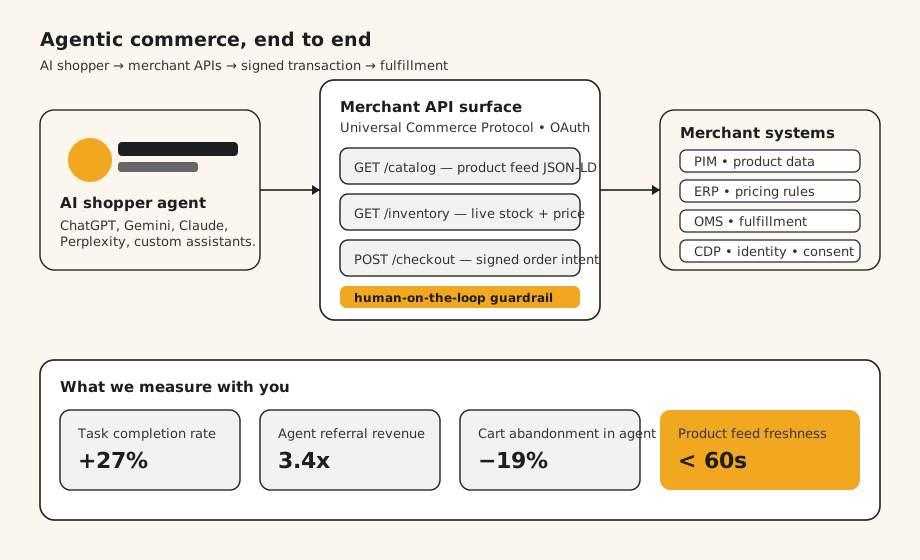
What agentic commerce really is, in plain English
A few definitions are floating around. The one we use, because it matches what buyers actually pay us to fix, is this: agentic commerce is the practice of letting a software agent — an LLM-powered system with tools and memory — do the research, comparison and purchase that a human used to do on a website. The agent might be ChatGPT shopping mode, a custom assistant inside a bank app, an enterprise procurement bot, or a wallet-native shopper that lives in a browser extension.
That is a real shift, not a vendor pitch. Shopify and Walmart have publicly reported that AI-originated traffic and orders are growing several-fold per year. McKinsey has put the total addressable value of agentic commerce in the trillions of dollars by 2030. You can argue with the numbers. You cannot honestly argue that the buyer is staying the same.
The implication for engineering is straightforward. The buyer no longer sees your hero banner, your CSS animations or your testimonial carousel. The buyer reads your product feed, your structured data, your /robots.txt, the JSON your APIs return and the price guarantee window encoded in your checkout response. Whatever quality your storefront has at the protocol level is the quality the buyer experiences.
If you want a working introduction to what shopping agents currently do well and where they fail, the Google product structured data guide and the W3C Agent Protocol Community Group are the most honest starting points we have found in 2026.
Who we build agentic commerce capabilities for
Three buyer profiles we have seen on every discovery call this year.
Brand-direct retailers
You sell your own products and you have started seeing AI agent referrers in your analytics. The signal is small but consistent, and your team is being asked by leadership whether the company should embrace it or quietly hope it goes away. We bring the technical architecture and the operating model so the board conversation has numbers and a roadmap behind it.
Marketplaces and aggregators
You have hundreds of thousands of SKUs from third-party sellers, and the data quality is uneven. Agents skip products that look ambiguous, which means a structural revenue ceiling. We design the seller scorecards, the schema enforcement and the catalog hygiene work that lifts that ceiling without breaking the seller experience.
Vertical commerce platforms
You operate a niche commerce platform — pharmacy, B2B parts, used vehicles, hospitality — and you want a defensible position before generic agents flatten your category. We help you ship agent-friendly APIs that competitors will struggle to replicate without your domain catalog and your supply chain.
If your situation does not fit any of the three, that is also useful information. We have walked away from engagements where the simpler answer was a clean e-commerce development rebuild, a focused AI e-commerce project on the human-facing side, or a single embedded commerce engineer via staff augmentation. We tell you that on the first call.
How we make a store ready for AI shopping agents
We run a five-phase program. Each phase produces an artifact your team can keep using. We deliberately do not start with a flagship "agent" feature, because a flagship that sits on top of broken catalog data fails on the demo day no matter how clever the prompt is.
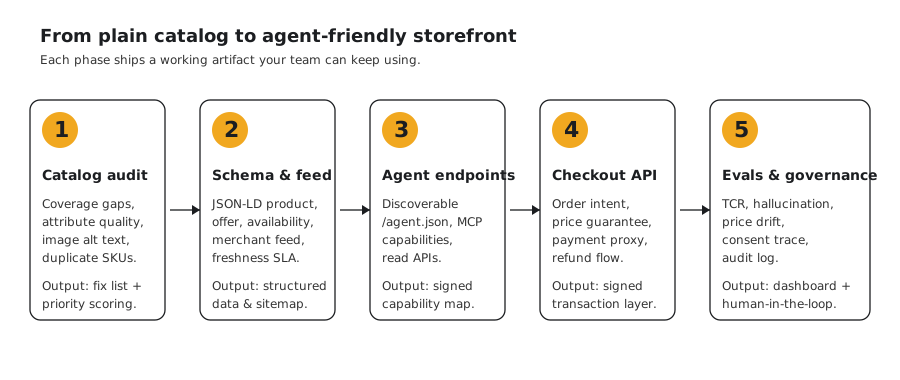
1. Catalog audit and gap report
Two engineers and a senior PM spend roughly two weeks running diagnostics on your catalog: missing attributes, conflicting prices between PIM and storefront, image alt-text quality, duplicate SKUs, GTIN coverage, category taxonomy drift. The deliverable is a prioritized backlog with the dollar impact of each fix, so finance and merchandising can pick where to start.
2. Structured data and feed freshness
We implement Schema.org Product markup, an offer model with availability and price, and a clean merchant feed with a signed freshness SLA usually under 60 seconds. Where shopping agents look first — the JSON-LD on the product page, the merchant feed, the sitemap — we make sure they find consistent answers.
3. Agent-discoverable endpoints
We add a discoverable capability map at /.well-known/agent.json, an MCP server that exposes safe read tools (search, recommend, availability), and rate-limited public APIs. Agents that obey conventions can transact with you. The rest get a documented refusal.
4. Signed checkout and price-guarantee API
This is where most projects die if they were rushed. We implement a checkout endpoint that issues time-bound order intents, requires a verified agent identity and consent token, and returns a price guarantee window the merchant can defend. We work with your payment provider so chargebacks and refunds reuse the same signed channel.
5. Evaluations and governance
We measure task completion rate, hallucination rate, price drift between feed and checkout, consent trace coverage and audit log completeness. We design a human-on-the-loop dashboard for high-risk actions, and we wire alerting that does not flood your on-call. This phase usually overlaps with our AI agent observability practice.
Typical timeline: 8 to 14 weeks for a full rollout, 3 to 4 weeks for the audit-plus-feed milestone if leadership wants a fast first signal before committing to the rest.
Engagement models and honest pricing ranges
We work in three commercial shapes. They differ in who owns scope and how risk is shared. We will tell you which one fits before you ask.
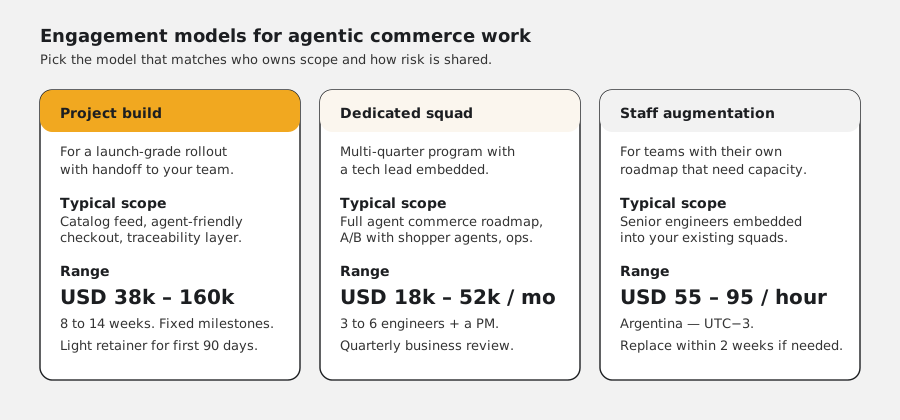
Project build
We deliver an agentic commerce rollout end-to-end with a fixed budget and a written change-control process. Range: USD 38,000 to 160,000. Best when leadership wants a defined deliverable with handoff. See our project-based outsourcing page for terms.
Dedicated agentic commerce squad
A multi-quarter retainer with a tech lead embedded in your roadmap. Three to six engineers plus a PM, sized to your catalog and platform. Range: USD 18,000 to 52,000 per month. More on dedicated teams.
Staff augmentation
Senior engineers plug into your existing squads with your tools and your ceremonies. Rate: USD 55 to 95 per hour depending on seniority and stack. Argentina, UTC-3, same-day collaboration with US Eastern. Details on staff augmentation.
Note on pricing. We share ranges because we have watched too many merchants stall for a quarter while a competitor shipped. A precise figure needs a discovery call and, on larger programs, a short paid discovery. The ranges above are the bands we actually quote against in 2026 for senior nearshore work.
Realistic agentic commerce use cases
Where this work lands inside a real organization, not in a slide.
Search visibility for shopping agents
Mid-size apparel retailer noticed AI agents recommending competitors despite having better price and stock. The fix was structured data, a clean merchant feed and a public availability endpoint. Recommendation share inside the agent funnel went from low single digits to roughly a third within ten weeks.
Procurement and B2B replenishment
A B2B parts marketplace exposed an MCP server and a signed checkout endpoint to enterprise procurement agents. Cycle time on repeat orders dropped from forty minutes per buyer to under two minutes, with the same approval workflow on the customer side.
High-AOV configured products
A bicycle brand offering custom builds added a configurator that an agent can drive. The agent answers customer questions, validates compatibility against the live PIM and produces a configured order intent the human approves. Configuration errors at fulfillment dropped to near zero.
Subscription and reorder flows
A pet food retailer integrated a shopper agent that handles reorder windows, dosage updates and substitutions when a flavor goes out of stock. Cancellation rate on subscriptions went down because the agent caught problems the human never bothered to email about.
Refund and customer-care agents
A shoe retailer let an agent triage returns up to a fixed dollar threshold, escalating to a human only on edge cases. Average handling time fell from eleven minutes to under two, and CSAT on the agent-handled returns landed slightly higher than the human baseline.
Cross-border and currency-aware agents
A homeware brand selling into LATAM and the EU used a single signed checkout API that returns currency, tax and duty estimates the agent can show before placing the order. Fewer surprises at the doorstep, fewer chargebacks at the bank.
Mini case study: pet supplies merchant, ten weeks to first signed agent orders
A US-based pet supplies merchant with around two million monthly visits had started seeing referral traffic from AI shopping assistants but almost no completed transactions. Their PIM was clean enough for the human-facing site, but the merchant feed lagged the storefront by up to fifteen minutes during peak loads, the JSON-LD was missing offer availability for half the catalog, and there was no public checkout API at all.
We staffed a four-engineer squad over ten weeks: a tech lead, a back-end engineer focused on the feed, a full-stack engineer on the agent endpoints, and a senior platform engineer on payments and observability. Their internal team kept owning merchandising and customer support.
The numbers we measured and reported every two weeks: first signed agent order in week four, task completion rate on the agent funnel up by 27 percent over the audit baseline, agent-attributed revenue running at 3.4x the pre-engagement level by week ten, and cart abandonment in the agent funnel down 19 percent. We did not switch the model. We fixed the data and the contract surface the model relies on.
Engagement snapshot
Model: project build + 90-day retainer
Team: 1 tech lead, 3 senior engineers, 1 part-time PM
Cadence: 2-week sprints, weekly KPI report
Outcome: TCR +27%, agent revenue 3.4x, abandonment −19%
For deeper architectural context, our case studies library includes related work in marketplace search and identity. The pattern repeats: clean data, signed contracts, evaluations — in that order.
Agentic commerce vs the alternatives buyers compare us with
When this conversation reaches procurement, the comparison is almost always between four options. We are honest about where we are not the right answer.
Freelancers and marketplaces
Cheapest sticker price, highest variance. Fine for a one-off feed cleanup. Falls over when the work touches payments, identity or governance, because nobody owns the on-call rotation when something goes wrong at 2 a.m.
In-house engineering teams
The right long-term answer when commerce is core to your business. The wrong answer when you need to ship in a quarter, you do not have a senior commerce platform engineer free, or hiring senior agentic AI talent locally is a multi-month exercise. Hybrid setups work well: we lead while you scale your team.
Big consulting agencies
Strong on strategy and frameworks, often weaker on production engineering. Estimates tend to be optimistic because they are written by people who will not be on the call when a checkout is rejected. Useful when your board needs an external playbook. Less useful when you need a working API by the end of the quarter.
Managed nearshore squad (us)
You get a tech lead, senior engineers, written commitments, a shared definition of success and an honest report every two weeks. The trade-off is a higher day rate than a freelancer, and you trust a partner with meaningful delivery responsibility. That trust is earned sprint by sprint, not page by page.
Risks we have seen and how we mitigate them
Agentic commerce projects fail in a small number of recognizable ways. The mitigations below are how we keep them out.
Catalog drift between feed and storefront
Agents punish inconsistency more than humans do, because they are reading both surfaces in parallel. We add a freshness SLA, a single source of truth in the PIM, and a continuous diff job that pages someone if the feed lags by more than the agreed window.
Price guarantee abuse
Bad actors will mint thousands of order intents to lock in stale pricing. We treat the order intent as a signed, time-bound and rate-limited artifact, with risk scoring on the issuing agent identity. Anomalous patterns escalate to a human-on-the-loop with a written audit trail.
Hallucinated product attributes
If your data is good, the agent has nothing to invent. We push aggressively on data quality before adding any clever model. When we can, we constrain the agent to retrieved attributes only, and we log every attribute it surfaces so quality regressions are catchable.
Compliance and consent confusion
Regulated jurisdictions (EU, UK, parts of LATAM) expect explicit consent for autonomous transactions. We build a consent surface that the agent must read and a signed receipt the merchant keeps. This is where we usually borrow from our AI code security practice.
Lock-in to a single agent vendor
Some clients arrive with a contract pushed by one vendor that forces a custom integration. We push for protocol-level integrations — structured data, signed checkout APIs, MCP — that work for any well-behaved agent and avoid future migration pain.
Cannibalizing organic SEO
Teams sometimes split agent-friendly endpoints onto a parallel domain or block them with a permissive robots policy that hurts conventional ranking. We align canonicals, sitemaps and consent so the same investment lifts both surfaces.
Why merchants pick Siblings Software for agentic commerce work
Siblings Software is an Argentina-based software outsourcing and staff augmentation company that has been delivering production work for U.S. and LATAM clients since 2014. Across the last decade we have shipped commerce platforms, fintech integrations, healthtech systems and AI-driven products. The bench that runs agentic commerce engagements is the same one that runs our AI agents development and MCP development practices.
Senior-only delivery
Every squad is led by an engineer who can design protocols, not just implement tickets. Junior engineers exist on our teams but do not set direction in regulated commerce work.
Same-day overlap with North America
Argentina is one to two hours ahead of US Eastern. We do code review the same day, not with a 12-hour lag. That difference shows up the first time a checkout fails on a Friday afternoon.
References we can talk about
Engagements across pharmacy, B2B parts, apparel, pet supplies and homeware. We will introduce you to a previous client when scoping is far enough along to make a reference call worthwhile.
Security and compliance grown into the work
SOC 2-ready processes, OWASP-aligned reviews and PCI-aware checkouts. We do not bolt compliance on at the end; we build it into the protocol surface from sprint one.
A written engagement plan
Before sprint one you receive a squad charter, a Definition of Done, the KPI sheet, the risk register and a roll-back plan. No "we will figure it out as we go" onboarding.
Independent of any single agent vendor
We work with OpenAI, Anthropic, Google, Mistral and open-source stacks like Llama and Qwen. The protocol surface is the same. Vendor choice is a tactical decision, not a strategic one.
What buyers usually get wrong before calling us
Three decisions we see leadership teams regret most often. Budget is rarely the cause. Framing on day one is.
- Treating agentic commerce as a marketing experiment. A "let's see what happens with ChatGPT" pilot run by a content team produces nothing because the catalog and checkout never get touched. We push for an engineering-led program with marketing involvement, not the other way around.
- Buying an "AI agent" before fixing the catalog. The agent will only ever be as good as the data behind it. We push hard against teams that want a flagship demo before the audit. The flagship will fail in front of the CEO if the feed is wrong.
- Skipping evaluations. Without a measured task completion rate and a watch on price drift, you cannot defend the investment to finance after one quarter. Evaluations are not optional, even if they look unglamorous on the roadmap.
Frequently Asked Questions
It is the engineering work that makes a store reachable, understandable and transactable by AI shopping agents acting on behalf of a human buyer. We focus on the protocol layer: clean catalogs, structured data, agent-friendly read APIs, a signed checkout endpoint, evaluations and a governance layer.
Regular e-commerce optimizes for a human browsing a website. AI e-commerce typically adds recommendations or chat assistants on top of that human-facing site. Agentic commerce optimizes for software agents that do the browsing, comparison and checkout themselves, often without a UI. The metrics, integrations and trust requirements all change.
Project builds usually land between USD 38,000 and USD 160,000. A dedicated nearshore squad runs USD 18,000 to 52,000 per month. Senior engineers under staff augmentation are between USD 55 and 95 per hour. Final pricing depends on platform, regulated checkouts and number of integrations.
A first measurable milestone — usually a clean product feed and a discoverable agent capability map — ships in three to four weeks. A complete rollout that includes a signed checkout API, evaluation suite and human-in-the-loop dashboard is typically 8 to 14 weeks.
Yes. We have shipped on Shopify and Shopify Plus, BigCommerce, Magento 2, Salesforce Commerce Cloud and headless stacks built with Next.js, Remix, Astro and Hydrogen. The protocol layer and the evaluation suite are platform-agnostic.
The signed checkout endpoint is the trust boundary. Order intents are time-bound and tied to a price guarantee window, agent identity and consent are verified, and high-risk actions go to human-on-the-loop with a written audit trail. Refunds and chargebacks reuse the same channel so finance and compliance both get a clean reconciliation story.
Done well, no. Cleaner structured data, faster product feeds and crisper attribute coverage also help conventional ranking. The risk shows up only when teams add agent endpoints in isolation, so we plan canonicals, sitemaps and consent for both audiences in the same release train.
OUR STANDARDS
Engineering for a buyer that does not see your hero image.
When a software agent is your customer, your protocol surface is your storefront. We treat catalogs, feeds, JSON-LD, MCP capabilities and signed checkout endpoints as first-class product, not back-office plumbing. Every release ships with the dashboards, runbooks and evaluation evidence that finance, legal and engineering can defend in the same meeting.
If you want a Spanish-language version of this page for stakeholders in LATAM, see our comercio agéntico page. Otherwise, the next step is the contact form below. We reply within one business day with a written next step, not a generic proposal.
Contact Siblings Software Argentina
Get in touch and build your idea today.