Commerce engineers who treat checkout and inventory sync as production systems
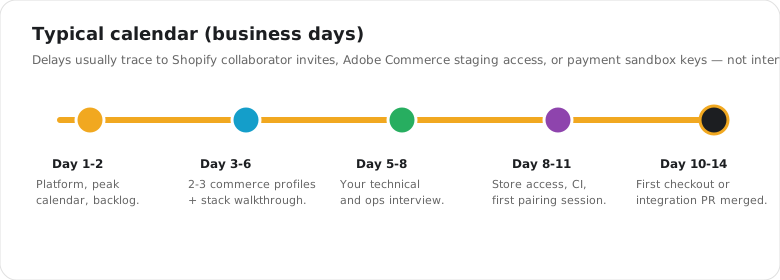
· Typical time to first production merge: 10–14 business days after store access is granted
If you are evaluating vendors for hire eCommerce developers searches, the hard part is rarely finding someone who lists Shopify on a resume. It is finding someone who understands your promotion stack, your ERP order states, and what happens when a payment capture fails at 11 p.m. on a launch weekend. We staff Argentina-based commerce engineers who join your standups, adopt your release checklists, and treat revenue paths as seriously as your ops team does.
This page covers what those engineers do day to day, how we vet them differently from generic full-stack candidates, published monthly ranges, and where staff augmentation stops making sense (we will say so). For the broader practice, see software staff augmentation at Siblings; for a managed squad instead of individual seats, compare our dedicated eCommerce development team.
Reviewed by Javier Uanini, co-founder, who still signs off on senior commerce matches before client introductions.
Who hires eCommerce developers through us—and why now
Three patterns cover most serious inquiries in 2025–2026. None of them are “we need a cheaper developer.” They are operational realities where a bad hire shows up in revenue, not Jira velocity.
DTC brands before peak season
Black Friday, Cyber Monday, or a product drop is six weeks away and checkout still flakes under stacked discounts. You need engineers who have already lived through a bad launch—not someone learning promotion engines under fire.
B2B marketplaces drowning in order exceptions
The storefront looks fine. Operations spends hours reconciling inventory mismatches, failed payment captures, and manual invoice checks. Buyers here need integration engineers who think in order state machines, not theme tweaks.
Teams replatforming without freezing merchandising
Magento to Shopify Plus, WooCommerce to headless, or a monolith split into composable services. Marketing still needs to run campaigns while engineering migrates. We often pair commerce engineers with our React staff augmentation pods when the storefront and API move together.
What an embedded eCommerce developer actually does here
Day one is not a platform overview deck. Within the first sprint you should see work touching revenue paths: a promotion regression fixed, an ERP sync hardened, or checkout smoke tests added before marketing ships a campaign. Typical workstreams:
Storefront and checkout
Theme or headless UI changes with performance budgets, accessibility checks, and analytics events that finance can audit. On Shopify, that includes Functions, checkout extensibility, and knowing when a native app beats custom Liquid.
Integrations and order flow
ERP, OMS, WMS, tax, payment, returns, and shipping connectors with retries, idempotency keys, reconciliation reports, and alerts ops can act on—not log lines nobody reads.
Catalog, search, and discovery
Product data cleanup, faceted search, semantic discovery experiments, and guardrails around AI-generated descriptions. If you are preparing for AI shopping agents, we coordinate with our agentic commerce development practice without duplicating that protocol work on a staff-aug seat.
Release discipline you can audit
Checkout smoke suites, staged rollouts, rollback runbooks, and INP-aware performance checks tied to CI. Engineers document what they changed in promotion logic—not only in pull request titles.
Platform references we expect finalists to know: Shopify developer documentation, Adobe Commerce developer docs, and Interaction to Next Paint guidance for checkout performance.
The Peak Season Readiness Gate—three questions before we propose anyone
We use this internally to avoid sending a theme specialist when you need an integration surgeon—or a greenfield headless engineer when you are six weeks from peak season on a legacy Magento stack. Answer these on a discovery call and matching accelerates.
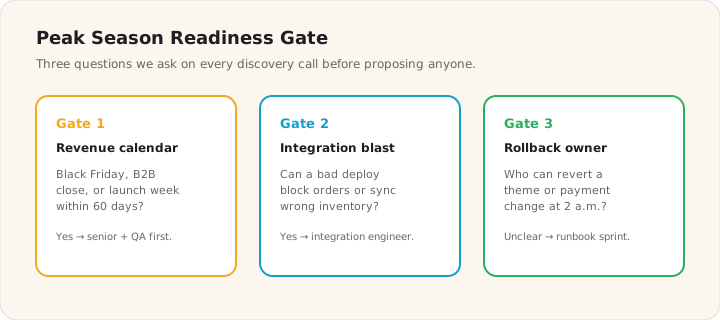
- Is a revenue-critical date within sixty days? If yes, we prioritize seniors with QA coverage and defer net-new architecture experiments until after the calendar clears.
- Can a bad deploy block orders or sync wrong inventory? That answer decides whether your first seat should skew integration-heavy versus storefront-heavy.
- Who owns rollback at 2 a.m.? If the answer is unclear, week one includes a runbook sprint—not a feature sprint.
Engagement models and published monthly bands
Publishing ranges respects your time. Final pricing moves with platform (Shopify versus Adobe Commerce), seniority, English fluency for vendor calls, and whether you need overnight peak-season coverage.
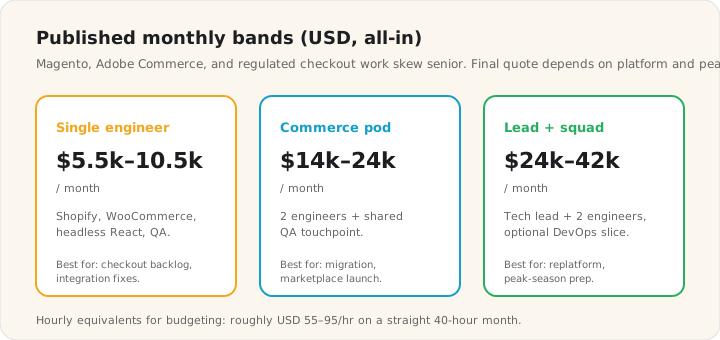
Hourly equivalents for budgeting math usually land near USD 55–95 per hour on a straight 40-hour month—aligned with our wider nearshore staff augmentation bands because the talent market is shared. Need a fixed-scope replatform instead of embedded seats? See eCommerce development outsourcing for project and squad pricing.
Vetting lanes: why only a minority of “eCommerce” resumes become finalists
Roughly one in four candidates who pass CV review survives our commerce-specific technical lanes in a typical quarter. Our active commerce bench holds about sixteen specialists across Shopify, Magento, WooCommerce, and headless stacks—not hundreds of interchangeable full-stack profiles.
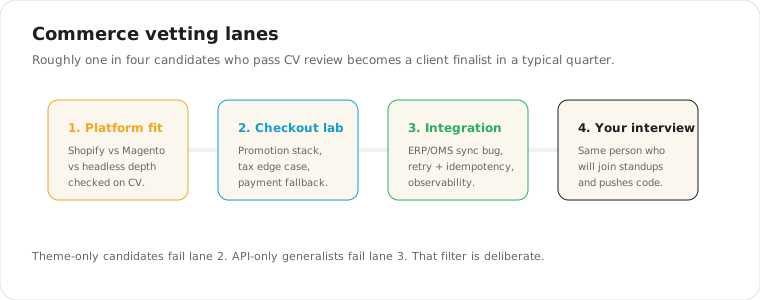
Theme developers who have never debugged a tax boundary fail lane two. Backend generalists who have never reconciled an OMS state fail lane three. That filter is deliberate—better a short bench of trustworthy engineers than a long bench of warm bodies who learn checkout on your dime.
Siblings vs Upwork vs in-house hiring vs a large agency
Upwork wins when you need fifteen focused hours—a Liquid tweak before a photo shoot, or a one-off payment gateway config in sandbox.
Upwork hurts when you need someone in release planning every Monday who will still be there when Q4 peak hits. Continuity and PCI-aware onboarding are not marketplace strengths.
In-house wins when commerce is your ten-year center of gravity and you can wait out a US hiring loop without a migration deadline.
In-house hurts when the ERP sync is on fire now. Every week without a hire is a week your existing seniors absorb context-switching tax.
Large agencies often optimize for account size. The architect from the sales call may not be the engineer fixing your checkout on launch week. We stay deliberately small so the person you interview commits code.
Evaluating mixed stacks first? Read how we staff general roles on the hire software developers overview—then return here when commerce depth is the bottleneck.
Mini case study
Fewer order exceptions for a B2B wholesale marketplace
Context. A US distributor ran a custom marketplace for retailers. The storefront looked acceptable, but operations lost hours on order exceptions: mismatched inventory, failed payment captures, and manual invoice checks.
What we did. Embedded one backend developer, one frontend developer, one QA engineer, and a part-time delivery lead via staff augmentation. Week one mapped order states. Weeks two–eight tightened API contracts, added checkout smoke tests, and built alerts for inventory and payment sync failures.
Outcome. Manual reconciliations dropped materially within the first quarter; support tickets tagged “order stuck” fell roughly 35% over ninety days. No client name—numbers rounded from production metrics they already tracked.
Snapshot
Model: Staff aug pod (4 roles)
Stack: Custom marketplace, Node.js, React
Primary win: ~35% fewer stuck-order tickets
Risks of external commerce hiring—and how we mitigate them
Promotion logic silos
Mitigation: pairing on discount rules, documented test matrices for stacked promotions, and a hard rule that pricing changes never ship without QA sign-off during peak windows.
Integration drift
Mitigation: contract tests against ERP sandboxes, reconciliation dashboards ops can read, and explicit ownership for retry policies—not “the API team will figure it out.”
Launch-week surprises
Mitigation: staged rollouts, feature flags where the platform allows, and rollback runbooks reviewed before campaigns—not improvised in Slack.
Agent-ready catalog gaps
Mitigation: if AI shopping agents are in your 2026 roadmap, we map catalog quality against Google product structured data guidance early—structured feeds matter for humans and agents alike.
Why Siblings Software for eCommerce staff augmentation specifically
We are an Argentina-based engineering company shipping product for North American and European clients since 2014—not a marketplace, not a recruiter shop. Commerce engagements often pair with our eCommerce outsourcing projects when you later want a fixed-scope replatform, but staff augmentation stays the right tool when you already own the roadmap and need credible engineers inside your rituals.
Miami-based commercial leadership and Córdoba-delivery engineering means US-friendly overlap without pretending we are in Palo Alto. For PHP-heavy WooCommerce or Magento work, we also staff through our PHP developers lane when the bottleneck is backend integration, not storefront UX. Need proof of delivery culture first? Start with case studies or ask for a reference call.
Frequently Asked Questions
A mid-level Shopify, WooCommerce, or headless React engineer embedded full-time is typically USD 5,500 to 7,500 per month all-in. Seniors who own Magento or Adobe Commerce migrations, complex promotion engines, or ERP integrations usually land around USD 7,500 to 10,500. A two-engineer commerce line with a shared QA touchpoint is commonly USD 14,000 to 24,000, and a commerce tech lead plus two engineers is often USD 24,000 to 42,000. Figures include equipment and local employment overhead; they do not include your platform licenses or payment processor fees.
Most clients review finalists within five to eight business days after the discovery call. Onboarding plus a first meaningful pull request—usually a checkout fix, integration hardening task, or promotion regression—lands between day ten and fourteen once store collaborator access, staging credentials, and payment sandbox keys are in place. If procurement blocks access, the clock pauses—we document that risk in writing during week one.
Yes, but we staff by platform depth, not a generic full-stack label. Shopify and Shopify Plus, WooCommerce, Magento 2 and Adobe Commerce, BigCommerce, and headless stacks built with Next.js, Remix, Astro, or Hydrogen are all in scope. Salesforce Commerce Cloud and custom marketplaces take longer to match because the wrong architect costs more than waiting an extra week.
Every finalist passes a live checkout lab: stacked promotions, tax boundary cases, payment fallback behavior, and a deliberate what-happens-when-the-ERP-is-down scenario. Theme-only candidates fail here. We also run an integration lane with idempotency keys, retry policies, and observability hooks—API generalists who have never reconciled order states against an OMS fail that lane. Roughly one in four CV-passing candidates becomes a client finalist in a typical quarter.
We replace them at no placement fee for the swap and cover a short overlap so runbooks and staging access do not vanish. After the first month, either side can exit with fifteen days notice. Commerce staff augmentation only works when the engineer earns trust before peak season—not when everyone politely ignores a mismatch until Black Friday.
Marketplaces optimize for breadth; recruiters optimize for speed-to-submittal. We optimize for production commerce: finalists have already passed platform-specific checkout and integration exercises, references are checked before you meet them, and engineers are full-time with Siblings—not juggling five storefronts. You pay a predictable monthly rate, not a percentage of salary, and you interview the exact person who will push code in your repo.
Yes. Many teams start with a single senior to stabilize checkout or an ERP sync, then add a mid-level engineer once the backlog is groomed. When you lack internal commerce leadership, we can introduce a tech lead who owns release checklists, dependency upgrades, and peak-season runbooks. Larger squads roll into our dedicated eCommerce development team model when you want end-to-end ownership instead of embedded individuals.
OUR STANDARDS
Checkout paths, promotion logic, and integrations you can roll back.
Commerce teams win or lose on small decisions: whether a discount stacks safely, whether an ERP retry is idempotent, whether INP on mobile checkout is measured before marketing ships a hero video. The engineers we place are expected to write code your ops team will not dread during peak season—clear runbooks, deterministic tests, and release plans that assume something will go wrong.
If we are not confident we can improve delivery within the first sprint, we will say no. Staff augmentation that only shuffles theme tickets without touching order flow helps nobody.
Contact Siblings Software Argentina
Tell us your platform, peak calendar, and the commerce work blocked in your backlog.