Hire Node.js Developers
If you are searching to hire Node.js developers, you probably are not looking for a language tutorial. You are comparing staffing options, trying to understand cost, wondering how fast someone can join, and deciding whether an outside engineer can safely touch a production backend.
Siblings Software helps product and engineering teams add Node.js capacity from Argentina: senior backend developers, TypeScript API engineers, integration specialists, and full-stack developers who can work across Node.js, React, Next.js, and cloud deployment pipelines.
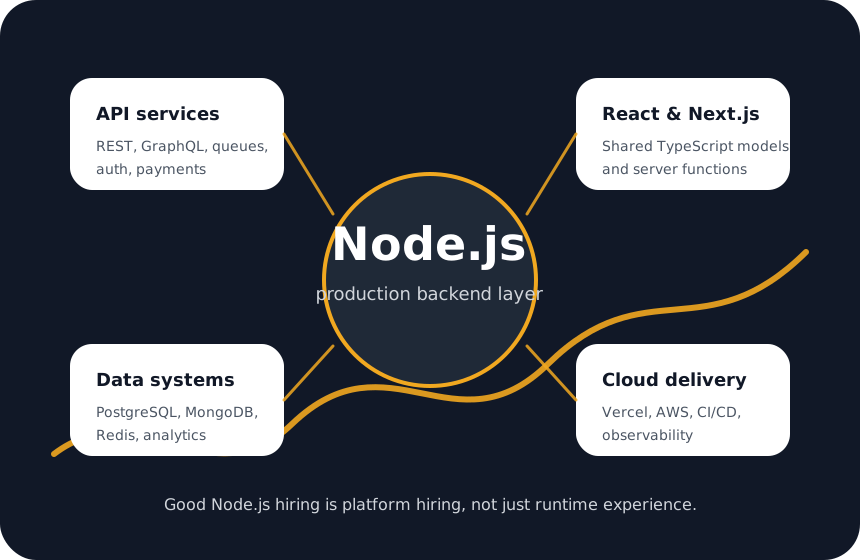
Teams that need backend progress, not another recruiting project
Node.js connects a lot of product surface, but flexibility hides risk.
Node.js is often chosen because one language can connect a lot of product surface: browser JavaScript, React interfaces, Next.js server functions, API gateways, queues, webhook consumers, dashboards, and admin tools. That flexibility is useful, but it also hides risk. A developer who can build a small Express endpoint may still struggle with long-running jobs, streaming, database contention, or a payment webhook that must never double-charge a customer.
We are usually brought in when a company already has product direction but lacks enough experienced backend hands. Common examples include a CTO who needs one senior Node.js engineer for a roadmap surge, a SaaS company modernizing a JavaScript monolith into TypeScript services, or an operations-heavy business that needs integrations with ERPs, CRMs, logistics providers, and payment processors.
Argentina matters here for practical reasons. Our team is based in Cordoba, with strong overlap with US business hours and a work culture shaped by long-running relationships with North American clients. The JavaScript ecosystem also has a meaningful Argentine thread: Guillermo Rauch, creator of Next.js and founder of Vercel, is from Argentina. That does not make every Argentine engineer a Next.js expert, but it is a useful reminder that serious product infrastructure can come from this region, not only from the usual hiring markets.
If your frontend is built in React, your backend is Node.js, and your deployment path includes Next.js or Vercel, the hiring conversation should be about the whole system. A good Node.js developer protects API contracts for the React team, understands where Next.js server code begins and ends, and knows when a serverless function is the wrong place for CPU-heavy work.
Node.js roles we commonly add to client teams
Match the role to the work, not the keyword.
The right profile depends less on the word "Node" and more on the failure modes of your product. We map the role to the work, then shortlist people who have seen that shape before.
Node.js API developer
Builds and maintains REST, GraphQL, and internal APIs with Express, NestJS, Fastify, or similar frameworks. Useful when your backlog is full of product endpoints, data models, and third-party integrations.
TypeScript backend engineer
Improves type safety, shared contracts, test coverage, and maintainability across a JavaScript backend. Often paired with our TypeScript developers.
Node.js + React full-stack developer
Works across UI and backend boundaries, especially where React screens depend on careful API shape, validation, authentication, and performance. See also our React staffing work.
Next.js backend-capable engineer
Handles route handlers, server actions, caching decisions, deployment constraints, and the blurred line between frontend and backend in modern Next.js applications. Related: Next.js developers.
Integration specialist
Designs webhook handling, retry policies, idempotency, queue workers, and monitoring for systems that depend on external APIs. This overlaps with our API development practice.
Node.js technical lead
Reviews architecture, breaks down work, mentors mid-level developers, and makes tradeoffs visible to product leadership. This is the safer option when the codebase is already business-critical.
From "we need Node.js help" to a useful first sprint
Match a Node.js developer to your product risk, not a stack of resumes.
Sending a stack of resumes is easy. Matching a Node.js developer to your product risk is harder. We start by asking what kind of backend work is actually blocked: feature delivery, incident reduction, integrations, performance, modernization, or team leadership. For most roles, the first useful shortlist appears within a week. More specialized work, such as regulated fintech, high-volume streaming, or deep DevOps requirements, deserves a little more patience.
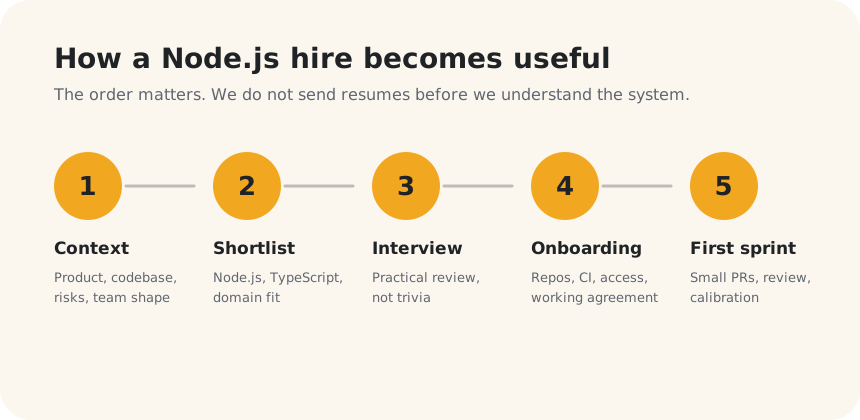
1. Product and system review
We review roadmap pressure, current architecture, deployment process, incident history, team capacity, and the first 30 days of expected value.
2. Role design
We decide whether you need a hands-on backend developer, a full-stack engineer, a tech lead, or a small pod with QA and DevOps support.
3. Practical interviews
We prefer real discussions about code, tradeoffs, incidents, and prior systems over trivia about the event loop. Trivia rarely predicts ownership.
4. Tooling and access
The developer joins your repository, tracker, CI/CD, documentation, Slack or Teams channels, and security process. We avoid shadow workflows.
5. Small first sprint
The first sprint should prove collaboration: one or two meaningful pull requests, code review rhythm, test expectations, and release path.
6. Calibration
We check whether the match is working before scaling. If communication, seniority, or domain fit is off, we fix it early.
The realistic ways companies hire Node.js developers
Buyers deserve a practical frame before a sales call.
We do not publish a universal hourly rate because it would be misleading. Seniority, duration, leadership load, QA expectations, and timezone coverage change the cost.
Single developer
Best when you already have a product owner, architecture direction, and review capacity. You add one Node.js or full-stack developer inside your sprint.
Budget shape: monthly retainer per engineer, usually based on seniority and expected hours.
Senior lead plus developer
Best when the work includes architecture decisions, modernization, or a legacy backend that nobody fully trusts anymore.
Budget shape: lead allocation plus one or more engineers, often more efficient than asking a mid-level developer to guess.
Node.js delivery pod
Best for integrations, platform rebuilds, or a product area that needs backend, frontend, QA, and DevOps moving together.
Budget shape: monthly squad cost, commonly planned in the low five figures and up depending on team size.
The expensive mistake is comparing only hourly rates. In-house hiring has recruiting time, benefits, management load, equipment, and attrition risk. Freelancers may look cheaper until continuity, documentation, and emergency coverage matter. A managed nearshore model usually wins when speed, overlap, and sustained delivery are more important than owning every role permanently.
Node.js staff augmentation vs freelancers, in-house hiring, and agencies
There is no universal best option.
Freelancers
Where it works: short fixes, isolated scripts, prototypes, or a narrow integration.
Where it gets risky: production ownership, handover, backup coverage, and long-term maintenance can be thin.
What we change: we provide managed continuity, replacement coverage, review standards, and escalation paths.
In-house hiring
Where it works: core platform ownership, long-term product knowledge, and permanent leadership roles.
Where it gets risky: hiring takes time. A vacant backend role can stall a roadmap for months.
What we change: we add capacity while your internal hiring continues at a healthier pace.
Large agencies
Where it works: broad programs, procurement-heavy environments, or multi-country delivery structures.
Where it gets risky: senior people may disappear after sales. Process can become heavier than the product needs.
What we change: you stay closer to the people making technical and staffing decisions.
Siblings staff augmentation
Where it works: roadmap acceleration, backend modernization, API delivery, React and Next.js product support.
Where it gets risky: it only works if ownership, communication, and code review expectations are clear.
What we change: we define those expectations before the developer is measured on velocity.
Real Node.js work that staff augmentation can handle
Most useful when the work is urgent, cross-functional, or risky.
Not every Node.js task needs an outside team. If you have a clean backlog and enough internal backend capacity, keep it in-house. We are most useful when the work is urgent, cross-functional, or risky enough that experience matters.
Stabilizing an Express or NestJS API
We review route structure, validation, error handling, dependency health, test coverage, and slow endpoints. The goal is not a rewrite by default. Usually the first win is making releases boring again.
Building integrations that do not lose data
Webhook consumers, retries, idempotency keys, dead-letter queues, audit logs, and alerting matter more than the happy path. This is where many "simple API calls" become production work.
Supporting a React or Next.js product team
Frontend teams move faster when backend contracts are stable. Our Node.js developers can design typed responses, align with React component needs, and work with Next.js documentation patterns where server and UI code overlap.
Moving from JavaScript to TypeScript
A careful migration improves refactoring confidence without freezing feature delivery. We usually start at API boundaries and shared models, then increase strictness as the team learns.
Mini case study: a logistics platform with fewer failed handoffs
The client's internal team had strong product knowledge and a capable React frontend group. What they did not have was enough backend time to clean up webhook handling, add reliable retries, and make shipment status changes observable. Failed events were being patched manually. Nobody trusted the logs.
We added one senior Node.js engineer and a fractional tech lead. The first two weeks were not glamorous: trace the existing event flow, document status transitions, add tests around the most expensive failure cases, and identify where duplicate events could update the same shipment twice.
By the second month, the team had moved the riskiest integrations behind idempotent handlers, added a queue for retryable failures, created a small dashboard for stuck events, and aligned API response contracts with the React team. It did not require a big rewrite. It required patient backend work and a client team willing to fix the boring parts.
6 weeks
First measurable reduction in manual support checks.
42%
Fewer integration tickets in the next release cycle.
3
Critical webhook flows covered by tests and alerting.
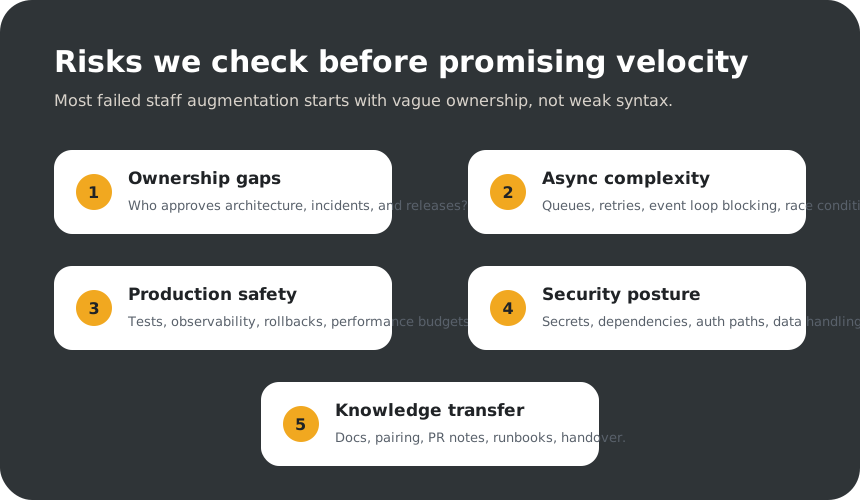
Risks we look for before they become incidents
Most Node.js failures do not come from not knowing JavaScript.
They come from unclear ownership, shallow tests, overloaded event loops, unchecked dependencies, secret handling mistakes, and integrations that assume every external API behaves politely.
Our developers use the official Node.js learning resources and ecosystem standards as a baseline, but client work needs more than baseline knowledge. We check how the current system fails, who is paged, how rollbacks work, and whether observability tells the truth.
- Async complexity: queues, promises, event emitters, streams, and retries need explicit error handling.
- Frontend contracts: React and Next.js teams need stable response shapes, not surprise backend changes.
- Security: dependency review, secret storage, auth boundaries, and input validation are part of the work.
- Knowledge transfer: PR notes, runbooks, and pairing prevent vendor lock-in.
What clients usually get wrong about hiring Node.js developers
The frequent mistakes worth naming up front.
They hire for framework labels instead of system responsibility
A candidate can list Express, NestJS, Prisma, GraphQL, and Redis and still be wrong for your project. We care about what they have owned: migrations, incidents, integrations, performance, messy handoffs, and production support.
They skip the first-sprint calibration
The first sprint should be smaller than everyone wants. It reveals how the developer asks questions, writes PRs, responds to review, handles ambiguity, and documents decisions.
They separate frontend and backend too cleanly
Modern JavaScript products are connected. A React dashboard may expose backend latency. A Next.js route handler may need server-side cache decisions. A Vercel deployment may change how a Node.js function should be structured. We keep those boundaries visible.
They treat staff augmentation like outsourcing without management
Augmented engineers still need direction, feedback, access, and a clear definition of done. Siblings Software supports the match, but the best results happen when your product context is shared early and honestly.
For broader JavaScript coverage, see our JavaScript developers. If you need a complete backend group rather than one or two embedded engineers, our backend development team model may fit better.
Frequently Asked Questions
For standard backend or full-stack roles, plan on reviewing a shortlist within about a week and onboarding the selected person within one to two weeks after approval. Security-heavy environments can take longer because access, VPNs, compliance reviews, and repository permissions have to be done properly.
Both, but most new Node.js work benefits from TypeScript. We do not force a migration for its own sake. In an older JavaScript codebase, we usually start with API boundaries, shared DTOs, and new modules before increasing strictness. The goal is safer change, not type gymnastics.
Yes. Node.js is frequently the backend half of a React product, and Next.js often places backend decisions directly inside the web application. Our engineers understand API shape, server rendering constraints, route handlers, cache behavior, and the impact backend latency has on UI experience. They also stay aligned with official React documentation when frontend contracts are involved.
Most clients ask for senior or strong mid-level developers. We can also provide a fractional technical lead when the work includes architecture review, modernization planning, performance decisions, or mentoring. Junior-only augmentation is rarely a good fit for production backend work unless the client already has strong internal supervision.
We work in your repositories, trackers, documentation spaces, and CI/CD systems. We write PR notes, update runbooks, pair with internal developers, and keep decisions visible. If the relationship ends, the code and knowledge should remain usable by your team.
No. Node.js is excellent for APIs, real-time applications, integration layers, serverless workloads, and JavaScript-heavy product teams. It is not always ideal for CPU-heavy processing, certain data engineering workloads, or systems where a different language already dominates your internal expertise. A good partner should say that before selling you a role.
OUR STANDARDS
Node.js engineers who can own production backend work, not just write Express endpoints.
Every Node.js developer we place has shipped production backends under real release pressure. We screen for ownership of integrations, retries, idempotency, observability, and the discipline to design API contracts that protect the React team from surprises.
We define ownership, communication rhythm, code review standards, and escalation paths up front. The work belongs to your team; we provide capacity, calmer release weeks, and a vendor relationship close to the people making decisions.
Contact Siblings Software Argentina
Tell us what backend work is blocked and we will suggest the smallest team that makes sense.