Hire a Back-End Development Team
Siblings Software builds dedicated back-end development teams from Argentina for companies that need experienced engineers on APIs, databases, integrations and cloud platforms without running a long recruiting cycle. The team works in your repositories, joins your ceremonies and owns delivery with the same seriousness you expect from an internal platform group.
When a billing API is slow, a legacy monolith blocks a product launch, or an integration queue keeps waking people up at night, you need more than resumes. You need a small team that can understand the system, make tradeoffs and ship safely.
The real search intent: choosing a reliable back-end hiring partner
Commercial investigation with transactional pressure.
A company searching for "hire back-end development team" wants to know whether a vendor can supply engineers fast, whether those engineers are senior enough to work on core systems, how much it will cost, and what happens if the first match is wrong.
We designed this service for buyers who need one of three outcomes. First, extending an existing engineering team that has more roadmap than capacity. Second, giving Siblings Software ownership of a bounded platform area such as billing, order orchestration, identity, reporting or partner integrations. Third, replacing fragile freelance work with a stable pod that documents decisions and stays long enough to learn the domain.
This is not the right fit if you need a weekend script, a one-off bug fix, or the cheapest possible hourly rate. It is a fit when the back-end is close to revenue, operations or customer trust.
When clients hire our back-end teams
The strongest use cases are specific, slightly painful and tied to a deadline.
A product launch depends on new APIs
You need REST, GraphQL or gRPC endpoints that are documented, versioned, tested and ready for front-end or mobile teams. We often pair this with our API development services when contracts and developer experience matter as much as code.
A legacy monolith is slowing the business
The answer is not always microservices. Sometimes the better first move is isolating a module, removing accidental coupling, and adding tests around the riskiest flows. We will say that in the first week if it is true.
Integrations keep breaking
Payments, ERPs, CRMs, warehouse systems and partner APIs all fail in ways that look boring until they hit revenue. We build retries, idempotency, audit logs, alerting and reconciliation flows so operations teams are not guessing.
Your database needs adult supervision
Slow queries, unsafe migrations, missing indexes and unclear ownership create risk that product teams learn to work around. Our engineers review schema design, migration practice, backups, query patterns and data access boundaries.
Pricing and engagement models
Realistic ranges before the first call.
Competitors often hide pricing until the third call. We do not quote final numbers without seeing the system, but realistic ranges help you decide whether the conversation is worth having.
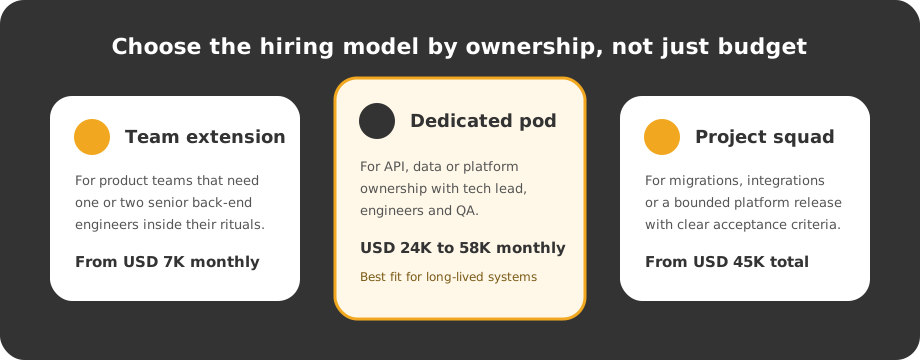
Team extension
From USD 7,000 per senior engineer per month. Best when your architecture, backlog and code review process already exist. You manage priorities; we supply vetted back-end engineers who work exclusively with you.
Dedicated back-end pod
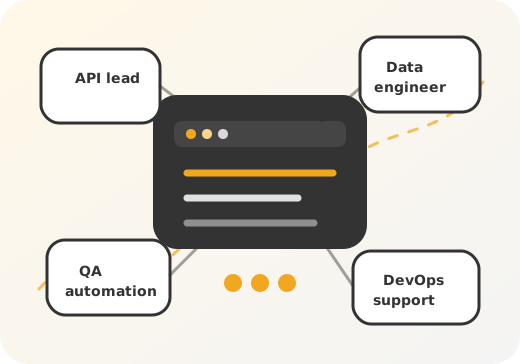
Usually USD 24,000 to 58,000 per month. A common pod includes a tech lead, two or three engineers, QA automation and part-time DevOps. This is the model for platform areas that need continuing ownership.
Project squad
Usually from USD 45,000 total. Useful for a migration, integration program or clearly scoped backend release. We agree on outcomes, milestones and acceptance criteria before the team starts.
Rates vary by seniority, technology and risk. A Go engineer for a high-throughput payments system costs more than a mid-level PHP engineer maintaining internal tools. Nearshore Argentina is usually more expensive than low-cost offshore regions, but it reduces time-zone friction, makes senior collaboration easier and keeps critical decisions out of a 24-hour async loop.
How the hiring process works
A fast start is useful only if it does not skip due diligence.
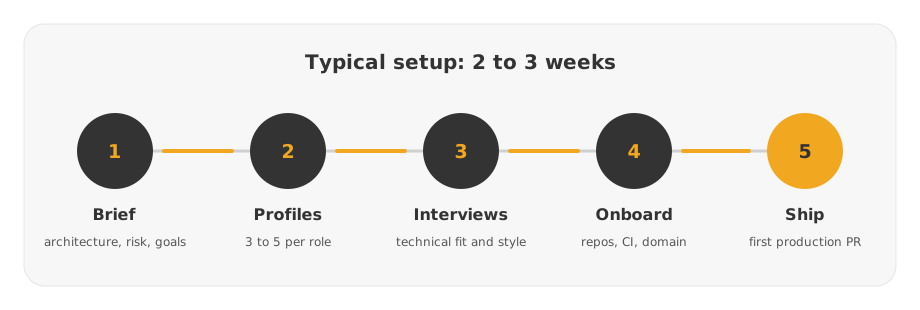
1. Technical brief
We ask for the unglamorous details: current stack, deployment target, database size, production incidents, security constraints, roadmap pressure and who approves architecture. This prevents the common mistake of hiring "Node developers" when the real problem is data modeling or release discipline.
2. Team design
We choose the seniority mix and roles. A small SaaS product may need two senior engineers. A regulated workflow may need a tech lead, QA automation, DevOps and a database specialist. You should not pay for a PM if your internal product manager already runs a clean backlog.
3. Interviews and calibration
You meet finalists, usually three to five per role. We prefer practical discussions around code review, system design and production incidents over trick questions. If a candidate is technically strong but a poor communication fit, we keep looking.
4. Onboarding
The team enters your repos, CI, issue tracker and chat channels. In the first sprint we map risky flows, document local setup, review monitoring, and agree on pull request expectations. We also clarify what Siblings Software can decide alone and what needs client approval.
5. First production release
We aim for something small but real: a fixed endpoint, a tested migration, a queue retry improvement, or a piece of instrumentation. The point is not ceremony. It is proving that the team can move code through your production path safely.
6. Ongoing governance
Weekly demos, written status, backlog health and risk notes keep the work visible. For longer engagements we run architecture reviews every quarter and update capacity plans before the roadmap becomes a surprise.
Back-end teams compared with freelancers, in-house and agencies
If the work will join your operating backbone, hire a stable team.
Freelancers
Good for narrow tasks, prototypes or emergency help. Risk increases when the work touches architecture, security, data migration or long-term ownership. The hidden cost is usually management time.
In-house hiring
Best for permanent strategic roles. It is slower and more expensive when you need capacity this quarter. Recruiting, benefits, equipment and retention are part of the real cost.
Traditional agency
Useful for a defined project, but some agencies keep clients away from the engineers. That is a problem when product and platform knowledge must compound over time.
Dedicated team
Best when you need continuity, senior judgment and flexible capacity. You get engineers integrated into your workflow, with Siblings Software handling replacement, retention and delivery support.
Technologies, standards and how we make decisions
The useful question is when not to add complexity.
We work across Node.js, Python, Java, .NET, Go, PHP and Ruby. We are comfortable with PostgreSQL, MySQL, SQL Server, MongoDB, Redis, Kafka, RabbitMQ, AWS, Azure and Google Cloud.
For API security, we use the OWASP API Security Top 10 as a baseline. For relational data work, our engineers lean on vendor documentation such as the PostgreSQL documentation instead of folklore. For cloud reliability and cost decisions, we often reference the AWS Well-Architected Framework, even when the deployment target is not AWS, because the tradeoff categories are still useful.
API and service design
Versioning, idempotency, pagination, error contracts, rate limiting, OpenAPI documentation, authentication and authorization. We pay attention to developer experience because bad APIs create support tickets.
Data and reliability
Schema design, migrations, indexing, backup strategy, caching, queue semantics and observability. We care about p95 and p99 latency, but we also care whether someone can debug a failed job at 2 a.m.
Delivery discipline
Automated tests, code review, CI/CD, feature flags, rollback plans and written runbooks. Mature back-end work is not dramatic. It is predictable enough that releases stop feeling like events.
Mini case study: rebuilding a marketplace integration layer
A familiar story: temporary scripts that became business-critical.
A North American B2B commerce company came to us with a familiar problem: their marketplace integrations had grown from temporary scripts into business-critical infrastructure. Orders arrived late, stock updates disagreed between systems, and the internal team was afraid to change the sync logic before peak season.
What we changed
- Replaced direct point-to-point calls with a queue-based workflow and idempotent handlers.
- Added audit tables so operations could answer "what happened to this order?" without asking engineering.
- Introduced contract tests for three partner APIs that changed behavior without notice.
- Moved deployment from manual release notes to a CI pipeline with rollback steps.
What improved
- Manual reconciliation dropped from about 14 hours a week to under 3.
- Failed order syncs became visible within minutes instead of appearing in customer support tickets.
- The client's internal team took ownership after documentation and pair-review sessions.
For more examples across products and industries, see our case studies.
Risks we expect, and how we reduce them
Predictable failure modes, addressed early.
The wrong seniority mix
A team of only senior engineers can be expensive and oddly slow if the backlog contains routine implementation. A team without a senior lead can move fast in the wrong direction. We design the team around decisions, not titles.
Knowledge trapped outside your company
Every significant decision goes into lightweight documentation: ADRs, API specs, runbooks or onboarding notes. You should not need us forever to understand your own system.
Security and access concerns
We work with NDAs, role-based access, separate vendor accounts, secret management rules and client-owned repositories. If your policy requires limited environments, we adapt the workflow before coding starts.
Velocity without production safety
Back-end teams can create expensive problems by shipping invisible changes too quickly. We use tests, feature flags, staged rollouts and observability to make releases boring.
If your needs are broader than the back-end, we can coordinate with our web development, full-stack team and staff augmentation services.
Questions buyers usually ask before hiring
The decisions that come up before the engagement starts.
Can we start with one engineer and grow later?
Yes. Many clients start with one senior engineer or a small two-person team. If the work expands, we add capacity after the first sprint or month, once we know the codebase and communication rhythm.
What happens if an engineer is not a fit?
We replace them. We run early calibration calls because waiting three months to admit a mismatch is unfair to everyone. The client should not carry replacement and retention risk alone.
Do you support existing codebases?
Yes, and most work starts there. Greenfield projects are simpler. Existing systems require humility: read before rewriting, measure before optimizing, and understand why strange code exists before deleting it.
Who owns the code?
You do. Contracts assign work product and source code to the client. We can work under your MSA or provide ours, with standard confidentiality and IP assignment terms.
Can the team work in our time zone?
Our teams are based in Argentina, which gives strong overlap with US and Canadian teams and workable afternoon overlap with Europe. We use written updates for anything that should not depend on a meeting.
Do you only provide back-end engineers?
No. This page is focused on back-end hiring, but Siblings Software also provides product design, front-end, mobile, QA automation and DevOps support when the project needs a wider delivery team.
OUR STANDARDS
Back-end engineers who treat your production system like their own.
Every back-end engagement we lead is anchored by a senior engineer who has shipped APIs, integrations, and migrations under real release pressure. We design teams around the decisions you actually need made, not job titles, and we keep the work visible through demos, written status, ADRs, and risk notes you can read in five minutes.
We document trade-offs in your repository, keep credentials in your accounts, prefer feature flags and staged rollouts over hero launches, and write the runbooks your future hires will rely on. The goal is not heroics. It is releases that stop feeling like events.
Contact Siblings Software Argentina
Send us the system, deadline, and risk. We will come back with a recommended team shape.