Nearshore iOS developers who understand your app, not just Swift syntax
Hiring iOS developers is not buying Swift hours. It is adding someone who understands what a mobile app actually costs you: permissions that kill conversion, App Review cycles, memory on older devices, accessibility, in-app payments, privacy rules, and a long list of details that never show up on a resume.
Siblings Software helps product companies, agencies, and startups add iOS engineers from Córdoba, Argentina. We work in GMT-3 with real overlap for US teams and a useful window into Europe. This page answers what buyers usually need before signing: profiles, rates, process, scenarios, risks, and when we will honestly tell you not to hire us.
The real intent behind hiring iOS developers
This is not an informational search. It is a commercial decision with technical risk.
Whoever searches to hire iOS developers already knows they need capacity. What they are trying to solve is more concrete: how long it takes, what it costs, whether the profile will understand an existing app, and what happens if a release fails. That is why we do not sell a generic mobile development promise.
We sell a way to add vetted iOS capacity on a flexible contract, with enough technical oversight that your internal team does not have to babysit the engagement.
Mature buyers usually arrive with a list like this: we need two seniors for a SwiftUI roadmap, someone who can live inside an old UIKit app, mobile QA with real devices, or a squad to pull a rejected App Store release out of intensive care.
If that is your problem, staff augmentation makes sense. If you need a full app built from zero, you are probably better served by our app development service or a fixed-scope project.
Who typically hires us
Four situations we see over and over.
SaaS products with an app that already moves metrics
You have active users, real bugs, and a mobile team that is too small. The iOS lead does not need someone to juniorize the work; they need another senior who can own a whole area, learn the domain, and merge without creating new debt.
Startups with funding and an App Store deadline
Design is moving, the backend is half-built, and investors want a native app, not a wrapper. We can add one engineer or a small squad to reach TestFlight and scale capacity down later without layoffs or eternal contracts.
Agencies that sold mobile and do not want payroll risk
You sell two strong iOS projects a year. Hiring in-house for peaks leaves people idle between accounts. We act as white-label capacity: your client relationship stays intact, our team integrates behind you.
Companies with a legacy app nobody wants to touch
Objective-C, heavy UIKit, a signing pipeline that only works on one Mac, and privacy warnings that show up late. We do not promise magic: we stabilize, instrument, and migrate in parts while keeping the app publishable.
What our iOS developers actually do day to day
Swift programmer, yes. Also product, platform, and release engineering.
The typical profile is not only a Swift coder. It is someone comfortable with product, Apple platform work, backend integration, and release engineering. In 2026 that also means on-device models, sensitive data security, wallets, payments, privacy, and experiences that start to overlap with AI, blockchain, or Vision Pro.
Swift and SwiftUI features
New screens, UIKit to SwiftUI migration, state management, accessibility, localization, widgets, and flows that need real mobile UX judgment. We follow Human Interface Guidelines, but we also push back when design was clearly thought for web.
Reliability and performance
Instrumentation with Sentry, Firebase, or Datadog; Instruments profiling; memory leak fixes; cold start; battery use; Swift Concurrency threading; and testing on real devices. Simulators help. They are not enough.
App Store and release engineering
TestFlight, certificates, provisioning profiles, Fastlane, Xcode Cloud, privacy manifests, review responses, and staged rollouts. The App Store Review Guidelines are not a last-day read.
Legacy modernization
Objective-C to Swift, UIKit to SwiftUI, Core Data cleanup, giant modules to packages, dependency debt, and domain separation. We do not defend big rewrites unless the business can actually afford them.
AI, security, and sensitive data
Core ML features, local classification, anti-fraud controls, biometrics, Keychain, passkeys, DeviceCheck, and App Attest. For health or fintech apps, privacy and audit trails matter as much as code.
Product integrations
StoreKit 2, RevenueCat, payments, push notifications, deep links, analytics, video, audio, camera, BLE, and native SDKs with irregular docs. When the SDK fails, the user blames your app, not the vendor.
We also cover adjacent stacks when it helps: Swift developers for broader Apple work, React Native when you need shared code, Flutter for Dart teams, and Objective-C when the old app still pays the bills. For a full dedicated squad instead of augmentation, see our dedicated iOS development team.
Engagement models and approximate pricing
We publish ranges because secret pricing is a bad signal.
The final number depends on seniority, English level, stack complexity, and whether you need specialists in StoreKit, video, mobile security, or on-device AI.
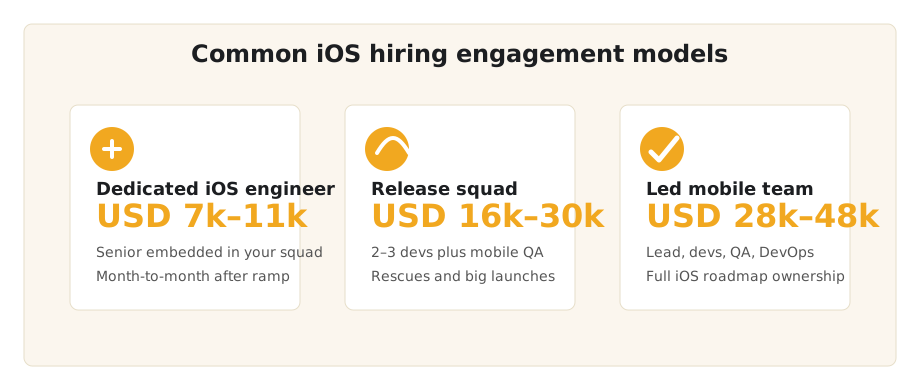
Dedicated iOS engineer
A strong senior or solid mid-level joins your squad, uses your tools, joins your dailies, and takes tickets from the roadmap. Works when you already have mobile leadership and only need capacity.
USD 7,000 to 11,000 per month.
Release squad
Two developers plus mobile QA, with part-time lead support. Useful to rescue a release, ship a big version, cut crash rate, or close a bounded migration.
USD 16,000 to 30,000 per month.
Led mobile team
iOS lead, two to four engineers, QA, and part-time DevOps. For companies without an internal mobile org or a roadmap that needs an owner for several quarters.
USD 28,000 to 48,000 per month.
Ranges assume full-time dedication, 40-hour weeks, and a three-month minimum for squads. They include recruiting, laptops, benefits, and local taxes. They do not include external accounts such as Apple Developer Program, Sentry, RevenueCat, or CI tools: those stay on the client side.
How the hiring process works
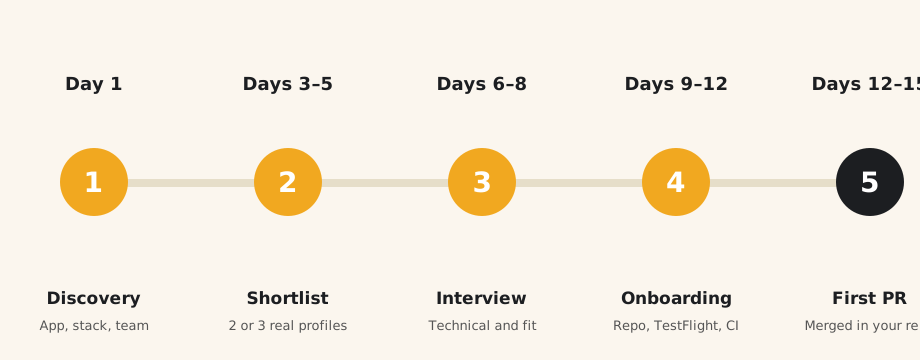
From first brief to first pull request, usually two weeks.
- Technical discovery. We review the app, stack, minimum iOS version, crash rate, pipeline, backlog, and who will review code. If the brief is fuzzy, we clarify it before sending CVs.
- Written shortlist. Two or three real profiles with technical notes: shipped apps, strengths, English level, availability, and risks. We do not dump twenty resumes and hope one sticks.
- Client interview. Live coding, architecture review, pair session, or product conversation. We recommend using a real bug from your app instead of an abstract puzzle.
- Operational onboarding. Repo, Apple Developer, TestFlight, CI, Sentry, docs, local environment, and a small first ticket. We use a checklist because about 70% of ramp delays are access, not skill.
- First merged PR. A small real change: a fix, a test, a pipeline tweak, or instrumentation. It validates review flow, not vanity output.
- Adjustment window. During the first 14 days, if the fit is wrong, we replace at no cost and cover overlap. After that, standard 15-day notice applies.
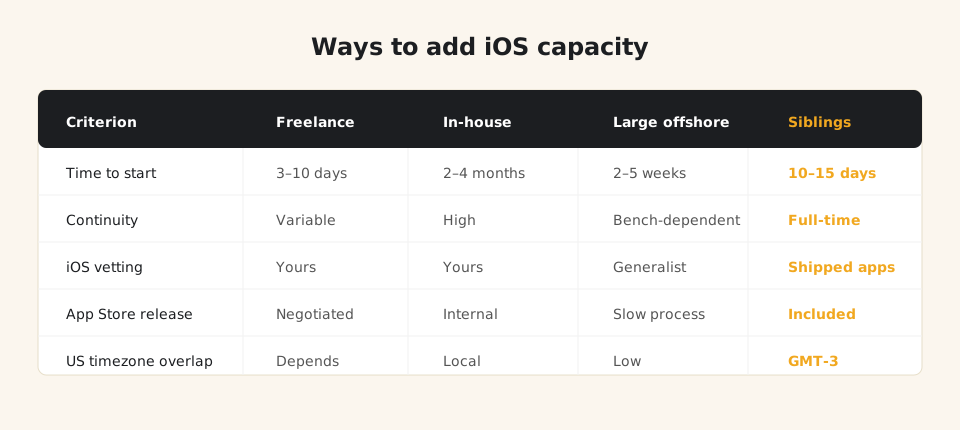
Siblings Software vs freelance, in-house, and generic offshore
Each option has a place. The expensive mistake is choosing by habit.
Where freelance wins
A scoped module, a performance audit, a hard animation, or a spike under 80 hours. If you know exactly what you need and do not need continuity, a specialist freelancer is often the best buy.
Where freelance hurts
Long roadmaps, App Store responsibility, post-release support, and invisible work: pipelines, runbooks, docs, and tests. Good freelancers are busy; cheap ones rarely stay for the boring parts.
Where in-house wins
If iOS is your long-term core, an owned team is ideal. Several clients start with us to unlock capacity, then hire internally with better judgment.
Where in-house hurts
Time and risk. Hiring a senior iOS engineer in the US can take three months. A bad hire costs more than salary: lost onboarding, a delayed roadmap, and an exit nobody wanted.
Real scenarios where iOS staff augmentation fits
Anonymized data, real patterns.
These examples blend real contracts with anonymized details. Numbers are rounded, but the shape matches what we hear on discovery calls.
Fintech with App Store rejections
Context: US wallet with KYC, transfers, and StoreKit for a premium tier. Two rejections over privacy metadata and late permission explanations.
What we did: One senior iOS engineer for six months. Privacy manifests, tracking prompt order, permission flow cleanup, and a submission runbook.
Outcome: The next build was approved in 36 hours. The internal team kept using the runbook without us.
Healthtech with a high crash rate
Context: Telemedicine app with video, 120,000 monthly sessions, and a 97.8% crash-free rate on iOS, too low for paid visits.
What we did: iOS engineer plus mobile QA. Fine-grained instrumentation, tests on older iPhones, AVFoundation leak fixes, and reconnection handling.
Outcome: Crash-free rate above 99.6% in ten weeks. Fewer video-related support tickets.
Retail with an old UIKit app
Context: Loyalty app from 2017, painful UIKit screens, one internal developer.
What we did: Incremental SwiftUI migration by flow, not by technical layer. Every sprint left something publishable.
Outcome: 38 screens migrated in five months without freezing commercial features.
AI startup with on-device features
Context: Productivity app classifying sensitive notes locally without sending them to a server.
What we did: Senior iOS with Core ML and local security experience. Model size, inference time, and Keychain storage tuned.
Outcome: Beta in TestFlight in six weeks with acceptable inference on iPhone 12 and newer.
Mini case study: a delivery app that stabilized checkout without rewriting iOS
Measure well, touch less code than the team wanted at first.
Client. Regional delivery marketplace with weekend traffic spikes. The iOS app was profitable, but checkout failed intermittently when payments, coupons, and saved addresses combined.
Brief. Add one senior iOS developer for four months to stabilize checkout without stopping commercial campaigns.
What we did. Sprint one was instrumentation, not features. Funnel events, error breadcrumbs, regression tests on coupons, and an incident runbook. Then we isolated checkout into a testable Swift module and removed three race conditions between fare calculation, payment method, and address.
Result in 90 days. iOS checkout errors dropped from 2.9% to 0.8%. Mean time to diagnose incidents went from hours to minutes because events finally told the full story.
The unglamorous part. The win was not a clever architecture. It was measuring well, testing where it hurt, and changing less code than the team wanted to touch at the start.
At a glance
Industry: delivery and marketplace
Engagement: 1 senior iOS, 4 months
Stack: Swift, UIKit, StoreKit, Sentry, Fastlane
Checkout errors: 2.9% → 0.8%
First PR: day 13
Real risks when hiring iOS developers, and how we reduce them
What we say before you sign.
Risk: they know Swift but cannot ship
Mitigation. Vetting covers App Store, TestFlight, certificates, privacy manifests, and concrete rejections. For seniors, publishing to production is not optional.
Risk: the legacy app becomes untouchable
Mitigation. Before promising migration, we review architecture, dependencies, and pipeline. Small cuts, ADRs, and tests around critical zones. Goal: weekly releases, not winning a technical argument.
Risk: knowledge leaves when the contract ends
Mitigation. Release runbooks, written architecture decisions, README files for hard modules, and a final handoff. Documentation is part of the job, not a bonus.
Risk: augmentation becomes invisible management for your lead
Mitigation. Weekly technical follow-up from Siblings Software, direct feedback, and early replacement if the level is off. Your lead should review product and architecture, not chase hours.
We also use Apple’s official documentation as a technical baseline, especially Swift on Apple Developer and post-WWDC SDK changes. Obvious, maybe, but many bad decisions come from staying two versions behind with no plan.
Why Siblings Software
Small, nearshore, and fairly direct.
2014
Founded in Córdoba.
Teams for clients in the US, Canada, Europe, and Argentina.
40+
Apps shipped or maintained.
Fintech, health, logistics, retail, media, and SaaS.
GMT-3
Useful overlap.
Real meetings with product teams, not overnight handoffs.
Founders still sit on discovery calls and larger contracts. We do not have a sales layer promising profiles engineering cannot back. If the brief does not fit, we say so early. If it fits, the first month should show evidence: PRs, metrics, documentation, and a cadence your team would want to keep.
What buyers often underestimate: App Store experience matters as much as Swift; an expensive iOS developer can be cheap if they prevent two weeks of blocked release; and a huge agency does not automatically have better mobile judgment. On iOS, the difference is people who shipped, broke, and fixed real apps.
Frequently Asked Questions
A senior iOS developer is usually USD 7,000 to 11,000 per month. A small squad with two devs and mobile QA runs USD 16,000 to 30,000. A led team for a full roadmap can reach USD 48,000. Pricing is all-in, with no separate recruiting fee.
Typically 10 to 15 days until a real first PR. If repo, Apple Developer, TestFlight, and CI access are ready, it can be faster. If those are missing, the bottleneck is not the engineer.
Yes. Many engagements start with legacy apps. We migrate by flow and keep frequent releases. If a full rewrite looks tempting, we look at metrics, dependencies, and business risk first.
Yes. Certificates, profiles, builds, TestFlight groups, staged rollouts, review responses, and Fastlane or Xcode Cloud automation can be in scope. The Apple account always stays yours.
Full-time Siblings Software employees or long-term vetted collaborators. We do not resell anonymous marketplace profiles. You interview the person who will write the code.
We replace at no cost during the first 14 days and cover overlap. After that, standard 15-day notice applies. The signal we use is simple: if this were an in-house hire, would you keep them?
If you need one codebase and the app does not lean on heavy native APIs, React Native or Flutter can be better. If iOS is the premium experience, with camera, audio, widgets, payments, or local security, native usually wins.
Yes. Modern iOS work depends on APIs, AI models, security policy, observability, and analytics. We can add complementary profiles from our API developers, AI developers, and backend developers pages when the scope requires it.
OUR STANDARDS
Less outsourcing theater, more verifiable engineering.
Onboarding ends when code is merged, not when the calendar says the contract started. We test on iPhones from different generations because one new iPhone on the desk does not represent all your users. We document what matters: release runbooks, ADRs for hard calls, and README files for modules another team will maintain.
If the profile is wrong, we say so in the first two weeks, because waiting three months is easier for the vendor and worse for the client. Code, accounts, pipelines, and artifacts stay in your repos and your tools, always.
Contact Siblings Software
Tell us about your iOS app, current team, and what you need to unblock. We reply within one business day.