Hire Flutter Developers
Looking to hire Flutter developers? Our staff augmentation services place vetted Flutter and Dart engineers from Argentina who embed with your product team for app delivery, native integrations, testing, CI/CD, and store releases. Most clients have a developer onboarded in about two weeks.
We have been staffing software teams from Cordoba since 2014, mostly for U.S. and European clients that need timezone overlap, senior engineers, and a calmer alternative to hiring in a rush.
Who this service is for
Compare options, reduce hiring risk, and add capacity without waiting a quarter.
A product company with one overloaded mobile lead
Your lead knows the codebase but is stuck reviewing pull requests, fixing release bugs, and explaining the same architecture decisions to every new contractor. You need a Flutter engineer who can take a feature area, write tests, and ask good questions without draining the lead all day.
A startup building its first serious mobile app
You have a backend, a Figma file, and investor pressure to launch on iOS and Android. Hiring a full internal mobile team would take too long. We can start with one senior developer or a small squad and keep the architecture simple enough for your future team to inherit.
An agency that sold a mobile project and needs trusted delivery capacity
We often work behind the scenes for digital agencies. Their client relationship stays theirs; our engineers join their Slack, GitHub, and sprint rhythm. This works best when the scope is real, the deadline is known, and nobody wants to hire permanent mobile staff between projects.
A company modernizing a Cordova, Ionic, or separate native app stack
Flutter can be a good replatforming choice, but only when the migration is planned screen by screen. We help keep the old app alive, build the new one with clean boundaries, and avoid the "rewrite everything and disappear for nine months" trap.
We are not the best fit for a five-hour bug fix or a vague "build the next Uber" request with no product owner. We are strongest when there is a real app, a real roadmap, and a team willing to review code.
What our Flutter developers actually do
The difference shows up in release week, not in syntax.
Flutter hiring gets talked about as if it were just a Dart syntax problem. It is not. The difference between a decent Flutter developer and a mobile engineer shows up in release week, on older Android devices, when a vendor SDK has no package, or when a payment flow fails during app review.
App architecture and state management
Riverpod, Bloc, Provider, GetX, or your existing custom pattern. We do not push migrations for sport. A senior developer first stabilizes the current architecture, then recommends changes only when rebuild storms, tangled dependencies, or untestable feature modules are actually slowing the team down.
Native bridges and device features
When a plugin is not enough, our senior engineers write Swift and Kotlin. Common work includes biometric login, card scanning, background location, camera flows, Bluetooth devices, health APIs, in-app purchases, and payment SDKs. For larger bridges, they use type-safe patterns such as Pigeon.
Performance on real devices
Not just "it runs on my simulator." They profile with Flutter DevTools, check frame rendering, reduce expensive rebuilds, compress image paths, and test on mid-range Android phones where jank appears first. The goal is boring: smooth scrolling and predictable memory use.
Testing and release engineering
Unit tests, widget tests, integration tests, golden tests where they help, and CI pipelines in GitHub Actions, Codemagic, Bitrise, or Fastlane. They also handle signing, TestFlight, Google Play internal tracks, staged rollouts, and review feedback. Store release work is not treated as an afterthought.
Every Flutter developer we place has shipped at least one production app. The stronger candidates have shipped several, across logistics, retail, fintech, healthcare, education, and internal field-service tools.
Engagement models and approximate rates
Hidden pricing wastes the first call.
We publish ranges because final pricing depends on seniority, English level, native integration depth, timezone overlap, and whether you need release ownership or just feature delivery.
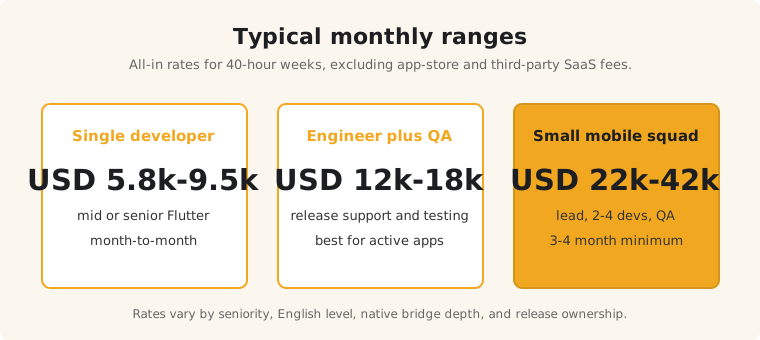
Single developer, month-to-month
One vetted Flutter developer joins your team. You keep product ownership, sprint planning, and code review. We handle payroll, equipment, HR, replacement risk, and local compliance.
Good for: backlog acceleration, maintenance, a second pair of senior hands, or a stable feature stream.
Developer plus mobile QA
One engineer and one mobile QA who tests on real devices. This is the model we recommend when an app is live, release risk is high, and bugs are more expensive than development hours.
Good for: stores, regression suites, app rescue work, and teams with no dedicated mobile tester.
Small Flutter squad
A lead, two to four engineers, and QA. The lead owns architecture, release cadence, and technical decisions while your product owner owns priorities. Minimum terms are longer because ramp-up has real cost.
Good for: new product builds, replatforming, or a mobile roadmap with more work than one person can safely own.
These are all-in monthly ranges for 40-hour weeks. They do not include Apple Developer Program fees, Google Play registration, Firebase, Sentry, RevenueCat, or other third-party tools. Those should stay in your accounts so you keep control.
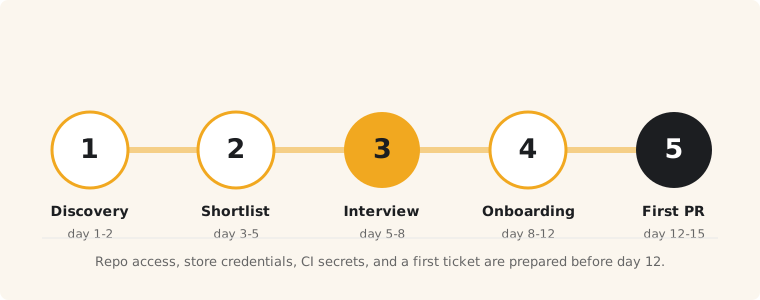
How the hiring process actually runs
From first conversation to first merged pull request in about two weeks.
- Discovery, day 1 to 2. We ask about your Flutter version, state management, release pipeline, native integrations, product roadmap, and the people who will review code. We also tell you if staff augmentation is the wrong model.
- Shortlist, day 3 to 5. You receive two or three profiles with specific notes: apps shipped, state management used, native work, testing depth, English level, and timezone availability. No anonymous resume pile.
- Your interview, day 5 to 8. You can run live coding, architecture review, product discussion, or a practical bug triage. We suggest asking candidates to explain a real Flutter decision they regret. It reveals more than a puzzle.
- Onboarding, day 8 to 12. Repo access, Apple and Google developer invites, signing credentials, CI secrets, crash reporting, analytics, device matrix, and first ticket. A messy access process is the most common reason onboarding slips.
- First pull request, day 12 to 15. We prefer a small real task: a failing test, a crash fix, or a contained UI feature. It validates the workflow before anyone promises velocity.
- Fit check, first 14 days. If the match is wrong, we replace the engineer at no additional cost and cover transition overlap. After that, standard notice is 15 days unless a squad minimum was agreed.
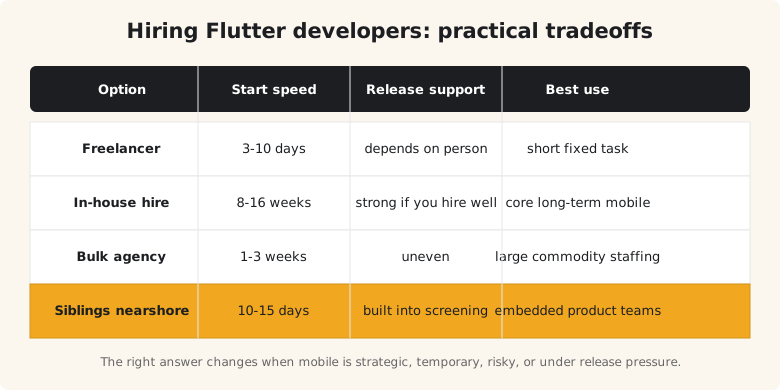
Flutter staff augmentation vs freelancers, in-house hiring, and agencies
There is no universal best option.
The right choice depends on how strategic mobile is, how much release risk you can tolerate, and whether the work is a short task or an ongoing product responsibility.
Where freelancers win
Short, isolated tasks. A package upgrade, a custom animation, a small native plugin, or a performance audit under 80 hours. If the work is fully defined and does not need continuity, a specialist freelancer can be the best use of money.
Where freelancers hurt
Ongoing product work. A freelancer may be excellent and still unavailable when App Store review rejects a build or your checkout flow breaks on Android 15. Continuity matters in mobile because small release decisions compound.
Where in-house wins
If mobile is the heart of your business, a permanent team is eventually the right answer. Some clients start with us, learn what good Flutter delivery looks like, and then hire internally with a clearer scorecard.
Where in-house hurts
Speed. A senior mobile hire in the U.S. or Europe can take two to four months, and the first hire is easy to get wrong if nobody internal can assess Flutter architecture. Staff augmentation buys time without pretending it replaces long-term ownership.
If you need a vendor to own the whole product rather than embed engineers into your rituals, look at our Flutter development outsourcing service. If you need a larger dedicated group, compare it with a dedicated Flutter team. If you are still choosing a framework, our cross-platform app development page explains where Flutter, React Native, and native apps fit.
Real hiring scenarios we see repeatedly
Composites from real engagements, anonymized and rounded.
These are included because buyers usually want to know whether their situation is normal before they call.
Scenario A: the internal operations app nobody can release
Context. A logistics company had a driver app used by 1,400 contractors. It worked, but releases were monthly and stressful because regression testing was manual.
What we did. Placed one senior Flutter engineer and a part-time mobile QA. First month: added integration tests for dispatch, proof of delivery, and offline queueing. Second month: moved builds to Codemagic and cleaned signing.
Outcome. Release cadence moved from monthly to every two weeks. Crash-free sessions improved from 98.2% to 99.5% over the next quarter.
Scenario B: the fintech app with a native SDK problem
Context. A lending startup had a Flutter app and a card-verification vendor that shipped native SDKs but no maintained Flutter package. Their team had Dart experience, not native bridge experience.
What we did. Placed a senior with Swift and Kotlin bridge work. Built the plugin wrapper, added error telemetry, wrote a rollback path, and paired with the internal team so they could maintain it later.
Outcome. Verification completion rose by about 14% after the new flow shipped. The client kept the engineer for two more quarters to stabilize payments and release automation.
Scenario C: the agency overflow project
Context. A U.S. agency sold a 16-week Flutter build for a retail client. Their only mobile developer was already booked.
What we did. Two engineers joined under the agency's delivery lead. We kept our branding out of the client-facing work, used their Jira and GitHub, and handled store-readiness tasks in the final month.
Outcome. The app launched one week late, not six. The agency brought us back for support and a second client six months later.
Scenario D: the replatform that needed restraint
Context. A healthcare company wanted to replace an older Ionic app. The instinct was a full rewrite, but their clinicians could not tolerate a long feature freeze.
What we did. A lead and two Flutter developers rebuilt the highest-use workflows first, kept the old app alive, and migrated authentication and patient forms behind shared APIs.
Outcome. The first Flutter release shipped after 18 weeks with a limited user group. The old app was retired screen by screen instead of all at once.
Deep-dive: how two Flutter engineers rescued a field-service app before peak season
Client. A North American home-services company with technicians using a Flutter app for route changes, work orders, customer signatures, and photo uploads. The app was central to daily operations, but offline sync was fragile and peak season was eight weeks away.
Brief. Add two senior Flutter developers who could work inside the existing mobile pod, stabilize offline behavior, and improve release confidence without changing the backend contract.
What we did. Week one was mostly reading and instrumentation. The team added crash breadcrumbs around sync retries, wrote a small device lab checklist, and found that failed photo uploads were being retried in the wrong order after app restarts. One engineer rebuilt the local queue and conflict handling; the other added widget tests around the signature and work-order flows, then wired integration tests into GitHub Actions.
Result over 10 weeks. Failed work-order submissions dropped from roughly 7% to under 1.5%. Release time went from a two-day manual checklist to a half-day. The internal lead kept architecture ownership; our engineers gave them capacity and a cleaner release pipeline.
Honest caveat. This was not magic. A lot of the win came from finally giving offline sync dedicated attention. The reason it worked is that the engineers had seen similar mobile sync failures before and did not spend the first month guessing.
At a glance
Industry: field services
Engagement: 2 seniors, 10 weeks
Stack: Flutter, Riverpod, SQLite, GitHub Actions, Firebase Crashlytics
Failed submissions: about 7% to under 1.5%
Release prep: 2 days to half a day
Risks of hiring Flutter developers, and how we reduce them
Staff augmentation is not risk-free.
The right question is whether the vendor knows where the risk usually hides and has a practical habit for handling it.
Risk: the engineer knows Flutter samples but not production mobile
How we handle it. Our screening includes a real architecture conversation, a Dart exercise, and questions about releases, crash reporting, native bridges, and state management tradeoffs. We care less about perfect vocabulary and more about scars from shipped apps.
Risk: the app becomes dependent on an external person
How we handle it. Documentation lives in your repo. Native bridge decisions get short ADRs. Release runbooks are written as part of the work. We expect your team to be able to continue without us.
Risk: package upgrades and SDK changes stall the roadmap
How we handle it. Before we start, we check your Flutter SDK version against the official Flutter release archive, package health on pub.dev, and the state of critical plugins. If a dependency is risky, we flag it early.
Risk: App Store or Google Play rejection delays launch
How we handle it. Privacy manifests, permissions text, screenshots, test accounts, tracking disclosures, and release notes are prepared before submission week. Experienced mobile engineers know review problems are usually operational, not just technical.
Why Siblings Software specifically
A small nearshore firm is not the right answer for everyone.
11+
years staffing teams
Founded in Cordoba, Argentina in 2014.
2-4h
U.S. timezone overlap
Often more, depending on client location and team schedule.
1:1
you interview the person
No bait-and-switch, no faceless bench.
The decision-making mistake we see most often is hiring for "Flutter years" instead of the actual risk in the app. A commerce app might need someone who understands payments and release operations. A field app might need offline sync. A healthcare app might need privacy and native device permissions handled carefully. We shape the shortlist around that risk, not around a generic technology checklist.
For adjacent skills, you can also review our Dart developer staffing, React Native developers, and mobile app developers pages.
Frequently Asked Questions
Most mid-level Flutter developers land around USD 5,800 to 7,200 per month. Seniors with native bridge and release experience are usually USD 7,500 to 9,500. A small squad with QA and technical leadership ranges from USD 22,000 to 42,000 monthly.
Candidate interviews usually happen within five to eight business days. Onboarding is commonly complete by day 10 to 15 if repo access, app-store accounts, CI secrets, and test credentials are ready.
Yes. We match for your architecture first: Riverpod, Bloc, Provider, GetX, Redux-style patterns, or custom modules. We do not recommend changing state management unless the current setup is clearly blocking delivery or testing.
Yes. Senior engineers can support signing, TestFlight, Google Play internal testing, staged rollouts, release notes, privacy disclosures, and review responses. Some clients keep release authority internal; others delegate the operational work to us.
We will say so. Flutter is excellent for many product apps, but native development can be better for heavy 3D, advanced media editing, specialized hardware, or mature native teams. The wrong framework choice is too expensive to politely ignore.
Sometimes, yes. We do not use non-competes to trap people. If direct hiring becomes the right long-term move, we discuss a conversion fee and transition plan openly instead of pretending the conversation is taboo.
OUR STANDARDS
Flutter engineers who can own real mobile work, not just write Dart widgets.
Every Flutter developer we place has shipped at least one production app, knows how to read a stack trace on a real Android device, and can have a calm conversation about release operations, native bridges, and state management tradeoffs. We screen for scars from shipped apps, not for perfect vocabulary.
Documentation lives in your repo. Native bridge decisions get short ADRs. Release runbooks are written as part of the work. We expect your team to be able to continue without us, and we shape the shortlist around the actual risk in your app rather than a generic technology checklist.
Contact Siblings Software Argentina
Tell us what your Flutter app needs and we will suggest the smallest team that makes sense.