Flutter Development Services for Product and SaaS Teams
Flutter development services from Siblings Software help product and SaaS teams ship iOS and Android apps from one Dart codebase, with a managed team that owns architecture, QA, native integrations, and store releases. We are a software outsourcing company based in Cordoba, Argentina, and we work with US and Canadian buyers who need nearshore overlap without running a full mobile recruiting cycle.
Most visitors here already know Flutter exists. They are deciding whether an outside team can take real responsibility for a mobile product: planning, release discipline, package risk, offline behavior, and the work that shows up after the first demo. This page explains what the service covers, who it fits, how delivery works, typical team shapes, pricing drivers, risks, and when staff augmentation or a dedicated squad is a better fit.
Need one engineer inside your rituals instead of a managed program? See hire Flutter developers. For a long-running pod with roadmap ownership, compare a dedicated Flutter development team.
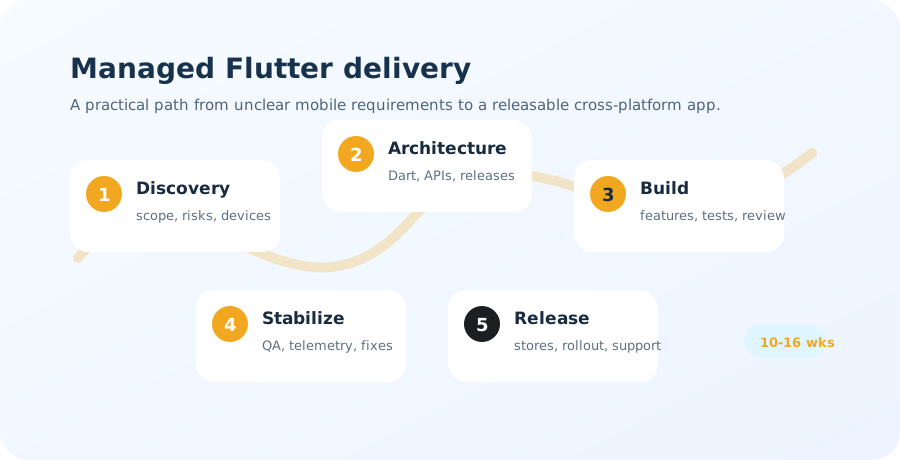
What Flutter Development Services Cover
Cross-platform delivery with the native, QA, and release work included.
We use Flutter when shared business logic, consistent UI, and one release train for iOS and Android reduce cost and coordination more than maintaining two native teams. The official Flutter documentation covers the framework well; the buying decision is usually about delivery risk, not widgets.
A typical engagement includes feature development, app architecture, state management, API integration, native plugins, analytics, crash reporting, device testing, CI/CD, store preparation, and support after launch. When the app needs Swift or Kotlin for biometrics, payments, location, Bluetooth, health data, or a vendor SDK, we plan that explicitly instead of assuming every package on pub.dev is production-ready.
Architecture and Dart code
Riverpod, Bloc, Provider, modular features, package boundaries, and the boring decisions that keep a codebase readable after the first release. Language-level work pairs with our Dart development practice when server or shared libraries matter.
Native integrations
Platform channels, Swift, Kotlin, signing, permissions, and third-party SDKs that need careful wrapping. We document ownership so native forks do not become silent sprint debt.
Quality and devices
Unit tests, widget tests, integration tests, real-device checks, crash reports, and release checklists that catch problems before store review week.
Delivery and store ops
Backlog shaping, sprint cadence, demos, acceptance criteria, TestFlight and Play staged rollouts, privacy disclosures, and runbooks inside your tools.
Still comparing frameworks? Our cross-platform app development page explains where Flutter, React Native, .NET MAUI, and native development fit. For broader mobile context, see mobile app development services.
Who This Service Is For
When a managed Flutter team is worth more than a single contractor.
A startup building the first production app
You have product direction, designs, and a backend plan, but not enough mobile leadership to ship iOS and Android safely. We help define the first release, keep scope honest, and build an app your future team can maintain.
A company replacing an older mobile stack
Flutter is often considered when Cordova, Ionic, Xamarin, or two separate native apps become hard to maintain. The useful decision is the migration path that keeps operations running, not a rewrite slogan.
A live app with release pain
Crashes, manual QA, store rejection, fragile signing, untested offline behavior, and slow package upgrades can block the roadmap. A focused rescue sprint can be more useful than adding another feature developer.
A product team that needs a managed squad
You have the business owner and domain knowledge, but you need a Flutter lead, developers, QA, and release support working as one unit. That is outsourcing, not only hiring resumes.
We are usually not the right partner for a one-day widget fix or a speculative idea with no product owner. A freelancer is often simpler for that. We are useful when delivery risk is real and someone needs to own the mobile outcome.
How Delivery Works
From first call to a releasable app, with visible increments.
1. Product and codebase review
We ask about users, device mix, app-store accounts, Flutter and Dart versions, state management, APIs, release pipeline, analytics, and where the current team is stuck.
2. Scope and team design
You get a recommended model, responsibilities, timeline, and budget range. If the app needs backend or UX work, we say that before development starts.
3. Architecture and release plan
We define feature modules, state patterns, API contracts, test strategy, CI/CD, device coverage, crash monitoring, and store submission requirements.
4. Build in visible increments
The team works in your tools or shared tools, with regular demos, pull requests, QA notes, and direct discussion of tradeoffs. No black-box handoff at the end.
5. Stabilize before launch
Release candidates go through smoke tests, regression checks, analytics validation, crash monitoring, permissions review, and test accounts for app review.
6. Support and handover
After launch, we monitor crashes, fix urgent issues, document release runbooks, and either continue as your mobile squad or hand the app to your internal team.
Team Composition
Start with the smallest team that can own the real risk.
Rescue pair
Flutter lead plus one senior developer, with fractional QA. Best for crash reduction, store blockers, package upgrades, or an unstable native bridge. Short and focused.
First-release squad
Flutter lead, one to three developers, QA, and project coordination. Backend support when APIs are not ready. Common for an MVP or first serious store release.
Dedicated mobile squad
Lead, developers, QA, and release support owning a roadmap over months. Useful when the product keeps shipping after the first launch. See also our dedicated Flutter team page.
Pricing and Engagement Models
Ranges buyers can use before the first call.
Exact pricing depends on scope, seniority, backend complexity, QA depth, native integrations, and launch responsibility. Still, commercial buyers deserve a range before discovery.
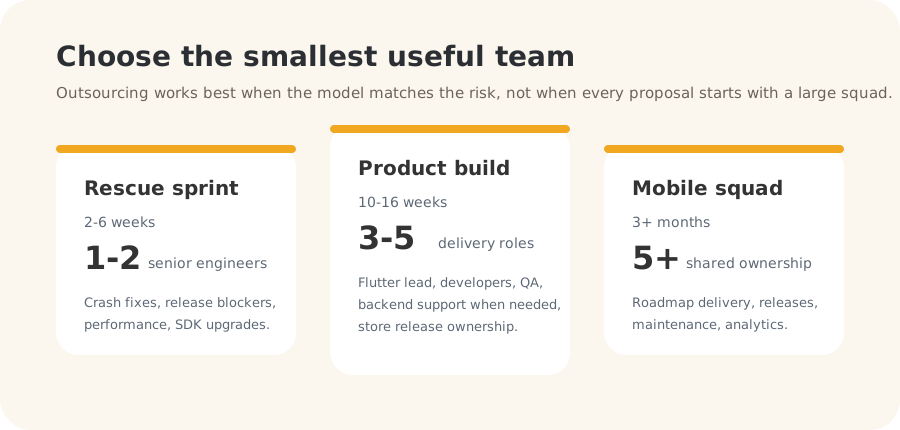
Rescue sprint
Typical range: USD 12,000 to 25,000.
Best for crash reduction, release blockers, package upgrades, performance issues, store rejection, or an unstable integration. It starts with a code and release review.
First product release
Typical range: USD 28,000 to 65,000 for an MVP or first serious release.
Usually includes a Flutter lead, one to three developers, QA, project management, and backend support when APIs are not ready.
Dedicated mobile squad
Typical range: USD 24,000 to 55,000 per month.
Useful for long-running product work where the team owns a roadmap, release rhythm, maintenance, analytics, and ongoing improvements.
A common mistake is buying the cheapest hourly rate and then paying for the missing leadership with delays. If nobody owns scope, QA, release readiness, or the native integration plan, the budget usually leaks anyway. Nearshore delivery from Argentina is covered on our nearshore development page.
Comparison with Freelancers, Staff Augmentation, In-House, and Agencies
There is no universal best option.
Freelancers
Where it works: small widgets, audits, package fixes, or very contained native plugins.
Where it gets risky: availability, release coverage, documentation, and continuity after launch.
What changes with us: a managed team with delivery rhythm, backup, QA, and release ownership.
Staff augmentation
Where it works: your team already has product management, architecture, QA, and release operations.
Where it gets risky: the model fails when you really need someone to shape scope and own delivery.
What changes with us: process and leadership for a defined outcome. If you only need people, use Flutter staff augmentation.
In-house hiring
Where it works: permanent product ownership and deep institutional knowledge.
Where it gets risky: hiring takes time, and the first mobile hire is hard to evaluate without internal expertise.
What changes with us: we help you ship now and can leave a maintainable app for future hires.
Large agencies
Where it works: big procurement, broad programs, and multi-vendor governance.
Where it gets risky: senior people may vanish after sales, and delivery can become process-heavy.
What changes with us: you stay close to the people making technical decisions.
If you are weighing Flutter against React Native for the same product surface, also read our React Native development page.
Example Engagement: Field Ordering for Distributors
Composite illustrative scenario based on common Flutter outsourcing patterns.
A wholesale distributor already had a B2B web portal connecting suppliers and retailers, similar in shape to the commerce work described in our Bari case study. The next need was a mobile ordering workflow for field sales reps and buyers who worked away from a desk.
The risky assumption was that Flutter would make the mobile part simple because the backend already existed. Product images were inconsistent, order drafts needed offline behavior, and reps needed a fast reorder flow while standing with a customer. A small managed team (Flutter lead, developer, QA, fractional backend) started with a code and API review, cut scope to catalog search, order drafts, and sync conflict handling, then shipped a limited release after a multi-sprint build.
The practical win was operational, not theatrical: fewer manual orders, less duplicate data entry, and a mobile codebase that could extend without a rewrite. Pricing rules stayed behind the API so the internal team kept ownership of commerce logic.
Explore published work in our case studies. For framework decision criteria, see the Flutter docs.
Example focus
Team: Flutter lead, Flutter developer, QA, backend support.
Stack: Flutter, Dart, REST APIs, crash reporting, CI for store builds.
Work: offline drafts, catalog performance, order flow, release readiness.
Lesson: cross-platform speed only pays off when API contracts, QA, and release ownership are planned early.
Risks and How We Reduce Them
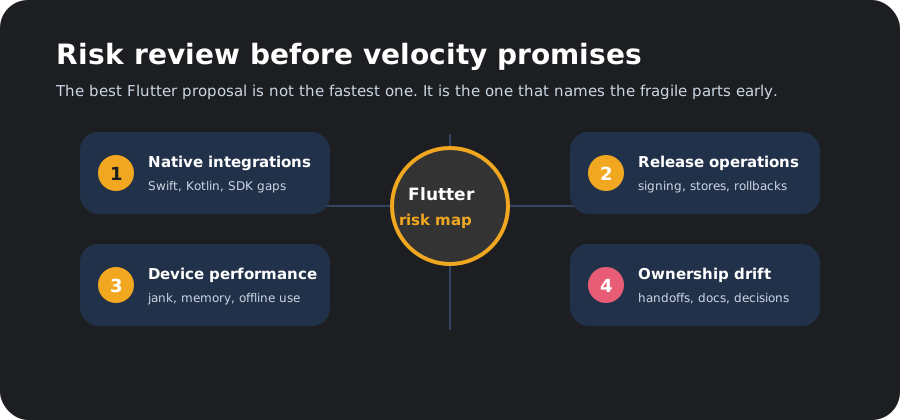
Mobile projects usually fail in the boring places.
Outsourcing fails when the vendor sells velocity before understanding the fragile parts. Our review looks at package health, native integrations, release workflow, app-store constraints, analytics, crash history, device coverage, and who owns product decisions.
We write short architecture notes for decisions that future developers will question. We keep credentials in your accounts. We document release steps in your repo. We prefer staged rollouts over dramatic launch days. None of that is glamorous, but it is where mobile projects usually stop bleeding time.
Package and plugin debt
Every critical package gets an owner, upgrade policy, and a fallback plan before estimates close.
Store policy surprises
Privacy disclosures, permissions, and test accounts are sprint-zero work, not submission-week surprises.
Hidden native scope
Native forks stay on a separate backlog with signed deferrals, not silent sprint additions.
Handoff gaps
Runbooks, ADRs, and credentials stay in your systems so the app survives the engagement.
Frequently Asked Questions
A short rescue sprint usually starts around USD 12,000 to 25,000. A managed Flutter product build is commonly USD 28,000 to 65,000 for the first release, depending on scope, backend needs, QA, native integrations, and release support. Long-term mobile squads are usually priced monthly, often between USD 24,000 and 55,000.
Yes. Staff augmentation gives you individual engineers who join your existing process. Outsourcing gives you a managed delivery model with planning, technical leadership, QA, release discipline, and outcome ownership for a defined mobile scope.
Yes. The first step is a codebase and release review. We look at Flutter and Dart versions, state management, package risk, native integrations, CI/CD, crash reports, app-store setup, and test coverage before promising velocity.
Yes. We can support signing, TestFlight, Google Play internal testing, staged rollouts, release notes, privacy disclosures, screenshots, test accounts, and review responses. Some clients keep final release approval internal.
Flutter is a strong fit for many product apps, but native can be better for heavy 3D, advanced media editing, highly specialized hardware, or organizations that already have mature Swift and Kotlin teams. We flag those cases during discovery.
Yes. Many engagements involve your product owner, designer, or backend team. We define API contracts, design constraints, acceptance criteria, and release responsibilities so the mobile team does not work in isolation.
Siblings Software is based in Cordoba, Argentina. Our location gives strong timezone overlap with North American clients and workable overlap with many European teams.
OUR STANDARDS
Mobile delivery you can hand to your future team without a rewrite.
Every Flutter engagement we run is led by an engineer who has shipped real iOS and Android releases. We take responsibility for architecture, native integrations, QA discipline, and release readiness, not just feature counts.
We document trade-offs, keep credentials in your accounts, prefer staged rollouts, and write the runbooks that internal teams will rely on after launch. Outsourcing only earns its name when the work survives the engagement.
Contact Siblings Software Argentina
Tell us what your Flutter app needs and we will suggest the smallest team that can own the real delivery risk.