Platform Engineering Outsourcing from Argentina
We are a platform engineering software outsourcing company headquartered in Córdoba, Argentina. From here we design, build, and run Internal Developer Platforms (IDPs) for product companies in the United States, Canada, and Europe—so your teams get self-service infrastructure, golden paths, and guardrails without hiring an entire platform org overnight.
Industry analysts keep pointing in the same direction: mature engineering organizations consolidate delivery behind platform teams and paved roads. If your developers still open tickets for a staging namespace or copy-paste Terraform from a wiki, you are paying for friction that a deliberate platform can remove. We help you close that gap with a delivery model that pairs senior platform engineers in Argentina with your architects and SREs abroad—daily overlap with US Eastern time is part of how we work, not an exception.
Need people embedded in your rituals? Our staff augmentation model brings Kubernetes, Terraform, and portal specialists alongside your existing DevOps crew; dedicated teams own the IDP roadmap end-to-end when you want a turnkey build.
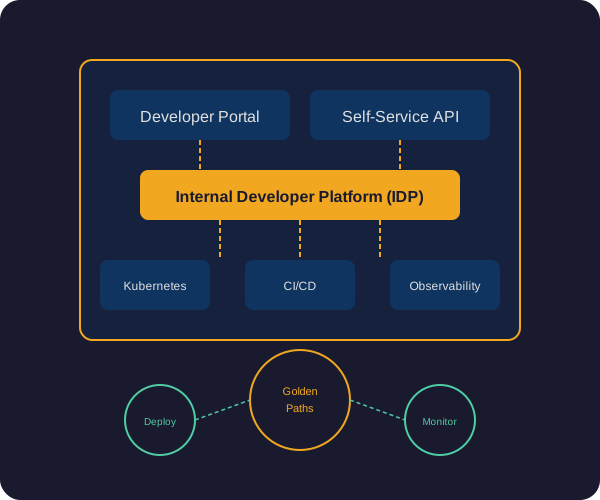
Platform Engineering Services
We build platforms that treat your infrastructure as a product, not a ticket queue.
Most companies we work with have already tried some version of DevOps. They have Terraform scripts, a CI/CD pipeline that mostly works, and a wiki full of outdated runbooks. What they lack is the cohesive developer experience that ties all those pieces together into something teams actually want to use. That is what platform engineering delivers — and it is what we specialize in building.
We have seen engineering orgs where developers spend 30 to 50 percent of their time wrestling with infrastructure instead of writing features. The frustration compounds: new hires take weeks to onboard, environment drift causes production incidents, and tribal knowledge walks out the door every time someone leaves. Our platforms eliminate these problems by making the right way the easy way.
Our platform work sits next to back-end development and API development squads in the same company—so service scaffolding, observability, and runtime policy stay aligned with how your services are actually written.
Internal Developer
Platform (IDP) Design & Build
We build the centralized platform your teams use to provision services, manage environments, and deploy code — all through a self-service portal that enforces organizational standards without creating bottlenecks.
Golden Path
Engineering
Pre-architected, opinionated workflows for common tasks: spinning up a new microservice, creating a data pipeline, deploying a frontend app. Developers follow the golden path and get production-ready infrastructure in minutes, not weeks.
Developer Portal
& Service Catalog
A single pane of glass where teams discover services, access documentation, view ownership, and track dependencies. Built on Backstage, Port, or custom solutions depending on your ecosystem.
Why Traditional DevOps Breaks Down at Scale
When every team reinvents the wheel, the wheels stop turning.
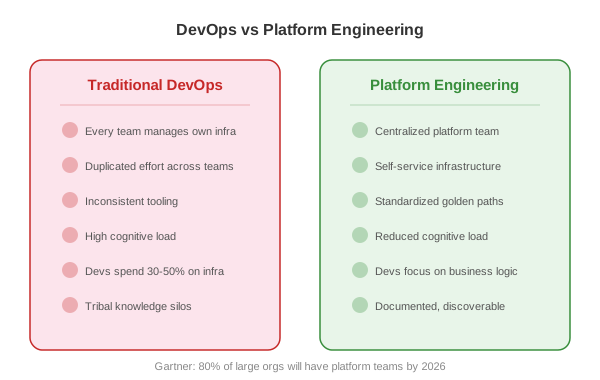
The DevOps movement delivered enormous improvements in how companies build and deploy software. But as organizations scale past 50 or 100 engineers, the "you build it, you run it" philosophy starts to crack. Suddenly you have fifteen teams maintaining fifteen slightly different CI/CD pipelines, each with its own quirks, its own monitoring gaps, and its own security blind spots.
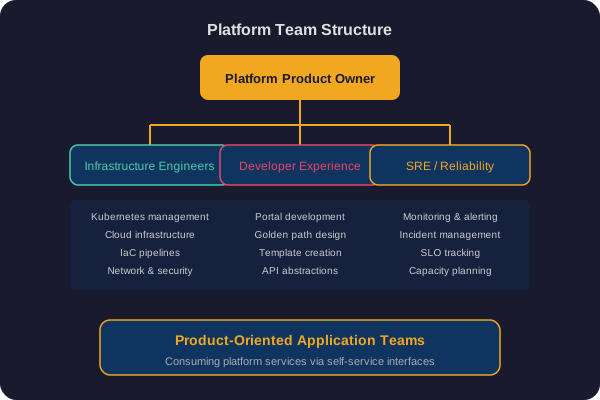
Platform engineering is not a rejection of DevOps — it is its natural evolution. Instead of asking every developer to be a Kubernetes expert, you build a platform team that handles the complexity and exposes it through well-designed, self-service interfaces. The application teams keep their autonomy; they just stop spending half their sprint on infrastructure plumbing.
Benchmarks vary by industry, but the pattern holds: teams with paved roads and measurable delivery metrics outperform ad-hoc setups on lead time and change failure rate. When we engage with a client, we agree on a small set of DORA-style indicators—deployment frequency, lead time for changes, change failure rate, time to restore—so improvement is visible in your tools, not only in slide decks.
Ready to evolve beyond traditional DevOps?
We will assess your current infrastructure maturity and deliver a concrete platform roadmap in 4 weeks.
How We Build Internal Developer Platforms
Building a platform is not a six-month waterfall project. We treat it like the product it is — with discovery, user research (your developers are the users), iterative delivery, and continuous feedback loops. Here is our proven approach:
1. Platform Assessment
We audit your current infrastructure, CI/CD pipelines, deployment patterns, and developer workflows. We interview engineers across teams to understand where the bottlenecks actually are — not where leadership thinks they are.
2. Platform Architecture
We design the IDP architecture: which abstractions to build, what golden paths to prioritize, how to handle multi-cloud or hybrid scenarios, and which tools to adopt versus build. Every decision is documented and justified.
3. Iterative Build
We deliver the platform in increments, starting with the highest-impact golden path. Each increment is tested with real development teams before moving to the next. Quick wins build momentum and organizational buy-in.
4. Adoption & Evolution
We run developer onboarding sessions, measure adoption metrics, collect feedback, and iterate. A platform nobody uses is a waste of money. We stay until your teams are self-sufficient and the platform has internal advocates.
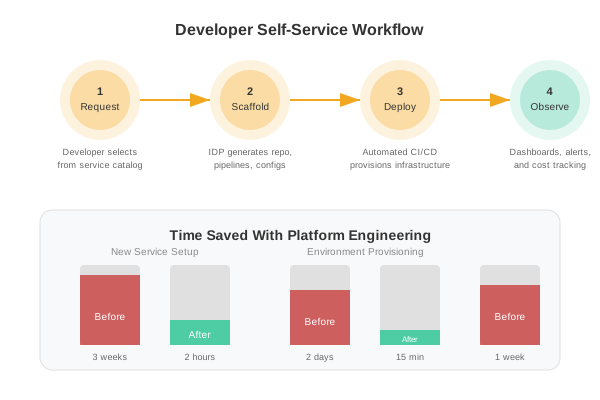
Platform Engineering Technology Stack
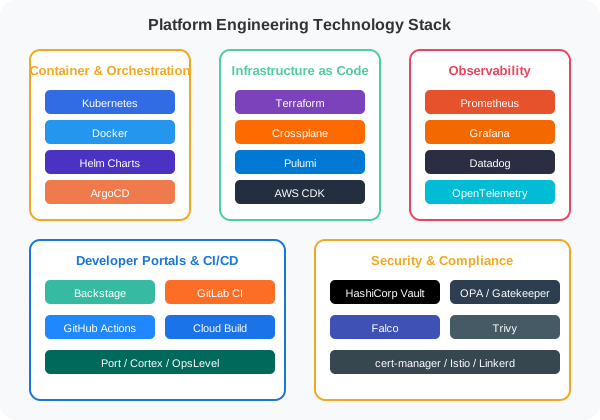
We are not wedded to any single vendor. We choose tools based on your existing ecosystem, team skills, and long-term sustainability — not whatever raised the most funding last quarter. Here is the core technology landscape we work across:
Kubernetes & Container Orchestration
Production-grade Kubernetes clusters on EKS, GKE, or AKS, with ArgoCD for GitOps deployments, Helm for package management, and Kustomize for environment-specific configurations.
Infrastructure as Code
Terraform, Crossplane, and Pulumi for declarative infrastructure. We design modules and abstractions that your teams compose through the platform portal rather than writing raw IaC.
Developer Portals
Backstage, Port, and Cortex for service catalogs, documentation hubs, and developer experience. We also build custom portals when off-the-shelf solutions do not fit your workflow.
Observability Stack
Prometheus, Grafana, Datadog, and OpenTelemetry for metrics, logs, and distributed tracing. We wire observability into every golden path so teams get dashboards from day one.
Security & Policy
HashiCorp Vault for secrets management, OPA and Gatekeeper for policy enforcement, Falco for runtime security, and Trivy for container scanning — all integrated into the platform layer.
CI/CD & GitOps
GitHub Actions, GitLab CI, ArgoCD, and Flux for continuous integration and delivery. We standardize pipelines across your organization while allowing teams to customize within guardrails.
Our platform engineering work often pairs with Python and Go development for custom controllers, operators, and glue services. We lean on the CNCF landscape for orchestration and delivery choices, wire tracing through OpenTelemetry when we standardize observability, and align developer portals with Backstage patterns when that fits your culture—without forcing a single vendor story. For teams standardizing on Amazon Web Services, we align guardrails with the AWS Well-Architected Framework when we design account boundaries and blast-radius limits.
Golden Paths: The Core of Every Good Platform
The concept of golden paths — sometimes called paved roads — is what separates a real Internal Developer Platform from a collection of scripts glued together with hope. A golden path is an end-to-end, opinionated workflow that takes a developer from zero to deployed in the shortest time possible while following every organizational best practice.
The key word is opinionated. Golden paths do not offer twenty options for every decision. They make the default choice for you — the choice that the platform team has validated as production-ready, secure, and observable. Developers who need to deviate from the golden path can, but they do so knowingly, understanding they are leaving the paved road.
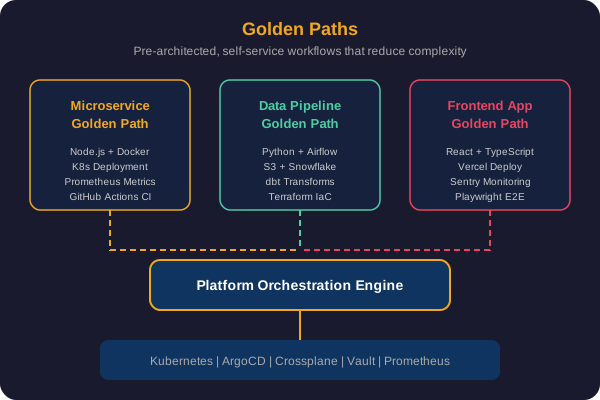
We typically start with three golden paths that cover the majority of development work: a backend microservice path, a frontend application path, and a data pipeline path. Each includes repository scaffolding, CI/CD configuration, infrastructure provisioning, monitoring setup, and documentation templates.
For community perspective on platform as product, Platform Engineering publishes talks and patterns we cross-check with our own delivery playbooks. When we standardize on Kubernetes, we map abstractions to upstream concepts from the Kubernetes documentation so your teams can escalate to official references when edge cases appear.
Building platforms that developers actually want to use.
Case Study: LATAM Fintech Preparing a US Market Launch
How a Córdoba-headquartered payments company tightened its platform before crossing borders—without freezing feature work.
The Challenge
A payments technology company with roots in Argentina had grown to roughly 110 engineers spread across microservices on AWS. Product leadership wanted to enter the US market within eighteen months, which meant stricter audit expectations, clearer ownership of services, and less “snowflake” infrastructure. In practice, twelve teams each had a slightly different way to ship: some used ad-hoc Jenkins jobs, others GitHub Actions with copy-pasted YAML, and a few still deployed from laptops during on-call nights.
Provisioning a new non-production environment could take nine business days because networking, secrets, and observability were hand-stitched each time. Compliance reviews dragged because there was no single catalog that showed which service touched cardholder data. The client did not need a slide deck—they needed a platform that could absorb regional regulation (including BCRA-aligned controls locally) while giving US partners a story they could inspect.
What We Built Together
We stood up a four-person platform squad in Córdoba alongside the client’s two existing SREs, with weekly architecture reviews that included their Miami-based security lead. Over eight months we executed in three slices—not big-bang:
- Months 1–2 — Truth layer: A Backstage portal with a service catalog, ownership tags, and links to runbooks in both Spanish and English. Terraform modules were consolidated so “create VPC + EKS add-ons” stopped being a custom project every time.
- Months 3–5 — Golden paths: Two paved roads first: Node.js APIs behind API Gateway, and Python workers for batch settlement. Each path shipped with GitHub Actions → Argo CD → EKS, Prometheus scrape configs, and OpenTelemetry traces sampled into their existing vendor—developers picked a template and filled five fields, not forty.
- Months 6–8 — Hardening for expansion: Policy-as-code gates on container images, separate AWS accounts per stage with automated guardrails, and dashboards per squad so finance could see burn next to reliability metrics.
9→1.5
Days to get a standard lower env (median)
38%
Fewer infra-related incidents (quarter over quarter)
12→4
Variations of “how we deploy” (teams merged paths)
6→2
Business days for new engineer to first prod-like deploy
The work did not remove their DevOps culture—it gave it a product surface. SREs spent less time resetting clusters and more time on failure modes that actually needed human judgment. Product teams in Buenos Aires and Miami stopped arguing about pipeline syntax and started arguing about customer features again, which was the point.
Custom automation mixed Go for Kubernetes controllers, Python for data jobs on the golden path, and React for Backstage plugins. GitOps landed on EKS with Argo CD; metrics and traces followed the paths we described above.
Want more proof points? Browse our case studies for product and platform wins, or read how we operate from Argentina when you need a nearshore partner with a real office—not a faceless ticket queue.
Platform Engineering Maturity Model
Most companies are at Level 1 or 2. We meet you where you are and help you get where you need to be.

Not every company needs a fully automated, AI-driven platform on day one. In fact, trying to build one before you have the foundations in place is a guaranteed way to waste money. We use a five-level maturity model to assess where your organization sits and create a realistic roadmap forward:
- Level 1 — Ad-Hoc: Infrastructure managed through scripts, wikis, and tribal knowledge. Deployments are manual and error-prone.
- Level 2 — Standardized: Shared CI/CD pipelines, IaC templates, and documented processes. Still requires significant manual intervention.
- Level 3 — Self-Service: A developer portal with golden paths. Teams can provision services and environments without filing tickets.
- Level 4 — Product-Led: The platform is managed as an internal product with user research, feature roadmaps, and adoption metrics.
- Level 5 — Optimized: AI-assisted operations, predictive scaling, automated cost optimization, and continuous platform evolution.
Why Choose Us for Platform Engineering?
We have built platforms that serve thousands of developers. Here is what sets us apart.
Product Thinking for Platforms
We treat your Internal Developer Platform like a product, not a project. That means user research with your developers, adoption metrics, feature prioritization based on impact, and a roadmap that extends beyond the initial engagement. A platform nobody wants to use is a platform that failed.
Full-Stack Infrastructure Expertise
Platforms touch everything: Kubernetes, networking, CI/CD, security, observability, cost management, and developer tooling. Our team has battle-tested experience across the entire stack, so you do not need to piece together five different vendors to build one coherent platform.
Knowledge Transfer Built In
We do not build platforms and disappear. Every engagement includes structured knowledge transfer: pair programming, documentation, runbooks, and hands-on training for your team. Our goal is to make ourselves unnecessary — a successful platform team does not need us forever.
OUR STANDARDS
Platforms that are secure, observable, and built to last.
Security is not a bolt-on for platforms — it is the foundation. Every platform we build integrates policy-as-code (OPA/Gatekeeper) for automated compliance checks, secrets management (Vault) for zero-hardcoded credentials, and supply chain security (Cosign, Trivy) for container image verification. These are not optional add-ons; they are baked into every golden path.
We follow a "secure by default, flexible by design" principle. Developers on the golden path get enterprise-grade security automatically. Teams that need to customize have escape hatches that require explicit acknowledgment of what guardrails they are bypassing. This approach satisfies both the security team's need for control and the development team's need for speed.
Our platform engineering work frequently complements our full-stack development outsourcing engagements. Great platforms need great applications on top of them, and we bring that end-to-end capability.
Platform Engineering Outsourcing
Why Outsource Platform Engineering?
Benefits of Platform Engineering Outsourcing
Building a platform team from scratch takes 12-18 months. Outsourcing gets you there in a fraction of the time.
Platform engineering requires a rare combination of skills: deep Kubernetes expertise, infrastructure-as-code fluency, developer experience design sensibility, and product management thinking. Finding even one person who checks all those boxes is hard. Assembling a full team? That is a multi-quarter hiring effort that delays your platform initiative by a year or more. Outsourcing provides an alternative:
Immediate Expertise
Our platform engineers have built IDPs for companies ranging from 50-person startups to 2,000+ engineer enterprises. You skip the learning curve and get battle-tested patterns from day one.
Faster Time to Value
While competitors spend months recruiting platform engineers, you can have a working developer portal and your first golden paths live in weeks. Speed matters in a market where developer productivity is a competitive advantage.
Cross-Industry Patterns
We bring lessons from fintech, healthcare, SaaS, and e-commerce platform builds. The problems are surprisingly similar across industries — the solutions we have already built can accelerate your journey.
Cost Efficiency
A senior platform engineer in major US markets often lands in a compensation band that makes a three-person team a seven-figure annual line item before tools. Delivering from Córdoba with senior profiles and English-language rituals, our clients typically achieve a materially lower total cost for the same skills—while keeping time-zone overlap with US East that pure APAC outsourcing rarely matches.
Flexible Scaling
Start with a two-person team for assessment and architecture, scale to six for the build phase, then hand off to your internal team for maintenance. No long-term headcount commitments or severance obligations.
Reduced Risk
Platform initiatives fail when they over-engineer the solution or under-invest in adoption. We have seen both failure modes and know how to avoid them. Our iterative approach delivers value at each milestone, reducing the risk of a big-bang failure.
Flexible engagement models tailored to your platform journey.
How to Work With Us
Project-Based
Outsourcing
We own the platform build end-to-end. Ideal for companies that want a turnkey Internal Developer Platform without managing the development process. We deliver a production-ready platform with documentation and training.
Dedicated
Teams
A full platform engineering team — infrastructure engineers, developer experience specialists, and SREs — dedicated exclusively to your organization. They work as an extension of your engineering team with full context.
Staff
Augmentation
Embed individual platform engineers into your existing team. Perfect if you have the vision and project management in place but need hands-on Kubernetes, Terraform, or Backstage expertise to execute.
Industries We Serve
Platform engineering delivers outsized returns in fast-moving, compliance-heavy industries.
In Argentina we regularly touch teams regulated under BCRA-style oversight, retail-facing fintech, and agtech platforms exporting data upstream—contexts where audit trails and repeatable deployment matter as much as raw speed. The same companies that benefit globally—scaling SaaS, banks, marketplaces—benefit here when the platform encodes compliance once instead of re-litigating it in every pull request.
The companies that benefit most from platform engineering are those scaling rapidly, operating in regulated environments, or both. Here are the industries where we see the strongest impact:
SaaS & Technology
Fast-growing SaaS companies with expanding engineering teams benefit from standardized deployment paths and self-service infrastructure that keeps velocity high as headcount grows.
Financial Services
Banks and fintech companies need platforms that bake compliance, audit trails, and security controls into every deployment without slowing developers down.
Healthcare
HIPAA-compliant platforms with data residency controls, encrypted pipelines, and access management built into golden paths from the start.
E-Commerce
High-traffic e-commerce platforms need auto-scaling infrastructure, canary deployments, and rapid rollback capabilities — all standard features in our platform builds.
Enterprise Software
Large enterprises with multi-cloud environments and hundreds of microservices need platforms that provide consistency and governance without stifling innovation.
Media & Entertainment
Content delivery platforms, streaming services, and media companies need infrastructure that handles traffic spikes gracefully and deploys globally.
Choose us as your
Platform Engineering Partner
from Argentina
Platform Engineering from Córdoba, Built for Global Teams
We are an Argentine software company with a delivery center in Córdoba and a long track record serving clients in North America and Europe. Platform engineering is not a side gig for us—it is a practice where infrastructure, developer experience, and governance meet. You work with engineers who have shipped under real regulatory pressure (financial services, healthcare-adjacent workloads) and who are used to bilingual documentation when your stakeholders sit in more than one country.
We are not a cloud reseller pretending to be neutral: we pick Kubernetes, GitOps, portals, and observability stacks based on what your teams can operate, hire for, and audit—not on a vendor quota. That usually means CNCF-aligned building blocks, explicit ownership in Backstage or similar, and upgrade paths that do not require rewriting everything when one tool falls out of fashion.
Our platform engineering practice draws on experience across our broader service offerings, including Node.js development, TypeScript development, and AI development, giving us a uniquely full-stack perspective on what developers actually need from their platform.
Platform Engineering
Frequently Asked Questions
Platform engineering is the discipline of designing and building Internal Developer Platforms (IDPs) that provide self-service capabilities for software development teams. Instead of each developer managing their own infrastructure — writing Terraform scripts, configuring CI/CD pipelines, setting up monitoring — a dedicated platform team creates standardized workflows and automation that abstract away that complexity. The goal is to let developers focus on business logic while the platform handles everything from infrastructure provisioning to deployment and observability.
DevOps is a cultural practice that encourages teams to own their infrastructure end-to-end. Platform engineering is a product-oriented approach where a dedicated team builds and maintains a shared platform that all other teams consume. Think of it this way: DevOps says "everyone should know how to deploy." Platform engineering says "we will build a deployment system so good that everyone can deploy without being an expert." The result is the same autonomy DevOps promises, but without the cognitive load of learning Kubernetes, Terraform, and ten other tools.
Golden paths (also called paved roads) are pre-architected, self-service workflows that help developers ship code faster while following organizational best practices. For example, a microservice golden path might include a code repository template with standard project structure, a pre-configured CI/CD pipeline, Kubernetes deployment manifests, monitoring dashboards, and alerting rules — all ready to use immediately. Developers choose a golden path from a catalog, fill in a few parameters, and get a fully operational service in minutes rather than weeks.
An initial assessment and architecture phase typically takes 4 to 8 weeks. Your first golden path can be live within 2 to 3 months. A comprehensive platform with multiple golden paths, a developer portal, and full observability integration usually takes 6 to 12 months. We recommend an iterative approach — start with the highest-impact golden path, get it into production, measure adoption, and expand from there. Trying to build the entire platform before releasing anything is the most common cause of platform engineering failures.
If your DevOps engineers are spending the majority of their time responding to infrastructure tickets and provisioning resources for application teams, then a platform engineering approach can transform that reactive, ticket-driven work into proactive self-service systems. Many organizations evolve their existing DevOps function into a platform team. The key shift is treating infrastructure as a product with internal customers — developers — rather than as a support function that responds to requests.
Related Services