Case study · Staff augmentation
Relay Works
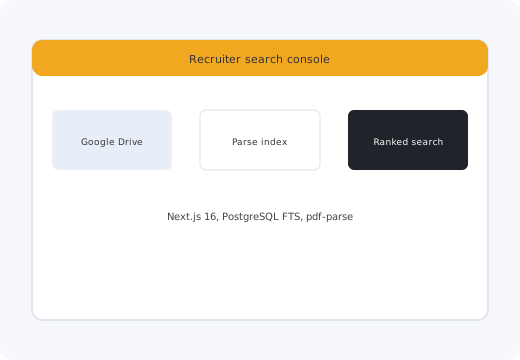
How Siblings Software helped Relay Works make eight hundred resumes searchable in minutes
Relay Works, a fictional US software consultancy, hires fast—and their recruiters were losing half a morning every time they needed to find a candidate who mentioned Kubernetes on page two of a PDF in a shared Drive folder.
Their internal platform skeleton existed: Next.js 16, Prisma 7, PostgreSQL, JWT auth. What was missing was ingestion that survived real folders, full-text search that felt instant, and pdf-parse pipelines that did not choke on scanned résumés.
Siblings embedded three engineers for ten weeks at roughly USD $7k/month each—staff augmentation inside Relay's ceremonies, not a separate black-box pod.
- Industry: Software consultancy & internal recruiting
- Engagement model: Staff augmentation at ~USD $7k/month per engineer
- Team: Three embedded engineers (full-stack lead, backend/search specialist, integration engineer)
- Core services: Hire full-stack developers
- Related: Web development outsourcing
Reviewed by Javier Uanini, Founder & CEO, Siblings Software · LinkedIn
Engagement snapshot
- 4 hours → <10 min typical resume search time for recruiters
- 800+ resumes indexed with parsed text and metadata
- 10-week calendar with three embedded engineers
- ~$7k/mo per engineer staff augmentation band
Who is Relay Works?
Relay Works is a fictional US software consultancy that sells delivery capacity to mid-market clients while hiring steadily for its own bench. Internal recruiters sit beside billable engineering leads—when search fails, hiring slows and project staffing feels the lag within a quarter.
They had started a Next.js recruiter platform but deprioritized indexing when client work spiked. By the time leadership reopened the roadmap, recruiters had already gone back to Drive search.
Relay needed senior engineers who could embed, ship search, and hand off—not a vendor proposing a six-month greenfield rewrite.
Project objectives
- Connect Google Drive with OAuth and incremental sync for resume folders recruiters already used.
- Index 800+ existing PDFs and new uploads with parsed text stored in PostgreSQL FTS.
- Deliver sub-ten-minute search for skill, employer, and keyword combinations recruiters actually type.
- Keep Relay's engineering lead as product owner while we owned the indexing and search seams.
The recruiting search maturity test
Three questions before we wire Drive sync into a production recruiter console.
1. Do recruiters search files or fields?
If they need keyword-in-PDF search, filesystem browsing fails. Relay needed parsed text in Postgres—not another folder tree UI.
2. Is OAuth the real bottleneck?
Drive permissions drift. We tested incremental sync and token refresh before we polished the search box.
3. Will hiring managers trust parsed text?
When pdf-parse misses a table, recruiters blame search. We surfaced parse warnings and re-index controls in admin views.
Ten weeks reflected Drive edge cases and FTS tuning—not greenfield UI polish. Staff aug let Relay keep their roadmap owner while we closed the search gap.
The situation we walked into
Relay's recruiters stored résumés in Google Drive because candidates emailed PDFs and account managers dropped files in shared folders. The internal Next.js app listed candidates as rows—but search only matched titles recruiters rarely typed correctly.
Manual exports to spreadsheets returned whenever a hiring manager asked for 'anyone with payments and React.' Leadership wanted search fixed without pausing client delivery for a six-month rewrite.
- 800+ PDFs scattered across Drive folders with inconsistent naming.
- Search limited to structured fields while recruiters thought in keywords and employers.
- No incremental sync—uploads after go-live would rot unless someone clicked Reindex.
- pdf-parse failures silent, leading to false negatives in search results.
How we approached it
- Drive integration: OAuth, scoped folders, incremental sync jobs, and token refresh monitoring.
- Indexing pipeline: pdf-parse extraction, text normalization, Postgres FTS vectors, and re-index triggers on file change.
- Search UX: recruiter-first query patterns with highlighting and filter chips tied to parsed metadata.
- Embedded delivery: three engineers in Relay standups with their engineering lead owning priorities.

We indexed in batches with checkpoint tables so a failed PDF did not block the entire folder sync.
What we delivered
The finished platform keeps Relay's Next.js shell and adds an ingestion and search backbone recruiters treat as infrastructure—not a side project.
- Google Drive OAuth with folder-scoped sync and incremental update jobs.
- pdf-parse pipeline with quarantine for unscanned PDFs and operator re-index actions.
- PostgreSQL full-text search with ranked results and snippet highlighting.
- Admin views for sync health, parse warnings, and manual re-index.
- JWT-protected API routes aligned with Relay's existing auth model.
How we worked together
Embedded cadence
Engineers joined Relay's two-week sprints and demoed search latency numbers—not story points alone.
Their engineering lead prioritized folder scope; our search specialist owned FTS ranking tweaks without a separate vendor roadmap.
Knowledge transfer
We documented sync checkpoints and parse failure modes so Relay's team could extend indexing when new file types appear.
Pairing sessions covered Prisma migrations and search tuning—not slide decks.
Outcomes that moved the needle
- Typical resume search dropped from four hours of manual folder hunting to under ten minutes using keyword and employer queries.
- 800+ résumés indexed with parsed text searchable in PostgreSQL FTS.
- Incremental Drive sync kept new uploads discoverable without nightly manual exports.
- Parse warnings visible to recruiters instead of silent false negatives.
- Relay kept product ownership while Siblings closed the ingestion and search seams.
In Relay Works's words
“We had the app scaffold and no time to become search experts overnight. Siblings engineers sat in our standups and made Drive plus Postgres feel boring—in the good way.”
Engineering Lead, Relay Works
Engagement ran as full-stack staff augmentation at roughly USD $7k/month per engineer—inside our USD $4k–$9k band.
What we would carry into the next engagement like this
Two lessons we reuse on internal recruiter platforms.
Index text, not filenames
Recruiters search for skills buried in PDFs. Parsed text in Postgres beat any folder UI Relay could have shipped.
Staff aug works when the owner is clear
Relay's engineering lead owned priorities; we owned search and ingestion depth without a parallel roadmap.
Engagement models and pricing bands
Siblings Software runs case studies like this one across three commercial shapes. The numbers below are the bands we quote in discovery calls today—not list prices on a rate card, but honest brackets so buyers can sanity-check scope before the first workshop.
Project-based delivery
USD $15k–$120k total, typically 2–6 engineers for 1–6 months. Best when the backlog has a defined finish line—an MVP, a migration slice, or a pilot with acceptance criteria everyone can sign.
Dedicated team
USD $12k–$60k / month, usually 4–12 people for 6–24+ months. The pod owns a workstream end-to-end with a delivery lead on our side. This engagement ran as a dedicated team.
Staff augmentation
USD $4k–$9k / month per developer, 1–5 specialists for 1–12 months. Engineers embed in your ceremonies and report to your engineering lead. This program matched that model.
Dedicated squad vs freelancers vs in-house vs project agency
Buyers rarely fail because they picked the wrong programming language. They fail because they picked a hiring model that cannot carry the operational load the product demands.
| Model | Time to start | Best for | Main tradeoff |
|---|---|---|---|
| Dedicated squad (Siblings) | 2–4 weeks | Multi-surface products with queue/workflow logic, compliance gates, or a roadmap that outlasts one sprint. | Less day-to-day control over individual task order than embedded staff aug. |
| Freelancers / marketplaces | Days to weeks | Isolated modules with a clean hand-off boundary under four weeks. | Weak institutional memory, no shared QA/DevOps bench, high churn on regulated workflows. |
| In-house hire | 8–16 weeks | Roles that define engineering culture for years—platform leads, security owners, domain architects. | Recruiting lag and compensation pressure in US talent markets. |
| Project agency (fixed SOW) | 3–6 weeks | Marketing sites, one-off integrations, deliverables with frozen scope documents. | Change requests pile up once operators touch production; weak fit for daily-use internal tools. |
Services & capabilities
- Google Drive OAuth integration
- pdf-parse ingestion pipelines
- PostgreSQL FTS tuning
- Next.js 16 feature delivery
- Embedded team collaboration
Technology stack
- Next.js 16 & React 19
- Prisma 7 & PostgreSQL FTS
- Google Drive OAuth
- pdf-parse
- JWT auth
Frequently asked questions
7 questions buyers ask once they have read the narrative—the follow-up objections from the second and third calls.
Need search inside the recruiter tool you already started?
If your team has the Next.js shell but recruiters still live in Drive search, we embed engineers to close ingestion and FTS gaps fast.
See our careers page if you want to hire the engineers who build these systems.
Also published for US buyers at siblingssoftware.com/en/case-studies/relay-works/.
CONTACT US
Last updated: June 2026