Success case · Nearshore delivery from Argentina
Vyxia
Vyxia Case Study: Custom Store from LatAm Delivery
Vyxia was built for a business model that does not fit commodity templates: personalized products, visual customization, operational handoffs, and payment behavior tuned to the region. The product needed to feel simple to buyers while supporting complexity behind the scenes.
Siblings Software delivered the platform from Argentina for an international-ready roadmap. That nearshore setup mattered because product, engineering, and business stakeholders could collaborate in shared workday windows without waiting a full day for each technical decision.
The resulting platform combines Next.js 16, Prisma, PostgreSQL, Fabric.js, and Mercado Pago into one operational product that spans storefront, account, admin, and production workflows. You can see the live experience at vyxia.vercel.app.
- Market: Personalized e-commerce and made-to-order retail
- Delivery model: Nearshore product and engineering execution from Argentina
- Core stack: Next.js 16, React 19, Prisma, PostgreSQL, Fabric.js, Mercado Pago
- Related service: E-commerce development
- Delivery setup: Outsource development team with nearshore overlap
Project snapshot
- Custom storefront and account experience
- In-browser product personalization editor
- Mercado Pago payment and webhook flow
- Role-based admin and operations modules
Business context and delivery reality
International buyers often ask a practical question before they ask about frameworks: can this team build quickly without turning communication into overhead? Vyxia is a clear example of why Argentina nearshore delivery is strategic for this type of product. The platform blended UX-heavy flows, catalog logic, editor constraints, and payment behaviors that required active discussion between product and engineering. That is hard to execute well if every key decision waits overnight.
The project operated with shared working hours across LatAm and North American stakeholders, which allowed design reviews, architecture tradeoffs, and release planning to happen in real time. Instead of batching unresolved questions, the team handled them during the same sprint cycle, with implementation continuing immediately after each review window. This rhythm reduced ambiguity and kept momentum while preserving technical depth.
The case also reflects a broader pattern in custom commerce work. Businesses frequently outgrow generic storefront builders once personalization, custom production flows, and nuanced payment operations become core to revenue. Vyxia did not need another marketing skin over an inflexible model. It needed a product architecture that could scale with business logic and still remain understandable for operators and maintainers.
What buyers evaluated
- Can engineering and product work in overlapping business hours?
- Can the stack support both customer UX and internal operations?
- Can personalization logic stay maintainable over time?
- Can payment integrations fit local behavior without brittle custom code?
Product scope that matched real operations
The build covered buyer journey, personalization experience, and operational flows inside one coherent platform.
Storefront and account
Catalog, product detail, cart, checkout, account areas, and content pages were handled in the same application, not spread across disconnected systems.
Customization layer
Fabric.js powered a product editor where users compose personalized designs while the platform stores design state for downstream production.
Operations and admin
Admin modules covered catalog control, roles, order flows, and payment events so business teams could operate without developer intervention for daily actions.
For companies comparing delivery regions, this matters: the team did not only ship screens. It delivered a connected operating model where customer actions, payment confirmations, and production instructions moved through one product lifecycle.
Technical architecture choices
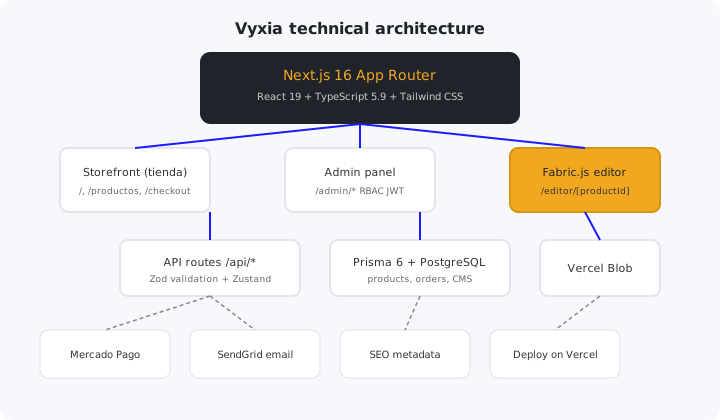
Vyxia runs as a modern Next.js 16 application that keeps storefront pages, API routes, and admin surfaces under one framework. This gave the team a single execution model for routing, rendering, and deployment while still allowing clear modular boundaries in the codebase. React 19 and TypeScript supported predictable component behavior and safer evolution as features expanded.
At the data layer, Prisma and PostgreSQL handled a schema with substantial relational depth: products, categories, variants, customization profiles, printable areas, order entities, payment records, and role assignments. This was essential for a product where personalization is not cosmetic; it is attached to inventory, order fulfillment, and operational visibility.
The personalization editor used Fabric.js to manage canvas interactions and object state in-browser. That allowed customers to customize products directly while preserving structured data that the platform could reuse later. In parallel, Mercado Pago integration connected checkout and payment-event processing through dedicated routes and provider structures that keep future payment evolution feasible.
Implementation discipline
- Single product architecture: one codebase for storefront, account, admin, and API behavior.
- Typed data evolution: Prisma migrations and schema updates tracked catalog and order complexity safely.
- Payment flow clarity: Mercado Pago integration was treated as product infrastructure, not ad hoc checkout glue.
- Operations-first modules: role and permission paths were implemented so teams could scale usage beyond founders.
- Nearshore communication rhythm: architecture decisions and implementation stayed in sync through timezone overlap.
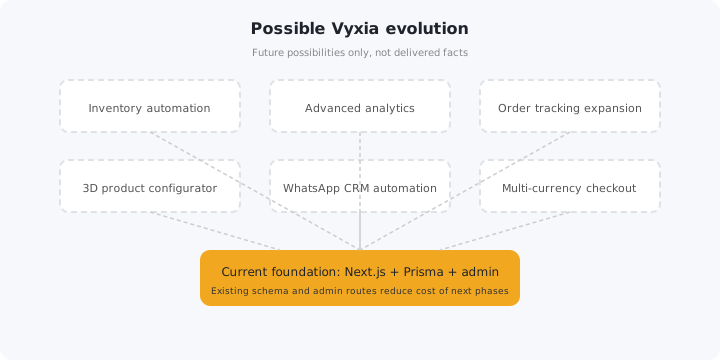
This approach aligns with international teams looking for web development outsourcing that is product-centered and operationally realistic.
What was delivered in practice
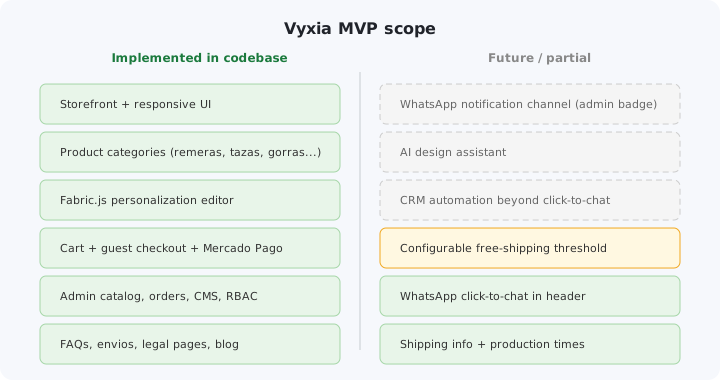
- Storefront journey with product discovery, detail pages, and purchasing flow tuned for personalized product decisions.
- Customization editor with canvas-based composition, configurable zones, and persistent design data.
- Checkout and payment pipeline integrated with Mercado Pago, including transaction and webhook handling paths.
- Administrative control surface for product configuration, content modules, order workflows, and role-based permissions.
- Operational entities that connect user-side behavior to production and fulfillment contexts.
- A maintainable code structure ready for iterative feature growth, not a one-off launch artifact.
No vanity claims were needed to validate the result. The product itself demonstrates delivery quality: the live site, the integrated editor behavior, and the operational modules reflect a full-stack implementation with coherent architecture choices.
Nearshore collaboration model for international teams
Timezone overlap as an execution asset
For buyers in North America and broader LatAm markets, delivery from Argentina offered practical overlap for planning, reviews, and issue resolution. This removed one of the biggest friction points in distributed software programs: delayed feedback that increases rework.
Decision speed without quality shortcuts
Architecture decisions moved from discussion to implementation in the same cycle. That did not mean rushing blindly. It meant preserving technical rigor while reducing idle waiting between teams that needed to collaborate daily.
Delivery structure for growing products
The engagement reflected the setup many global buyers seek in a nearshore partner: clear ownership, direct communication, and maintainable implementation choices that remain readable for future contributors.
Why this matters beyond one launch
Custom commerce products evolve quickly. Teams need a partner that can deliver present scope while keeping room for future iterations. The Vyxia build shows how that foundation can be established from day one in a nearshore model.
If your team is comparing regions, this is the same model we apply in nearshore development engagements for product-heavy platforms.
How the product flow was designed for scale
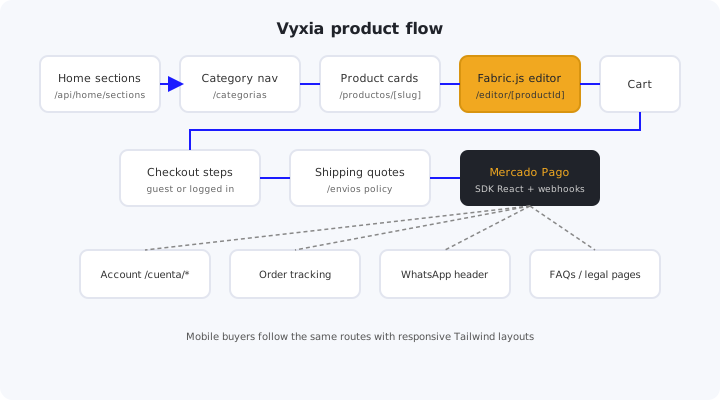
Custom commerce projects often launch quickly but become rigid when real usage expands. Vyxia was designed to avoid that by treating catalog, personalization, payments, and admin controls as connected product capabilities rather than isolated features.
The team separated editing concerns from checkout and order constraints, so customers get a flexible creation experience while the platform preserves valid commerce states. Personalization entities were linked to product and order structures through the data model, which keeps downstream operations interpretable and easier to extend.
What international teams can learn from this build
Teams evaluating LatAm delivery often balance communication reliability with engineering depth. This case shows both can coexist when overlap windows are used for real technical alignment, not only status reporting.
The broader lesson for international buyers is to evaluate engagement quality by shared accountability and architecture clarity. That model usually creates better long-term outcomes than optimizing only for hourly rate while ignoring coordination cost and roadmap friction.
Frequently asked questions
Questions from international buyers evaluating custom commerce delivery from LatAm.
Planning a similar platform from a nearshore partner?
If your roadmap includes custom e-commerce, personalized product flows, and operations-aware architecture, we can help you scope a realistic implementation path. Teams that engage us usually want technical depth, transparent collaboration, and delivery cadence that works with international business hours.
See our broader e-commerce development and web development capabilities, plus our nearshore development model for international teams.
For the US domain version, visit siblingssoftware.com/en/success-cases/vyxia/.
CONTACT US
Last updated: July 2026