Hire Ruby Developers for Your Software Team
· Typical time to first merged PR: 12 to 15 business days
Hire Ruby developers through Siblings Software when you need senior engineers embedded in your team without running a full recruiting process. We help CTOs, engineering managers, and founders add Rails, Grape, Sinatra, and Sidekiq capacity from Córdoba, Argentina, with four to eight hours of overlap with US Eastern business hours. Screening focuses on production-shaped pair exercises, job system discipline, and whether the work is language-first Ruby or deep Rails product delivery.
This page explains what embedded Ruby engineers do week to week, how we vet candidates, engagement models and monthly bands, timelines to onboarding, comparison with freelancers and in-house hiring, risks we contract around, and when a dedicated Ruby development team fits better than individual seats. For the parent service, see staff augmentation. For breadth across stacks, see multi-stack staff augmentation; for timezone context, read nearshore developer hiring. For full delivery ownership, compare Ruby development outsourcing from the same leadership team.
Prefer numbers before a call? Jump to monthly pricing bands for embedded seniors, pairs, and small pods.
Who hires Ruby engineers through us
Four buyer shapes cover most discovery calls; your situation may combine two.
Rails teams with a broken hiring funnel
Rails 7 or 8 in production, healthy internal culture, and requisitions open long enough that roadmap bets slip. Staff aug bridges the gap while you close an in-house hire, or becomes the steady state when recruiting cost is not where you want margin to go.
Monolith owners carving services carefully
You are not chasing a rewrite fantasy. You need someone who can extract a bounded Grape or Sinatra surface, wire Sidekiq queues that reflect business priority, and keep dual-boot upgrade paths honest while the monolith still ships weekly.
Founders who inherited Ruby they did not write
Post-acquisition or post-departure, you need a calm audit: which gems are liabilities, which metaprogramming blocks upgrades, where tests are load-bearing versus theatre. The goal is a written map before anyone suggests a rewrite.
Platforms where Ruby is glue, not the headline
Thor CLIs, internal gems shared across repos, CSV pipelines, Grape in front of another runtime. The work is Ruby-the-language. We screen for that explicitly because a Rails-only resume often misses the tooling mindset.
None of the above? Say so on the call. We turn down engagements when the fit is wrong, which keeps our bench credible.
What an embedded Ruby engineer does week to week
Concrete work streams, not a reprint of the Ruby homepage.
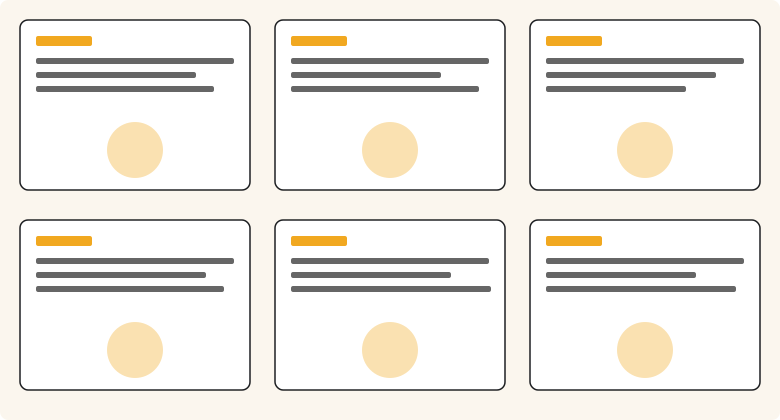
“Senior Ruby developer” is overloaded. In a typical month with us, an embedded engineer might ship customer-facing Rails work, tighten a payments-related Sidekiq queue, review dependency PRs from Dependabot, pair with a mid-level on a tricky ActiveRecord transaction, and document a runbook for the job class that used to wake whoever was on call Sunday night. The diagram below is a schematic of those parallel tracks; your mix will depend on backlog and risk.
Rails delivery on existing apps
Features on existing apps, disciplined use of concerns, ViewComponent or Hotwire where it fits, and upgrades staged with dual-boot patterns when the codebase is large. We treat the official Rails guides as the contract, not random blog cargo cults.
Grape and Sinatra where the boundary is real
Versioned JSON APIs, small HTTP surfaces that should not pay a full Rails boot, and extraction work behind feature flags so you can retire a mounted engine without a big bang deploy.
Sidekiq and ActiveJob that stop paging people
Idempotent jobs, bounded retries, explicit dead-letter handling, queue naming that matches business priority, and tracing hooks compatible with Datadog or Sentry you already pay for.
Ruby as tooling, owned by your org
Thor CLIs, private gems, readable Rake tasks, and one-off migrations that get deleted after cutover. We treat this as first-class engineering, not “scripts nobody owns.”
How we vet Ruby developers
Resume screens miss the failures that show up in week three. We end on live pair work.
Before anyone joins your stand-up, we run a written scoping answer on a small Ruby design question, then a ninety-minute pair session on production-shaped problems: a Sidekiq job with misleading retries, a Rails controller with a subtle N+1, or a Grape entity that behaves differently across environments. We check communication in English or Spanish, how they explain tradeoffs to a tech lead, and whether they reach for tests before refactors on money paths. Red flags we screen out: candidates who cannot read an existing gem codebase, who treat Sidekiq as fire-and-forget, or who need a rewrite to show value in week one.
External reference: we align language and style expectations with the official Ruby documentation and your team's RuboCop or StandardRB config, not a private style guide invented for the interview.
The Three-Signal Fit (generalist versus framework specialist)
A lightweight decision model buyers can reuse even if they never hire us.
Most mismatches on Ruby engagements come from hiring the wrong shape of senior: a brilliant Rails product engineer who freezes when the task is a standalone Grape service, or a polyglot who can sketch microservices but slows your Rails backlog. Before we shortlist, we score three signals with your tech lead on a thirty-minute call.
- Signal A: upgrade pressure. If Ruby 3.3+ or Rails 8 is on the critical path, we overweight candidates who have run dual-boot upgrades and who can read framework diffs calmly.
- Signal B: job system load. If p95 latency or Redis memory is the recurring incident theme, we prioritize engineers who have operated Sidekiq at real concurrency with tracing in place, not only written small async demos.
- Signal C: boundary shape. If more than thirty percent of the work sits outside Action Pack (standalone APIs, gems, CLIs), we bias toward language-first Rubyists; if the roadmap is overwhelmingly Hotwire and ActiveRecord, we bias toward deep Rails specialists, including routes into our Ruby on Rails staff augmentation lane.
Those three signals reduce guesswork before anyone signs a statement of work. Your tech lead validates the shape on the discovery call; we match the bench to that profile rather than sending a generic full-stack resume.
Engagement models and monthly ranges
Published bands beat “contact us for a quote” when you are budgeting a quarter.
We publish ranges because hidden pricing wastes cycles. The point inside the band moves with seniority, how much stakeholder-facing English you need, and rare depth such as Sidekiq Enterprise operations or long-running Rails engine extraction.
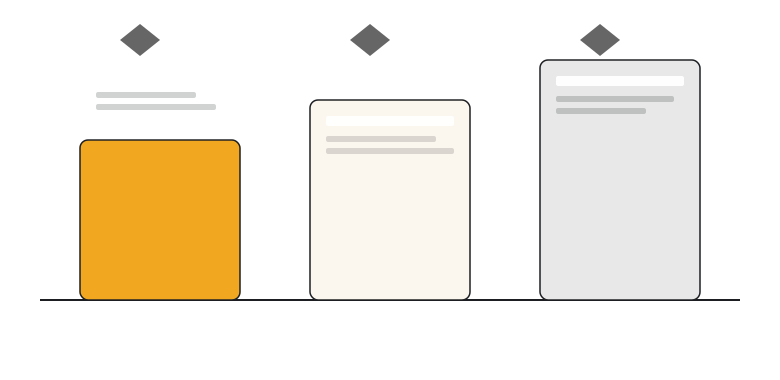
Embedded senior
One senior in your ceremonies and code review rotation. Strong when your engineering culture is healthy and you need additional throughput without re-teaching basics.
Monthly: USD 6,500 to 10,500. Minimum: three months.
Senior + mid pair
The senior sets quality and architecture guardrails; the mid-level absorbs tickets quickly once context lands, usually by week four. Common when you want sustained velocity more than a single niche specialist.
Monthly: USD 12,000 to 19,000. Minimum: three months.
Small pod (three to four engineers)
Covers vacations internally and can split between Rails feature work and a parallel API or jobs track under your tech lead. If you want a vendor-owned roadmap instead, a dedicated Ruby team is usually the better commercial shape.
Monthly: USD 18,000 to 34,000. Minimum: four months.
Figures include recruiting, benefits, laptops, and Argentine employer costs. Infra and SaaS (Heroku, Render, AWS, Datadog, Sentry, Sidekiq Pro) stay on your accounts.
How hiring a Ruby engineer through us works
Short, inspectable steps that end with you meeting the person who will commit.
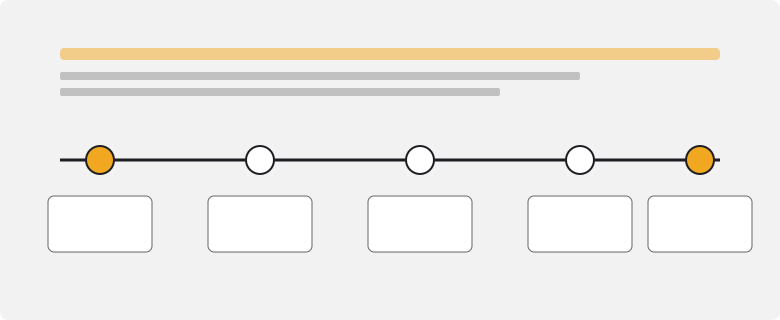
- Discovery (day 1). Stack, team topology, risk areas, hard nos on tooling, budget envelope. We say no on the call when we are the wrong partner.
- Shortlist (by day 5). Two or three profiles from our bench plus, when needed, engineers we have tracked for years who are finishing notice elsewhere. You receive repos, talk recordings where available, and a written answer to a scoped Ruby question.
- Live pair (days 5 to 8). Ninety minutes with your tech lead on a sanitised slice of work: failing job, sneaky N+1, or API contract mismatch.
- Paperwork (days 8 to 10). Master services agreement, monthly statement of work, fourteen-day swap clause in plain language.
- First merged PR (days 12 to 15). Onboarding pairs on a small production-safe change so you see integration speed, not slide decks.
Ruby with us versus freelancer, in-house, or large offshore bench
Each option wins sometimes; pretending otherwise wastes your time.
Freelance marketplaces
Win on narrow spikes under ~80 hours. Lose on continuity, gem audits, and queue hygiene when the incentive is ticket throughput.
In-house hiring in the US or UK
Wins on five-year ownership. Loses on funnel length and regret cost when the hire misses at month six while incidents continue.
Large offshore agencies
Win when you truly need ten mid-level Rails ticket takers with a PM layer. Lose when the engineer in the interview is not the engineer in the repo, or when Sinatra and Grape depth are treated as change-order territory.
Where we sit
Small senior bench, GMT-3, full overlap with US Eastern hours, fifteen-day notice after the minimum, and the person you interview is the person who commits. That is the trade we optimize for.
Composite scenarios (illustrative, anonymised)
Shapes we have shipped multiple times; details blended to protect clients. Not named case studies with verified metrics.
Rails dual-boot stuck on 6.1
US marketplace, hundreds of thousands of lines, bespoke attachment layer blocking Rails 7. Embedded senior, dual-boot branch, ActiveStorage migration path, Pundit replacing a YAML permissions DSL. Tests green across upgrade, faster boot on the upgraded path, internal team back on feature work within one quarter.
Sidekiq Monday meltdown
UK SaaS with batch ingest hammering Redis. Six-week engagement: queue split by business priority, per-class concurrency caps, dead-letter discipline, throttling around third-party rate limits, operator runbook. Incident frequency on the ingest path dropped sharply and stayed under operational control in the following quarters.
Example engagement
Checkout reliability after Sidekiq and lock fixes (illustrative)
One senior, four months, no client name. Illustrative pattern based on common Rails plus Sinatra plus Sidekiq engagements.
Context. Rails 7 patient app plus a Sinatra webhook receiver, large monolith, seven internal engineers. Checkout errors trended up for several months; the team suspected payment-confirmation jobs but lacked tracing to prove it without freezing roadmap work.
What we did. Weeks one and two were instrumentation-heavy: structured logs, trace ids from Stripe through Sinatra into Sidekiq, and pairing on the smallest safe commits. Root cause combined an ActiveRecord lock edge case, a retry policy that re-touched cards already captured, and swallowed exceptions in the Sinatra layer. Three focused PRs across weeks four to seven, each with tests aimed at regression classes rather than vanity coverage.
Outcome. Checkout errors fell sharply from the week-one baseline; duplicate-charge tickets stopped recurring; payments queue depth stabilized. The internal team kept shipping product work in parallel. For documented client work with named outcomes, see published case studies.
Note. Weeks one and two looked slow if you measure demo-friendly story points only. That trade is explicit: we optimize for compounding fixes, not hero commits.
At a glance
Stack: Rails 7, Sinatra, Sidekiq, Stripe, Postgres, Datadog
Engagement: one embedded senior, four months
First merged PR: about 11 business days
Risks of external Ruby staff and how we mitigate them
Honest controls beat “risk-free” slogans.
Interview star, week-three stall
Mitigation: pair on real code, fourteen-day swap window, explicit day-fourteen check-in with your lead.
Shadow contractor behavior
Mitigation: refuse “side lane” engagements; our engineer joins your reviews both directions, not only outbound PRs.
Knowledge leaves with the engagement
Mitigation: ADRs for non-obvious calls, runbooks for jobs we touch, handover notes at month three even if you extend.
Vanity refactors instead of metrics
Mitigation: monthly scorecard on three to five numbers your leadership actually tracks: error budget, p95 on money paths, queue depth, lead time.
Why Siblings for Ruby staff augmentation
Small bench, direct access, no parallel sales organization inventing capacity.
30+
Engineers in-house
Córdoba-based team; fintech, health, retail, logistics clients
Dozens
Ruby staff aug placements
Rails-heavy plus Grape, Sinatra, and pure Ruby tooling
GMT-3
Argentina overlap
Same-day with US East; workable with most US zones
We are deliberately not a fifty-person recruiting shop. Founders still review new Ruby engagements, and engineers talk to clients without a telephone game of account managers. That is why the process above stays short.
Reviewed by Javier Uanini, Founder & CEO, Siblings Software. Technical discovery on Ruby engagements, pricing bands, and fit decisions.
Frequently Asked Questions
Senior and mid-senior Ruby engineers employed full-time by Siblings and embedded in your team. They join your stand-ups, open pull requests in your repository, review code with your engineers, and work in your Slack or Teams. We cover recruiting, payroll, hardware, benefits, and Argentine employer obligations. You keep product direction, backlog priority, and intellectual property. Typical scope spans Rails features, Grape or Sinatra services, Sidekiq and ActiveJob workers, internal Ruby CLIs and gems, dependency and upgrade work toward Ruby 3.4 and Rails 8, and targeted performance investigations.
A single senior Ruby engineer is usually USD 6,500 to 10,500 per month all-in. A senior plus mid pair lands around USD 12,000 to 19,000 per month. A three-to-four person pod with shared QA context is typically USD 18,000 to 34,000 per month. Figures assume a full-time month, include recruiting and local taxes, and exclude your own cloud, observability, and paid gem licenses so you keep billing and data custody.
Most engagements reach a first merged production change in roughly 12 to 15 business days: discovery on day one, a two-or-three-person shortlist by day five, a ninety-minute live pair session on real Ruby code before day eight, paperwork by day ten, then onboarding with your tech lead. If you already interviewed a candidate we employ under an employer-of-record path, we can compress the middle steps toward seven to nine days.
We end on a live pair exercise drawn from production-shaped problems: a Sidekiq job with misleading retries, a Rails controller with a subtle N+1, or a Grape entity that behaves differently across environments. We publish a short written answer to a small design question before the call so you see reasoning, not buzzwords. If the match is wrong in the first fourteen days, we replace the engineer at no placement fee with overlap for handover.
Freelancers fit narrow scopes under roughly eighty hours. For ongoing product work they optimize for utilization, which often starves tests, gem hygiene, and queue hardening. Our engineers are full-time employees in one time zone with a fifteen-day notice period after the minimum term, a fourteen-day swap window, and an explicit expectation to do unglamorous maintenance alongside features.
We replace the engineer at no placement fee during the first fourteen days and cover reasonable handover overlap. After that, either side may exit with fifteen days notice. We track fit with a simple day-fourteen question to your tech lead so quiet failure modes do not drift for a quarter.
Rails is the most common framework we join, but many searches on this page are driven by Ruby outside Rails: Grape APIs, Sinatra services, Thor CLIs, private gems, and data jobs that should not inherit a full Rails boot. If Rails is ninety percent of the roadmap, our Ruby on Rails staff augmentation page may be the cleaner entry. If you need full delivery ownership rather than individuals embedded in your rituals, compare Ruby development outsourcing or a dedicated Ruby development team.
Our standards for Ruby work
What we hold ourselves to once embedded.
- Idiomatic before clever. Explicit APIs, small objects, metaprogramming only when it pays rent on complexity.
- Tests that protect money paths. RSpec or Minitest with assertions that would fail for the incident you fear.
- Jobs you can operate. Idempotency, backoff that respects payments, dashboards someone on call can read.
- Gem hygiene. Renovate or Dependabot on, unmaintained dependencies flagged with an owner and a date.
- Security lint in CI. Brakeman (or equivalent) blocks merges on new findings; exceptions are documented.
- Written artifacts. ADRs, short runbooks, README files on modules we introduce.
Contact Siblings Software Argentina
Describe the codebase, team, and risk areas. We reply within one business day, or tell you we are not the right partner.