Angular engineers who ship in your repo—not a parallel science project
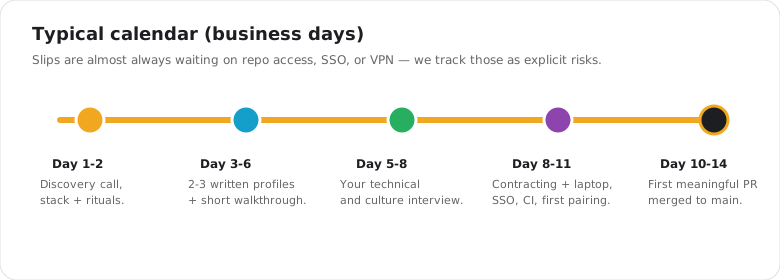
· Typical time to first merged PR: 10–14 business days after access is granted
If you are comparing vendors for hire Angular developers searches, you already know the hard part is not finding someone who lists Angular on LinkedIn—it is finding someone who understands your module boundaries, your RxJS hot spots, and the way your team actually ships. We staff Argentina-based Angular + TypeScript engineers who join your standups, adopt your lint rules, and treat your backlog as theirs.
This page spells out what those engineers do day to day, how we vet them differently from generic front-end candidates, what monthly ranges look like, and where staff augmentation stops making sense (we will tell you). For the broader practice, see software staff augmentation at Siblings; for full product ownership, compare our dedicated Angular development team option.
Reviewed by Javier Uanini, co-founder, who still signs off on senior Angular matches before client introductions.
Who hires Angular developers through us—and why now
Three patterns cover most serious inquiries in 2025–2026. None of them are “we read that Angular is enterprise-ready.” They are operational realities.
Enterprise teams stuck between major versions
Angular 15–19 upgrades, standalone migrations, and retiring deprecated APIs are not “weekend chores” when millions of users hit your bundles. You need engineers who have already moved large modules without freezing feature work.
B2B SaaS with complex forms and role matrices
Typed reactive forms, lazy routes, and accessibility audits are table stakes. Buyers here care about velocity without regressions—which means disciplined testing and someone who can read Chrome performance traces, not only stack Overflow snippets.
Product orgs pairing Angular with heavy TypeScript services
When your API layer is strict TypeScript, you want front-end engineers who think in shared DTO contracts—not a wall between “UI people” and “API people.” We often place engineers alongside our TypeScript staff augmentation pods when both sides need to move together.
What an embedded Angular developer actually does here
Day one is not a slide deck. Within the first sprint you should see pull requests touching real modules: routing guards cleaned up, redundant subscriptions removed, or a flaky test stabilized. Typical workstreams look like this:
Shipping and stabilizing
Feature slices with reactive forms, table virtualization, and optimistic UI where it is safe. On-call support for production Angular bundles when your team already runs a follow-the-sun model.
Architecture hygiene
Splitting oversized feature modules, tightening lazy loading boundaries, and aligning dependency injection patterns so test doubles do not become archaeology projects.
State and data flow
NgRx where events cross many surfaces; signals and lightweight stores where local UI state should stay local. We screen for the difference—Angular’s official signals guide is required reading internally, not trivia.
Quality gates you can audit
Jest or Karma + Jasmine pipelines, Cypress or Playwright smoke suites, and accessibility checks tied to CI—not a spreadsheet promise. Engineers document ADRs when they change change-detection strategy or introduce a new global store pattern.
The Angular Rewrite Readiness Score—three questions before we propose anyone
We use this internally to avoid sending you a “full stack” generalist when you need a migration surgeon—or vice versa. If you can answer these aloud on a discovery call, matching accelerates.
- Is the risk in shipping new features, or in upgrading without stopping the world? Different seniority curves. Upgrades skew principal-heavy; net-new UI skews toward strong component testers.
- Does your state live mostly in routers and services, or in a global store touched by half the app? That answer decides whether we prioritize NgRx fluency or signal-first ergonomics.
- Who owns the template performance budget? If nobody does, we assign that explicitly in the first sprint plan so bundle regressions do not become a surprise post-mortem.
Engagement models and published monthly bands
Publishing ranges respects your time. Final pricing moves with seniority, English fluency for customer-facing roles, and regulated industries (finance, healthcare) that need stricter access controls.
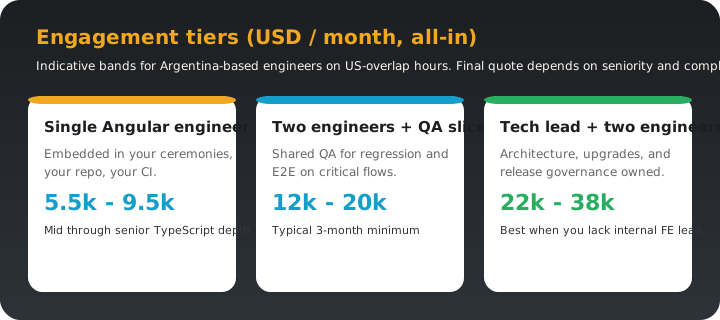
Hourly equivalents for budgeting math usually land near USD 55–95 per hour on a straight 40-hour month—inside the same bands we publish on larger nearshore staff augmentation engagements because the talent market is shared.
Vetting lanes: why only a minority of “Angular” resumes become finalists
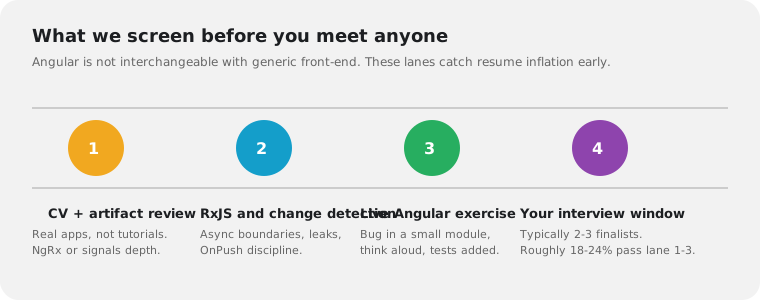
Roughly eighteen to twenty-four percent of candidates who pass CV review survive our Angular-specific technical lanes in a typical quarter. That is intentional—better a short bench of trustworthy engineers than a long bench of warm bodies.
Siblings vs Upwork vs in-house hiring vs a big-box offshore shop
Upwork wins when you need twenty focused hours from a specialist—for example tuning bundle budgets before a conference demo.
Upwork hurts when you need someone in retro every Tuesday who will still be there in Q4. Continuity and security onboarding are not marketplace strengths.
In-house wins when Angular is your ten-year center of gravity and you can wait out a four-month US hiring loop without shipping pressure.
In-house hurts when the backlog is on fire now. Every week without a hire is a week your existing seniors absorb context switching tax.
Large offshore agencies often optimize for headcount velocity. You get a name change mid-quarter and a different engineer on the video call. We stay deliberately small so the engineer you interview is the engineer who commits.
Still evaluating the wider talent pool? Read how we staff mixed stacks on the hire software developers overview—then come back here when Angular depth is the bottleneck.
Mini case study
Cutting admin-task latency for a regulated logistics dashboard
Context. A US logistics SaaS company with a role-heavy Angular admin portal saw p95 interaction times climb after adding multi-stop routing. In-house team was two seniors carrying five micro-frontends.
What we did. Placed one senior Angular engineer for four months. Week one: traced change detection thrash tied to oversized immutable snapshots. Week two–six: refactored state boundaries, introduced targeted OnPush, split NgRx feature modules, and added Cypress smoke coverage on the worst forms.
Outcome. p95 table interactions dropped from about 1,100 ms to 320 ms on Chrome desktop; support tickets tagged “UI slow” fell roughly 40% over ninety days. No client name—numbers rounded from production analytics they already tracked.
Snapshot
Model: Single senior, staff aug
Stack: Angular 17, NgRx, RxJS, Cypress
Primary win: p95 1.1s → 0.32s
Risks of external Angular hiring—and how we mitigate them
Knowledge silos
Mitigation: pairing blocks, recorded walkthroughs (internal-only), ADRs checked into your repo, and a hard rule that critical paths always have a second reviewer from your side or ours.
Security and compliance drift
Mitigation: SSO-first access, least-privilege tokens, and checklists aligned to SOC 2-friendly practices—before the engineer touches production configuration.
“Works on my machine” releases
Mitigation: CI parity, deterministic builds, and staged rollouts. If your pipeline is brittle, we say so in week one instead of hiding behind story points.
Framework churn surprises
Mitigation: we map your Angular version against the Angular release train before signing. If you are more than one LTS behind, we document an upgrade runway alongside feature work.
Why Siblings Software for Angular staff augmentation specifically
We are an Argentina-based engineering company that has shipped product for North American and European clients since 2014—not a marketplace, not a recruiter shop. Angular engagements usually pair well with our Angular outsourcing projects when you later want a fixed-scope modernization, but staff augmentation stays the right tool when you already own the roadmap and need credible engineers inside your rituals.
Miami-based commercial leadership and Cordoba-delivery engineering means you get overlap-friendly hours without pretending we are in Palo Alto. If you need proof of delivery culture first, start with case studies or ask for a reference call—we prefer that over marketing superlatives.
Frequently Asked Questions
A mid-level Angular + TypeScript engineer embedded full-time is typically USD 5,500 to 7,500 per month all-in. Seniors who own migrations, NgRx-heavy domains, or accessibility-critical flows usually land around USD 7,500 to 9,500. A two-engineer line with shared QA touchpoint is commonly USD 12,000 to 20,000, and an Angular tech lead plus two engineers is often USD 22,000 to 38,000. Figures include equipment and local employment overhead; they do not include your SaaS licenses.
Most clients review finalists within five to eight business days after the discovery call. Onboarding plus first merged pull request usually lands between day ten and fourteen once repository access, SSO, and CI secrets are in place. If procurement blocks access, the clock pauses—we surface that risk in writing during week one.
Yes, but we staff it differently. Maintenance on AngularJS needs engineers who remember digest cycles and hybrid upgrade paths, not someone who only knows standalone components in Angular 18. We label those profiles explicitly so you do not accidentally get a greenfield specialist dropped onto a legacy shell.
We test for the model you actually run. NgRx engagements get exercises around selectors, facades, and side-effect isolation. Signal-first or smaller apps get scenarios about computed graphs, resource APIs, and minimizing unnecessary template re-renders. Knowing the syntax of both is not the same as knowing when each hurts velocity—we interview for that distinction.
We replace them at no placement fee for the swap and cover a short overlap so knowledge does not vanish. After the first month, either side can exit with fifteen days notice. The policy exists because staff augmentation only works when the engineer earns trust quickly—if that is not happening, prolonging the match helps nobody.
Marketplaces optimize for breadth; contingency recruiters optimize for speed-to-submittal. We optimize for production Angular: every finalist has already passed our live exercise, references are checked before you meet them, and engineers are full-time with Siblings—not juggling five clients. You pay a predictable monthly rate, not a percentage of salary, and you interview the exact person who will push code.
Yes. Many teams start with a single senior to stabilize releases, then add a mid-level engineer once the backlog is groomed. When you lack internal frontend leadership, we can introduce an Angular tech lead who owns architecture reviews, dependency upgrades, and your definition of done for templates. Larger squads roll into our dedicated Angular team model when you want end-to-end ownership instead of embedded individuals.
OUR STANDARDS
Typed templates, observable discipline, and releases you can roll back.
Angular teams win or lose on small decisions: where state lives, how often the zone runs, whether tests catch regressions in lazy routes. The engineers we place are expected to write code your next hire will not curse—clear module boundaries, deterministic tests, and performance budgets treated as product requirements.
If we are not confident we can improve delivery within the first sprint, we will say no. Life is too short for staff augmentation engagements that only shuffle Jira cards.
Contact Siblings Software Argentina
Tell us about your Angular version, state model, and the sprint you need unblocked.