Offshore Software Development from Argentina
If you searched for offshore development outsourcing, you are probably not looking for a dictionary definition. You are deciding whether an external software team can move faster than local hiring, cost less than a large agency, and still protect your product.
Siblings Software is a software outsourcing company in Cordoba, Argentina. Since 2018, we have helped companies build web apps, mobile products, APIs, payment tools, B2B commerce platforms, and internal systems. Our offshore model is straightforward: hire a senior developer, a small pod, or a dedicated product squad that works in your backlog, uses your tools, and ships production software with review discipline.
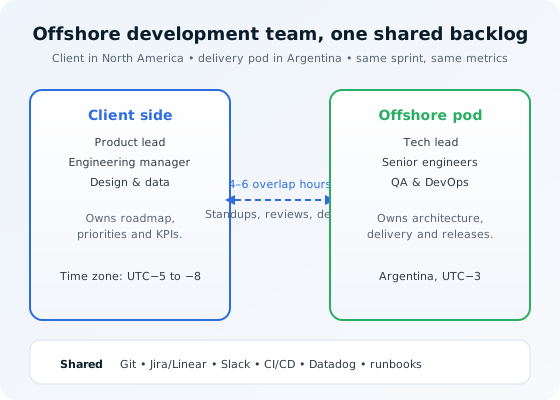
What buyers really need to decide
Beyond "we have great developers".
The intent behind this page is commercial investigation. A buyer may type "offshore development outsourcing" early in the search, but the real question is sharper: should we trust a remote team with meaningful product work?
That decision needs more than reassurances. You need team shape, pricing, ramp time, time-zone overlap, ownership boundaries, security, communication, and replacement coverage before you can judge the model honestly.
If your main need is North American time-zone overlap, also compare our nearshore development outsourcing page. For a longer-running product pod, review our dedicated development teams. If scope is already defined, project-based outsourcing may be cleaner.
Argentina is not the cheapest option, and that is the point
Why teams choose Cordoba over the lowest hourly rate.
There are cheaper hourly markets. If your only goal is to buy the lowest rate, you will find it. The reason companies choose Argentina is different: strong engineering education, direct communication, product-minded senior developers, and working hours that are much easier for US teams than Asia and often easier than Eastern Europe.
India has a massive talent pool and many excellent engineers, but the time-zone distance can be brutal for US product teams. Decisions slip into overnight messages, and small misunderstandings wait a day to be corrected. Eastern Europe also has serious talent, but costs have risen and the overlap with the Americas is thinner.
We are proud of building software from Argentina. Local engineers grow up in a market where they must be resourceful, bilingual, and comfortable with US and European clients early in their careers. That creates a practical kind of seniority: knowing when to push back on a brittle release plan or an overcomplicated architecture.
Better overlap for US teams
Daily planning, reviews, pairing, and escalations can happen during normal business hours instead of after midnight.
Senior product judgment
We expect engineers to ask why, notice risk, and discuss tradeoffs, not simply close tickets.
Strong remote habits
Clear pull requests, decision notes, demos, and written handoffs matter more than noisy meetings.
Cost without chaos
You still reduce hiring cost, but the target is sustainable delivery, not bargain-rate churn.
Good offshore projects have a real business reason
A specific pressure that local hiring cannot solve quickly enough.
A roadmap is blocked
You have product clarity but not enough senior capacity. A backend queue is slowing the front end, integrations are piling up, or mobile releases keep slipping.
A legacy system needs careful modernization
You cannot pause operations for a rewrite. You need incremental refactoring, test coverage, migration planning, and engineers who respect existing business logic.
A product team needs a full squad
You need frontend, backend, QA, DevOps, and delivery coordination working as one unit, not a collection of unrelated contractors.
Engagement models and approximate budgets
Most clients start smaller than they think they need.
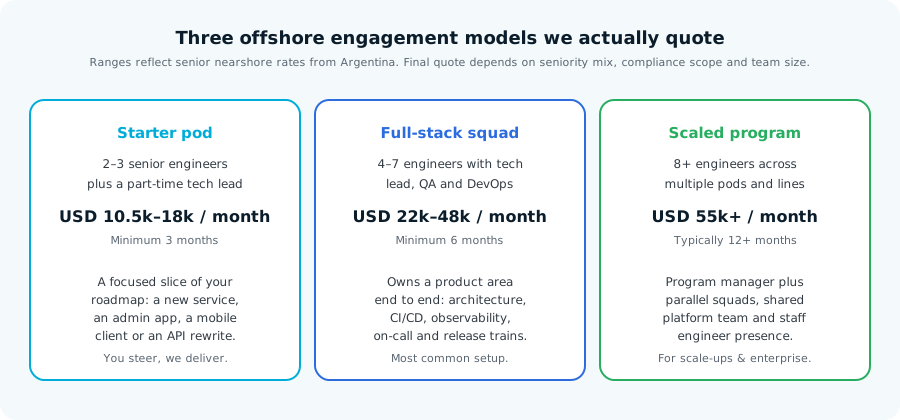
A senior pod can learn the codebase, expose bottlenecks, and prove the working model before a larger squad is justified. Pricing depends on seniority, duration, compliance requirements, and whether we provide delivery leadership. The ranges below are not a quote, but they are useful for budget screening.
Staff augmentation
Best when your team already owns product management, architecture, and code review. We add one or more vetted engineers who work inside your sprint rhythm.
Dedicated offshore squad
Best when you want a stable team to own a product area, internal platform, modernization stream, or release pipeline for several months.
Project-based delivery
Best when success criteria, timeline, and acceptance conditions are concrete enough to plan discovery, build, QA, launch, and support as phases.
From first call to useful velocity
A practical onboarding path, not ceremony for its own sake.
It is compatible with the Scrum Guide, but we do not force ceremony for its own sake. The method matters less than shared visibility and fast decisions.
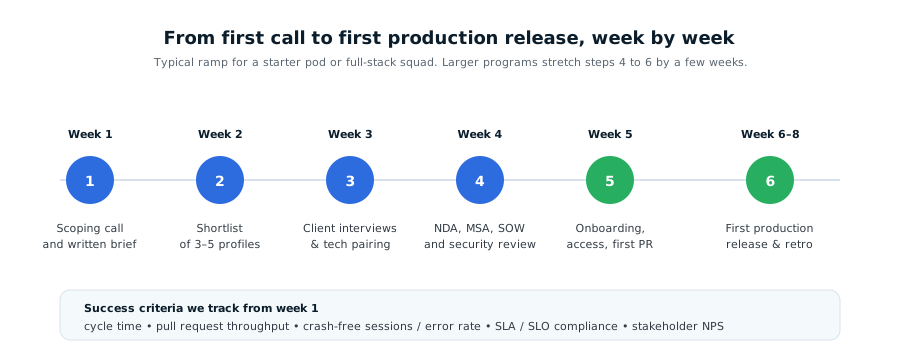
1. Scope the pressure
We ask what is blocked, what must not break, which systems are risky, and what the first 30 days should prove.
2. Design the team
You get a recommended composition: one senior backend developer, a two-person pod, or a full squad with QA and tech leadership.
3. Review people and fit
For staff augmentation, you meet the actual engineers. For squads, we introduce the lead roles and explain how decisions will be made.
4. Set access and safeguards
We enter your repositories, CI/CD, issue tracker, documentation, Slack or Teams channels, and security process with least-privilege access.
5. Start with a small sprint
The first sprint should be deliberately modest. It validates estimation, review quality, release paths, and communication habits.
6. Calibrate and scale
Once the team is producing clean work, we adjust roles, increase throughput, add QA automation, or split into a second workstream.
Offshore team vs freelancers, in-house hiring, and large agencies
There is no universal best option.
Freelancers
Where it works: short tasks, prototypes, narrow fixes, or a specialist review.
Where it gets risky: continuity, documentation, backup coverage, and long-term ownership are fragile.
What we change: we provide managed coverage, shared standards, and replacement planning when a role changes.
In-house hiring
Where it works: permanent strategic roles and deep product ownership.
Where it gets risky: recruiting can take months, and the management load stays with your team.
What we change: we add capacity now while you keep hiring at a sustainable pace.
Large agencies
Where it works: complex procurement, global coverage, and very broad programs.
Where it gets risky: senior people can disappear after sales. Delivery becomes account-heavy.
What we change: you work closer to the people making technical and staffing decisions.
Argentina offshore team
Where it works: product acceleration, modernization, dedicated squads, and senior staff augmentation.
Where it gets risky: it fails when onboarding is shallow or ownership boundaries are vague.
What we change: we define communication, review expectations, release paths, and escalation rules before promising velocity.
What an offshore team can own
Strongest when work can be described, reviewed, and released in slices.
Modernizing a revenue-critical application
We can help move a legacy front end toward React or Angular, expose cleaner APIs, build test coverage around business rules, and reduce release fear without a risky rewrite.
Building integration-heavy workflows
Payments, ERPs, CRMs, logistics tools, and analytics platforms need more than "call the API." Our API development team plans retries, idempotency, observability, and failure states.
Adding QA before a serious launch
Many teams add QA too late. We bring smoke tests, regression planning, acceptance criteria, release checklists, and a habit of reproducing bugs clearly.
Extending a web or mobile product team
For web-first roadmaps, see our web development outsourcing. For iOS, Android, or cross-platform work, compare app development outsourcing.
Bari: a six-person team for a B2B commerce platform
A short mini case study.
Bari needed a wholesale commerce platform that connected distributors and retailers. The product had high-volume purchasing flows, distributor-specific pricing, a .NET Core REST backend, a React frontend, and GraphQL decisions that reduced endpoint churn while the product was still changing.
Siblings Software assembled a six-person team: three backend developers, two frontend developers, and a project manager. The first challenge was not code speed. It was keeping daily operations stable while creating a new ordering path that retailers would actually use. The team released the product after six months, then continued with maintenance using a smaller backend, frontend, and project management setup.
The platform reached 12 distributors and 230 retailers, with reported wholesale activity across the platform. You can read the original Bari case study for more context.
What made the work possible
- A stable cross-functional team instead of scattered contractors.
- GraphQL where frontend iteration needed flexibility.
- Release planning that respected the client's existing operations.
- Ongoing maintenance after launch, not a handoff-and-vanish project.
The risks are real, and pretending otherwise is a bad sign
We would rather discuss risks early than hide them behind a glossy pitch.
Offshore development fails for predictable reasons: weak onboarding, unclear ownership, hidden seniority gaps, late QA, poor written communication, and no release discipline.
Communication drift
We keep decision notes, demo cadence, visible blockers, and written handoffs. Tools like GitHub Flow help keep reviews understandable.
Quality drops under pressure
We define review standards, smoke tests, and release checks before the first urgent production fix arrives.
Security and access risk
We follow least-privilege access, client-side permissions, NDA/MSA controls, and audit-friendly onboarding.
Wrong seniority mix
A cheap team with no technical leadership is expensive later. We match roles to the actual risk in the codebase.
Small habits matter more than slogans
How we work day to day.
Our teams work best when we can see the real product context: users, constraints, logs, support issues, and the reason a feature matters. We prefer practical technical notes over theatrical documentation, pull requests that explain intent, and demos that show what changed.
Clients often get one thing wrong: they treat outsourcing as a procurement event instead of an operating model. If access is late, priorities are vague, and nobody can answer product questions, the team spends its energy guessing. Sharp onboarding changes that quickly.
Our teams regularly work with JavaScript, TypeScript, React, Angular, Node.js, .NET, Python, mobile stacks, SQL databases, cloud services, and CI/CD pipelines. We use official references where it matters, such as the TypeScript documentation, but delivery quality comes from judgment, not tool names.
Frequently Asked Questions
It is the practice of hiring a software team in another country to build, test, modernize, or maintain software. In our case, the team is based in Argentina and can work as staff augmentation, a dedicated squad, or a project-based delivery team.
For US and Canadian clients, Argentina is usually discussed as nearshore because of time-zone overlap. For Europe, the UK, and some global teams, it is often considered offshore. The label matters less than overlap, communication, and delivery quality.
A small senior pod commonly lands around USD 10,500 to 18,000 per month. A full-stack squad with QA, tech leadership, and DevOps support often ranges from USD 22,000 to 48,000 per month. Very small advisory or staff augmentation engagements are scoped separately.
We work under client contracts, access controls, repository permissions, and secure onboarding requirements. Most clients keep ownership of repositories, cloud accounts, secrets, and production credentials. We adapt to your security process rather than asking you to weaken it.
Yes, if your internal team can provide product direction, code review, and architecture context. If those are missing, one developer may move slowly through no fault of their own. In that case, a small pod with part-time technical leadership is usually safer.
We plan for continuity through documentation, shared code review, internal knowledge transfer, and replacement coverage. No outsourcing company can honestly promise zero turnover. A serious partner shows how they reduce the damage when people change.
OUR STANDARDS
Argentina-based offshore delivery that earns its name only when the work survives the engagement.
Bring us the messy version: the roadmap pressure, team gaps, budget limits, and what has already failed. We define communication, review expectations, release paths, and escalation rules before we promise velocity.
We work in your repositories, your trackers, and your release pipelines. We document trade-offs and write the runbooks future hires will lean on. None of that is glamorous, but it is the boring discipline that keeps an offshore engagement quiet and productive.
Contact Siblings Software Argentina
Tell us what is blocked and we will suggest the smallest team that can move it forward.