AI E-Commerce Development Company in Argentina
We are an AI-powered e-commerce software development company based in Argentina. We design, build and deploy intelligent recommendation engines, personalization platforms, agentic shopping assistants and predictive analytics systems that transform static online stores into adaptive retail experiences that learn from every customer interaction.
In 2026, the global AI-enabled e-commerce market is on track to reach $22.6 billion, with companies excelling at personalization generating 40% more revenue than those that do not. The shift is clear: shoppers expect platforms that understand their preferences, anticipate their needs and respond to natural-language queries like a knowledgeable store associate would. Agentic AI has moved from experimental concept to production reality, with autonomous shopping assistants now handling complex requests like "Find me a sustainable dress for a beach wedding under $200" and completing purchases end to end. Our team of experienced AI and e-commerce engineers builds these intelligent systems from the ground up, tailored to your catalog, your customers and your business goals.
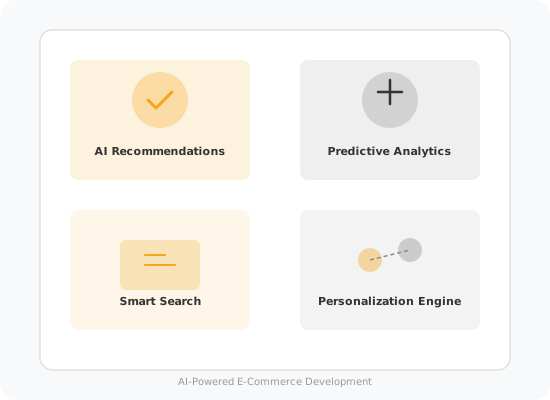
AI E-Commerce Development Services
We build the intelligence layer that turns browsers into buyers.
Traditional e-commerce platforms treat every visitor the same way: the same homepage, the same search results, the same product recommendations regardless of who is browsing. AI changes this fundamentally. Instead of static category pages and keyword-matching search, we build systems that understand individual shopping intent, predict what each customer is most likely to buy and present products in the right context at the right moment. The result is not just a better user experience but measurably higher conversion rates, larger average order values and significantly lower cart abandonment. We specialize in building these AI-powered retail systems for mid-market and enterprise e-commerce businesses that want to compete with the personalization capabilities of platforms like Amazon, MercadoLibre and Shopify Plus.
AI Recommendation
Engines
We build recommendation systems that go beyond basic collaborative filtering. Our engines combine behavioral signals (clicks, dwell time, scroll depth, add-to-cart patterns) with product metadata, inventory levels and margin data to surface the products most likely to convert for each individual shopper. Real-time scoring means recommendations update with every interaction, not on batch cycles.
Personalization
Platforms
We design and implement end-to-end personalization infrastructure that adapts every touchpoint of the shopping experience: homepage hero banners, product listing order, search result ranking, email content, push notifications and even pricing and promotions. Each shopper sees a store that feels curated specifically for them, powered by ML models that learn continuously from behavior data.
Agentic Shopping
Assistants
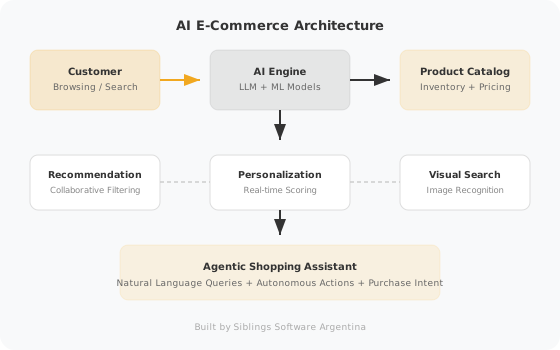
2026 marks the shift from static recommendation widgets to autonomous AI agents that act as personal shopping concierges. We build LLM-powered assistants that understand complex natural-language queries, browse your catalog intelligently, compare options, apply discount codes and guide customers through checkout, handling the entire purchase flow conversationally.
How We Build AI E-Commerce Solutions
A data-first approach to transforming your online store into an intelligent retail platform.
Every AI e-commerce project starts with data. Before writing a single line of model code, we audit your existing data infrastructure: what behavioral signals are you capturing, how clean is your product catalog, what customer segmentation already exists and where the gaps are. The reality is that 68% of personalization failures stem from poor data quality, not bad algorithms, so getting the foundation right is essential.
From there, we build incrementally. The first phase typically focuses on the highest-ROI opportunity: usually an AI recommendation engine or intelligent search that can demonstrate measurable conversion lift within weeks. We then expand into deeper personalization (homepage, email, pricing), add agentic shopping assistants for high-intent interactions and layer in predictive analytics for demand forecasting and inventory optimization. Every component is validated against real traffic through A/B testing before full rollout, and we integrate with your existing e-commerce platform whether that is Shopify, Magento, WooCommerce, VTEX or a custom-built system.
Ready to make your e-commerce platform intelligent?
If you need AI-powered personalization, recommendation engines or shopping assistants for your online store, we can help. We also offer general AI development, AI agents development and Python development services.
AI E-Commerce Technologies and Stack
The AI e-commerce technology landscape has matured rapidly. LLM inference costs dropped 70% since 2024, making real-time AI personalization economically viable for mid-market retailers, not just enterprise giants. We select technologies based on production experience with real retail workloads, not just benchmarks.
Python / TensorFlow / PyTorch
LLMs (Claude, GPT, Llama)
Pinecone / Weaviate / pgvector
React / Next.js Storefronts
Elasticsearch / Algolia
AWS / GCP / Redis
We integrate AI capabilities into React and Next.js storefronts, build backend inference services with Node.js and Python, and connect them to AI agent frameworks and MCP servers for end-to-end intelligent automation.
If you need to add AI intelligence to your e-commerce platform, we can help.
Your store should know your customers better than your best salesperson.
Case Study: AI Personalization Platform for a Fashion Retail Brand in Buenos Aires
One of the most impactful AI e-commerce projects our team has delivered involved building a complete personalization platform for an Argentine fashion retail brand with 18 physical stores and a rapidly growing online channel. The company operates from Buenos Aires and sells to customers across Argentina, Chile and Uruguay through a VTEX-based e-commerce platform that carries over 12,000 SKUs across women's, men's and children's clothing, footwear and accessories.
The challenge was common but painful: despite investing heavily in paid advertising, their online conversion rate was stuck at 1.8%, well below the 3% industry average for fashion e-commerce. Their product search returned irrelevant results for anything beyond exact keyword matches, and their recommendation widgets used basic "bestseller" and "new arrival" logic that treated every visitor identically. Cart abandonment hovered around 76%, and the marketing team was spending over $40,000 per month on retargeting ads to recover lost sales, a band-aid approach that was getting more expensive every quarter.
When they came to us, they had already evaluated several off-the-shelf personalization tools but found them either too expensive for their volume (enterprise SaaS pricing) or too rigid to accommodate their specific business rules around seasonal inventory, regional shipping constraints and their multi-brand product hierarchy. They needed a custom solution that understood their catalog, their customers and the nuances of Argentine retail (seasonal inversions compared to Northern Hemisphere markets, local payment methods like installment plans through Mercado Pago and local credit cards, and bilingual Spanish/English support for cross-border customers).
Over twelve weeks, a five-person team from our Cordoba and Buenos Aires offices built and deployed a three-layer AI personalization platform. The first layer was a real-time recommendation engine powered by a hybrid model: collaborative filtering for purchase patterns combined with a content-based model trained on product images and descriptions. This engine processes behavioral signals (page views, hover time, scroll depth, add-to-cart actions, wishlist saves) in real time through a Redis-backed event pipeline, updating relevance scores for each active session within 200 milliseconds.
The second layer was an intelligent search system built on Elasticsearch with a custom ranking model. Instead of pure keyword matching, the search understands intent: a query like "vestido para fiesta" (party dress) returns results ranked not just by text relevance but by the shopper's size preferences, price range history, brand affinity and current seasonal trends. We added visual search capabilities so customers can upload a photo from Instagram and find similar items in the catalog, which increased search-to-purchase conversion by 3.2x.
The third layer was an agentic shopping assistant powered by Claude, integrated into the storefront as a conversational interface. The agent has access to the full product catalog, real-time inventory data, shipping estimates and the customer's browsing history through MCP servers. Customers can ask questions like "What goes well with these jeans?" or "I need a complete outfit for a wedding in Mendoza next month, budget around $80,000 pesos" and the assistant provides curated selections with reasoning, handles objections and completes orders within the chat interface.
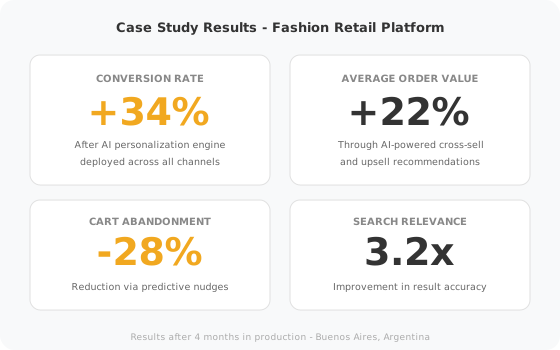
Results after 4 months in production:
+34%
Increase in conversion rate across all channels, from 1.8% to 2.4% on desktop and 3.1% on mobile
+22%
Average order value increase driven by AI cross-sell and upsell recommendations presented at the right moment in the shopping journey
-28%
Reduction in cart abandonment through predictive nudges, personalized urgency messaging and the agentic assistant's ability to answer last-minute questions
3.2x
Improvement in search relevance measured by click-through rate on search results, with visual search accounting for 15% of all product discoveries
The entire platform was built with Python (scikit-learn, PyTorch), Elasticsearch, Redis, VTEX APIs, Claude (via MCP) and a Next.js micro-frontend for the shopping assistant widget. The brand has since expanded the AI layer to email marketing personalization and is piloting dynamic pricing for seasonal clearance. The retargeting ad budget was cut by 60% because the AI-driven experience converts visitors before they leave. Want to see what AI can do for your e-commerce platform? Let's talk.
Why Choose Us for AI E-Commerce Development?
We combine deep AI expertise with real-world e-commerce engineering experience.
E-Commerce Domain Expertise
Our engineers have built AI systems for retail platforms serving millions of shoppers. We understand the domain-specific challenges: seasonal demand patterns, long-tail catalog optimization, multi-currency pricing, marketplace dynamics and the unique logistics of Latin American e-commerce. We don't just build ML models; we build solutions that deliver revenue impact.
Full-Stack AI Capabilities
We cover the entire stack from data pipeline to storefront: ETL and feature engineering, ML model training and serving, LLM integration for conversational commerce, front-end implementation in React/Next.js, and backend APIs in Python and Node.js. One team, zero handoff friction.
Measurable ROI Focus
Every AI feature we build is tied to a measurable business metric: conversion rate, average order value, cart abandonment, customer lifetime value or ad spend efficiency. We implement A/B testing infrastructure from day one and optimize continuously. No AI for the sake of AI; only AI that moves the revenue needle.
Why Argentina for AI E-Commerce Development?
Argentina: Latin America's AI and E-Commerce Powerhouse
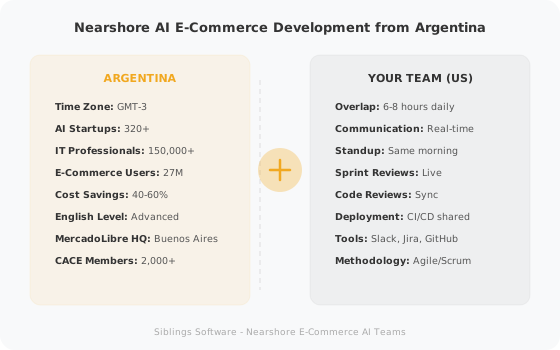
Argentina stands at a unique intersection of AI innovation and e-commerce maturity that makes it an ideal nearshore partner for building intelligent retail platforms. The country is home to MercadoLibre, the largest e-commerce and fintech company in Latin America, which plans to invest $3.4 billion in Argentina in 2026 alone, a 30% increase over the previous year. This single company employs 16,700 people in the country and has created an ecosystem of over 2.7 million SMEs selling through its platform, generating deep expertise in e-commerce engineering, logistics technology and payment systems at scale.
The numbers tell the story. Argentina has 25.1 million active online buyers, with e-commerce revenue growing 60% in 2025 according to the Argentine Chamber of Electronic Commerce (CACE). Mobile commerce accounts for 65% of all transactions, and the average transaction value has risen to $110. This is not a nascent market; Argentine developers build e-commerce systems for a mature, demanding consumer base that expects fast search, personalized recommendations and frictionless checkout with local payment methods like installment plans and digital wallets.
On the AI side, Argentina has approximately 320 active AI startups, over 150,000 IT professionals and 5,000 computer science graduates per year from universities like UBA, ITBA and UNC. Buenos Aires launched a dedicated AI District offering tax incentives for companies developing AI applications, and the country's AI talent pool is growing rapidly. For companies looking to outsource AI e-commerce development, Argentina offers the rare combination of engineers who understand both AI/ML and retail tech at scale, work in the same time zone as US East Coast teams (GMT-3), communicate fluently in English and cost 40-60% less than equivalent US talent. Learn more about the advantages of working with Argentine development teams.
Stop losing sales to generic shopping experiences.
Benefits of AI for Your E-Commerce Business
Why Leading Retailers Are Investing in AI-Powered Shopping Experiences in 2026
The technology that makes every product page, search result and recommendation count.
AI-driven personalization is no longer a competitive advantage; it is table stakes. Retailers implementing AI personalization see 20-35% revenue lifts and 15-25% higher conversion rates compared to traditional systems. The companies that fail to adopt will increasingly lose market share to competitors whose platforms anticipate customer needs rather than waiting for explicit search queries. Here is what AI brings to your e-commerce stack:
Hyper-Personalized Discovery
Every visitor sees a store tailored to their preferences, browsing history and purchase patterns. AI curates product discovery from homepage to checkout, replacing one-size-fits-all category pages with individually ranked product feeds that adapt in real time.
Conversational Commerce
Agentic shopping assistants handle natural-language queries, product comparisons and purchase completion within a chat interface. Instead of forcing customers through rigid navigation paths, let them shop the way they would talk to an expert store associate.
Predictive Inventory and Pricing
ML models forecast demand by product, region and time period, enabling smarter inventory allocation and dynamic pricing that maximizes margin without sacrificing conversion. No more over-stocking slow movers or running out of trending items.
Visual and Multimodal Search
Let customers search by image: upload a screenshot from social media and find matching products instantly. Visual search drives up to 3x higher conversion rates for high-intent shoppers who know what they want but not what it is called.
Intelligent Fraud Detection
AI-powered transaction monitoring identifies suspicious patterns in real time, reducing chargebacks and false positives. Models learn from your transaction data to distinguish between legitimate customers and fraud with increasing accuracy over time.
Reduced Customer Acquisition Cost
When your platform converts better, every ad dollar works harder. AI personalization reduces reliance on expensive retargeting by converting more first-visit shoppers and increasing organic repeat purchase rates through personalized email and push notifications.
For more insights on AI in e-commerce, explore Shopify's AI e-commerce resources and the CACE Argentine e-commerce statistics.
Choose us as your
AI E-Commerce Development Company
in Argentina
Industries
AI-powered e-commerce delivers measurable results across every retail vertical.
We build AI e-commerce solutions for companies across a wide range of industries. Here are examples of where intelligent retail technology delivers the most impact:
Fashion and Apparel
AI recommendation engines that understand style preferences, size patterns and seasonal trends. Visual search for "shop the look" experiences. Agentic assistants that help customers build complete outfits based on occasion, budget and personal style.
Food and Grocery
AI-driven personalization for grocery e-commerce: smart reorder suggestions, meal plan recommendations, dietary preference filtering and predictive inventory management that reduces waste while ensuring availability of high-demand items.
Electronics and Technology
Intelligent product comparison tools, compatibility checking engines and AI assistants that help customers navigate complex specifications. Predictive pricing for flash sales and clearance optimization.
Health and Beauty
AI-powered skin analysis, shade matching and personalized product recommendations based on individual profiles. Subscription optimization that predicts replenishment timing and cross-sell opportunities.
B2B and Wholesale
AI-driven catalog personalization for business buyers: custom pricing models, predictive reorder automation, intelligent quoting systems and volume discount optimization that adapts to each account's purchasing patterns.
Marketplace Platforms
AI infrastructure for multi-vendor marketplaces: seller ranking algorithms, cross-seller recommendation engines, fraud detection across multiple storefronts and demand prediction that helps marketplace operators optimize commission structures.
AI E-Commerce Development
Frequently Asked Questions
AI-powered e-commerce development involves integrating artificial intelligence technologies into online retail platforms to create personalized shopping experiences. This includes recommendation engines that learn from user behavior, agentic shopping assistants that handle natural-language queries autonomously, predictive analytics for demand forecasting, visual and multimodal search, dynamic pricing optimization and intelligent fraud detection. The goal is to move beyond static product catalogs toward intelligent systems that adapt in real time to each individual shopper.
Argentina is one of Latin America's largest e-commerce markets with over 25 million active online buyers, and it is home to MercadoLibre, the region's biggest e-commerce platform. Argentine developers have deep experience building AI-driven retail systems at scale. The country offers time zone alignment with US East Coast teams (GMT-3), strong English proficiency, top-tier technical universities and rates 40-60% lower than equivalent US talent. The Argentine Chamber of Electronic Commerce (CACE) reports that e-commerce grew 60% in 2025, creating a mature ecosystem of engineers specialized in retail tech.
A basic collaborative filtering recommendation system can be deployed in 3-4 weeks. A production-grade AI personalization platform with real-time scoring, multimodal search, agentic shopping assistants and integration with your existing e-commerce stack typically takes 8-16 weeks depending on catalog size, number of data sources and the complexity of the personalization rules required.
AI e-commerce platforms are built with Python and TensorFlow or PyTorch for machine learning models, LLMs like Claude or GPT for natural-language shopping assistants, vector databases like Pinecone for similarity search, and front-end frameworks like React and Next.js for the storefront. The stack also includes tools like Elasticsearch for intelligent product search, Redis for real-time caching, and cloud services from AWS or GCP for scalable inference infrastructure.
Related Services