JAVIER UANINI
Software Engineer · Founder & CEO of Siblings Software
Also available in Spanish (Argentina, es-AR).

FOUNDER & CEO
Javier Uanini is the founder and CEO of Siblings Software, a software development company headquartered in Córdoba, Argentina — one of the fastest-growing tech hubs in Latin America. He leads a team of roughly 30 engineers building products for clients in fintech, healthcare, construction, and logistics.
His relationship with technology started early. In 1999, using a Windows 98 desktop, an Arcor dial-up connection, and a copy of Microsoft FrontPage, he published his first website. He was twelve. By the time he reached high school, he was already spending afternoons writing small programs in Visual Basic and tinkering with HTML tables and inline styles — years before CSS was something you could rely on across browsers.
He went on to study Software Engineering at Universidad Tecnológica Nacional (UTN), Facultad Regional Córdoba, where he met his future co-founders Maximiliano Tomassi and José Obregón. College shaped more than his technical skills — it gave him a network of people who later became the backbone of the company.
After graduating, Javier moved to New York City to work in the payment processing industry. It was there that he encountered the complexity of financial systems at scale: PCI compliance, real-time transaction routing, multi-currency settlement engines, and the relentless pressure of zero-downtime deployments. Those years left a lasting mark on how he thinks about software architecture and operational reliability.
He returned to Córdoba with a plan. In 2018, he and his sister Constanza Uanini founded Siblings Software. The name was literal — a company built by siblings. Maximiliano and José joined immediately, and the four of them took on the first projects out of a small office near downtown Córdoba. There was no external funding, no accelerator, no pitch deck. Just contracts, delivered code, and word of mouth.
What sets the firm apart from a generic "dev shop" is the mix: US-market rigor on compliance and uptime, with day-to-day engineering happening in Argentina's second-largest tech cluster. Clients get the same Slack threads and code reviews they would expect from a domestic team, but with cost structures that reflect Córdoba rather than Manhattan — without treating quality as negotiable.
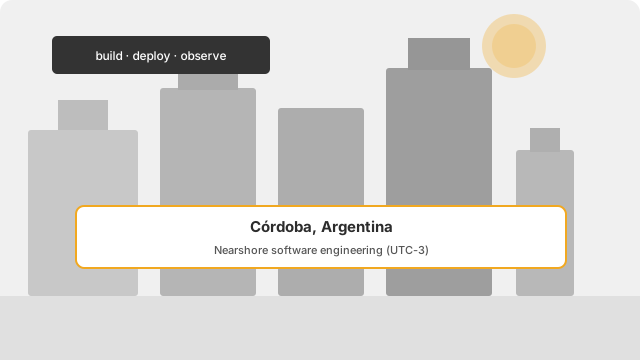
Córdoba combines universities, startups, and a manageable cost of living — a practical base for long-term product work, not one-off tickets.
From freelancers to a 30-person engineering team
The early days of Siblings Software looked nothing like a typical tech startup. Javier and Constanza started as freelancers, picking up development contracts wherever they could. Their first clients were small businesses in Argentina that needed custom web apps — inventory systems, internal dashboards, payment integrations. Nothing glamorous, but each project built trust and sharpened their delivery process.
By 2020, the team had grown to ten people, all working remotely across Córdoba. The pandemic, paradoxically, accelerated growth: international companies that had been hesitant about remote teams suddenly had no choice. Siblings Software's timezone overlap with the US East Coast (UTC−3) and their fluency in English made them a natural fit for American startups looking for engineering capacity without the overhead of a San Francisco salary.
In March 2021, the company incorporated as an LLC in Florida, establishing a legal presence in the United States. This wasn't about relocation — the engineering team remained in Córdoba — but it simplified contracts, invoicing, and compliance for US-based clients. Today, Siblings operates as a dual-presence company: American entity, Argentine talent.
Javier's leadership style is hands-on. He still reviews architecture decisions, participates in sprint planning, and writes code when a deadline needs an extra pair of hands. He's not the kind of CEO who retreats into spreadsheets. Engineers at Siblings regularly describe the culture as "flat" — you can ping Javier directly on Slack, and he'll answer the same afternoon.
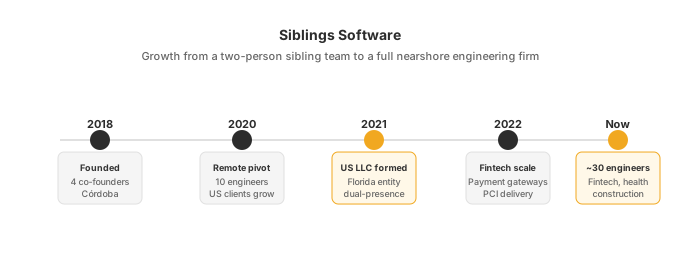
From a two-person sibling team to a full nearshore engineering firm in six years — with no outside funding.
Want to learn more about the team? Meet our full engineering leadership, or explore the projects we've delivered across industries.
Industry expertise and technical depth
Javier's technical background spans the full stack, but his deepest experience is in domains where software touches money, health, or operational logistics — systems where bugs aren't just inconvenient, they're costly.
Fintech & payment processing
Before founding Siblings, Javier spent years in the payment processing industry in New York. That experience now shapes how the company approaches fintech projects: PCI-DSS compliance by default, idempotent transaction APIs, real-time reconciliation pipelines, and thorough audit logging. The team has built payment gateways, digital wallet backends, and KYC verification flows for clients in both the US and Latin America. You can see one example in the SUR Technology Holdings case study.
Healthcare software
Healthcare has been a recurring vertical. The team has built clinical data platforms, appointment scheduling systems, and remote patient monitoring applications. These projects demand careful attention to data privacy, role-based access control, and reliable uptime — you can't have a patient-facing app go down during a consultation. Javier typically leads the security architecture review for these engagements personally, given the sensitivity of the data involved.
Construction & logistics
In the construction sector, Javier has led projects involving project management dashboards, real-time field reporting apps, and inventory tracking systems that bridge the gap between office and jobsite. The team delivered a distributor web portal for Bari that streamlined order processing and reduced manual data entry by over 60%.
Preferred stack
For modern web products, the team's go-to stack is React + Next.js + Node.js deployed to Vercel. This combination delivers fast iteration cycles, strong SEO out of the box thanks to SSR/ISR, and a deployment workflow that eliminates most DevOps overhead. For mobile, the team works with React Native, Swift, and Kotlin depending on the project's constraints. Backend services frequently run on Node.js with TypeScript, Express or NestJS, PostgreSQL, and Redis.
Case snapshot: Argentina retail flows, US processor rules
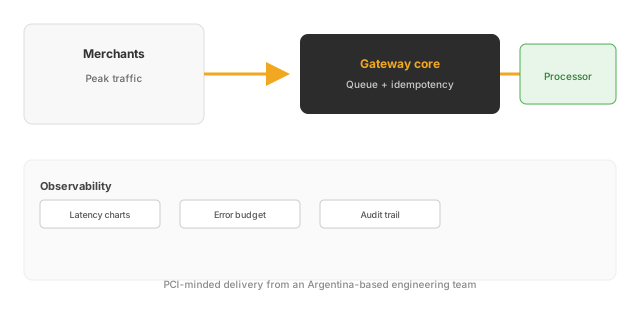
In late 2022, a US-based fintech asked us to stabilize a payment gateway that was losing transactions when Argentine retail volume spiked — think Friday afternoons when card-present and e-commerce traffic overlap. The stack had been patched by several contractors; retries were not idempotent, and the settlement queue could reorder under load. From Córdoba, Javier's team reproduced the failure with production-like traffic in a staging environment wired to the same processor sandbox.
The fix was not a rewrite for its own sake: they isolated the hot path, added idempotency keys on every retry, moved settlement work to a BullMQ-backed queue with Redis, and capped the database pool with back-pressure so spikes could not exhaust connections. Observability — latency dashboards, error budget tracking, and structured audit logs — was part of the definition of done. That's a habit forged in payment processing, where "it works on my machine" is not an acceptable release criterion.
After go-live, failure rates during peak windows fell sharply, disputed charges dropped as a share of transaction volume, and the next PCI review landed without blocking findings. The client retained a three-person squad from Siblings for ongoing changes — a typical pattern when Argentina-based engineers own the integration layer between Latin American merchants and US card networks.
More client stories: browse our full case study library, including SUR Technology Holdings for fintech-scale delivery.
Why Córdoba, Argentina
Javier chose to build Siblings Software in Córdoba for reasons that go beyond personal attachment. The city has over 330 technology startups and continues to climb in global ecosystem rankings — jumping from 318th to 226th worldwide in just four years, according to the Startup Genome report.
The talent pipeline is deep. Córdoba's 14 universities graduate thousands of engineering students every year, and the province's literacy rate sits at 98.5%. The UTN campus alone produces a steady stream of Information Systems engineers who are immediately competitive in backend, frontend, and mobile development roles.
Córdoba also sits in the UTC−3 timezone, which means full workday overlap with US Eastern Time clients and significant overlap with European teams. For Javier, this geographic advantage was deliberate: it allows Siblings to operate as a nearshore partner without the friction of asynchronous communication across distant time zones.
The cost of living in Córdoba is substantially lower than Buenos Aires or major US cities, which translates directly into competitive rates for clients without sacrificing engineer compensation. It's one of the reasons Siblings has been able to retain talent at a rate well above the Argentine industry average. Javier has written about this tradeoff on DEV Community — arguing that the best nearshore relationships are built on stable, well-compensated teams, not on chasing the cheapest rates.
How we work with clients (and how Javier stays involved)
Engagements usually start with a short discovery: business outcomes, compliance constraints, and what "done" means in production. Javier or a principal engineer joins that conversation when architecture or payment flows are non-trivial. Delivery runs in two-week cycles with visible increments, not opaque black boxes — useful whether you are a US product company or an Argentine scale-up modernizing a legacy stack.
If you are comparing vendors, the difference we emphasize is accountability: the same person who signs off on technical risk is reachable on Slack, and the stack we recommend — for example Next.js with Node.js services — is one we run for paying customers, not a slide deck.
Javier personally reviews the first sprint plan for every new engagement. His view: the first two weeks tell you more about a project's real constraints than any amount of pre-sales conversation. Getting that right early is cheaper than correcting course at sprint 8.
We are also hiring engineers who want that level of transparency — see open roles and how we interview.
Resources & communities Javier follows
A selection of external resources that inform how Javier and the team approach software development — including Argentina's digital policy context and the open communities where they share and learn:
- Argentina — open government & digital innovation — public-sector context for digital services in Argentina
- Node.js Community — the runtime many of our backends use; official community hub
- Martin Fowler — Software Architecture — patterns for distributed systems and microservices that Javier returns to regularly
- DORA Metrics — measuring engineering team performance and delivery velocity
- Next.js Documentation — the framework at the center of Siblings' preferred web stack
- DEV Community — where Javier and teammates share technical posts and engineering perspectives
Interested in working with Javier's team? Get in touch, or explore open positions if you'd rather join than hire.